What Texas Address Confidentiality Won’t Hide and How an Advocate Helps

The Texas Address Confidentiality Program (ACP) gives eligible victims of family violence, sexual assault, stalking, human trafficking, or child abduction a substitute P.O. box and free mail forwarding through the Office of the Attorney General, so their real address stays off most public records. Household members can enroll too. You’ll need documentation, often a protective order or police report, and while advocate assistance is strongly encouraged, some legal exceptions can still require disclosure of your actual address.
TL;DR:
- The application process requires documentation such as protective orders, police reports, or court records to succeed, with advocate support often enhancing approval chances.
- Mail forwarding delays can be three to four days, and packages or parcels are not covered by the program, requiring separate arrangements for delivery.
- Participants must renew every three years and notify the Office of the Attorney General at least 10 days before any address or name changes to avoid cancellation.
- The program’s protections are not absolute, as legal orders or law enforcement agencies can disclose addresses in certain court or investigation situations.
- Private entities like banks and landlords are not required to accept the substitute address without presentation of authorization and acceptance proof.
Table of Contents
- Who Qualifies for the Texas Address Confidentiality Program
- How the Substitute Address and Mail Forwarding Work
- How to Apply for Address Confidentiality in Texas
- Documents Checklist for Your ACP Application
- What to Expect Once You’re Enrolled
- Why Advocate Support Strengthens Your Safety Plan
- How Long ACP Protection Lasts and When to Renew
- When Your Real Address Can Still Be Disclosed
- Where to Get Help and Submit Your Application
- An Attorney’s View on ACP’s Real-World Limits
- How Anna Din Law Supports Your Safety Paperwork
- Sources
- FAQ
Who Qualifies for the Texas Address Confidentiality Program
You qualify for ACP if you’re a victim of family violence, sexual assault, stalking, human trafficking, or child abduction, and you either live in Texas now or plan to move here. Household members living with you can also be added to your application, which matters if you have kids or a partner who shares your home.
Residency isn’t as strict as it sounds. You don’t need to already be settled in Texas. Planning a relocation to the state is enough to start the process.
Documentation is where most applications succeed or stall. The Office of the Attorney General accepts several forms of proof, and you generally only need one:
- A protective order or temporary injunction
- A police report documenting the crime
- Medical records tied to the incident
- Other court documents connected to your case
If you don’t have a protective order yet, working with an attorney to secure one often solves two problems at once. It creates a paper trail that also satisfies ACP’s documentation requirement.
How the Substitute Address and Mail Forwarding Work
Once approved, the OAG assigns you a substitute P.O. box address and mails you an authorization card. That address becomes your legal stand in for your real home address, and the state forwards your mail to your actual location at no cost to you.
Forwarding covers first-class mail and legal documents. It does not cover packages, magazines, or most parcel-type deliveries, which stay behind unless you make separate arrangements for them.

You can use your substitute address on your driver license or state ID, voter registration, school enrollment forms, and most court and government paperwork. Agencies will ask to see your authorization card before they’ll accept the substitute address, so keep it with you. For driver license or ID changes specifically, Texas DPS requires you to present that card in person at a driver license office.
How to Apply for Address Confidentiality in Texas
Applying isn’t something you have to do alone, and in many cases the OAG expects you not to. Here’s the path most applicants follow:
- Meet with a local advocate. Shelters, sexual assault centers, law enforcement victim liaisons, and prosecutors’ offices all work with ACP regularly. The OAG often won’t accept applications without documentation unless an advocate submits them on your behalf.
- Gather your documentation. Pull together your protective order or police report, photo ID, and information for any household members joining the application.
- Submit your application. You or your advocate can upload it online or mail it in. Most applications are processed within about two weeks of the OAG receiving everything.
Pro Tip: Use the exact same name on every document in your application. A mismatch between your ID and your protective order is one of the fastest ways to get flagged for delay or denial.
Notify the OAG before you move or change your name, not after. Waiting creates gaps that can jeopardize your standing in the program later.
Documents Checklist for Your ACP Application
Bring this list with you to your advocate meeting or use it to prepare before you contact the OAG directly.
- Protective order or temporary injunction, if you have one
- Police report, medical records, or other documentation of the crime
- Photo ID for yourself and any household members applying
- Completed application affirmation checklist confirming your information is accurate
- Any additional forms your school district or driver license office requires for the address change
Missing documentation doesn’t always end your application, but it does slow it down. An advocate can tell you which substitute is acceptable if you’re missing something on this list.
What to Expect Once You’re Enrolled
Mail forwarding isn’t instant. Because everything routes through the OAG before it reaches you, expect a three to four day delay on anything sent to your substitute address. Plan around that for time-sensitive mail like bills or court notices.
Packages, magazines, and similar non-letter mail won’t reach you through the program. You’ll need a separate plan for deliveries, whether that’s a trusted contact’s address or a private mailbox service.
Private businesses, banks, landlords, utility companies, aren’t required to accept your ACP address just because a state agency does. You’ll likely need to show your authorization card and acceptance letter and explain the program to get them on board.
Returned mail carries real consequences. Four returned mail events can trigger cancellation of your participation, so keeping your information current with the OAG matters more than it might seem.
Why Advocate Support Strengthens Your Safety Plan
An advocate does more than help with paperwork; in some states, such as California, DV prefile intervention programs provide additional support to victims navigating protective orders and safety plans. They help you think through safety planning, verify your documents meet OAG standards, and submit your application securely, services the OAG actively recommends for many applicants.
Organizations like the Texas Council on Family Violence, the Texas Association Against Sexual Assault, and the National Domestic Violence Hotline can connect you with a local advocate. Ask them what documentation your specific situation requires before you start.
Pro Tip: If someone is threatening to expose your address through a custody case or court filing, don’t wait to see how it plays out. Talk to an attorney about your options, including protective order enforcement, the same week you learn about the threat.
How Long ACP Protection Lasts and When to Renew
Standard participation runs for three years, after which you’ll need to renew to stay covered. Mark that date somewhere you’ll actually see it.
You must notify the OAG at least 10 days before any move or name change. Skipping that step risks cancellation, along with other triggers like false statements on your application, repeated returned mail, or simply choosing to withdraw voluntarily.
When Your Real Address Can Still Be Disclosed
ACP protects your address from public records, but it isn’t absolute. The OAG can be legally required to disclose your true address in response to a court order, a law enforcement investigation, or a Department of Family and Protective Services child welfare case.
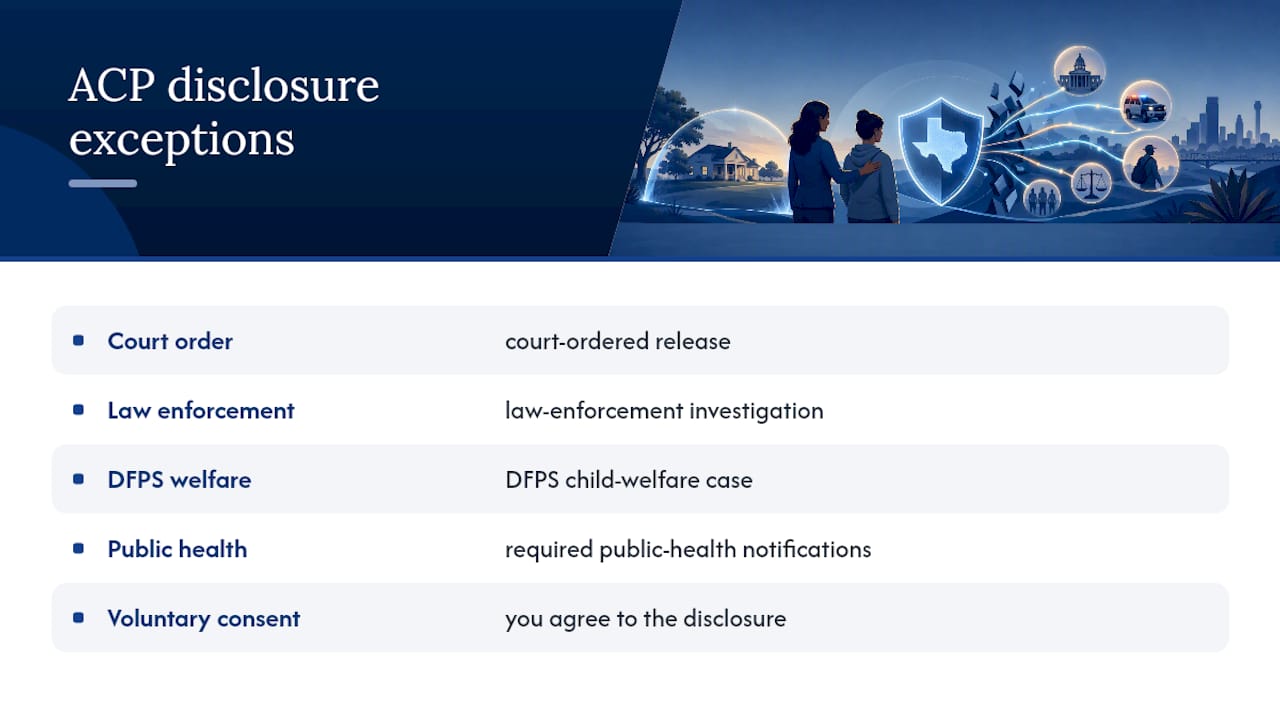
Certain public health notifications and situations where you voluntarily consent to disclosure are exceptions too. If you learn that someone is trying to compel disclosure of your address, whether through a subpoena, a custody dispute, or a court filing, contact an attorney right away. Acting early gives you more options to limit what gets released.
Where to Get Help and Submit Your Application
You don’t have to track down these resources alone; here’s where to start.
- Office of the Attorney General ACP unit: handles applications, renewals, and address change notifications
- Texas DPS driver license offices: update your ID or license once you have your authorization card
- National Domestic Violence Hotline, TCFV, and TAASA: connect you with a local advocate for safety planning
- Texas Secretary of State: assists with voter registration questions tied to your substitute address
An Attorney’s View on ACP’s Real-World Limits
ACP is genuinely useful. It’s also just one layer of protection, not a guarantee of physical safety, and treating it as the whole plan is a mistake we see cost people time when disclosure threats surface unexpectedly. Pairing enrollment with a protective order and, when needed, legal counsel gives you a sturdier foundation. If someone is pushing to expose your address through the courts, that’s the moment to call an attorney, not wait and see.
— Giri
How Anna Din Law Supports Your Safety Paperwork
Beyond ACP itself, the paperwork trail around it, protective orders, name changes, court filings, often determines whether the program actually protects you. Anna Din Law handles protective and restraining orders throughout The Woodlands and Houston area, along with adult and child name changes that keep your ACP application consistent and free of the mismatches that cause denials.

If you’re navigating custody complications, a threatened disclosure, or simply need a protective order in place before you apply for ACP, a local family law attorney can move faster than trying to piece it together on your own. Reach out through the contact page to schedule a consultation and get your paperwork moving in the right direction.
Sources
- Address Confidentiality Program | Department of Public Safety
- Address Confidentiality Program | Office of the Attorney General
This article is general information, not a substitute for advice from a qualified lawyer. Consult a qualified legal professional about your own circumstances before acting on anything here.
FAQ
What States Have an Address Confidentiality Program?
Most states, including Texas, offer some version of an address confidentiality program for crime victims, though eligibility rules and services vary by state.
What Is Rachel’s Law in Texas?
Texas doesn’t have a law by that name tied to this program; the Texas version is simply the Address Confidentiality Program administered by the Office of the Attorney General.
How Does Address Confidentiality Work?
The OAG assigns you a substitute P.O. box address and forwards your legitimate first-class mail to your real address, keeping your home address out of most public and government records.
Who Qualifies for Crime Victims Compensation in Texas?
Crime victims compensation is a separate program from ACP, though many ACP-eligible victims, including those affected by family violence, sexual assault, or trafficking, may also qualify; check with the Office of the Attorney General’s Crime Victim Services division for compensation eligibility specifics.
How Long Does ACP Processing Take?
Most applications are processed within about two weeks once the Office of the Attorney General receives complete documentation.
Recommended
Questions About Your Situation?
Every family is different. Schedule a confidential consultation with Anna Din to discuss your options.
Schedule a Consultation