6 Steps to File in the Right Texas Court: Guardianship vs Custody
Custody applies when parents are dividing decision-making and residence between themselves, typically in family court. Guardianship applies when a non-parent needs court-ordered authority because a parent cannot fulfill that role, and it often runs through probate or juvenile court. If you’re a parent negotiating a divorce or breakup, you want a custody order. If you’re a grandparent, relative, or family friend stepping in for a child, guardianship is usually the path forward.
TL;DR:
- Guardianship is often sought by non-parents like relatives or caregivers when parental rights are not involved, and it usually requires court supervision.
- Custody involves parental rights divided between parents, with modifications triggered by significant changes in circumstances, unlike guardianship that persists until a major change occurs.
- Filing in the correct court is crucial because custody cases generally go through family court, while guardianship petitions are often handled by probate or juvenile court.
- Guardianship grants legal authority over the child’s daily care and finances, allowing use of authority similar to a parent, but parental rights remain intact and can be restored.
- Temporary arrangements like standby guardianship or caregiver affidavits can suit short-term needs but often need formal guardianship for ongoing legal recognition.
Table of Contents
- Guardianship vs Custody: The Legal Definitions You Need First
- Custody vs Guardianship: Side-by-Side Differences
- When Does Each Arrangement Actually Apply?
- How to Establish Custody or Guardianship in Court
- What Custody and Guardianship Actually Look Like Day to Day
- Standby Guardianship and Other Short-Term Alternatives
- How Judges Decide: The Best Interest Standard
- What Families Get Wrong About These Two Paths
- How Lawofficeofannadin Helps With Custody and Guardianship Cases
- Sources
- FAQ
Guardianship vs Custody: The Legal Definitions You Need First
Custody and guardianship sound interchangeable, but they answer different legal questions. Custody splits two rights between parents: legal custody (who decides on school, medical care, and religion) and physical custody (where the child actually lives). A parent can have joint legal custody with an ex while holding primary physical custody, for example.
Guardianship is a court-created relationship, not a parental one. It gives a non-parent the authority a parent would normally hold, and it can cover the child’s person, the child’s finances (sometimes called a conservatorship over the estate), or both. According to the Legal Information Institute, guardianship differs from custody largely in who holds the authority and which court oversees it, with guardianship often requiring continued court supervision that custody orders don’t require.
- Legal custody: decision-making power over major life choices.
- Physical custody: where the child physically resides.
- Guardian of the person: day-to-day care and consent authority for a minor.
- Guardian of the estate/conservator: management of the child’s money or property.
Custody cases almost always sit in family or divorce court. Guardianship petitions, depending on your state, may land in probate, family, or juvenile court.
Custody vs Guardianship: Side-by-Side Differences
The fastest way to sort these two out is to ask who’s filing and why. A parent fighting for time with their own child files for custody. A grandmother raising her grandchild because the parents are incarcerated files for guardianship.
| Factor | Custody | Guardianship |
|---|---|---|
| Who files | A parent | Typically a non-parent (relative, caregiver) |
| Court | Family or divorce court | Often probate or juvenile court |
| Effect on parents | Rights divided between parents | Parental rights usually suspended, not terminated |
| Adoption connection | Not applicable | Separate from adoption; parentage stays intact |
| Typical duration | Until modified or child reaches adulthood | Often until majority, or until circumstances change |
Because guardianship doesn’t erase parental rights, a parent can petition later to have the arrangement modified or ended if their situation improves, according to FindLaw. Custody orders, meanwhile, get modified when circumstances change substantially, such as a job relocation or a parent’s changed living situation. Filing in the wrong court is one of the more common and costly mistakes families make in these cases, since probate courts and family courts don’t always handle the same petitions.
When Does Each Arrangement Actually Apply?
Matching your situation to the right legal tool saves time and legal fees. Here’s how the scenarios usually break down:
- Divorce or separation between parents. This calls for custody, whether contested or by agreement, since both adults retain parental rights.
- Unmarried parents establishing rights. Custody and support orders apply once parentage is legally established.
- A parent’s incapacity, incarceration, or substance abuse crisis. A relative or family friend typically seeks guardianship to step into the caregiving role.
- Kinship caregiving without a crisis trigger. Grandparents raising grandchildren informally often benefit from formal guardianship to enroll a child in school or authorize medical care.
- Short-term need without full guardianship. Standby guardianship works when a parent anticipates a temporary inability to care for a child, such as military deployment or medical treatment.
- Overlapping situations. A custody order between parents can coexist with a guardianship over the child’s finances if the child receives a settlement or inheritance.
How to Establish Custody or Guardianship in Court
Custody cases generally follow this sequence: file a petition, serve the other parent, exchange a proposed parenting plan, attend mediation or a hearing, and receive a signed order. If circumstances shift later, either parent can petition for modification.
Guardianship cases move differently. You file a petition, provide notice to the parents and interested relatives, and the court often appoints a guardian ad litem to represent the child’s interests independently. A hearing follows, and if the judge approves, you receive Letters of Guardianship (or Letters of Conservatorship for financial matters), which prove your authority to schools, doctors, and banks.
- Gather documentation showing the need for the arrangement.
- File the petition in the correct court for your state.
- Complete service and required notice periods.
- Attend the hearing, with a guardian ad litem involved in guardianship cases.
- Receive the signed order or Letters of Guardianship.
- Revisit the order later through a modification petition if circumstances change.
Uncontested cases often resolve in a matter of weeks; contested ones can stretch for months once custody evaluations or guardian ad litem investigations get involved. Filing fees vary by county and case type.
Pro Tip: Before you file anything, call a family law attorney for a consultation. A ten-minute conversation about which court has jurisdiction can save you months of delay if you’ve filed in the wrong venue.
What Custody and Guardianship Actually Look Like Day to Day
The paperwork matters less than what it lets you do. A legal guardian can typically enroll a child in school, consent to medical treatment, and access benefits on the child’s behalf, addressing exactly the gaps that leave informal caregivers stuck at the pediatrician’s front desk, per guidance from the Administration for Children and Families.
- Enrollment and consent: custodial parents and appointed guardians both have this authority; informal caregivers usually don’t.
- Child support: custody orders typically set support obligations between parents; guardianship may or may not include a support component depending on state rules.
- Court oversight: guardians often file periodic accountings and sometimes post a bond, obligations parents don’t face.
- Spending limits: judges can require court approval before a guardian makes major financial decisions on a child’s behalf.
Standby Guardianship and Other Short-Term Alternatives
Not every situation needs a full guardianship petition. Standby guardianship lets a parent name a future caregiver in advance, activating automatically if a specific condition, like a terminal diagnosis or deployment, occurs.
- Standby guardianship: pre-authorized, activates on a triggering event.
- Caregiver authorization affidavits: let a relative enroll a child in school or authorize routine medical care without a court order, though rules vary by state.
- Power of attorney: grants temporary decision-making authority, but a parent generally retains the right to revoke it.
Pro Tip: If a caregiving arrangement is dragging past a few months, convert it into formal guardianship. Informal affidavits don’t hold up well with insurance companies or hospitals demanding proof of legal authority.
How Judges Decide: The Best Interest Standard
Every custody and guardianship case runs through the same lens: what’s best for the child. The Childwelfare include the child’s stability, each party’s fitness, any history of abuse or neglect, and the child’s own preference when they’re old enough to express one meaningfully.
- Stability of the current living situation
- Parental or guardian fitness, including mental and physical health
- History of family violence or neglect
- The child’s preference, weighed by age and maturity
- The likely impact of changing the arrangement
When a non-parent petitions for guardianship, they typically carry a heavier burden of proof than a parent seeking custody against another parent, since Texas courts start from a presumption that parents act in their children’s best interest. What judges weigh in custody litigation tends to hinge on similar stability and safety questions, though the standards courts apply can differ by state, so confirm your state’s specific factors before you walk into a hearing.
What Families Get Wrong About These Two Paths
Families often assume guardianship is the “lesser” or temporary cousin of custody, something you settle for when you can’t get full parental rights. That’s backwards. Guardianship exists because the law recognizes that a non-parent stepping in to raise a child needs real legal authority, not a workaround. A grandmother with guardianship can sign a consent form at an emergency room just as fast as a parent with custody can.
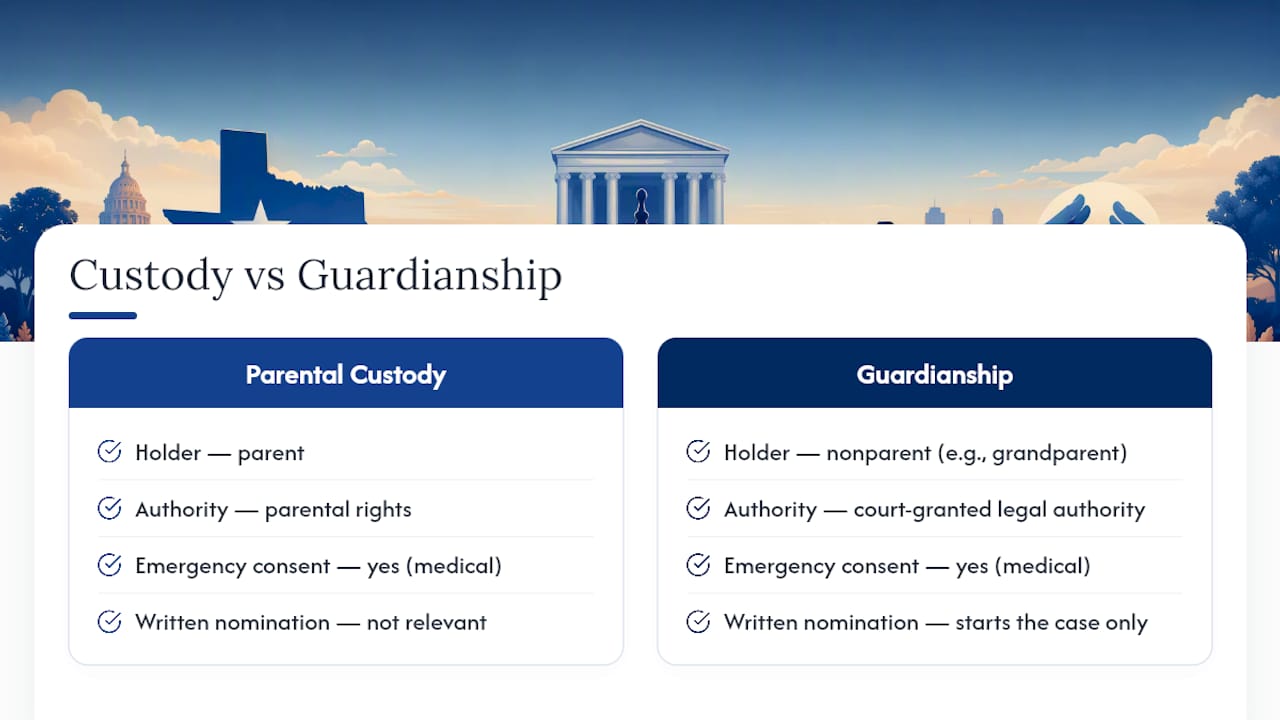
The bigger misconception is that a parent’s written nomination of a guardian, say, in a will, settles the matter. It doesn’t. A judge can override that nomination if the evidence points to a different arrangement serving the child better, according to FindLaw’s guidance on guardianship. Families should treat that nomination as a strong starting point, not a guarantee.
Before you file anything, gather your child’s birth certificate, school and medical records, and any written communication showing the current caregiving arrangement. Contested guardianship or custody cases, especially ones where a parent’s rights are at risk, are where legal representation changes outcomes the most. A local attorney can help you pick the right court the first time and avoid the venue mistakes that stall so many of these petitions.
— Giri
How Lawofficeofannadin Helps With Custody and Guardianship Cases
Sorting out whether you need custody or guardianship isn’t something to guess at, especially when a child’s daily care is on the line. A family law practice can handle custody disputes between parents and guardianship petitions for relatives stepping in when a parent cannot care for a child.

A first consultation typically covers your specific facts: who the child currently lives with, what’s driving the need for a change, and which court actually has jurisdiction over your case. Bring your child’s birth certificate, any existing custody or guardianship paperwork, and a timeline of recent events. If your situation involves a custody modification or a guardianship petition tied to a parent’s incapacity, that documentation lets an attorney give you a realistic read on your options fast. Reach out through the firm’s child custody practice page to schedule a consultation and get a clear answer on which path fits your family.
Sources
- guardian | Wex | US Law | LII / Legal Information Institute
- Guardianship vs. Custody vs. Adoption | FindLaw
- Child Welfare Information Gateway (ACF) - custody FAQ
- Childwelfare
This article is general information, not a substitute for advice from a qualified lawyer. Consult a qualified legal professional about your own circumstances before acting on anything here.
FAQ
Is It Better to Have Guardianship or Custody?
Neither is universally “better.” Custody fits parents dividing rights between themselves; guardianship fits non-parents who need court-authorized power to care for a child a parent can’t currently raise.
Can You Be a Legal Guardian and Not Have Custody?
Yes. Guardianship and custody are separate legal concepts, so a guardian can hold decision-making authority over a child’s care without holding a custody order, particularly in cases involving a child’s estate or finances.
Do Parents and Guardians Have the Same Rights?
Not exactly. Guardians typically gain the authority to make major decisions and provide day-to-day care, but courts often require ongoing oversight, like accountings or bonds, that parents don’t face under a standard custody order.
What Are the Downsides of Guardianship?
Guardianship can come with court reporting requirements, spending restrictions on the child’s assets, and the possibility that a parent later petitions to modify or end the arrangement once their circumstances change.
Recommended
Questions About Your Situation?
Every family is different. Schedule a confidential consultation with Anna Din to discuss your options.
Schedule a Consultation