Child Support in Texas: What Every Parent Needs to Know
July 27, 2026 · Law Office of Anna Din PLLC

Child support in Texas is a court-ordered financial obligation requiring one parent to contribute to a child’s basic living costs, medical care, and sometimes childcare — enforceable by Texas courts and the OAG Child Support Division. Whether you need to establish a new order, enforce an existing one, or register an out-of-state order under the Uniform Interstate Family Support Act (UIFSA), the Texas Family Code and the Texas State Disbursement Unit (SDU) provide the legal framework and payment infrastructure to make that happen.
Your immediate next steps depend on your situation:
- Starting a new case: Gather recent pay stubs, tax returns, and proof of health insurance costs for your child, then apply through the OAG or file a petition in your county’s family court.
- Enforcing an existing order: Contact the OAG Child Support Division or file an enforcement motion under Texas Family Code Chapter 157 in the court of continuing, exclusive jurisdiction.
- Registering an out-of-state order: File a certified copy of the order, a regular copy, and an affidavit of arrearages in the Texas county where your child lives.
Pro Tip: The OAG is the fastest, lowest-cost route when your case is straightforward. If the other parent disputes income, hides assets, or the case involves complex custody arrangements, a private family law attorney will give you the personalized strategy the OAG cannot.
Table of Contents
- What does child support cover under Texas law?
- Who pays support, who receives it, and how does paternity affect your case?
- How is child support calculated in Texas?
- How do you start a child support case in Texas?
- How are payments made, tracked, and what happens if they stop?
- What happens when child support isn’t paid?
- How do you modify or end a child support order in Texas?
- How does UIFSA handle out-of-state child support orders?
- Common mistakes parents make and the documentation checklist that prevents them
- Key Takeaways
- What a Texas family law attorney actually looks for in a child support case
- How the Law Office of Anna Din can help with your child support case
- Official sources and further reading
What does child support cover under Texas law?
Under the Texas Family Code, child support is a monetary obligation separate from conservatorship (custody) and visitation. A parent can be ordered to pay support regardless of how much time they spend with the child, and a parent’s right to see their child is legally distinct from the obligation to pay.
The court treats the following as part of a child support arrangement:
- Basic living needs: Food, clothing, housing, and general daily expenses
- Medical support: Health insurance coverage for the child (a medical support order under Texas law), cash medical support when insurance is unavailable or inadequate, and dental and vision coverage
- Childcare costs: Reasonable work-related or education-related childcare expenses
- Education costs: In some cases, school fees and related expenses when proven necessary
Texas Family Code § 154.001 states that a court may order either or both parents to support a child in the manner specified by the order. Medical support is treated as a distinct component — courts routinely issue a separate medical support order requiring one parent to maintain health insurance for the child or pay a cash medical support amount when insurance is not accessible at a reasonable cost.
The OAG processes and records payments through the Texas State Disbursement Unit, which creates an official payment history for both parents. OAG forms for establishing and modifying orders are available directly through the OAG Child Support portal, and the SDU ensures that every payment is tracked and credited accurately.
Who pays support, who receives it, and how does paternity affect your case?
Obligor and obligee roles
The parent ordered to pay support is called the obligor. The parent or caregiver who receives support on the child’s behalf is the obligee. In most cases, the obligor is the noncustodial parent — the one with whom the child does not primarily reside — though Texas courts can order either parent to pay depending on the custody arrangement and each parent’s income.
How paternity is established
Paternity must be legally established before a court can issue a child support order for a child born outside of marriage. Texas law provides three main paths:
- Acknowledgment of Paternity (AOP): Both parents sign a voluntary AOP form, typically at the hospital at birth. This is the simplest and fastest method.
- Genetic testing: Either parent or the OAG can request DNA testing. Results above a 99% probability threshold establish paternity by statute.
- Court adjudication: A judge reviews evidence and issues a court order establishing legal parentage when the parties cannot agree or testing is disputed.
Once paternity is established, the OAG can locate the other parent, set an income withholding order, and begin enforcement. Without legal paternity, none of those tools are available to you.
Special situations worth knowing
- Children in more than one household: If the obligor already pays support for children in another household, Texas Family Code § 154.129 provides an alternative calculation method that adjusts the guideline percentages downward.
- Low-income obligors: Obligors whose monthly net resources fall below $1,000 are subject to a separate, reduced percentage schedule under § 154.125©.
- Incarcerated obligors: Incarceration does not automatically suspend a support obligation. Arrearages continue to accrue unless the obligor petitions the court for a modification.
- Disputed paternity: When paternity is contested, the OAG can initiate genetic testing as part of its services. If the matter is contested in court, private counsel is strongly advisable to protect your rights throughout the hearing.
How is child support calculated in Texas?
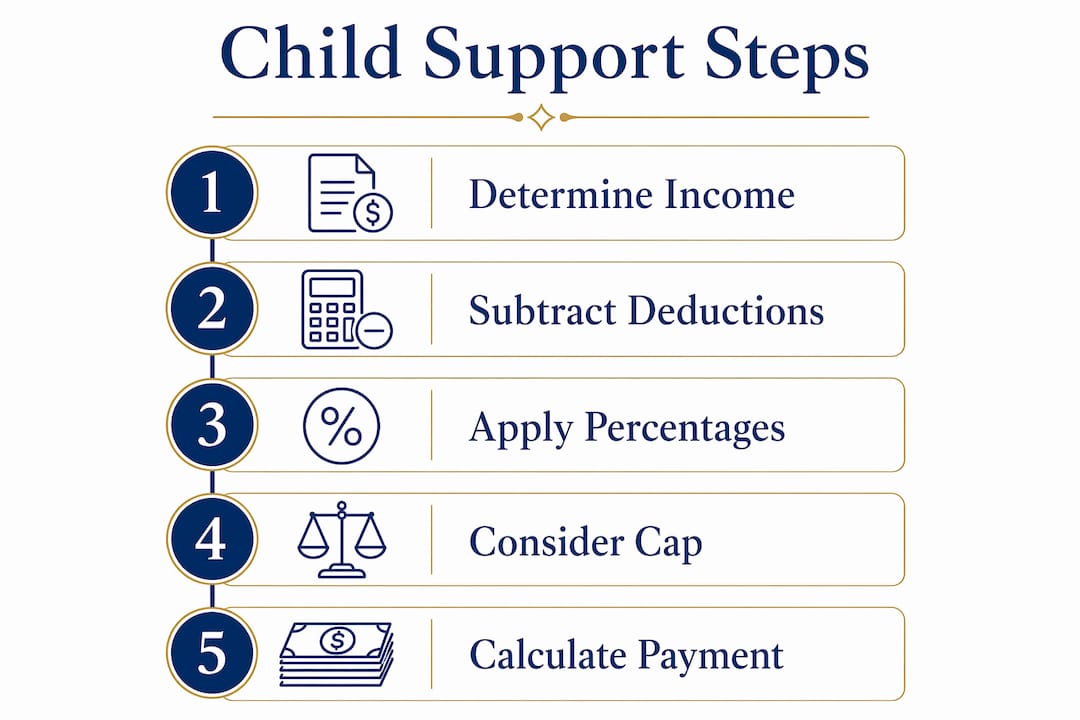
Texas uses a statutory formula under the Texas Family Code rather than leaving the amount entirely to judicial discretion. The calculation moves from gross income to monthly net resources, then applies guideline percentages. Here is how each step works.
Step 1: Determine monthly gross income
Gross income includes wages, salary, commissions, self-employment income, rental income, overtime, and most other regular sources of money. It does not matter whether income is reported on a W-2 or a 1099.

Step 2: Subtract allowable deductions to reach net resources
The OAG’s revised tax charts specify the exact deductions used to compute monthly net resources:
- Social Security taxes (FICA)
- Federal income tax withholding, calculated as if the obligor were single with one personal exemption and the standard deduction
- Health insurance premiums paid by the obligor for the child
- Union dues (if applicable)
- Mandatory retirement contributions required by law
The most common calculation error is treating take-home pay as “net resources.” Your actual bank deposit reflects voluntary deductions (like a 401(k) contribution beyond the mandatory amount) that the statute does not allow. Net resources under the Texas Family Code are a specific statutory figure, not your paycheck balance.
Step 3: Apply guideline percentages
Once net resources are determined, the court applies the following percentages from Texas Family Code § 154.125(b):
| Number of Children | Guideline Percentage of Net Resources |
|---|---|
| 1 child | 20% |
| 2 children | 25% |
| 3 children | 30% |
| 4 children | 35% |
| 5 or more children | 40% |
The statutory Cap
The guideline percentages apply only up to the Cap on net resources. Effective September 1, 2025, the OAG adjusted the Cap to $11,700 per month. If an obligor’s net resources exceed $11,700, the court applies the percentages to the first $11,700 and may order additional support above that amount based on the child’s proven needs.
Step 4: Add medical support and childcare
The guideline percentage covers basic support only. The court separately allocates:
- Health insurance premiums for the child (or a cash medical support Texas amount when insurance is unavailable)
- Work-related or education-related childcare costs, typically split proportionally between the parents
Sample calculation
Suppose an obligor earns $5,000 per month in gross wages and has one child in the other parent’s household:
| Step | Amount |
|---|---|
| Monthly gross income | $5,000 |
| Guideline percentage (1 child = 20%) | × 20% |
These figures are illustrative. Use the official OAG monthly child support calculator to run your actual numbers with current tax charts. The calculator applies the correct withholding assumptions and Cap automatically.
How do you start a child support case in Texas?
You have three main paths: apply through the OAG, file on your own in family court, or hire a private attorney. Each has a different scope, cost structure, and timeline.

Option 1: OAG Child Support Division
The OAG Child Support Division provides services at no direct cost to the custodial parent, including:
- Locating a noncustodial parent
- Establishing paternity through genetic testing
- Setting a support order and income withholding
- Enforcing existing orders and collecting arrearages
- Coordinating interstate cases under UIFSA
The OAG is a strong fit when your case is relatively straightforward, you are receiving public assistance, or you simply need the state to establish and collect a basic order. The tradeoff is that OAG attorneys represent the state’s interest in child welfare, not your personal legal interests. They will not negotiate custody, handle property disputes, or represent you in a contested hearing the way a private attorney would.
Option 2: Private family law attorney
Private counsel is often the right choice when:
- The obligor’s income is complex (self-employment, business ownership, variable commissions)
- You need discovery to trace hidden or underreported income
- The case involves a contested custody arrangement that affects support
- You need an urgent enforcement motion or a contempt hearing
- You want personalized strategy and direct representation at every hearing
Fees vary by attorney and case complexity. Most family law attorneys charge an initial retainer and bill hourly, though some offer flat fees for uncontested matters.
Option 3: Self-filing (pro se)
Filing your own petition is possible but carries real risk if the other parent has counsel or if income calculations are disputed. TexasLawHelp provides step-by-step guidance and forms for self-represented parents.
Step-by-step filing process
- Gather documents (see checklist below).
- File a Suit Affecting the Parent-Child Relationship (SAPCR) in the county where the child has lived for the past six months, or apply online through the OAG portal.
- Serve the other parent with a copy of the petition and citation.
- Attend a temporary orders hearing if urgent support is needed before the final order.
- Exchange financial information with the other party (income, insurance costs, childcare).
- Attend mediation or a final hearing to resolve disputed issues.
- Receive the signed court order and register it with the SDU for payment processing.
Typical timelines range from 60 days for an uncontested agreed order to six months or more for a contested case. Filing fees vary by county but generally run $200–$350 for the initial petition.
Document checklist for filing
- Recent pay stubs (last 2–3 months) for both parents if available
- Most recent W-2s and federal tax returns (last two years)
- Proof of health insurance costs for the child (premium statements)
- Childcare invoices and provider information
- Proof of prior payments (bank records, SDU payment history)
- Certified copy of any existing out-of-state order, if registering under UIFSA
- Birth certificate and, if applicable, Acknowledgment of Paternity form
How are payments made, tracked, and what happens if they stop?
Payment channels
Texas law requires that child support payments in most cases flow through the Texas State Disbursement Unit rather than directly between parents. The SDU records every payment, timestamps it, and makes the history available to both parties and the court. Payment methods include:
- Wage withholding: The most common method. The obligor’s employer deducts support from each paycheck and sends it to the SDU. Income withholding orders are mandatory in most Texas child support cases.
- Electronic payments: Obligors can make payments directly to the SDU online or by phone when wage withholding is not in place.
- Direct payments: Courts occasionally permit direct payment between parents, but this creates recordkeeping risk. Without SDU documentation, a payer may struggle to prove payments were made.
Tracking and arrearage calculations
The SDU maintains an official ledger. If you need a payment history for court, you can request a certified payment record from the OAG. Every missed or short payment accrues as arrearages, and unpaid arrearages accrue interest under Texas law. That interest compounds and can significantly increase the total amount owed over time.
Pro Tip: If you ever make a direct payment outside the SDU, get a signed, dated receipt immediately. A text message or email confirmation is better than nothing, but a notarized written receipt is the strongest evidence. Courts give far more weight to SDU records than to informal acknowledgments.
When an employer fails to withhold
If your employer is not complying with an income withholding order, contact the OAG immediately. The OAG can send a notice to the employer and pursue enforcement. Employers who ignore valid withholding orders face their own legal liability under Texas law.
What happens when child support isn’t paid?
Texas has some of the broadest enforcement tools in the country, and the OAG uses them aggressively. If you are owed support, you do not have to wait for the other parent to voluntarily comply.
Enforcement remedies available in Texas
- Income withholding: Mandatory in most cases; the employer sends payments directly to the SDU.
- Contempt of court: A judge can hold a nonpaying parent in civil or criminal contempt, which can result in fines or jail time.
- License suspension: Under Texas Family Code Chapter 232, the OAG can request suspension of a driver’s license when a parent is more than three months overdue. Professional licenses are also subject to suspension.
- Tax refund interception: Federal and state tax refunds can be intercepted and applied to arrearages.
- Property liens: The OAG can place liens on real estate, vehicles, and other assets.
- Bank account seizure: Funds in financial accounts can be levied to satisfy arrearages.
- Passport denial: Being more than $2,500 behind in child support makes a parent ineligible for a U.S. passport.
Filing an enforcement motion
Enforcement actions are filed in the court of continuing, exclusive jurisdiction — typically the court that issued the original order. Under Texas Family Code Chapter 157, an enforcement motion must identify each specific violation, the amount owed, and the relief requested. Key statutory deadlines:
- Contempt: Must be brought within two years after the child support obligation ends.
- Money judgment for arrearages: Must be confirmed within 10 years of the date each payment was due.
Missing these deadlines can permanently bar your ability to collect past-due support. If you are owed arrearages and time is running, consult a family law attorney before filing on your own. A procedurally defective enforcement motion can delay your case and give the obligor time to move assets.
The OAG can initiate enforcement on your behalf, but private counsel often secures faster or more targeted relief — particularly when the obligor uses nontraditional income sources or has moved assets to avoid collection.
How do you modify or end a child support order in Texas?
When modification is allowed
A Texas court can modify a child support order when there has been a substantial and material change in circumstances since the order was signed. Common triggers include:
- A significant increase or decrease in either parent’s income
- A change in the child’s primary residence (custody modification)
- A change in the child’s medical or educational needs
- Three years have passed since the last order and the current amount differs from the guideline amount by either 20% or $100 per month
The modification process
You file a Petition to Modify the Parent-Child Relationship in the court of continuing, exclusive jurisdiction. The process mirrors the original filing: serve the other parent, exchange financial information, and attend a hearing or mediation. The OAG can also process agreed modifications when both parents consent and the case is in the Title IV-D system.
Informal agreements between parents to pay a different amount are not enforceable. Only a signed court order changes your legal obligation.
When support ends
Under the Texas Family Code, child support typically terminates when the child:
- Turns 18 and has graduated from high school, or
- Graduates from high school, whichever occurs later
Support does not end automatically on the child’s 18th birthday if they are still enrolled in high school. Exceptions include emancipation by marriage or court order, and extended support orders for children with disabilities. Review common child support myths that can lead parents to stop paying prematurely and face contempt.
Practical advice: If you believe you qualify for a modification, do not simply reduce your payments on your own. Continue paying the ordered amount and file the petition promptly. Unilateral reductions create arrearages that courts rarely forgive retroactively.
How does UIFSA handle out-of-state child support orders?
The core UIFSA rule
The Uniform Interstate Family Support Act, adopted in Texas in 1995, allows Texas courts and the OAG to cooperate with other states to establish, enforce, and collect support orders across state lines. When an out-of-state order is registered in Texas, it becomes enforceable as if a Texas court had issued it as of the date of registration.
How to register an out-of-state order in Texas
- Identify the correct county: File in the Texas county where the child currently lives, or where the obligor resides if the child is not in Texas.
- Prepare your registration packet using the UIFSA guidance from the OAG:
- A certified copy of the out-of-state order
- A regular (uncertified) copy
- An affidavit showing the amount of any arrearages
- Any existing income withholding order from the issuing state
- File the packet with the district clerk and pay the applicable filing fee.
- Serve the obligor with notice of registration. The obligor has 20 days to contest registration.
- After the contest period, the order is confirmed and enforceable in Texas.
Per TexasLawHelp’s registration guidance, the affidavit of arrearages is a required document — missing it is one of the most common reasons registration packets are rejected.
Limits on modification after registration
A Texas court generally cannot modify another state’s order unless:
- All parties (child and both parents) have left the issuing state, and
- The parties agree in writing that Texas should assume jurisdiction, or
- Texas has personal jurisdiction over both parties
When those conditions are not met, Texas can enforce the order but must leave modification to the issuing state. Contact the OAG’s interstate unit or consult a private attorney experienced in UIFSA before attempting to modify a registered order.
Common mistakes parents make and the documentation checklist that prevents them
The most frequent errors
- Confusing gross income with net resources: As noted in the OAG’s tax chart guidance, net resources require specific statutory subtractions. Using your take-home pay instead produces a materially wrong support amount.
- Missing allowable deductions: Health insurance premiums for the child, mandatory retirement contributions, and union dues all reduce net resources. Failing to document these costs means paying more than the statute requires.
- Failing to register out-of-state orders: An unregistered foreign order is not enforceable in Texas. Parents sometimes wait months before registering, during which arrearages accrue without any collection mechanism in place.
- Not preserving proof of informal payments: Cash payments, Venmo transfers, or personal checks paid outside the SDU are nearly impossible to prove without contemporaneous documentation.
- Stopping payments without a court order: Believing support ends at age 18 (when the child is still in high school) or after a verbal agreement with the other parent creates enforceable arrearages.
Documentation checklist
Collect and organize the following before any filing, hearing, or enforcement action:
- Pay stubs (last 3 months minimum, last 12 months preferred)
- Federal tax returns (last 2 years, including all schedules)
- Employer withholding orders (copies of all active income withholding orders)
- Proof of health insurance premiums paid for the child (insurance statements, employer benefit summaries)
- Childcare invoices with provider name, address, and payment amounts
- Bank records showing payments made or received
- Written receipts for any direct payments, signed and dated by both parties
- Certified copies of all prior court orders and any out-of-state orders
- SDU payment history (request a certified record from the OAG)
Pro Tip: Create a single dated folder, both digital and physical, organized by year. Inside it, maintain a simple spreadsheet logging every payment: date, amount, method, and SDU confirmation number if applicable. When enforcement becomes necessary, having this record ready can shorten a contempt hearing significantly. If you suspect the other parent is hiding income, request employer payroll records early through formal discovery — waiting until the hearing date is too late.
At Lawofficeofannadin, cases where clients arrived with organized, complete documentation consistently moved faster and produced clearer outcomes than those where evidence had to be reconstructed after the fact. The difference is not just convenience — it directly affects what a court can find and order.
Key Takeaways
Texas child support is calculated from statutory net resources, not take-home pay, and enforced through the OAG and Texas courts using tools that range from wage withholding to license suspension and contempt.
| Point | Details |
|---|---|
| Net resources, not take-home pay | Subtract Social Security taxes, federal withholding, and child’s insurance premiums before applying guideline percentages. |
| Cap adjusted to $11,700 (Sept. 1, 2025) | Guideline percentages apply only to the first $11,700 of monthly net resources effective September 1, 2025; courts may order more above that amount based on proven needs. |
| Register out-of-state orders promptly | An unregistered order is unenforceable in Texas; file a certified copy, regular copy, and arrearages affidavit in the child’s county. |
| Enforcement has strict deadlines | Contempt must be brought within two years after the obligation ends; arrearage judgments must be confirmed within 10 years. |
| Lawofficeofannadin for complex cases | The firm handles establishment, enforcement, modification, and paternity actions for families in The Woodlands, Houston, and surrounding communities. |
What a Texas family law attorney actually looks for in a child support case
When a new client comes to us with a child support matter, the first thing we do is a thorough fact intake: current income documentation for both parents, the existing order (if any), paternity status, and any history of missed payments or informal arrangements. That foundation determines everything that follows.
For straightforward cases where income is clear and both parents are cooperative, OAG services often make sense as a starting point. But when the other parent is self-employed, owns a business, or has variable income, the statutory net resources calculation becomes a contested fact rather than a simple math problem. That is where private representation makes a concrete difference. We can issue discovery, subpoena payroll records, and retain forensic accountants when needed — tools the OAG does not deploy in individual cases.
Clients often ask how long their case will take and what it will cost. Uncontested modifications and agreed orders can resolve in 60–90 days. Contested enforcement or modification hearings typically run four to six months, sometimes longer in busy courts. We are transparent about that timeline from the first consultation, because realistic expectations reduce stress and help clients make better decisions about when to negotiate and when to litigate.
If you are unsure whether your situation warrants private counsel, a single consultation is usually enough to clarify your options. You can review the firm’s child custody and support practice area to understand the scope of representation we provide before reaching out.
How the Law Office of Anna Din can help with your child support case
Navigating child support on your own is manageable when the facts are simple. When they are not, having the right attorney changes the outcome.

Lawofficeofannadin handles the full range of child support matters for families in The Woodlands, Houston, and surrounding communities: establishing new orders, filing enforcement motions, petitioning for modifications, resolving paternity disputes, and negotiating medical child support Texas arrangements and childcare allocations. The firm’s approach centers on clear communication and personalized strategy — you will understand what is happening in your case at every stage, not just receive updates after the fact.
For parents dealing with a noncompliant obligor, the firm’s enforcement practice covers contempt motions, income withholding, and asset discovery. For those facing a modification request from the other side, we build the evidentiary record needed to defend the current order or negotiate a fair adjustment. You can read about past client outcomes on the firm’s success stories page to get a sense of what focused representation looks like in practice.
To schedule a consultation, visit the Law Office of Anna Din or contact the firm directly. Bring the documents from the checklist above and you will get the most out of your first meeting.
Official sources and further reading
The resources below are the primary references for Texas child support law, forms, and calculations. Bookmark them before filing anything.
| Resource | Best Used For |
|---|---|
| OAG Child Support Division | Overview of OAG services, online application, and enforcement tools |
| OAG Monthly Child Support Calculator | Estimating guideline support amounts using current tax charts |
| OAG UIFSA Guidance (PDF) | Registration steps, enforcement powers, and modification limits for interstate orders |
| TexasLawHelp — Registering Out-of-State Orders | Step-by-step instructions and required documents for UIFSA registration |
| Texas Family Code Chapter 157 | Enforcement motion requirements, contempt authority, and filing deadlines |
| Texas Register — Cap and Tax Chart Announcement | Official publication of the $11,700 Cap and revised 2025 tax charts |
| OAG Child Support Interactive Portal | Online account access, payment history, and case status |
How to use these sources: Save the calculator link before any negotiation or hearing. Download the UIFSA PDF if you have an out-of-state order — it explains exactly what Texas can and cannot do. Copy the Texas Family Code chapter numbers when filing enforcement motions so the clerk can confirm you are in the right court. The OAG portal gives you real-time payment history, which is the first document to pull when arrearages are disputed.
This article provides general legal information about Texas child support law and is not a substitute for advice from a licensed attorney about your specific situation. Consult a qualified family law attorney or the Texas Office of the Attorney General for guidance tailored to your circumstances.
Recommended
Questions About Your Situation?
Every family is different. Schedule a confidential consultation with Anna Din to discuss your options.
Schedule a Consultation