Chapter 15 Checklist: Start Collaborative Divorce in Texas
Yes, collaborative divorce is authorized in Texas under the Collaborative Family Law Act, Chapter 15 of the Texas Family Code. It lets you and your spouse resolve divorce issues privately, with collaboratively trained lawyers and neutral professionals, instead of putting decisions in a judge’s hands. The tradeoff is real: you gain control and privacy, but the process works only if both spouses sign a formal participation agreement and negotiate in good faith. Below, we walk through what the statute requires, who it fits, and how to start.
TL;DR:
- Collaborative divorce in Texas requires both spouses to sign a formal agreement and negotiate in good faith for the process to proceed effectively.
- The process typically lasts between 4 to 8 months and often costs less than litigation, mainly due to fewer court appearances and discovery expenses.
- If negotiations break down, lawyers involved are disqualified from representing you in court, making it crucial to choose experienced, trained collaborative attorneys.
- Neutral professionals, such as financial or child specialists, are jointly retained to reduce costs and speed up the resolution of complex issues.
- It is unsuitable for families with safety concerns, hiding assets, or spouses unwilling to negotiate openly.
Table of Contents
- What Is Collaborative Divorce in Texas?
- Key Legal Requirements Under the Collaborative Family Law Act
- Is Collaborative Divorce Right for Your Situation?
- How Long Does Collaborative Divorce Take in Texas, and What Does It Cost?
- Who’s on Your Collaborative Divorce Team?
- What Happens If the Collaborative Process Breaks Down?
- How to Choose a Collaborative Lawyer in Texas
- Law Office of Anna Din’s Perspective on Collaborative Divorce
- How the Law Office of Anna Din Can Help You Start
- Statutes and Guides Worth Reading Directly
- Sources
- FAQ
What Is Collaborative Divorce in Texas?
Collaborative divorce is a structured negotiation process where you, your spouse, and your respective collaboratively trained lawyers commit in writing to resolving your divorce without going to trial. Instead of filing motions and waiting for court dates, your legal team holds a series of joint meetings, sometimes with neutral financial or child specialists at the table, to work through property division, custody, and support directly.
This differs from litigation in a few concrete ways:
- Formal discovery (subpoenas, depositions, interrogatories) is replaced by voluntary, full disclosure between spouses.
- Decisions are negotiated by the parties, not imposed by a judge who has never met your family.
- Meetings happen in private offices, not open courtrooms, so financial details and family conflicts stay out of the public record.
- Communications made during the process are confidential and generally cannot be used later if the case ends up in court.
Texas was an early adopter of this framework, and the statute has governed collaborative cases statewide since its enactment.
Key Legal Requirements Under the Collaborative Family Law Act
Chapter 15 does more than encourage cooperation. It sets binding rules that shape how the process starts, runs, and ends. Before you sign anything, you should understand what the law actually requires.
- Written participation agreement. Under Tex. Fam. Code § 15.101 through § 15.103, the process begins only when both spouses sign a written agreement, and that agreement suspends any pending court intervention while collaborative negotiations continue.
- Informed consent. Section 15.111 requires your collaborative lawyer to walk you through the risks, costs, and alternatives, including litigation and mediation, before you sign on. This conversation should be documented in your file, not just mentioned in passing.
- Confidentiality protections. Sections 15.113 through 15.115 make most collaborative communications privileged, which is part of why couples find the process less adversarial than a courtroom fight.
- Enforceable settlements. Section 15.105 makes your final settlement agreement enforceable and grounds for judgment, as long as it states it is not subject to revocation and every party and lawyer signs it.
These aren’t optional formalities. A participation agreement missing the right language, or a lawyer who skips the informed-consent discussion, can undermine the entire process later.
Is Collaborative Divorce Right for Your Situation?
Collaborative divorce works well for couples who can still talk to each other, even if the conversations are hard. It’s not the right fit for every family, and knowing the difference early saves you time and money.
Collaborative divorce tends to work when:
- Both spouses are willing to negotiate honestly and disclose finances voluntarily.
- You share a goal of keeping the process private and out of the public court file.
- You want to preserve a cooperative co-parenting relationship after the divorce.
You should lean toward mediation or litigation instead when:
- There’s a history of family violence or ongoing safety concerns.
- One spouse is hiding assets or refusing to disclose financial information.
- You need an emergency order right away and can’t wait for a negotiated process to unfold.
- One spouse simply won’t negotiate in good faith.
If you’re unsure which category you fall into, that uncertainty itself is worth raising directly with a family law attorney before you commit to any path.
How Long Does Collaborative Divorce Take in Texas, and What Does It Cost?
Every Texas divorce, collaborative or not, has to clear two statutory hurdles before it’s official.
- Residency. At least one spouse must have been a Texas domiciliary for six months and a resident of the filing county for 90 days, under Tex. Fam. Code § 6.301.
- Waiting period. Section 6.702 imposes a mandatory 60-day waiting period from the date you file, which means the fastest any Texas divorce, collaborative or contested, can finalize is 61 days.
- Collaborative timeline. In practice, collaborative cases commonly take 4 to 8 months from the first joint meeting to a signed settlement, depending on how many issues need negotiating and how many neutral experts get involved.
Pro Tip: Ask your attorney upfront how many joint sessions a case like yours typically requires. That number drives your total cost more than almost anything else.
Cost ranges vary by complexity, but the same practice guides that report the 4 to 8 month timeline note that collaborative cases often cost less than a fully litigated divorce, mainly because you’re not paying for extended discovery battles or multiple court appearances. The bigger cost drivers tend to be the number of neutral professionals retained and how many issues remain unresolved going into the process.
Who’s on Your Collaborative Divorce Team?
A collaborative case usually involves more than just you, your spouse, and two lawyers. The team model is part of what makes the process work.
- Collaborative lawyers advise you privately and negotiate on your behalf, but they’re bound by the disqualification rule discussed below, which gives them a direct incentive to help you settle.
- Neutral financial specialists get jointly retained by both spouses to value assets, model tax consequences, or untangle business interests, so you’re not paying two separate experts to fight over the same numbers.
- Neutral child specialists step in when custody and parenting time are contested, offering recommendations both parents helped select rather than a court-appointed evaluator neither spouse chose.
Because these professionals are shared rather than duplicated, jointly retained neutrals tend to reduce overall expert fees and speed up how quickly both sides reach agreement on complex valuation or parenting questions.
What Happens If the Collaborative Process Breaks Down?
Chapter 15 builds in a serious consequence for failed negotiations, and you should understand it before you sign a participation agreement.
- Under Tex. Fam. Code § 15.106, if the process ends without a settlement, your collaborative lawyer and every other lawyer at their firm is disqualified from representing you in the litigation that follows.
- That means you’ll need to retain new trial counsel, though most of what you disclosed during the collaborative sessions remains confidential and can’t be used against you in court.
- Section 15.104 carves out an exception for emergency orders. If a genuine safety issue arises, either spouse can seek emergency relief from a judge, and doing so can terminate the collaborative process altogether.
This disqualification clause isn’t a technicality. It’s the mechanism that keeps collaborative lawyers focused on settlement rather than treating the process as a dry run for trial.
How to Choose a Collaborative Lawyer in Texas
Not every family law attorney is trained in collaborative practice, and the difference matters. Ask direct questions at your first consultation.
- Confirm the attorney has completed formal collaborative law training, not just general divorce experience.
- Ask how fees are structured, including what happens to unused retainer funds if the process ends early.
- Ask which neutral financial or child specialists they typically recommend, and why.
- Ask exactly how they document informed consent under Tex. Fam. Code § 15.111, since this conversation is required by statute, not optional courtesy.
- Ask what their process looks like if the case terminates and you need referrals to trial counsel.
Pro Tip: Before you sign, ask to see the actual participation agreement language and confirm it meets the requirements of Tex. Fam. Code § 15.101. A vague or incomplete agreement can create problems if a dispute arises later.
Red flags include a lawyer who can’t clearly explain the disqualification rule, or one who seems eager to skip the informed-consent conversation to move faster.
Law Office of Anna Din’s Perspective on Collaborative Divorce
We recommend collaborative divorce when both spouses genuinely want to protect a co-parenting relationship and keep financial details private, not simply because it sounds less confrontational. Our experience serving families in The Woodlands and across Harris County shapes how we select neutral financial and child specialists, since local familiarity often speeds up valuation and parenting discussions. At an initial collaborative intake, expect us to walk through your goals, assess whether your spouse is likely to negotiate in good faith, and explain exactly how informed consent gets documented before you sign anything.
— Giri
How the Law Office of Anna Din Can Help You Start
Some family law offices offer an alternative to courtroom battles for families seeking a private divorce resolution, providing legal guidance to explain statutory requirements clearly before any agreements are signed. If collaborative divorce fits your situation, we handle it as part of our divorce and marital law practice, and if custody or support needs a neutral child specialist, our child custody and support work integrates directly into that same collaborative team.

Before your first consultation, gather a basic snapshot of your finances: account statements, property records, and a rough list of shared debts. That saves time once you sit down with us. During your consult, ask specifically about our collaborative training, how we structure fees, and what happens if the process needs to shift toward litigation. If you’re ready to talk through whether collaborative divorce fits your family, schedule a consultation and bring your questions. We’ll walk through the participation agreement requirements together before you commit to anything.
Statutes and Guides Worth Reading Directly
For the full statutory text, read Texas Family Code, Chapter 15 on collaborative family law, and the residency and waiting-period sections that govern every Texas divorce filing. For practical timelines and cost expectations, the collaborative divorce practice guide offers a useful outside perspective.
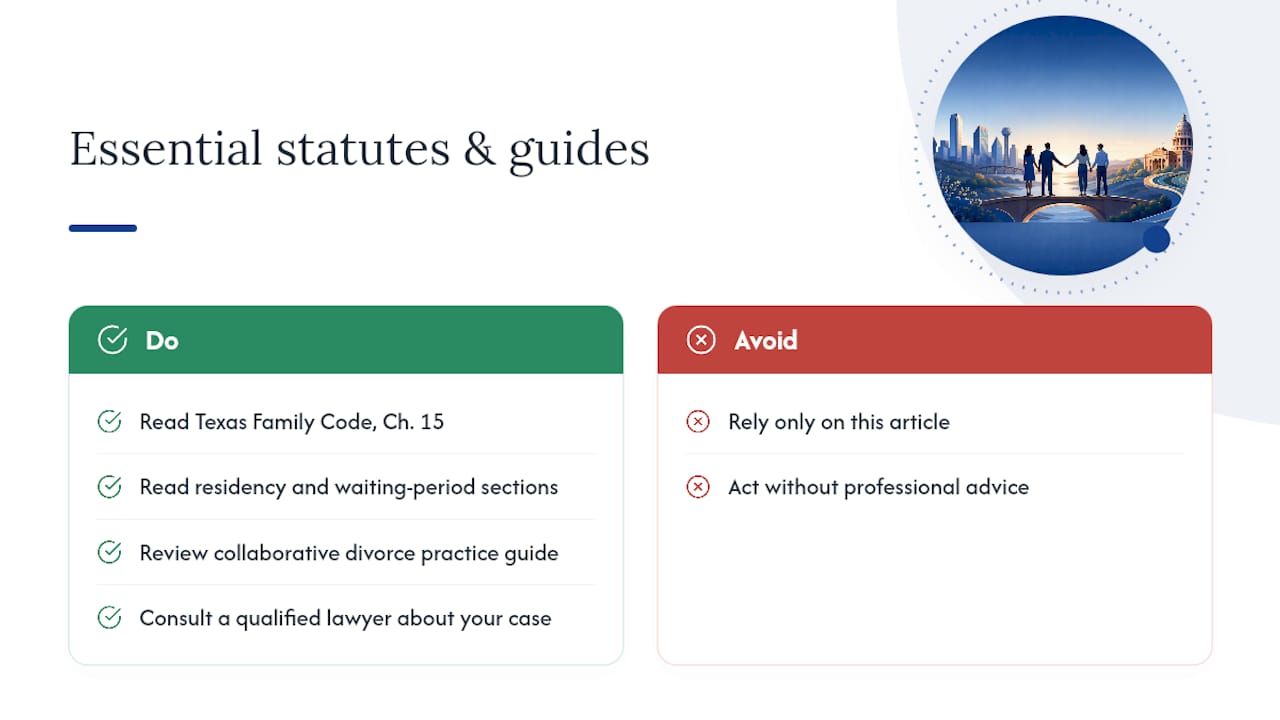
This article is general information, not a substitute for advice from a qualified lawyer. Consult a qualified legal professional about your own circumstances before acting on anything here.
Sources
- Texas Family Code, Chapter 15 — Collaborative Family Law
- Texas Family Code — Residency and waiting period (Sections 6.301, 6.702)
- Tex. Fam. Code § 15.106 — Disqualification of collaborative lawyer
- Collaborative divorce in Texas (practice guide)
FAQ
Is Collaborative Divorce a Good Idea?
It’s a strong option when both spouses are willing to negotiate honestly and want to keep the process private and out of a public courtroom. It’s not a good fit when there’s family violence, hidden assets, or a spouse who refuses to disclose financial information.
How Long Does a Collaborative Divorce Take?
Every Texas divorce faces a mandatory 60-day waiting period after filing, so the legal minimum is 61 days. In practice, most collaborative cases take 4 to 8 months to reach a full settlement, depending on complexity.
What Is the 10 Year Rule in Divorce in Texas?
Texas doesn’t have a “10 year rule” that changes how divorce itself works. The length of the marriage can support a stronger maintenance request, though the specific facts of each case still control the outcome.
Does the Wife Get Half of the 401(k) in a Texas Divorce?
Texas is a community property state, so retirement accounts earned during the marriage are generally divided, but not automatically split evenly for either spouse. In a collaborative case, a jointly retained financial neutral often helps both spouses agree on a fair division based on when contributions were made and each spouse’s overall settlement.
What Happens If My Collaborative Divorce Fails?
Under Tex. Fam. Code § 15.106, your collaborative lawyer and their firm are disqualified from representing you in the litigation that follows, so you’ll need new trial counsel. Most of what you disclosed during the collaborative process stays confidential and can’t be used against you in court.
Recommended
Questions About Your Situation?
Every family is different. Schedule a confidential consultation with Anna Din to discuss your options.
Schedule a Consultation