Avoid a 90 day Delay: Texas Custody Evaluations, Chapter 107, DRO Rules
A custody evaluation in Texas is a court-ordered assessment under Family Code Chapter 107 that investigates a family’s circumstances through interviews, records review, and often home visits. Courts typically order one when custody disputes turn complex or contested, and the process usually takes a minimum of about 90 days. The evaluator’s findings guide, but don’t bind, the judge’s final custody decision.
TL;DR:
- Custody evaluations in Texas usually last at least 90 days and are ordered only in high-conflict or complex custody disputes involving allegations of abuse, neglect, or mental health issues.
- Evaluations require interviews with each parent and child, review of records, home visits, and possibly psychological testing, with county offices often limiting evidence submissions to about 25 pages.
- Delays in completing intake or paying evaluation fees can extend the 90-day timeline significantly, especially in busy counties with limited appointment slots.
- The evaluation report is advisory; courts typically weigh it heavily but retain full discretion during custody decisions.
- Alternatives like mediation and targeted assessments can sometimes resolve custody issues more quickly and with less disruption than a full evaluation.
Table of Contents
- Understanding a Custody Evaluation in Texas and Why Courts Order One
- The Legal Basis: Texas Family Code Chapter 107
- What Evaluators Actually Do: Required Elements and Investigative Steps
- The Process, Fees, and Timeline You Should Plan Around
- How Judges Use the Evaluation Report
- How to Prepare for a Custody Evaluation
- When to Avoid a Full Evaluation: Alternatives Worth Considering
- A Firm’s View on Guiding Parents Through the Evaluation Process
- Get Ready for Your Custody Evaluation With the Right Legal Support
- Sources
- FAQ
Understanding a Custody Evaluation in Texas and Why Courts Order One
A custody evaluation exists to give the judge an independent, professional read on what living arrangement actually serves your child, separate from what either parent argues in court. The evaluator is a neutral expert, not an advocate for either side, and their job is to gather facts a judge can’t easily see from the bench.
Courts don’t order evaluations in every custody case. They tend to reserve them for situations where the stakes and the disagreement both run high.
- Contested conservatorship where parents can’t agree on primary custody or visitation.
- Serious allegations involving abuse, neglect, substance use, or mental health concerns.
- Complex parenting disputes involving relocation, special needs children, or high-conflict co-parenting.
The report an evaluator produces is advisory, meaning the judge isn’t legally required to follow it. In practice, though, Texas judges give these findings substantial weight because the evaluator has spent weeks investigating what the courtroom alone can’t reveal.
The Legal Basis: Texas Family Code Chapter 107
Chapter 107 of the Texas Family Code governs how courts order and structure these evaluations, and it sets specific requirements for what the order itself must contain. Under Section 107.103, the order must name the evaluator, state the purpose of the evaluation, and list the basic elements the evaluator is required to complete.
The statute also addresses evaluator qualifications and access. If a parent’s primary language isn’t English, the law requires either an evaluator who can communicate in that language or a licensed, certified interpreter, and the court can require a party to cover interpretation costs.
One provision parents often overlook involves nonparents seeking conservatorship.
When someone other than a parent is seeking custody, Texas courts generally require a showing of good cause before ordering the kind of evaluation that would typically apply between two parents. This good-cause threshold protects parental rights from being overridden without a substantive reason.
Knowing this framework matters because it tells you what a court can and can’t demand of your family, and it gives your attorney grounds to challenge an evaluation order that doesn’t meet these statutory requirements.
What Evaluators Actually Do: Required Elements and Investigative Steps
Section 107.109 spells out the minimum elements an evaluator must complete, and most Texas evaluations follow a fairly predictable sequence from there.
- Interview each parent individually, usually more than once, covering parenting history, home environment, and concerns about the other parent.
- Interview each child age four or older, conducted separately from parents and in an age-appropriate setting.
- Review relevant records, including school records, medical or mental health history, and prior court filings.
- Conduct home visits or observations, watching how each parent interacts with the child in their actual living space.
- Speak with collateral witnesses such as teachers, counselors, or extended family, when the evaluator determines it’s necessary.
- Administer psychological testing, if the court specifically orders it.
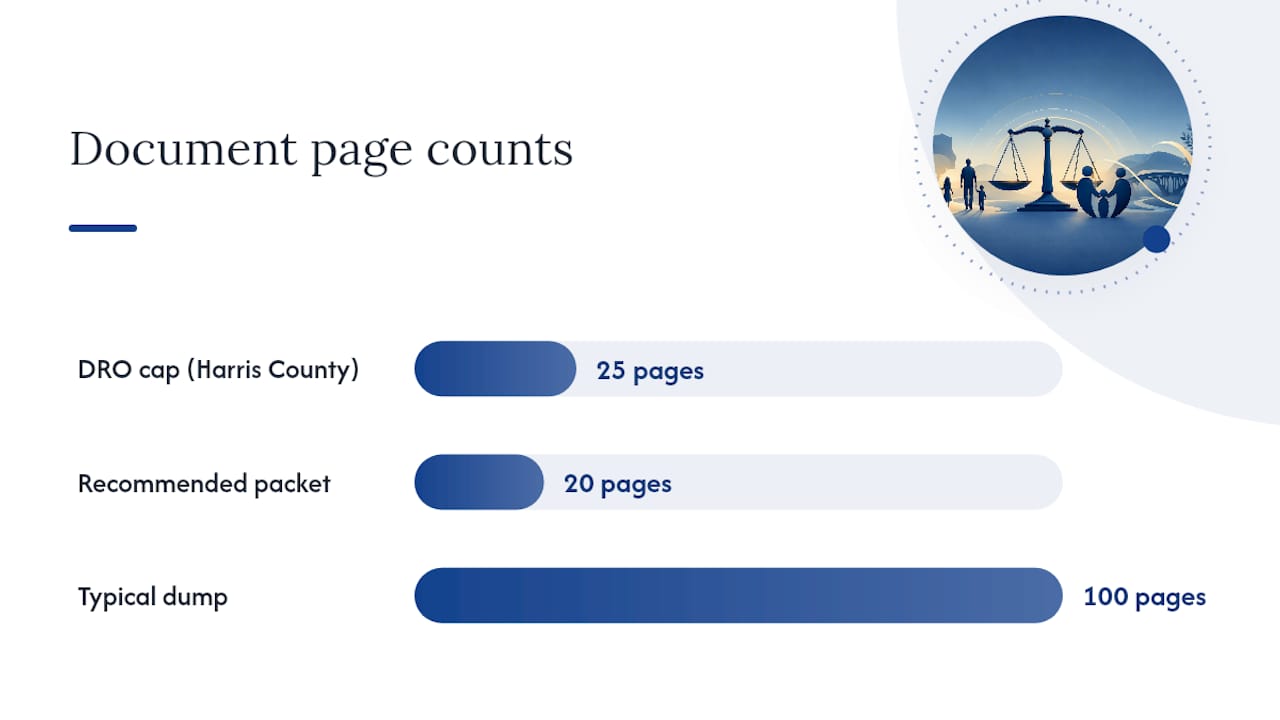
Beyond these core steps, evaluators working through a county Domestic Relations Office face real limits on what they’ll accept as evidence. Harris County’s DRO caps party submissions at 25 pages and generally won’t review attorney-submitted depositions or transcripts unless the court specifically orders the evaluator to consider them.
Pro Tip: Don’t assume more documentation helps your case. A tightly organized 20-page packet of school and medical records makes a stronger impression than a 100-page dump the evaluator can’t fully use anyway.
The Process, Fees, and Timeline You Should Plan Around
Once a judge signs the order, what happens next depends heavily on whether your county runs its evaluations through a Domestic Relations Office. Harris and Tarrant Counties both operate DROs, and their intake process looks similar.
- Bring the signed court order to your intake appointment with the DRO caseworker.
- Complete required forms and, in some counties, a parenting class before assignment moves forward.
- Pay evaluation fees in full, since Tarrant County’s DRO and comparable offices won’t assign an evaluator until intake and payment are both complete.
The baseline timeline for a Texas custody evaluation runs about 90 days from assignment, assuming both parents cooperate promptly with scheduling and documentation. Complex cases involving psychological testing, multiple children, or uncooperative parties routinely stretch well beyond that window.
Here’s a detail that surprises a lot of parents: missing a single intake appointment or delaying fee payment doesn’t just cost you a day. It can push the entire 90-day clock back to whenever the next available intake slot opens, which in a busy county can mean weeks.
How Judges Use the Evaluation Report
Once the evaluator finishes, the report goes to the court, and how it circulates from there depends on who conducted it. Judges weigh the findings heavily, since the evaluator has spent weeks doing what the court can’t do from behind the bench, but the recommendation is never the final word.
- DRO-conducted evaluations are typically not distributed as copies to the parties directly. Attorneys usually review the report in the DRO office and take notes rather than walking out with a full copy.
- Privately retained evaluators may follow different distribution rules, depending on the court’s order and local practice.
- Attorneys handle the review, discussing the findings with clients and identifying anything that needs to be addressed before a hearing.
- Judges retain final authority, meaning even a strongly worded recommendation doesn’t guarantee that outcome in the final custody order.
If you’re trying to understand how these findings connect to the bigger picture of a custody ruling, it helps to look at what Texas courts actually weigh when deciding conservatorship and possession schedules.
How to Prepare for a Custody Evaluation
Preparation determines more of the outcome than most parents expect, and it starts well before your first interview.
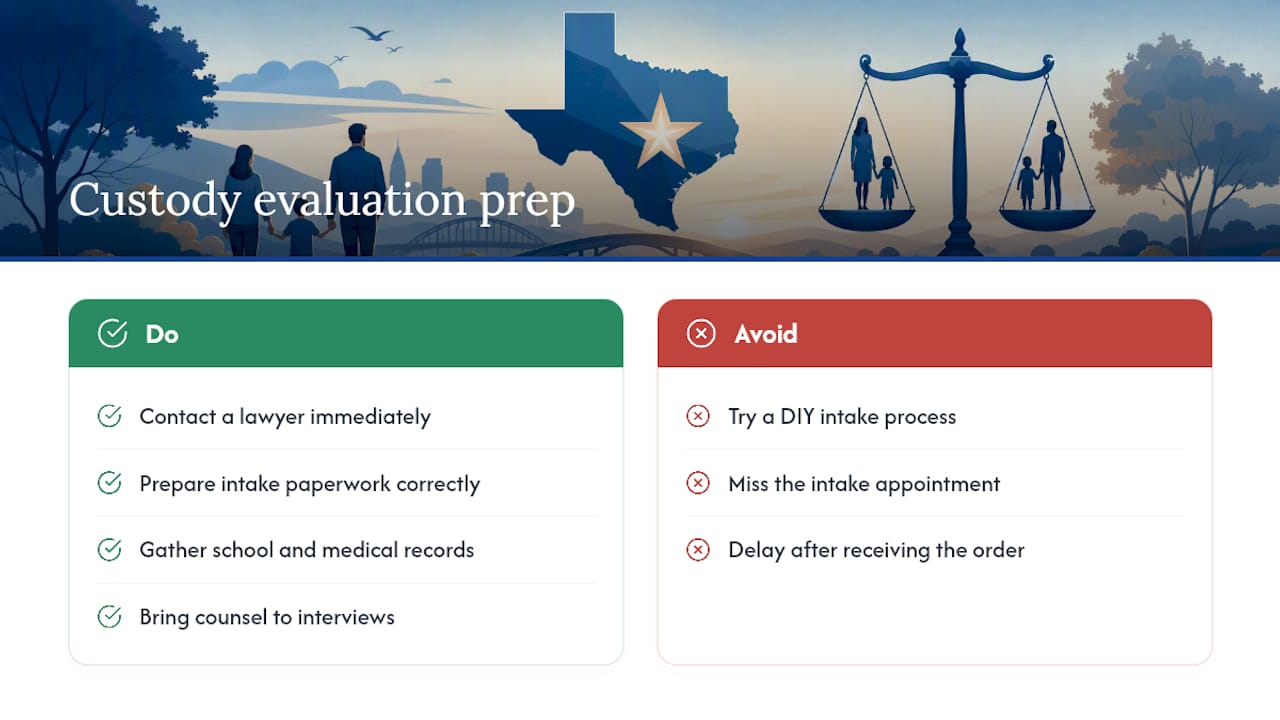
- Handle the administrative steps immediately. Complete intake questionnaires, sign any records-release forms, and confirm your fees are paid before your assigned intake date.
- Organize your documentation early. Pull together school records, medical history, and any relevant mental health documentation, keeping submissions concise given county page limits.
- Prepare references carefully. A short list of people who know your parenting firsthand, teachers, coaches, family friends, carries more weight than a long list padded with acquaintances.
- Watch your conduct, not just your paperwork. Never coach your child on what to say. Evaluators are trained to spot rehearsed answers, and it damages your credibility more than an honest, imperfect response would.
- Show stability through routine. Evaluators are assessing whether your home offers a nurturing, consistent environment, so consistent schedules, documented routines, and calm demeanor during interviews matter more than anything you say about the other parent.
- Loop in your attorney before you submit anything. Decide together what records to disclose, what needs a court order before an evaluator will consider it, and how to handle any sensitive evidence.
Pro Tip: Parents who spend their interview time attacking the other parent almost always come across worse than parents who simply describe their own home and routine. Evaluators notice the difference immediately.
When to Avoid a Full Evaluation: Alternatives Worth Considering
A full custody evaluation is intrusive, expensive, and slow, which is exactly why experienced family law practitioners treat it as a last resort rather than a default request.
- Mediation resolves many custody disputes faster and with far less disruption to the child, especially when both parents are willing to negotiate in good faith.
- Parenting coordination can address ongoing conflict over schedules and decision-making without the cost or timeline of a formal evaluation.
- Limited assessments focused on one specific issue, rather than a full home study, may satisfy the court’s concerns without the full 90-day process.
If you’re facing pressure to request or agree to a full evaluation, talk to your attorney about whether a narrower alternative could accomplish the same goal with less strain on your child and your wallet.
A Firm’s View on Guiding Parents Through the Evaluation Process
Custody evaluations put parents under a microscope at the worst possible time, right when emotions are highest and the stakes feel enormous. Lawofficeofannadin works with clients from the moment an evaluation is ordered, helping them complete intake requirements on time, organize documentation that actually strengthens their case, and prepare for interviews without second-guessing every word.
Attorneys attend conferences, flag issues before they become problems in the report, and help clients understand what an evaluator’s findings mean for their final custody order.
— Giri
Get Ready for Your Custody Evaluation With the Right Legal Support
Lawofficeofannadin gives parents facing a Texas custody evaluation something a DIY approach can’t: a lawyer who knows exactly how Harris and Tarrant County DROs handle intake, fees, and documentation limits, so you don’t lose weeks to an avoidable delay.

The firm’s child custody attorneys help clients prepare intake paperwork correctly the first time, organize the school and medical records evaluators actually want to see, and walk into interviews with a clear sense of what to say and what to leave to counsel. If your case also involves a pending divorce, the firm’s divorce representation works alongside custody matters so nothing falls through the cracks between the two proceedings.
Because missing an intake appointment can push your entire 90-day timeline back by weeks, the smartest move is contacting the firm as soon as you receive an evaluation order. Reach out to schedule a consultation and get ahead of the deadlines before they catch up to you.
This article is general information, not a substitute for advice from a qualified lawyer. Consult a qualified legal professional about your own circumstances before acting on anything here.
Sources
- Texas Family Code Chapter 107
- Child Custody Evaluations - Domestic Relations Office (Harris County)
- Custody Evaluations — Tarrant County Domestic Relations Office
- Guide to Texas Child Custody Evaluations
FAQ
How long does a custody evaluation take in Texas?
Most Texas custody evaluations take a minimum of about 90 days from the time an evaluator is assigned, though complex cases with psychological testing or scheduling delays often take longer.
Who pays for a custody evaluation in Texas?
Parents typically pay the evaluation fee, and county Domestic Relations Offices generally won’t assign an evaluator until the fee is paid in full and intake is complete.
Can a parent get a copy of the custody evaluation report?
It depends on the evaluator. DRO-conducted evaluations often aren’t distributed as full copies to parties, and attorneys typically review the report in person rather than receiving a copy to take home.
Is a custody evaluator’s recommendation binding on the judge?
No. The report is advisory, and while Texas judges often give it significant weight, the judge retains final authority over the custody decision.
What happens if a nonparent wants a custody evaluation?
Texas law generally requires a showing of good cause before a court orders the kind of evaluation typical between two parents when a nonparent is seeking conservatorship.
Are there alternatives to a full custody evaluation?
Yes. Mediation, parenting coordination, and limited assessments focused on a single issue can resolve many disputes without the cost and intrusion of a full 90-day evaluation.
Recommended
Questions About Your Situation?
Every family is different. Schedule a confidential consultation with Anna Din to discuss your options.
Schedule a Consultation