Getting a Default Divorce in Texas When Your Spouse Won’t Respond

Yes, Texas law lets you get a divorce by default if your spouse is properly served and fails to answer. You start by filing your Original Petition for Divorce, arranging service on your spouse, and filing proof of that service with the court. From there, the clock starts running on two separate deadlines.
- Your spouse generally has until the Monday following 20 days after being served to file an answer.
- Even if no answer ever comes, Texas requires a waiting period from the date you filed before a judge can sign your final decree.
- Miss a step in service, and the whole default request can stall or get thrown out.
The Texas Family Code and Texas Rules of Civil Procedure govern every piece of this timeline, and getting them right the first time saves you months.
Key Takeaways
A Texas default divorce becomes available once your spouse is properly served, fails to answer within the statutory window, and the 60-day waiting period has passed.
| Point | Details |
|---|---|
| Service must be airtight | Use a process server or sheriff and file the Return of Service promptly, since faulty service voids the whole default. |
| Two clocks run in parallel | Track the roughly 20-day answer deadline and the 60-day waiting period from your filing date separately. |
| Courts still apply legal standards | Property, support, and custody rulings in a default decree must follow Family Code standards, not just your requests. |
| County procedures vary | Pull the correct packet, like Harris County’s Divorce Set B - Default, before filing. |
| Attorney review reduces risk | Lawofficeofannadin helps Texas petitioners confirm proper service, draft enforceable decrees, and prepare for the default hearing. |
Table of Contents
- Who Qualifies for a Default Divorce in Texas and What the Timing Looks Like
- Your Step-by-Step Checklist for Filing a Texas Default Divorce
- What Documents You Need and How to Prove Service
- What a Judge Can Decide by Default, and Where the Risks Show Up
- Inside the Default Hearing: What Judges Actually Look For
- Why County Rules Differ and Where to Check Yours
- When It’s Time to Bring in a Family Law Attorney
- What the Statutes Don’t Tell You About Filing Alone
- How Lawofficeofannadin Handles Default Divorce Filings in Texas
- Sources
- FAQ
Who Qualifies for a Default Divorce in Texas and What the Timing Looks Like
Not everyone can walk into a Texas courtroom and ask for a default judgment. You need to meet the state’s residency threshold, serve your spouse correctly, and let the statutory clocks run their full course before a judge will sign anything.

Texas requires that at least one spouse has lived in the state for the six months before filing, and in the county of filing for the preceding 90 days, under the jurisdiction rules in the Texas Family Code. Once you file and your spouse is served, they’re considered “in default” if they don’t file a written answer by the deadline stated on the citation, typically the Monday after 20 days from service.
Here’s what to track on your calendar:
- Answer deadline: Usually 20 days plus time to the next Monday after service is completed.
- 60-day waiting period: Runs from your filing date, not your service date. Even an uncontested case can’t finalize before this window closes.
- Return of service: The process server or officer typically has to file proof of service promptly, and courts often want it on file at least 10 days before a default hearing.
If service was delayed or defective, you may need to re-serve before any of these clocks start counting.
Your Step-by-Step Checklist for Filing a Texas Default Divorce
Getting a default granted comes down to sequencing. Skip a step or file out of order, and a court coordinator will bounce your case back to the starting line.
-
File your Original Petition for Divorce. State the grounds (Texas allows no-fault “insupportability”), list children if any, and specify what you’re asking for on property, debt, custody, and support. Vague requests invite vague rulings, so be specific about the house, the retirement accounts, and any conservatorship terms you want.
-
Serve your spouse using an approved method. A process server or sheriff’s deputy typically hands the citation and petition directly to your spouse. Certified mail with restricted delivery is allowed in narrower circumstances. Once complete, the Return of Service gets filed with the district clerk, which is the document that legally proves your spouse knew about the case.
-
Watch the calendar. Track both the answer deadline and the 60-day waiting period simultaneously. If your spouse files anything, even a late answer, the default track ends and the case becomes contested.
-
Request the default and prepare your paperwork. Once both deadlines pass with no answer on file, you (or your attorney) file a request for default judgment, sometimes called a motion, along with a proposed Final Decree of Divorce. Attach any needed affidavits about property values, income, or the children’s living situation.
-
Attend the hearing and get your decree signed. Many Texas counties handle default divorce hearings quickly since there’s no opposing party to cross-examine. Bring your exhibits, answer the judge’s questions under oath, and walk out with a signed decree, or wait for it to arrive by mail if the judge takes it under advisement.
Pro Tip: Draft your proposed decree before the waiting period even ends. Judges reviewing default cases move fast, and a clean, complete decree that matches your petition’s requests gets signed with far less back and forth than one riddled with blanks or inconsistencies.
What Documents You Need and How to Prove Service
Texas district clerks expect a specific paper trail before they’ll process a default request, and missing one document is the single most common reason default hearings get delayed.
- Original Petition for Divorce, filed at the start of your case.
- Citation, issued by the clerk once you file, which gets delivered to your spouse along with the petition.
- Return of Service, filed by whoever served your spouse, documenting the date, time, and method of service.
- Proposed Final Decree of Divorce, drafted for the judge’s signature at the default hearing.
- Affidavit of service or default, in some counties, confirming no answer was filed within the deadline.
Acceptable service methods include a licensed process server, a sheriff or constable, or certified mail in limited situations where personal service isn’t required. Cornell’s Legal Information Institute lays out why proof of service matters so much: without it, a court has no legal basis to conclude your spouse was ever properly notified, and any default judgment built on faulty service is vulnerable to being undone later.
For the actual forms, TexasLawHelp’s default divorce checklist provides fillable packets accepted in many counties, and Harris County residents can pull the Divorce Set B - Default packet directly from the county law library.
What a Judge Can Decide by Default, and Where the Risks Show Up
A default decree isn’t a rubber stamp. Judges can rule on nearly everything a contested divorce would cover, but they still have to apply Texas legal standards, especially where children are involved.
Courts can determine:
- Division of community property and allocation of debts.
- Spousal maintenance, where the statutory criteria are met.
- Conservatorship, possession and access schedules, and child support, all subject to the Texas Family Code’s best-interest standards, not just what one parent requests.
The catch is that default proceedings are inherently one-sided. There’s no cross-examination, no opposing evidence, and often no pushback on your valuations or proposed possession schedule. That can work in your favor, but it also means the court is relying almost entirely on what you present. A default judgment can also be reopened later through a motion for new trial if your spouse shows up and demonstrates they had good cause for missing the deadline, which makes clean documentation critical from the start.
Pro Tip: If custody is part of your case, bring more than your own testimony and review our Divorce Sale checklist to understand home selling considerations during or after divorce. School records, a parenting schedule proposal, and evidence of your day-to-day caregiving role give the judge something concrete to rely on, and they make your decree far harder to challenge later. Our overview of what Texas courts actually consider in custody decisions breaks down exactly what judges look for.

Inside the Default Hearing: What Judges Actually Look For
Default hearings move quickly compared to contested trials, but the judge still has to build a factual record before signing your decree.
-
The judge confirms jurisdiction and service. Expect a few questions about how long you’ve lived in Texas and confirmation that your spouse was properly served and never answered.
-
You present sworn testimony or an affidavit. Many Texas courts now allow prove-up by written affidavit instead of live testimony, especially in uncontested and default settings, which speeds things up considerably.
-
You submit your exhibits. Bank statements, a property inventory, or a parenting plan should be labeled and organized so the clerk can attach them to the court’s file without confusion.
-
The judge signs the decree, either that day or shortly after, once satisfied the request matches Texas law and the petition on file.
Why County Rules Differ and Where to Check Yours
Every Texas county runs its own version of this process, even though the underlying statutes are the same statewide. Some district clerks require additional local forms, others schedule default hearings on specific days, and a few counties route uncontested and default cases through different coordinators entirely.
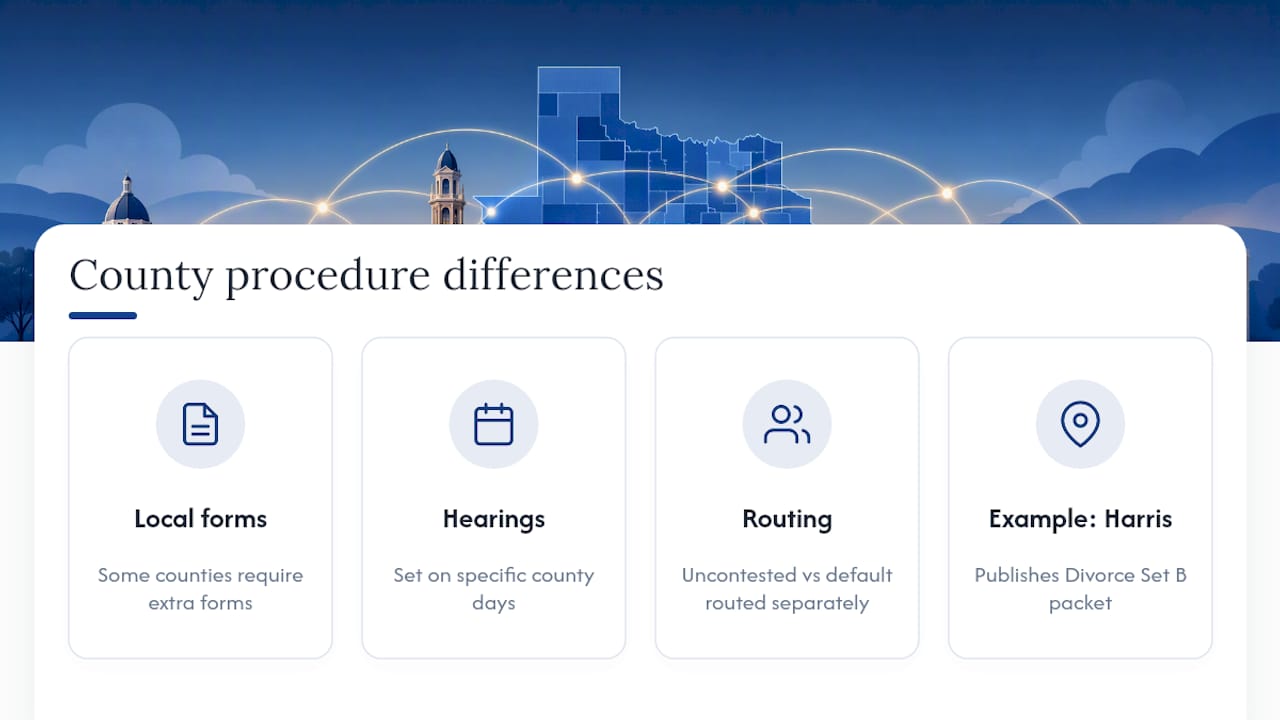
Harris County, for example, publishes its own Divorce Set B - Default packet with sample decrees and county-specific filing instructions. Before you file anywhere in Texas, check that county’s standing orders and call the district clerk’s office to confirm current local procedures. A packet built for one county rarely transfers cleanly to another.
When It’s Time to Bring in a Family Law Attorney
A default divorce sounds simple on paper, but the margin for costly mistakes is real, especially once children, retirement accounts, or a house are on the table.
Consider hiring counsel when:
- Custody or child support is contested even informally, since courts scrutinize these decrees more closely.
- Your spouse’s whereabouts are uncertain and you may need service by publication or a diligent-search affidavit.
- There’s real property, a business, or retirement assets that need precise legal descriptions to divide correctly.
- You’re not fully confident your service was done correctly the first time.
| Situation | DIY Default Filing | Working With an Attorney |
|---|---|---|
| Simple case, no children or major assets | Often manageable with TexasLawHelp forms | Adds review and peace of mind |
| Children or custody involved | High risk of incomplete decree language | Attorney drafts enforceable custody terms |
| Spouse’s location unknown | Requires precise diligent-search compliance | Attorney manages service by publication |
| Real estate, retirement, or business assets | Property descriptions often rejected by clerks | Attorney ensures decree is enforceable |
Pro Tip: Even a straightforward default case benefits from a quick attorney review before the hearing. A 20-minute consultation catching a defective service or a missing decree provision can save you from refiling months later. Lawofficeofannadin’s divorce practice page outlines exactly how the firm handles service, decree drafting, and hearing representation for default cases across The Woodlands and Houston area.
What the Statutes Don’t Tell You About Filing Alone
The Family Code and the Rules of Civil Procedure give you the mechanics: deadlines, service methods, waiting periods. What they don’t tell you is how often a technically correct filing still goes sideways because the petition asked for the wrong thing or the proposed decree left a gap a judge won’t sign off on.
Most people researching a default divorce assume the hard part is the paperwork. It isn’t. The hard part is knowing what to ask for in the first place, particularly around custody terms, property descriptions, and support calculations that hold up under Texas’s best-interest standards. A default hearing moves fast precisely because there’s no opposing counsel to catch an error, which means the burden of getting it right the first time falls entirely on you.
My honest read on the conventional advice out there: too much of it treats default divorce as a shortcut. It isn’t a shortcut. It’s a different procedural path that still has to satisfy every substantive requirement a contested case does, just without anyone on the other side to push back if you get it wrong. Prioritize service accuracy and decree language over speed, and the rest of the timeline takes care of itself.
How Lawofficeofannadin Handles Default Divorce Filings in Texas
Filing a default divorce yourself means absorbing every risk of a rejected service, an incomplete decree, or a custody provision that doesn’t hold up later. Lawofficeofannadin handles that risk for you, confirming service was done correctly, drafting a decree built to survive judicial review the first time, and standing with you at the hearing so nothing gets left to chance.

The firm has represented families across The Woodlands, Houston, and surrounding communities through contested and uncontested divorces alike, including cases where a spouse never responded at all. If you’re weighing whether to file on your own or want a professional set of eyes on your petition and proposed decree before your hearing date, reach out to Lawofficeofannadin’s divorce practice team to schedule a consultation and find out exactly where your case stands.
This article is general information, not a substitute for advice from a qualified lawyer. Consult a qualified legal professional about your own circumstances before acting on anything here.
Sources
- Texas Family Code — Chapter 153 (residence and jurisdiction)
- Instructions and Forms for a Default Divorce without Children — TexasLawHelp
- Divorce Set B - Default — Harris County
- Service of process — Cornell LII
FAQ
How long does a default divorce take in Texas?
At minimum, expect 60 days from your filing date, since Texas law requires that waiting period before a judge can sign a final decree, plus whatever time it takes to complete service and let the answer deadline pass.
What are the disadvantages of a default divorce?
Default proceedings are one-sided, meaning the court relies mainly on your evidence and testimony, and a judgment can later be reopened through a motion for new trial if your spouse shows good cause for missing the deadline.
What is the 10-year rule for divorce in Texas?
Texas courts can award spousal maintenance more readily when a marriage lasted 10 years or longer, though eligibility still depends on additional factors like income and ability to support oneself under the Family Code.
Do I need a lawyer for a default divorce?
Not always for simple, asset-free cases, but you should strongly consider one when children, real estate, retirement accounts, or an uncertain spouse’s location are involved, since Lawofficeofannadin can confirm service was proper and draft a decree that holds up.
Recommended
Questions About Your Situation?
Every family is different. Schedule a confidential consultation with Anna Din to discuss your options.
Schedule a Consultation