3 Questions to Ask Before Choosing Jury or Bench in Texas Family Cases
A jury trial puts factual questions in the hands of citizens who reach a verdict; a bench trial hands that same job to the judge alone. The jury route tends to favor cases with emotional weight or community sympathy, while the bench route tends to favor speed and technical, legally complex disputes. Which one fits your case depends on the type of claim you’re bringing, your evidence, and what you’re willing to trade in time and predictability.
TL;DR:
- Jury trials generally involve longer timelines and higher costs due to jury selection and instructions, while bench trials are quicker and more flexible.
- In criminal cases, both trial types require proof beyond a reasonable doubt, but civil cases are decided by a preponderance-of-the-evidence standard regardless of the trial route.
- Jury verdicts are more unpredictable and susceptible to community bias, whereas judge decisions tend to be more consistent but easier to challenge on legal errors.
- Jury trials favor emotional or sympathetic cases, while complex evidence like financial records or technical details typically benefit from a judge’s expertise.
- In Texas family law, juries can decide factual issues like property characterization, but judges retain authority over custody, conservatorship, and possession arrangements.
Table of Contents
- Jury Trial vs Bench Trial: Key Differences in Roles and Procedure
- Jury Trial vs Bench Trial: Weighing the Pros and Cons
- Factors to Consider When Choosing Between Jury and Bench
- How to Demand or Waive a Jury Trial
- Texas Family Law: Why Juries Have Limited Reach in Divorce and Custody Cases
- What We Tell Clients Deciding Between Jury and Bench
- How Lawofficeofannadin Can Help You Decide
- Sources
- FAQ
Jury Trial vs Bench Trial: Key Differences in Roles and Procedure
The core distinction comes down to who acts as the “finder of fact.” In a jury trial, a panel of citizens weighs the evidence and decides what happened, while the judge instructs them on the applicable law. In a bench trial, the judge does both jobs: deciding the facts and ruling on the law. There’s no jury box to fill, no verdict to wait on from twelve strangers.
This split traces back to the U.S. Constitution. The Sixth Amendment guarantees a jury trial in criminal prosecutions, while the Seventh Amendment preserves that right in most federal civil cases involving monetary claims above a minimal threshold. Federal procedure builds directly on those guarantees: FRCP 38 preserves the right to demand a jury, and FRCP 39 governs how that trial actually proceeds once demanded.
The mechanics look different depending on which path you’re on:
- Jury trials start with voir dire, the questioning process used to seat an impartial panel, and jurors deliberate privately before returning a verdict.
- Bench trials skip jury selection entirely; the judge hears the evidence, applies the law, and issues findings of fact and conclusions of law directly.
- Criminal cases require proof beyond a reasonable doubt regardless of who’s deciding.
- Civil cases use the lower preponderance-of-the-evidence standard, meaning the claim is more likely true than not.
The standard of proof doesn’t change based on who’s deciding your case, but how that standard gets applied often does. A jury trial can produce a verdict shaped by twelve different perspectives on the same set of facts, while a bench trial produces a single, reasoned decision from one legal professional applying that same standard consistently.
Jury Trial vs Bench Trial: Weighing the Pros and Cons
Neither option is universally better. Each comes with real trade-offs that matter depending on what kind of case you’re bringing and what outcome you’re hoping to protect.
Jury trial advantages:
- Jurors bring a community perspective that can favor sympathetic plaintiffs or defendants.
- Jury verdicts are typically hard to overturn on appeal absent fraud or clear procedural error, according to LII’s overview of jury trials.
- A panel of strangers may respond to emotional or human elements a judge, hearing similar cases daily, might weigh less heavily.
Jury trial disadvantages:
- Outcomes are less predictable; twelve people can reach a verdict a legal professional might not.
- Voir dire adds weeks or months to the timeline and requires real strategy.
- Juror bias, even unconscious, can swing a result in either direction.
Bench trial advantages:
- Cases move faster because there’s no jury to select, instruct, or wait on, according to the ABA’s practice note on bench trials.
- Judges bring legal and technical expertise that helps with complex evidence.
- Scheduling is more flexible since there are no juror availability constraints to work around.
- The written record of a judge’s reasoning is often clearer, which matters if you’re building a case for appeal.
Bench trial disadvantages:
- The entire outcome rests on one person’s judgment.
- Legal errors in a bench decision are often easier to challenge on appeal than a jury’s factual findings.
- There’s little room for the emotional persuasion that can move a jury.
Pro Tip: If your case hinges on a sympathetic story, a jury may serve you better. If it hinges on financial records, medical evidence, or contract language, a judge who reads that material daily may reach a more consistent result.
Factors to Consider When Choosing Between Jury and Bench
The right choice depends on specifics, not gut feeling. Before you decide, walk through these questions with your attorney.
- What type of case are you in? Criminal defendants have a constitutional right to a jury under the Sixth Amendment; civil litigants often have that right too, but it varies by claim type and jurisdiction.
- How technical is your evidence? Cases built on financial records, medical testimony, or contract interpretation often favor a judge who can absorb dense material methodically. Nolo’s comparison of judge versus jury trials makes this same point: emotional cases lean jury, technical cases lean bench.
- What’s actually at stake? Higher sentencing exposure or larger monetary damages can change your risk tolerance for an unpredictable jury outcome.
- What does your local jury pool look like? Community attitudes in Harris County differ from rural counties, and that shapes voir dire strategy.
- How much time and cost can you absorb? Jury trials generally cost more and take longer to reach a resolution, given the added steps of selection and instruction.
None of these factors work in isolation. A technically complex civil case with a highly sympathetic defendant might still call for a jury, depending on what your attorney thinks will resonate most with a panel.
How to Demand or Waive a Jury Trial
Getting a jury trial isn’t automatic, even when you have the right to one. You have to ask for it, and you have to ask on time.
- File a written demand. In federal court, FRCP 38 requires a written jury demand, typically within 14 days of the last pleading directed at the issue. State courts have their own deadlines, often similarly tight.
- Know the risk of missing the deadline. Miss it, and you generally waive your right to a jury, defaulting to a bench trial whether you wanted that outcome or not.
- Understand withdrawal rules. Once demanded, a jury trial can typically only be waived later with the other side’s consent or a formal stipulation, per FRCP 39.
- Prepare for voir dire if you go the jury route. Jury selection involves questioning potential jurors about bias, background, and ability to be impartial, and it’s a major reason jury trials run longer than bench trials.
- Understand how appeals differ. A bench trial’s findings of fact get reviewed for “clear error,” a relatively deferential standard, while legal rulings get reviewed fresh (de novo). Jury verdicts are reviewed even more deferentially on the facts, since appellate courts rarely second-guess what a jury believed.
Texas Family Law: Why Juries Have Limited Reach in Divorce and Custody Cases
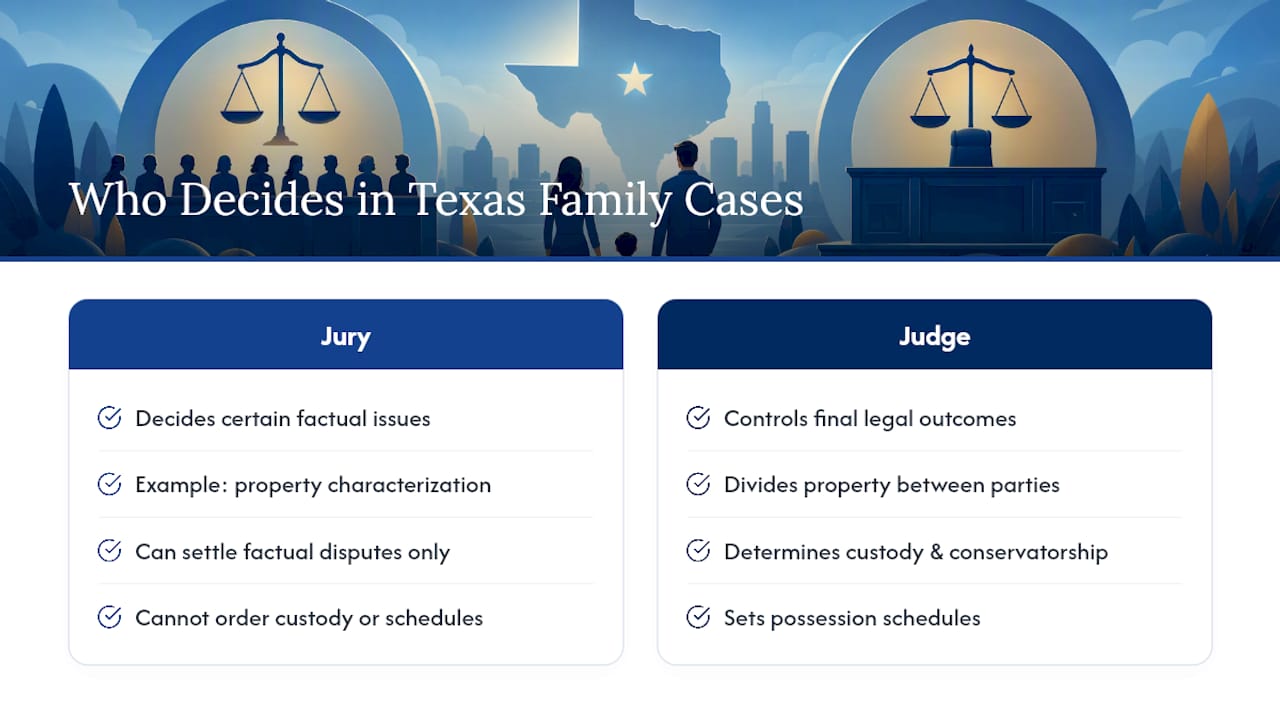
If you’re weighing this choice in a Texas divorce or custody dispute, know this upfront: juries have real limits here. The Texas Family Code allows juries to decide certain factual questions, like whether property is characterized as separate or community. But the judge, not the jury, ultimately controls how property gets divided and how custody, conservatorship, and possession schedules get structured.
That means a jury in a Texas family case can settle a specific factual dispute, but it can’t hand you the custody arrangement you’re hoping for. Most parenting-related outcomes stay with the judge regardless of what a jury decides on the side. If you’re in The Woodlands, Harris County, or the surrounding Houston area and weighing whether a jury has any real role in your case, that’s a conversation worth having early with a family law attorney who can flag which issues, if any, are jury-eligible before you spend time and money pursuing one.
What We Tell Clients Deciding Between Jury and Bench
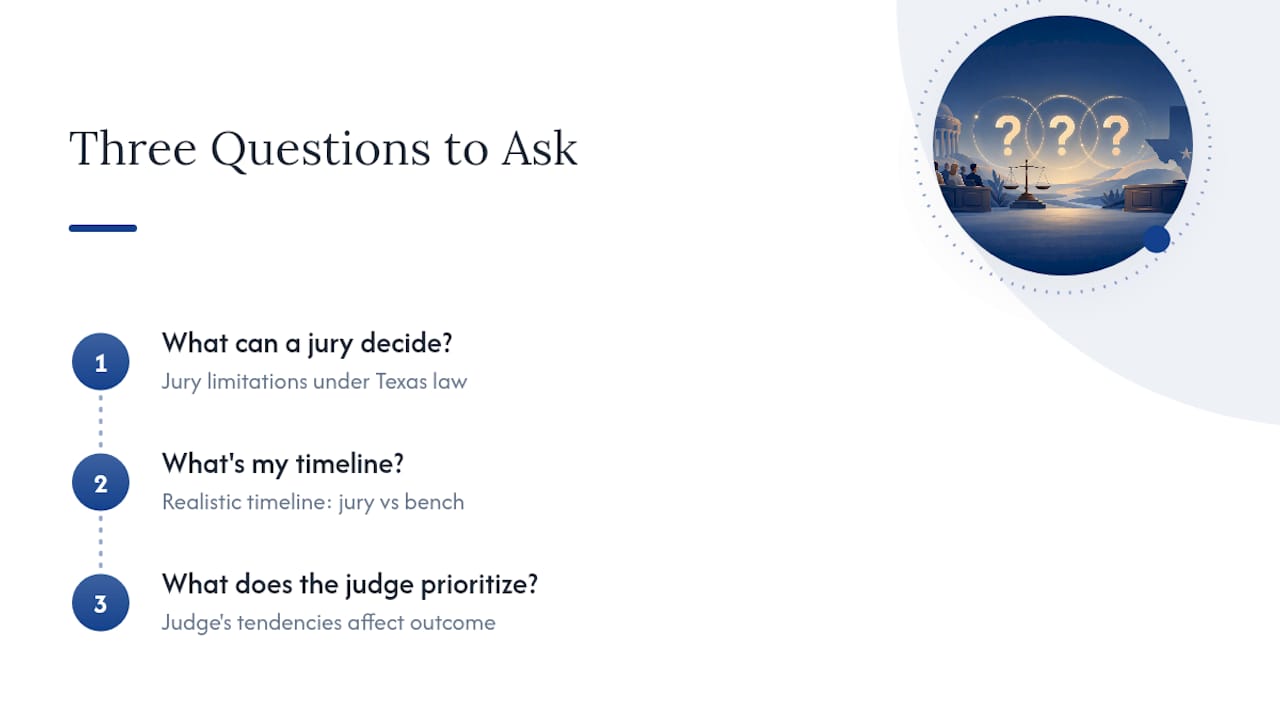
At Lawofficeofannadin, we walk clients through this decision by looking at three things: what you’re actually trying to protect, what your evidence supports, and where Texas law limits jury involvement. In most custody and divorce matters, we lean toward a bench trial, since a judge trained in family law usually reaches a more predictable, legally grounded result on parenting issues juries can’t fully decide anyway.
Before your consultation, come prepared with three questions: What can a jury actually decide in my case? What’s my realistic timeline either way? What does the judge assigned to my case tend to prioritize?
— Giri
How Lawofficeofannadin Can Help You Decide
Lawofficeofannadin is the option for Woodlands and Houston area families who need a straight answer on trial strategy, not a runaround. Deciding between a jury and a bench trial in a family law case means understanding exactly where Texas limits jury authority, and that’s a call best made with someone who has handled these cases locally, not a generic legal explainer.

Our practice areas cover divorce representation, child custody and support, and protective orders throughout The Woodlands, Houston, and the surrounding Texas communities. Anna Din’s success stories include securing custody rights for concerned parents facing exactly the kind of strategic decisions this article covers. If you’re weighing your options and want a clear answer on whether a jury has any real role in your case, schedule a consultation to talk through your specific situation before any deadlines pass.
This article is general information, not a substitute for advice from a qualified lawyer. Consult a qualified legal professional about your own circumstances before acting on anything here.
Sources
FAQ
Is it better to have a jury trial or a bench trial?
Neither is universally better. A jury trial often suits emotionally compelling cases where community sympathy matters, while a bench trial usually suits technical, evidence-heavy disputes where consistency and speed matter more.
Are bench trials faster than jury trials?
Yes, generally. Bench trials skip jury selection entirely and offer more flexible scheduling, according to the ABA’s practice note, which shaves real time off the process compared to jury trials.
Why would a defendant want a bench trial?
A defendant might choose a bench trial when the case involves complex or technical evidence a judge can evaluate more consistently, or when the facts are unlikely to generate jury sympathy.
What are the downsides of a bench trial?
The entire outcome rests on one decision-maker, and legal errors in that decision are often easier to challenge on appeal than a jury’s factual findings would be.
Can a jury decide child custody in Texas?
Not fully. Texas juries can resolve limited factual questions like property characterization, but judges retain control over custody, conservatorship, and possession schedules under the Texas Family Code.
Recommended
Questions About Your Situation?
Every family is different. Schedule a confidential consultation with Anna Din to discuss your options.
Schedule a Consultation