Kick Out Order Texas: Your Complete Legal Guide
August 4, 2026 · Law Office of Anna Din PLLC

TL;DR:
- A kick-out order in Texas allows one party to occupy a residence exclusively during a protective order. It requires recent residence, family violence, and a clear danger, but does not transfer property ownership. Legal assistance ensures proper documentation and effective enforcement of exclusion provisions.
A kick-out order is a provision inside a Texas protective order that grants one party exclusive occupancy of a shared residence and requires the other party to vacate. Under Texas Family Code §83.006, three statutory elements must all be present: the applicant must have lived in the residence within the 30 days before filing, the respondent must have committed family violence within those same 30 days, and there must be a clear and present danger of future family violence. When those elements are met, a court can issue a temporary ex parte order valid for up to 20 days, with a full hearing typically scheduled within about 14 days. Final protective orders can extend that exclusion significantly longer.
This guide walks you through every stage of the process, from the statutory basis to enforcement, using resources from TexasLawHelp, the Texas State Law Library, and the practice perspective of Lawofficeofannadin.
This article is general legal information, not legal advice. Confirm current rules with the Texas Family Code or a qualified Texas family-law attorney before acting.
Table of Contents
- What a kick-out order actually does under Texas law
- Which protective orders can include a kick-out provision?
- How to request a kick-out order in Texas: step-by-step
- What judges look for before granting exclusion
- Does ownership or lease status affect a kick-out order?
- What happens after the judge grants exclusion
- How long does exclusion last, and can it be modified?
- Court-ready checklist: what to bring to your hearing
- Attorney perspective: procedural pitfalls and what lawyers emphasize
- Key Takeaways
- Why legal representation often changes the outcome
- Lawofficeofannadin can help you protect your home and your family
- Useful sources and hotlines
- FAQ
- The case for getting this right the first time
What a kick-out order actually does under Texas law
A kick-out order is not a standalone document. It is a provision requested within a protective-order application, and applicants should not search for a separate “kick-out” form. Instead, you request exclusive occupancy as part of the protective-order affidavit and application. The Texas State Law Library describes it plainly: the court may grant any party exclusive access to a residence and, where appropriate, require the other party to vacate.
What the order does not do is equally important to understand:
- It does not transfer property title or change who owns the home.
- It does not permanently resolve who gets the residence in a divorce or civil proceeding.
- It controls only who may occupy or use the property while the order remains active.
- It can prohibit either party from transferring or disposing of shared property during the order period.
- It can grant one party exclusive use of shared personal property, such as a vehicle.
A plain-language example: you have lived in the family home for years, your spouse committed family violence against you two weeks ago, and you have reason to believe the danger continues. You file for a protective order and request exclusive occupancy. If the judge finds the statutory elements are met, your spouse is ordered to leave the residence. Your name on the lease or deed is not the deciding factor; the court’s finding of danger is.
The TexasLawHelp kick-out orders page and the Texas State Law Library both caution that this occupancy-only scope is one of the most commonly misunderstood aspects of protective orders. Long-term property claims belong in divorce or civil proceedings, not in a protective-order hearing.

Which protective orders can include a kick-out provision?
Three types of orders can carry an exclusive-occupancy provision in Texas. Each operates on a different timeline and procedural standard.
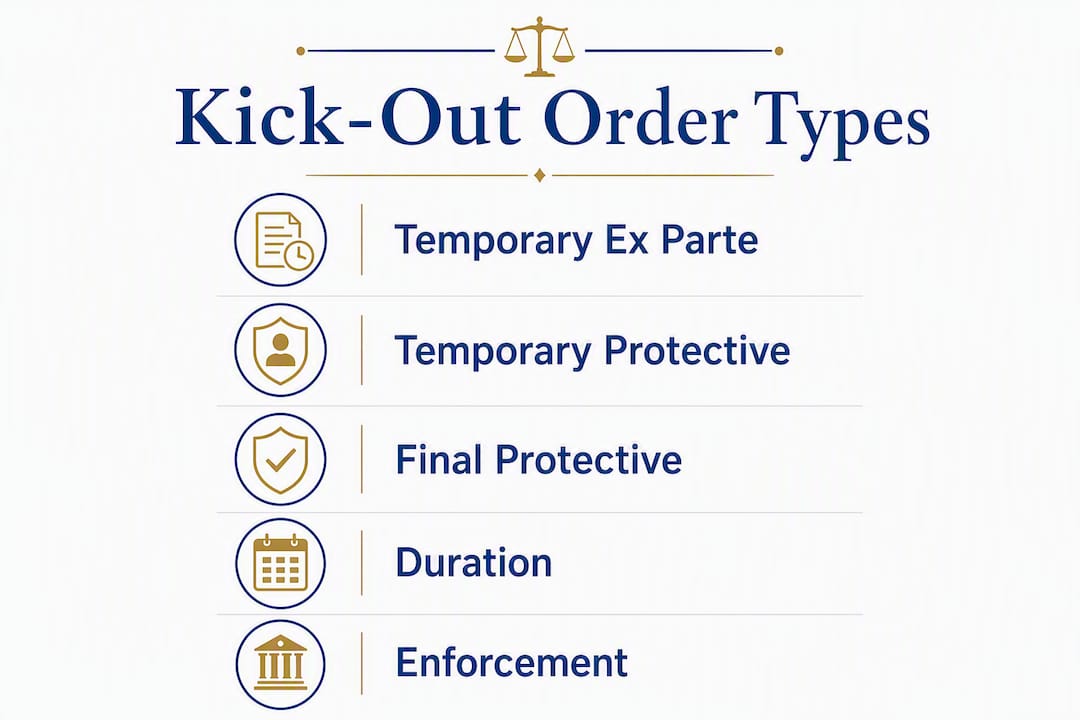
| Order Type | Typical Duration | When Exclusion Can Be Ordered |
|---|---|---|
| Temporary ex parte protective order | A short-term period determined by the court | At the ex parte hearing, without respondent present, if statutory criteria are met and applicant testifies in person |
| Final protective order | A period that may extend based on court findings | After a full hearing where respondent has been served and has opportunity to appear |
| Magistrate’s emergency protective order | A limited duration set by the magistrate | Issued by a magistrate at arrest, typically in domestic-violence situations; may include residence restrictions |
The temporary ex parte order is the tool most people need first. Texas Family Code §83 authorizes a court to issue this order without the respondent present when there is an immediate need. A full hearing is usually set within roughly 14 days of the application, giving the respondent an opportunity to appear and contest the order.
One procedural detail practitioners watch closely: under §83.006, the court may pause an ex parte hearing to contact the respondent by phone, allowing them to be present. The court must resume the hearing before the end of the same working day regardless of whether the respondent is reached. This is a due-process safeguard built into the statute, not a delay tactic.
The final protective order stage is where long-term exclusion is decided. The strength of evidence presented at that hearing determines whether the kick-out provision continues, is modified, or is dissolved.
How to request a kick-out order in Texas: step-by-step
The process moves quickly when you know the sequence. Here is the practical roadmap.
-
Prepare a detailed sworn affidavit. Describe the family violence, the dates it occurred (within the past 30 days), your residence at the address, and the specific reasons you believe future violence is likely. Be precise about dates, locations, and what happened. Vague affidavits rarely support exclusion.
-
File the protective-order application in the correct county. You may file in the county where you live, where the respondent lives, or where the family violence occurred. If you need to keep your address confidential, ask the clerk about address-confidentiality options at the time of filing.
-
Request ex parte relief explicitly. Your application should state that you are requesting a temporary ex parte protective order with an exclusive-occupancy provision. Do not assume the clerk or judge will infer it.
-
Appear in person at the ex parte hearing. A filed affidavit alone is not enough for a kick-out provision. You must appear and testify in person. The court needs to hear your testimony directly to justify issuing the exclusion under Texas Family Code §83.
-
Receive the temporary order and law enforcement instructions. If the judge grants the order, it will direct the sheriff, constable, or police chief to provide an officer to accompany you to the residence, notify the respondent of the exclusion, and protect you while you retrieve belongings.
-
Attend the final hearing (typically within 14 days). The respondent will be served and given the opportunity to appear. This is the hearing where the court decides whether to issue a final protective order and whether the kick-out provision continues.
-
Follow up on enforcement if needed. If the respondent refuses to leave or returns after being excluded, contact law enforcement with a copy of the order. Document every violation.
For official forms and self-help filing guides, TexasLawHelp and the Texas State Law Library both maintain current resources. Your county family court clerk’s office can also direct you to local forms.
What judges look for before granting exclusion
The legal standard under Texas Family Code §83.006 has three required elements, and judges apply them strictly. Meeting two out of three is not enough.
- Residence within 30 days: The applicant must have lived at the residence within 30 days of filing. A recent move, even a temporary one due to safety concerns, can complicate this element. Document your presence with utility bills, mail, or a lease.
- Family violence within 30 days: The respondent must have committed family violence within the same 30-day window. Older incidents may support the danger finding but do not satisfy this element on their own.
- Clear and present danger of future family violence: The court looks for evidence that the violence is likely to continue, not just that it happened once.
Evidence the court finds persuasive:
- Sworn affidavit with specific dates, locations, and descriptions of each incident
- Police reports from any calls to the residence
- Medical records or photographs of injuries
- Text messages, voicemails, or emails containing threats
- Witness statements from neighbors, family members, or coworkers
- Prior protective orders or prior criminal history involving family violence
- Evidence of escalating behavior or recent threats
“Clear and present danger” typically means a pattern or recent escalation, not a single isolated incident from years ago. Judges look for contemporaneous evidence: a police report from last week carries more weight than a general statement that the respondent “has always been violent.”
Pro Tip: Structure your affidavit chronologically. Start with the most recent incident and work backward. For each event, include the date, what was said or done, whether anyone witnessed it, and whether you sought medical care or called police. Judges read dozens of affidavits; a clear timeline with specific facts stands out.
The court may also weigh conflicting evidence. If the respondent appears at the final hearing and presents a counter-narrative, corroboration matters. A single witness or a single police report can be the difference between a granted and a denied exclusion.
Does ownership or lease status affect a kick-out order?
The short answer is no, not in the way most people assume. Texas Family Code §85.021 allows a court to grant exclusive occupancy regardless of who holds title or whose name is on the lease, subject to certain conditions.
- Jointly owned or leased home: Either party can be excluded. The court applies the statutory criteria, not the property records.
- Home titled or leased solely to the applicant: Exclusion is straightforward when the applicant holds the property interest.
- Home titled or leased solely to the respondent: Exclusion is still possible under §85.021, though the court may consider support obligations or other equitable factors.
What the order never does is transfer ownership. A respondent excluded from a home they own still owns it. The kick-out provision controls who sleeps there while the order is active. Long-term questions about who keeps the house in a divorce are decided through a separate property-division process.
This distinction matters practically. If you are going through a divorce at the same time as a protective-order proceeding, the two cases run on parallel tracks. The protective order addresses immediate safety; the divorce proceeding addresses permanent property rights. Confusing the two can lead to strategic mistakes in both cases. For questions about how child custody intersects with a protective order, those considerations belong in the family court as well.
For readers dealing with landlord-tenant questions that arise after someone is excluded from a residence, a resource like this legal guide on property and non-paying tenants can help clarify the separate landlord-tenant framework that may apply alongside a protective order.
What happens after the judge grants exclusion
Getting the order is step one. Getting the respondent to actually leave is step two, and it requires a clear understanding of what law enforcement can and will do at each stage.
-
Receive the court’s enforcement directive. The order will direct the sheriff, constable, or police chief to provide an officer to accompany you to the residence. This is not optional for law enforcement; it is a court directive.
-
Contact the designated law enforcement agency. Call the sheriff’s office or police department named in the order. Bring a certified copy of the order. Request the escort as soon as possible after the order is issued.
-
Accompany the officer to the residence. The officer will notify the respondent of the exclusion and direct them to leave. The officer will also protect you while you retrieve essential belongings.
-
Document the respondent’s response. If the respondent complies, note the time and date. If they refuse, document the refusal and ask the officer to note it in their report.
-
Understand the arrest threshold. During the ex parte phase, law enforcement can assist and notify, but arrest authority for violating the order typically increases once a final protective order is issued. A respondent who refuses to leave after a final order is in violation of a court order, which carries criminal consequences.
-
Report violations immediately. If the respondent returns to the residence after being excluded, call law enforcement, show them the order, and request assistance. Keep a written log of every violation with dates, times, and what occurred.
-
Pursue contempt or criminal charges for repeated violations. Documented violations can support a contempt proceeding in civil court or a criminal charge. Your attorney can advise on which path is appropriate given the specific facts.
The TexasLawHelp enforcement guidance confirms that courts order the sheriff, constable, or police chief to provide an officer to accompany the applicant, notify the respondent, and protect the applicant during property retrieval. Removal and arrest powers increase once a final order is in place.
How long does exclusion last, and can it be modified?
Duration depends on which type of order is in effect.
| Order Type | Typical Maximum Duration | Who May Move to Modify |
|---|---|---|
| Temporary ex parte protective order | Up to 20 days | Either party; applicant may request extension before expiration |
| Final protective order | Up to 2 years (longer with specific findings) | Either party by motion; hearing required |
| Magistrate’s emergency protective order | — | Issuing magistrate or court; limited modification options |
The Texas Bar’s guidance confirms that final protective orders may be effective for up to two years and longer in some cases depending on court findings. Courts can make findings that extend protection beyond the standard two-year period, particularly in cases involving serious or repeated violence.
To extend a temporary order, the applicant typically files a motion before the order expires and may need to show that the full hearing has not yet occurred or that circumstances warrant continued protection. For final orders, either party may file a motion to modify, but a hearing is required. The respondent cannot simply ask the court to dissolve the exclusion without going through that process.
The 14-day window from filing to full hearing is the critical interval. If the final hearing is delayed, the temporary order may need to be extended. Tracking these deadlines carefully is one area where an attorney’s involvement prevents procedural gaps that could leave you unprotected.
Court-ready checklist: what to bring to your hearing
Preparation before you walk into the courthouse matters as much as what you say once you are there.
Documents to bring:
- Completed sworn affidavit with specific dates and descriptions of each incident
- Dated photographs of injuries, property damage, or threatening messages
- Medical records from any treatment related to the violence
- Police reports from any calls to the residence or related incidents
- Printed copies of threatening text messages, emails, or voicemails (screenshots with timestamps)
- Contact information for any witnesses
- Copies of any prior protective orders or criminal records related to the respondent
- Proof of your recent residence at the address (utility bill, lease, mail)
Personal safety steps:
- Plan a safe route to the courthouse; avoid traveling alone if possible
- Bring a trusted person with you to wait outside the courtroom
- Have emergency contacts saved and accessible on your phone
- Know the location of local domestic-violence shelters and hotlines before you go
- If the order is granted, request a law enforcement escort to the residence before leaving the courthouse
Filing logistics:
- Confirm the correct courthouse and clerk’s office hours before your appointment
- Ask the clerk about address-confidentiality options if you need to keep your location private
- Check whether a local domestic-violence advocate can accompany you; many counties have courthouse advocates who assist applicants at no cost
Resources to consult in advance:
- TexasLawHelp kick-out orders page for forms and step-by-step guidance
- Texas State Law Library protective orders guide for statutory text and explanations
- Your county family court clerk for local forms and filing procedures
- National Domestic Violence Hotline: 1-800-799-7233
Attorney perspective: procedural pitfalls and what lawyers emphasize
Practitioners who handle protective orders regularly see the same mistakes repeat. Understanding them before you file can change your outcome.
The affidavit-plus-testimony requirement catches people off guard. Many applicants assume that filing a detailed affidavit is enough to get a kick-out provision. It is not. Judges will not grant an exclusion under an ex parte order based solely on a written affidavit. You must appear and testify in person at the temporary ex parte hearing. The affidavit frames the facts; your testimony confirms them under oath.
The 30-day windows are strict and commonly missed. Under-documenting the 30-day residency or the 30-day family violence window is the most frequent reason a kick-out request fails at the ex parte stage. If your most recent documented incident is 35 days ago, you may not satisfy the statutory element even if the danger is real. Contemporaneous evidence, a police report, a medical visit, a dated photograph, is what anchors the timeline.
Failing to coordinate with parallel family-law cases creates problems. If you have a pending divorce or custody matter, a protective order affects both. The custody implications of a protective order can be significant, and the two proceedings need to be managed together, not in isolation.
Common scenarios from practice:
- An ex parte kick-out worked immediately when the applicant arrived with a police report from two days prior, dated photographs, and a clear affidavit. The judge granted the order within hours.
- A court refused exclusion because the applicant’s most recent documented incident was outside the 30-day window, and the affidavit described a pattern of older events without a recent triggering incident. The applicant had to wait for a new incident to be documented before refiling.
Courtroom preparation tips attorneys give clients:
- Prepare concise, date-stamped evidence and organize it in the order you will reference it
- Anticipate cross-examination at the final hearing; the respondent’s attorney will challenge your timeline
- Coordinate law enforcement assistance in advance so there is no delay once the order is issued
- If you have a pending divorce, tell your attorney about the protective order immediately so both cases can be managed together
Legal representation through a firm like Lawofficeofannadin helps with affidavit drafting, filing coordination, courtroom testimony preparation, and follow-through on enforcement or modification, particularly when protective orders intersect with divorce or custody proceedings.
Key Takeaways
A kick-out order under Texas Family Code §83.006 requires three elements: residence within 30 days, family violence within 30 days, and clear and present danger of future family violence, and it controls occupancy only, not property ownership.
| Point | Details |
|---|---|
| Three statutory elements required | Residence within 30 days, family violence within 30 days, and clear and present danger must all be proven under §83.006. |
| Ex parte orders are temporary | Temporary ex parte orders last up to 20 days; a full hearing is typically set within about 14 days of filing. |
| Final orders can last up to two years | Final protective orders may be effective for up to two years, and longer with specific court findings. |
| Occupancy only, not ownership | A kick-out order controls who lives in the home while active; it does not transfer title or resolve property division. |
| Lawofficeofannadin provides representation | The firm assists with affidavit drafting, filing, courtroom testimony, and coordinating protective orders with divorce or custody matters. |
Why legal representation often changes the outcome
The procedural complexity of a kick-out provision is real. Proving “clear and present danger” within strict 30-day windows, appearing in person at an ex parte hearing, coordinating enforcement with law enforcement, and then managing a final hearing where the respondent may appear with their own attorney — each step has its own requirements, and a misstep at any one of them can leave you without the protection you need.
At Lawofficeofannadin, the practical value of representation shows up most clearly in three areas. First, affidavit drafting: a well-structured affidavit that maps facts to the statutory elements is the foundation of a successful ex parte hearing. Second, coordination: when a protective order runs alongside a divorce or custody case, the two proceedings need to be managed together so that decisions in one do not undermine the other. Third, enforcement follow-through: knowing exactly when and how to involve law enforcement, and how to document violations for contempt proceedings, requires familiarity with local court procedures.
Costs vary by case complexity. Many clients begin with a consultation to assess their situation, after which a retainer is established for representation. Some county-level domestic-violence advocates offer low-cost filing assistance for applicants who qualify. Call Lawofficeofannadin directly for specifics on fees and what to bring to an initial appointment.
Lawofficeofannadin can help you protect your home and your family
When safety is at stake, having an attorney who knows Texas protective-order law from filing through enforcement is not a luxury. Lawofficeofannadin handles restraining and protective orders as a core part of its family-law practice, serving clients in The Woodlands, Houston, and surrounding Texas communities.

The firm’s services for protective-order matters include drafting the sworn affidavit, filing the application in the correct court, appearing with you at the ex parte hearing, coordinating law enforcement assistance for enforcement, and representing you at the final hearing. When your protective order intersects with a divorce or custody case, Lawofficeofannadin manages both tracks so nothing falls through the gap.
To schedule a consultation, contact the firm directly through the contact page or call to speak with a member of the team. Bring your documentation, including any police reports, photographs, and a timeline of recent incidents, to make the most of your first appointment.
Useful sources and hotlines
- Texas Family Code §83.006 — Exclusion of Party from Residence: The primary statute governing ex parte kick-out orders, including the three eligibility elements.
- Texas Family Code §85.021 — Requirements of Order Applying to Any Party: Governs exclusion regardless of who holds title or lease.
- Texas Family Code §83 — Ex Parte Order Provisions and Timelines: Full statutory text on temporary ex parte orders, including the court’s option to contact the respondent by phone.
- Kick-Out Orders — TexasLawHelp: Plain-language explanation of the process, affidavit requirements, and enforcement steps.
- Protective Orders: General Information — Texas State Law Library: Overview of all protective-order types, including exclusive-occupancy provisions and property restrictions.
- Ending the Violence: How to Obtain a Texas Protective Order — Texas Bar: Bar-level guidance on protective orders, timelines, and final-order durations.
- Lawofficeofannadin — Restraining & Protective Orders: Practice page for legal representation in protective-order matters in The Woodlands and Houston area.
- Lawofficeofannadin — Contact and Consultation: Schedule a consultation to discuss your specific situation with a Texas family-law attorney.
FAQ
What is a kick-out order in Texas?
A kick-out order is a provision within a Texas protective order that grants one party exclusive occupancy of a residence and requires the other party to vacate, authorized under Texas Family Code §83.006 when the applicant shows recent residency, recent family violence, and a clear and present danger of future violence.
How difficult is it to get a protective order in Texas?
Getting a temporary ex parte protective order is relatively accessible if you can document the three statutory elements, but the kick-out provision specifically requires in-person testimony at the ex parte hearing, not just a filed affidavit. Final orders require a full hearing where the respondent has the opportunity to appear and contest.
Does a kick-out order change who owns the home?
No. A kick-out order controls occupancy only while the order is active; it does not transfer title or resolve long-term property rights, which are decided in divorce or civil proceedings under a separate process.
What is Rachel’s Law in Texas?
Rachel’s Law, enacted in Texas, strengthened protections for domestic-violence victims by expanding access to protective orders and improving law enforcement response requirements. It is part of the broader statutory framework that governs how Texas courts handle family-violence protective orders, including provisions related to residence exclusion.
Can a respondent contest or modify a kick-out order?
Yes. A respondent can appear at the final hearing to contest the exclusion, and either party may file a motion to modify a final protective order, though a hearing is required before the court will change the terms of an existing order.
The case for getting this right the first time
The procedural requirements for a kick-out provision are tighter than most people expect. The 30-day windows are not suggestions; they are statutory elements. The in-person testimony requirement at the ex parte hearing is not a formality; it is what the court needs to justify issuing the exclusion. And the enforcement steps after the order is granted require knowing exactly which agency to call and what documentation to bring.
What often gets overlooked is how much the final hearing matters. An ex parte order removes the respondent temporarily, but the final hearing is where the exclusion is either confirmed or dissolved. Applicants who arrive at that hearing without organized, corroborated evidence, or without an attorney who has coordinated the protective order with any pending divorce or custody matter, are at a real disadvantage.
The statute gives you the tools. Preparation determines whether you can use them.
Recommended
Questions About Your Situation?
Every family is different. Schedule a confidential consultation with Anna Din to discuss your options.
Schedule a Consultation