4 Legal Tools Texans Use When There’s No Legal Separation

Texas does not recognize legal separation. You are either married or divorced under Texas law, with nothing in between. If you’re not ready for divorce, your real options are a separation agreement or partition and exchange agreement, a SAPCR for custody and support, temporary orders, or a protective order if safety is at risk. Doing nothing leaves your property, debts, and parenting rights unprotected.
TL;DR:
- Without legal separation in Texas, property, debts, and support obligations remain joint and enforceable only until a final divorce decree is issued.
- Spouses can use separation agreements or partition agreements to define financial responsibilities and protect assets, but these lack the enforcement power of court orders.
- Custody and child support can be established through SAPCR filings without initiating divorce proceedings, providing enforceable parenting arrangements.
- Temporary orders can be obtained during ongoing cases to control property use, support payments, and safety measures, often faster than waiting for a final divorce.
- Informal separation by simply moving out leaves community property, financial, and safety protections unaddressed and potentially exposes individuals to ongoing joint liability.
Table of Contents
- Does Texas Have Legal Separation?
- What Are the Alternatives to Legal Separation in Texas?
- How Do Separation and Partition Agreements Work?
- Can You Get Custody and Child Support Without Divorcing?
- What Do Temporary Orders Cover While a Case Is Pending?
- What If Separation Involves Family Violence?
- What Happens If You Just Move Out and Do Nothing?
- How Do You Choose the Right Option?
- What We See in Separation Cases
- How Anna Din Can Help You Sort Out Your Options
- Sources
- FAQ
Does Texas Have Legal Separation?
No. Texas law treats you as married, with full community property and support obligations, until a judge signs a final divorce decree. There’s no “legal separation” filing that pauses the marriage or freezes your finances the way it works in states like California or New York.
That has real consequences while you’re living apart:
- Property stays community property. Income, retirement contributions, and purchases made after you move out are still presumed joint under Texas law, unless a written agreement says otherwise.
- Debts stay shared. A credit card opened by one spouse during the marriage can still be treated as a community debt.
- Insurance and benefits don’t change automatically. Health coverage, life insurance beneficiaries, and tax filing status remain tied to your marital status.
- You cannot remarry. Only a final decree of divorce or annulment ends the marriage.
TexasLawHelp and family law courts across the state confirm this repeatedly: there’s no shortcut status. The tools below are how Texans fill that gap.
What Are the Alternatives to Legal Separation in Texas?
Since there’s no separation decree to file, Texans rely on a handful of legal instruments that address specific problems, custody, money, safety, without ending the marriage.
- Separation agreement or partition and exchange agreement. A private contract that divides property, income, and bills going forward.
- SAPCR (Suit Affecting the Parent-Child Relationship). A court case that sets custody, visitation, and child support.
- Temporary orders. Interim court rules that apply while a divorce or SAPCR is pending.
- Protective order. An emergency remedy for family violence, independent of any other filing.
- Divorce. If permanent dissolution is actually the goal, filing sooner often protects you better than staying in limbo.
Each tool solves a different problem. Picking the wrong one, or picking none, is where people get hurt financially or lose ground on custody.
How Do Separation and Partition Agreements Work?
A separation agreement is a private contract where you and your spouse agree on who pays which bills, who lives where, and how you’ll handle finances while apart. It can include informal parenting terms, though it won’t be enforced by a family court the way a custody order is.
- Common clauses cover mortgage or rent payments, credit card responsibility, and division of bank accounts.
- Enforceability depends on full financial disclosure from both spouses and clean, specific drafting, vague promises don’t hold up.
- These agreements work well for cooperative couples but carry no built-in contempt power if one side stops complying.
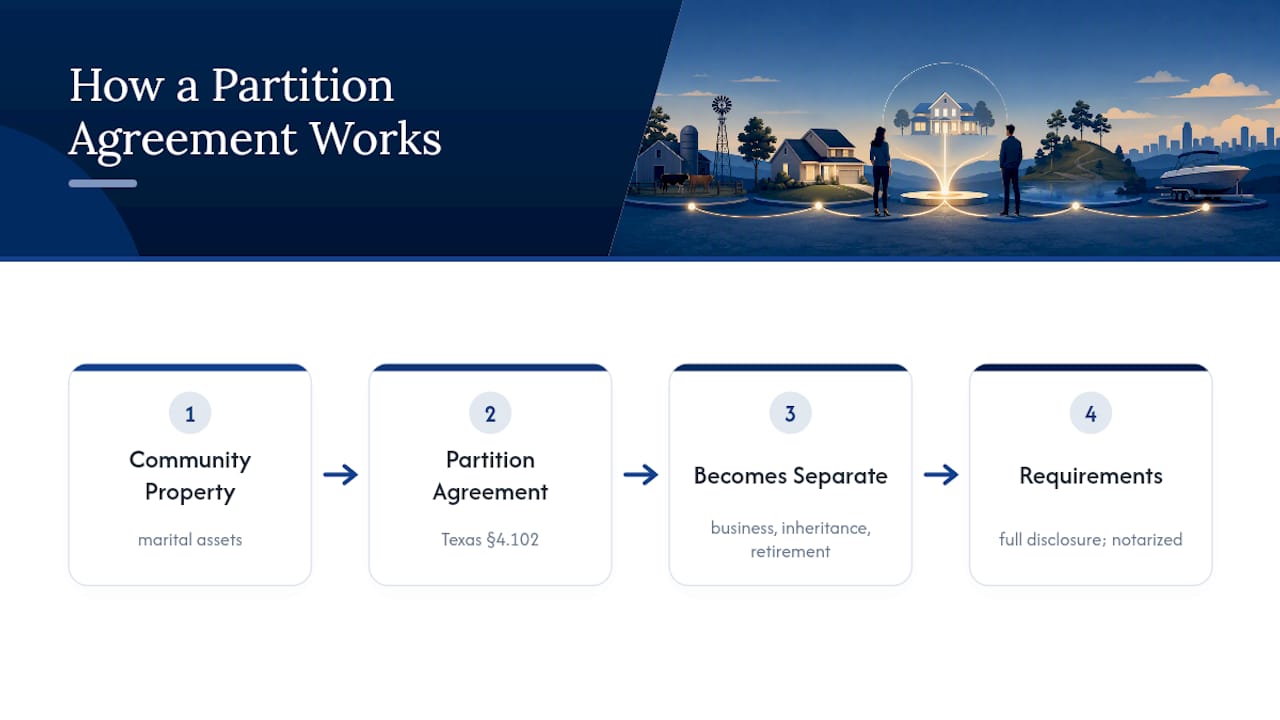
A Partition and Exchange Agreement under Tex. Fam. Code §4.102 goes further: it can convert future income and assets from community property into separate property, permanently. That’s a much stronger tool if you want a real financial boundary while remaining legally married.
Pro Tip: Don’t sign a separation agreement without listing every account, debt, and asset by name. A court reviewing the agreement later will scrutinize whether both spouses had complete financial information when they signed.
When Does a Partition Agreement Make Sense?
Section 4.102 lets spouses recharacterize community property into separate property going forward, effectively drawing a line where “ours” becomes “mine” and “yours.” It’s the right tool when someone wants to protect a new business, inheritance, or retirement contributions while staying married for insurance, benefits, or personal reasons. Lawyers typically require full disclosure statements and notarized signatures to keep the agreement from being challenged later.
Can You Get Custody and Child Support Without Divorcing?
Yes. A Suit Affecting the Parent-Child Relationship lets a court set conservatorship, possession schedules, and child support under Chapters 152 and 153 of the Texas Family Code, with no divorce filed at all.
- SAPCR orders are enforceable the same way divorce-related custody orders are, through contempt if a parent violates them.
- Filing a SAPCR instead of divorce makes sense when parents plan to stay married but need a formal parenting schedule and support obligation on paper now, as explained in detail in Child custody and taxes: who gets to claim the kids? | The Tax Refinery.
- Courts expect evidence: income records, the child’s school and medical history, and any documented safety concerns.
Enforcement and later modification follow the same SAPCR guidelines courts use in divorce cases, so a SAPCR order carries just as much weight.
What Do Temporary Orders Cover While a Case Is Pending?
Filing a divorce or SAPCR unlocks temporary orders under Tex. Fam. Code §6.502, court-enforceable rules that apply immediately, long before a final decree.
- A judge can grant exclusive use of the family home, set who pays which bills, and order temporary child or spousal support.
- Temporary orders can also restrain either spouse from draining bank accounts or selling shared property during the case.
- Violating them can lead to contempt, the same as violating a final order.
Here’s the tradeoff: getting temporary orders requires actually filing a case. Texas imposes a 60-day minimum waiting period before a divorce can be finalized, but temporary orders take effect almost immediately once you file. Many Texans file for divorce specifically to access temporary orders, then negotiate the rest at a slower pace. Reviewing our pre-filing checklist before you file helps you know what to request.
What If Separation Involves Family Violence?
Protective orders exist for exactly this situation, and they don’t require you to file for divorce or SAPCR first.
- A protective order can require an abusive spouse to stay away from your home, workplace, and children, and to have no contact with you at all.
- It’s a civil remedy focused entirely on safety, separate from any property or custody case, and can often move faster than other filings.
- Courts typically want documentation: police reports, medical records, texts, or photos showing the pattern of abuse.
If you’re in immediate danger, a protective order should be your first call, not your last resort.
What Happens If You Just Move Out and Do Nothing?
Informal separation, moving out with no agreement or court order, feels like the easy path. It rarely is.
- Community property keeps accumulating, and joint debts stay joint, regardless of who’s paying them.
- Tax filing status, insurance coverage, and named beneficiaries don’t update themselves; the IRS still treats you as married until a decree is final.
- Without paperwork, there’s nothing to enforce if your spouse violates an informal parenting arrangement or drains a shared account.
How Do You Choose the Right Option?
Match the tool to the actual problem you’re solving, not the one that feels most familiar.
- Identify your primary goal. Safety comes first if there’s violence. Custody clarity comes first if you have kids and no agreement. Financial protection comes first if one spouse controls the money.
- Ask an attorney about enforceability, taxes, and timeline. A partition agreement, SAPCR, and temporary order each interact differently with benefits, insurance, and your tax filing status.
- Watch for red flags. Unilateral asset transfers, verbal-only promises, refusal to share financial statements, or any ongoing violence all mean you need a court filing, not a handshake deal.
Pro Tip: If your spouse won’t disclose account balances or is transferring money to accounts you can’t see, don’t wait for a “final” separation agreement. File for temporary orders now; you can negotiate the rest once the money is protected.
What We See in Separation Cases
Most clients who come to us mid-separation aren’t sure whether they need a divorce, a SAPCR, or just a signed agreement, and that confusion is normal. We draft partition agreements and separation contracts with full financial disclosure built in, and we file SAPCRs or protective orders on an urgent timeline when safety or custody can’t wait. If there’s any violence involved, or your spouse is moving money, call a lawyer immediately. If you’re both cooperative and just need terms in writing, negotiation first is often reasonable.
— Giri
How Anna Din Can Help You Sort Out Your Options
The firm drafts separation and partition agreements, files SAPCRs, and pursues temporary and protective orders, providing comprehensive family law services so clients can avoid coordinating advice from multiple sources.

Bring account statements, a list of debts, your children’s school and medical information, and any documentation of violence or asset transfers to your first consultation. From there, Lawofficeofannadin can map out whether a partition agreement, a SAPCR, or temporary orders fits your situation, and file urgent requests, protective orders included, within days when safety is on the line. If divorce turns out to be the right path instead, the same team handles that too. Start with a consultation through our divorce attorney practice page to get a clear next step instead of more open questions.
This article is general information, not a substitute for advice from a qualified lawyer. Consult a qualified legal professional about your own circumstances before acting on anything here.
Sources
FAQ
Can You Legally Separate From Your Spouse in Texas?
Not in the formal sense. Texas has no legal separation status, so you remain married and subject to community property rules until a final divorce decree, but agreements, SAPCRs, and temporary orders can address custody, money, and safety in the meantime.
Does a Husband Have to Support His Wife During Separation in Texas?
There’s no automatic separate-maintenance obligation outside a court order. A spouse can request temporary spousal support through temporary orders once a divorce or SAPCR case is filed.
What Are the Disadvantages of Legal Separation?
Since Texas doesn’t offer legal separation, the real disadvantage is relying on an informal arrangement instead: no court enforcement, continued shared debt, and no protection if your spouse violates a verbal agreement.
Am I Entitled to Half of My Husband’s 401(k) in a Texas Divorce?
Contributions made during the marriage are generally community property and subject to division, though the exact split depends on the case. A partition agreement signed before divorce can change how future contributions are treated, and reviewing how divorce affects retirement accounts is worth doing early.
Recommended
Questions About Your Situation?
Every family is different. Schedule a confidential consultation with Anna Din to discuss your options.
Schedule a Consultation