Owelty Lien Texas: How to Keep the House in a Divorce
July 30, 2026 · Law Office of Anna Din PLLC

An owelty lien is a court-ordered security interest that lets one spouse keep the family home while guaranteeing the departing spouse receives their share of the equity — secured against the property itself, not just a promise. Under Texas Constitution Art. XVI § 50(a)(3), this type of lien is explicitly carved out from homestead protection, which means lenders can treat the refinance as a rate-and-term transaction rather than a Texas cash-out loan. That distinction matters because it typically allows the staying spouse to borrow up to approximately 95% LTV instead of the 80% cap that applies to standard cash-out refinances.
Your three immediate steps:
- Confirm the math: get a current appraisal or market analysis, pull the mortgage payoff statement, and calculate the equity your spouse is owed.
- Tell your attorney to include explicit owelty lien language in the divorce decree before the judge signs it. You cannot add this retroactively.
- Contact a divorce-experienced lender now, while the case is still pending, so underwriting can surface any qualification gaps before the decree is final.
A few things to have ready before your next attorney meeting:
- Current deed with the exact legal description of the property
- Mortgage payoff statement
- Recent appraisal or comparable sales analysis
- Your proposed owelty amount or the formula for calculating it
- Your most recent two years of tax returns and pay stubs for lender pre-qualification
Table of Contents
- What is an owelty lien under Texas law?
- When does an owelty lien make sense for your situation?
- How to create a valid owelty lien in Texas: the required documents
- What lenders need to know before you finalize the decree
- Common pitfalls that can make an owelty lien unenforceable
- A worked example: how the numbers play out
- What happens after the decree: payoff, release, and enforcement
- Attorney-ready checklist and sample decree language
- Key Takeaways
- The part most people get wrong about owelty liens
- How Lawofficeofannadin can help you protect your equity
- Useful sources and further reading
What is an owelty lien under Texas law?
An owelty lien, formally called an owelty of partition, is a security instrument created when co-owners divide property unequally and one party owes the other a sum to equalize the split. In a Texas divorce, it works like this: the court awards the home entirely to one spouse, but that spouse owes the other a specific dollar amount representing their share of the equity. The owelty lien secures that debt against the property itself.
The constitutional authority comes from Tex. Const. Art. XVI § 50(a)(3), which lists an owelty of partition imposed by court order or written agreement as one of the narrow exceptions to Texas homestead protection. Homestead protection ordinarily prevents creditors from forcing the sale of a family home, but this constitutional carve-out allows the departing spouse’s equity claim to attach as a valid lien on the homestead.
The practical effect of § 50(a)(3): Because the owelty lien is a recognized constitutional exception, a lender refinancing the staying spouse’s loan can classify the transaction as rate-and-term rather than a Texas home equity (cash-out) loan. That single classification difference can mean the difference between qualifying for the refinance and not qualifying at all.
Without a properly recorded owelty lien, the departing spouse is essentially an unsecured creditor with no right to force a sale if the staying spouse stops paying. A properly documented lien changes that entirely.

When does an owelty lien make sense for your situation?
This tool fits a specific set of circumstances. It works best when one spouse genuinely wants to stay in the home, the equity is significant enough to warrant securing, and the staying spouse can realistically qualify for a new loan on a single income.
Typical scenarios where an owelty lien is the right choice:
- One spouse wants to remain in the home for children’s school stability or continuity (courts often weigh children’s stability when approving property divisions)
- The home has substantial equity that cannot easily be offset by other marital assets
- The staying spouse has sufficient income and credit to qualify for a refinance independently
- Both spouses prefer to avoid the cost and disruption of listing and selling the home
Alternatives worth considering:
- Sale and split: If neither spouse can qualify alone or the home is underwater, selling and dividing proceeds is cleaner and avoids future disputes.
- Asset trade: Trading home equity for retirement accounts or business interests can work when the numbers align. See how retirement assets are divided in Texas divorce for context.
- Deferred sale: Sometimes spouses agree to co-own the home temporarily (common when children are young), with a sale triggered by a future event like the youngest child graduating. This avoids an immediate refinance but creates ongoing co-ownership complexity.
Texas family courts apply a “just and right” property division standard, so the owelty amount does not have to be a strict 50/50 split. It can reflect what the court determines is fair given the full picture of the marital estate.
One important note: owelty liens also arise in non-divorce partition situations, such as when heirs divide inherited property. In those cases, the favorable tax treatment that applies to transfers between spouses under Section 1041 of the Internal Revenue Code may not apply, and capital gains consequences can differ significantly.

How to create a valid owelty lien in Texas: the required documents
Getting the lien right requires four specific documents, prepared in advance and recorded promptly. Missing or vague language in any one of them can block the refinance entirely.
The four essential documents
-
Divorce decree with explicit owelty language. The decree must specifically award the owelty lien, name the amount (or provide a clear formula), identify the property, and set a deadline for the staying spouse to refinance or pay. Generic property division language is not enough.
-
Special Warranty Deed (or Owelty Partition Deed). This deed conveys the departing spouse’s ownership interest to the staying spouse while simultaneously encumbering the property with the owelty lien. It establishes both the title transfer and the lien in one instrument.
-
Promissory note. The note documents the staying spouse’s obligation to pay the owelty amount, including the payment terms, interest rate (if any), and due date. Lenders and title companies need this to confirm the debt is real and enforceable.
-
Deed of Trust to secure the owelty lien. This is the instrument that gives the departing spouse secured enforcement rights, including the ability to foreclose if the staying spouse defaults. Without it, the departing spouse has no lien, only a personal claim.
Practical timeline
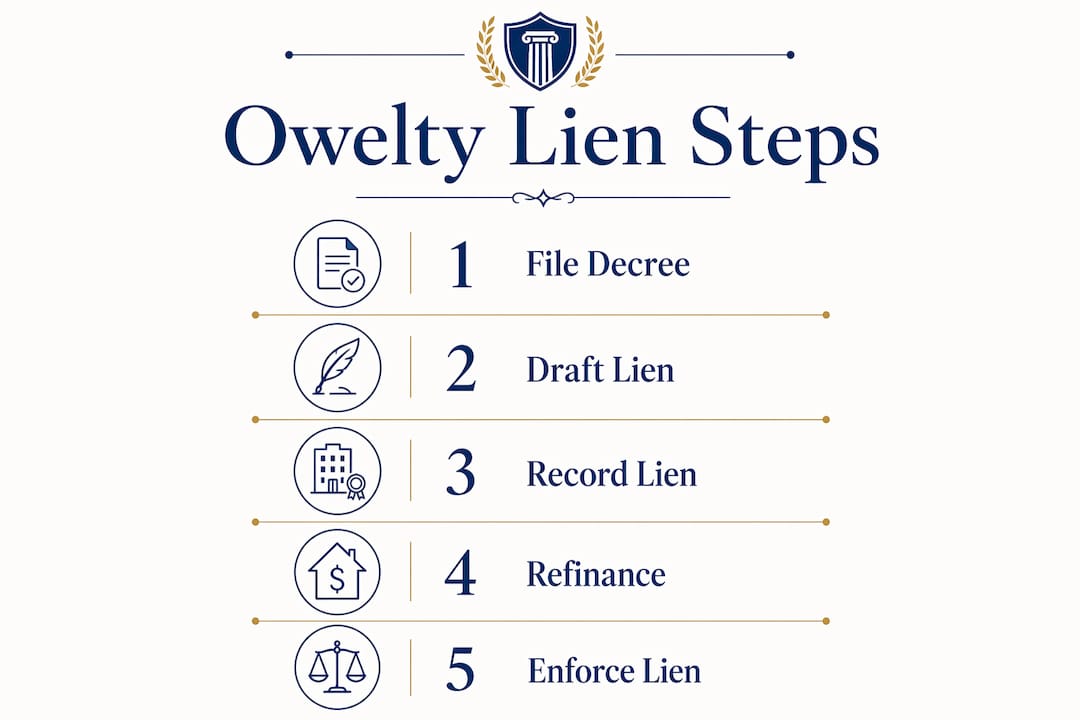
- Draft all four documents during settlement negotiations, before the decree is signed.
- The judge signs the final decree (after Texas’s mandatory 60-day waiting period from filing).
- Record the deed and deed of trust in the county property records immediately after the decree is signed.
- The staying spouse applies for and closes the refinance loan, which pays off the original mortgage and disburses the owelty amount to the departing spouse.
- The departing spouse signs a release of lien, which is then recorded to clear title.
Lenders typically require the recorded instruments before they will close the refinance. Do not wait until after closing to record.
Pro Tip: Always use the exact legal description from the current deed, word for word. Title underwriting departments commonly reject owelty instruments when the legal description is imprecise or the lien does not attach to the entirety of the property as recorded — and that rejection can delay or kill the refinance.
What lenders need to know before you finalize the decree
The lender’s role is not a formality. How a lender classifies the refinance determines whether the staying spouse can actually afford to buy out their co-owner, and beginning underwriting conversations early is one of the most important steps you can take.
Rate-and-term vs. Texas cash-out: why the classification matters
A standard Texas home equity (cash-out) refinance under Art. XVI § 50(a)(6) caps the loan at 80% of the home’s appraised value. An owelty refinance, when properly documented, is typically classified as rate-and-term, which allows the lender to go up to approximately 95% LTV. On a $400,000 home, that difference is $60,000 in available loan proceeds — often the margin between a workable buyout and an impossible one.
What lenders require before closing
- Recorded owelty language in the decree and recorded deed/deed of trust instruments
- A clear, exact legal description on all instruments matching the county records
- The staying spouse must qualify independently: acceptable credit score, debt-to-income ratio, and income documentation
- The refinance cannot close before the divorce decree is final
Questions to ask your lender and title company before signing the decree
- Will you classify this refinance as rate-and-term based on the owelty lien?
- What specific documents do you need recorded before closing?
- What is your minimum credit score and DTI requirement for this transaction?
- How long after the decree is recorded can we expect to close?
- Does your title underwriting department have any specific requirements for the owelty deed language?
The single most common mistake in owelty buyouts is finalizing a decree that is legally correct but financially impossible to execute because the staying spouse cannot qualify for the loan. Involving a lender early — while the case is still pending — surfaces those gaps in time to adjust the settlement terms.
Common pitfalls that can make an owelty lien unenforceable
Most owelty lien failures trace back to a small set of preventable errors. Knowing them in advance lets you and your attorney build safeguards directly into the decree.
Key risks to watch for:
- No recorded deed of trust. If the departing spouse accepts a promissory note without a deed of trust, they are an unsecured creditor. The lien does not exist without the recorded security instrument.
- Vague property description. Title and underwriting departments reject instruments that use informal descriptions (“the house on Maple Street”) rather than the exact legal description from the county deed records.
- Owelty language added after the decree is final. A final decree that lacks explicit owelty language cannot be retroactively amended to add it. All instruments must be drafted before the judge signs.
- Home is underwater. If the mortgage balance exceeds the home’s value, there is no equity to secure, and the lien has no practical value.
- Staying spouse cannot qualify alone. Courts can order a buyout, but they cannot force a lender to approve a loan. If the staying spouse’s income or credit is insufficient, the decree may be unenforceable as written.
- No refinance deadline in the decree. Without a clear deadline and enforcement remedy, the departing spouse may wait years for payment with limited recourse.
Priority and title interactions:
An owelty lien attaches to the property subject to any existing liens (the original mortgage, for example). When the staying spouse refinances, the new loan pays off the original mortgage, and the owelty lien is simultaneously satisfied and released. If the staying spouse misses the refinance deadline, the departing spouse’s deed of trust gives them the right to pursue foreclosure, though courts generally prefer to enforce payment rather than force a sale of the family home.
Practical safeguards to build into the decree:
- Include a specific refinance deadline (typically 90–180 days from the decree date)
- Add an enforcement clause specifying what happens if the deadline is missed (extended deadline, interest accrual, or right to demand sale)
- Require the staying spouse to provide proof of lender pre-qualification before the decree is signed
- Specify that the departing spouse must sign a release of lien within a set number of days after receiving full payment
A worked example: how the numbers play out
Here is a straightforward example to show how equity, loan limits, and funding options interact.
Assumptions:
- Home appraised value: $500,000
- Existing mortgage balance: $300,000
- Total equity: $200,000
- Each spouse’s share (50/50): $100,000
- Owelty lien amount: $100,000
| Scenario | Max loan amount | Proceeds available | Owelty payable? |
|---|---|---|---|
| Texas cash-out (80% LTV cap) | $400,000 | $100,000 after payoff | Barely — no margin for closing costs |
| Owelty rate-and-term (~95% LTV) | — | — | Yes, with room for closing costs |
The rate-and-term classification makes the buyout workable. Under the cash-out cap, the staying spouse would have limited proceeds after paying off the mortgage, leaving little margin for closing costs. The owelty refinance classified as rate-and-term can provide more proceeds after payoff, comfortably covering the owelty payment and transaction costs.
Funding options and their trade-offs:
- Owelty refinance (rate-and-term). The cleanest solution when the staying spouse qualifies. Pays off the original loan, disburses the owelty amount at closing, and releases the lien in one transaction. Requires independent qualification.
- Seller-financed promissory note secured by deed of trust. The staying spouse pays the owelty amount over time, like a second mortgage. Useful when immediate refinancing is not possible, but the departing spouse carries ongoing risk and does not receive a lump sum.
- Deferred sale with co-ownership. Both spouses retain title temporarily, with a sale triggered later. Avoids an immediate refinance but creates shared liability on the mortgage and potential disputes over maintenance and future sale price.
What happens after the decree: payoff, release, and enforcement
The owelty lien does not disappear when the decree is signed. It stays on title until it is formally paid and released.
Steps at closing
- The staying spouse’s new lender pays off the original mortgage from refinance proceeds.
- The lender disburses the owelty amount directly to the departing spouse (or into escrow per the decree terms).
- The departing spouse signs a Release of Lien document.
- The release is recorded in the county property records, clearing the owelty lien from title.
If the staying spouse defaults
The deed of trust gives the departing spouse real enforcement options. They can pursue the staying spouse for breach of the decree, initiate foreclosure proceedings under the deed of trust, or seek a court order compelling sale. The lien survives until it is paid and released — it does not expire on its own.
Duration and title effects:
- The lien remains on title and will appear in any title search until the release is recorded.
- If the staying spouse sells the home before paying the owelty, the title company will require the lien to be paid from sale proceeds at closing.
- If the staying spouse dies before the lien is paid, the obligation passes to their estate, and the title company will require resolution before any transfer or sale.
A brief note on tax treatment: When an owelty lien arises between divorcing spouses, transfers are generally non-taxable under Section 1041 of the Internal Revenue Code. When the same structure arises among heirs dividing inherited property, those favorable rules may not apply, and the parties should consult a tax professional. This article covers general information, not tax advice for your specific situation.
Attorney-ready checklist and sample decree language
Bring this packet to your settlement conference and your lender meeting. Having it ready before negotiations begin puts you in a much stronger position.
Documents and facts to assemble
- Current deed with the exact legal description (not the street address)
- Recent appraisal or two to three comparable sales from a licensed appraiser or real estate agent
- Mortgage payoff statement (request a 30-day payoff from your lender)
- Proposed owelty amount or the formula for calculating it if the value is uncertain at signing
- Two years of tax returns and recent pay stubs for the staying spouse (for lender pre-qualification)
- Credit report for the staying spouse
- Title company contact information (engage them early to confirm their recording requirements)
Sample decree language to adapt with your attorney
Award clause (fixed amount):
Formula option (when value is uncertain):
Enforcement clause:
Recording instruction to include in the decree:
Pro Tip: Title companies commonly require that the legal description in the deed, deed of trust, and decree all match exactly, character for character. A single discrepancy between instruments can delay closing by weeks. Pull the legal description directly from the county appraisal district records and copy it verbatim into every document.
Before you finalize any of this language, bring this checklist to a family law attorney and a lender experienced in divorce refinances. Sample language is a starting point, not a substitute for attorney review.
Key Takeaways
An owelty lien in Texas is only as strong as the documents behind it: explicit decree language, a recorded deed of trust, and a lender who classifies the refinance correctly are the three factors that determine whether the buyout actually works.
| Point | Details |
|---|---|
| Constitutional foundation | Art. XVI § 50(a)(3) is the authority that lets an owelty lien attach to a homestead and enables rate-and-term refinance classification. |
| Four required documents | Decree language, Special Warranty Deed, promissory note, and a recorded deed of trust are all necessary for an enforceable lien. |
| LTV advantage | An owelty refinance classified as rate-and-term typically allows up to ~95% LTV versus the 80% cap on standard Texas cash-out loans. |
| Involve the lender early | Begin underwriting while the case is pending so qualification gaps surface before the decree is signed and cannot be changed. |
| Lawofficeofannadin | The firm drafts decree language, prepares and records owelty instruments, and coordinates with lenders and title companies for clients in The Woodlands, Houston, and surrounding areas. |
The part most people get wrong about owelty liens
The most common misunderstanding is to treat an owelty lien as a paperwork formality rather than a real security instrument. Spouses and even some attorneys focus so much on negotiating the dollar amount that they underinvest in the documents that make that amount collectible.
A decree that says “Spouse A owes Spouse B $100,000 for their share of the home” without a recorded deed of trust is worth very little if Spouse A stops paying. The departing spouse becomes an unsecured creditor with no right to the property. Courts can hold the staying spouse in contempt, but contempt proceedings are slow and expensive, and they do not give the departing spouse a lien they failed to secure at the time of the decree.
The second overlooked issue is lender timing. Many people assume the refinance is a post-divorce administrative step. It is not. If the staying spouse cannot qualify for the new loan, the entire buyout structure collapses. The decree may be legally valid, but it is financially impossible to execute. Getting a lender’s preliminary underwriting review done before the decree is signed costs nothing and can prevent years of litigation over an unworkable agreement.
Finally, the rate-and-term classification benefit is not automatic. It depends on the lender accepting the owelty documentation and the instruments being recorded correctly. Not every lender handles these transactions regularly. Choosing a lender with direct experience in divorce refinances is as important as choosing the right attorney.
How Lawofficeofannadin can help you protect your equity
Dividing a home in a Texas divorce involves more moving parts than most people expect: decree language that satisfies both the court and a lender’s underwriting team, four documents that must be drafted, signed, and recorded in the right sequence, and coordination between your attorney, a title company, and a mortgage professional. A drafting error at any stage can block the refinance or leave the departing spouse without enforceable security.

Lawofficeofannadin handles the full process for clients in The Woodlands, Houston, and surrounding Texas communities. The firm drafts explicit owelty decree language, prepares the Special Warranty Deed, promissory note, and Deed of Trust, coordinates recording with the county clerk, and works directly with lenders and title companies to keep the transaction on track. Clients who come in with the checklist from this article are ready to move quickly once the decree is signed.
If you are considering keeping the family home in a divorce, the right time to involve an attorney is before the settlement conference, not after. Schedule a consultation with a Texas divorce attorney at Lawofficeofannadin and bring your current deed, mortgage payoff statement, and any appraisal you have. The firm will help you structure a buyout that is both legally sound and financially executable.
This article provides general legal information about owelty liens in Texas and is not a substitute for advice from a licensed attorney about your specific situation. Consult a qualified family law attorney and a tax professional to confirm how these rules apply to your case.
Useful sources and further reading
The following primary sources and practitioner guides support the legal and procedural points in this article.
- Texas Constitution Art. XVI § 50(a)(3) — The constitutional text that establishes owelty of partition as a homestead exception. Read this to confirm the statutory authority for everything discussed above.
- Texas Attorney General Opinion JC-0357 — Analyzes the scope of Art. XVI § 50 homestead exceptions, including the owelty carve-out. Useful background for attorneys and lenders who need to understand how the constitutional provision has been interpreted.
- Tarrant County Law Library: Owelty Deeds Research Guide — A practical county-level guide covering recording requirements, instrument types, and common title issues. Helpful for understanding what the county clerk and title companies expect.
- The Mortgage Institute: Deed of Trust to Secure Owelty of Partition — Underwriting-focused guidance on what mortgage professionals need to see in owelty instruments. Read this before your lender meeting to understand their documentation checklist.
- Texas Statutes: Family Code Chapter 7 — The governing statute for property division in Texas divorce, including the “just and right” standard that determines how equity is allocated between spouses.
Recommended
Questions About Your Situation?
Every family is different. Schedule a confidential consultation with Anna Din to discuss your options.
Schedule a Consultation