Texas Parents: What Evidence Wins Parental Alienation Cases
Parental alienation can absolutely affect custody outcomes in Texas, even though the state has no standalone parental alienation statute. Judges evaluate alienating behavior through the best-interest standard, and when it’s well-documented, courts can order anything from supervised visitation to a full change in conservatorship. If you believe your child is being turned against you, start documenting immediately, avoid retaliating in kind, and talk to a family law attorney before the pattern becomes harder to prove.
TL;DR:
- Document all incidents of alienating behavior immediately, including dates, witnesses, and any statements made by the child, as organized records are crucial in court.
- Preserve all communications with the other parent, such as texts, emails, and messages from co-parenting apps, by screenshotting and backing them up outside your device or shared platforms.
- Focus on collecting neutral third-party evidence like teacher observations, therapist notes, and medical or school records, which carry significant weight in custody evaluations.
- Understanding that Texas courts address alienation through various remedies, from supervised visitation to modifying conservatorship, usually after well-documented patterns rather than isolated incidents.
- Consult a family law attorney early to assess whether enforcement of existing orders or seeking a custody modification better addresses alienation concerns and to develop a strategic legal approach.
Table of Contents
- What Texas Law Actually Says About Parental Alienation
- Legal Remedies and How Judges Typically Respond
- Evidence Courts Rely On: What to Collect and Preserve
- Immediate Steps for a Parent Who Believes They Are Being Alienated
- CPS or Family Court: Choosing the Right Path
- How a Texas Family Law Attorney Supports a Targeted Parent
- Keep the Child Central While You Document
- Talk to a Family Law Attorney in The Woodlands or Harris County
- Sources
- FAQ
What Texas Law Actually Says About Parental Alienation
You won’t find the phrase “parental alienation” written into the Texas Family Code. That surprises a lot of parents who search for it expecting a clear legal definition. What you will find is a framework judges use to evaluate any behavior that harms a child’s relationship with a parent, alienation included.
Family Code §153.001 and §153.002 establish that custody decisions must serve the child’s best interest, and Texas courts routinely treat alienating conduct as evidence against that standard. Two related statutes give this teeth. Section 153.073 protects a parent’s right to information about the child, and §153.076 requires both parents to encourage a positive relationship between the child and the other parent. When one parent violates that duty by badmouthing the other, blocking contact, or coaching the child, they’re violating a statutory expectation, not just being unkind.
Courts also distinguish alienation from estrangement. Estrangement happens for real reasons: abuse, neglect, or a child’s own independent choice as they mature. Alienation is manufactured by a parent’s behavior. That distinction matters because §153.013 penalizes parents who knowingly make false reports to manipulate a case, which cuts both ways in these disputes.
Legal Remedies and How Judges Typically Respond
Texas judges have a full toolbox for addressing alienation, and they tend to escalate gradually rather than jumping straight to the most severe option.
- No-disparagement orders that bar either parent from criticizing the other in front of the child
- Structured communication platforms (court-ordered co-parenting apps) that create a documented, monitored record of exchanges
- Make-up possession time to restore time lost to interference
- Supervised visitation when contact needs monitoring
- Court-ordered therapy or reunification support aimed at repairing the parent-child bond
- Modification of conservatorship, up to a full change in primary custody
- Contempt findings and attorney fee awards when a parent violates existing orders
Judges tend to reserve conservatorship modification and contempt for sustained, well-documented patterns, not isolated incidents. A custody evaluator’s findings, safety concerns, or repeated violations of a standing order all push a case toward the more severe end of that list.
One change worth knowing about: House Bill 3783, effective September 1, 2025, restricts courts from ordering coercive reunification programs that isolate a child from a preferred parent, force overnight placement with an alleged abuser, or otherwise strip the child of agency. Courts still have authority to order evidence-based, child-safe therapeutic support. The practical effect is that judges now have less room to order the kind of aggressive “reunification camp” programs that drew criticism in high-conflict cases nationally.
Evidence Courts Rely On: What to Collect and Preserve
Judges don’t decide alienation cases on gut feeling. They decide them on paper, and the parent with the more organized paper trail usually has the advantage.
- Keep a contemporaneous incident log. Note the date, what happened, who witnessed it, and any statements the child made. Write entries close to when events occur. Logs written months later carry far less weight.
- Preserve every communication. Texts, emails, co-parenting app messages, missed exchange records, and calendar entries all count. Screenshot conversations before they can be deleted or edited.
- Save photos and videos that show missed visits, condition of the child at exchanges, or relevant home environments.
- Pull school and medical records. Attendance issues, counselor notes, or pediatrician visits sometimes reveal patterns a parent wouldn’t otherwise be able to document.
- Get neutral third-party statements, including therapist notes, teacher observations, or written witness declarations from people with direct knowledge, not secondhand opinions.
Custody evaluators and guardians ad litem carry outsized weight in these cases because their reports come from someone with no stake in the outcome. Their interviews, home visits, and record reviews often become the single most persuasive piece of evidence in the file.
Pro Tip: Store your documentation somewhere outside your phone or a shared family computer, like a personal email account or cloud folder only you control. Alienation cases sometimes involve a parent deleting or hiding evidence, and you don’t want your only copy to disappear.

Immediate Steps for a Parent Who Believes They Are Being Alienated
The first few weeks after you notice a pattern matter more than most parents realize. What you do now shapes both your child’s wellbeing and your legal position later.
- Start your log today. Don’t wait for a “big enough” incident. Small, consistent entries build a stronger record than a handful of dramatic ones.
- Preserve communications before they vanish. Export text threads and app messages regularly rather than trusting they’ll still be there in six months.
- Don’t interrogate or coach your child. Asking leading questions or pressuring a child to report on the other parent can backfire badly and may be used against you. Simply reassure your child that it’s okay to love both parents.
- Get independent documentation of your child’s mental health. A neutral therapist or evaluator, brought in early, can spot and record signs of alienation before memories fade.
- Decide whether you need enforcement or modification. If there’s an existing order and the other parent is violating it, like blocking scheduled possession, an enforcement motion addresses that violation directly. If the alienating behavior is ongoing and represents a broader pattern, a modification petition targets the underlying custody arrangement itself.
CPS or Family Court: Choosing the Right Path
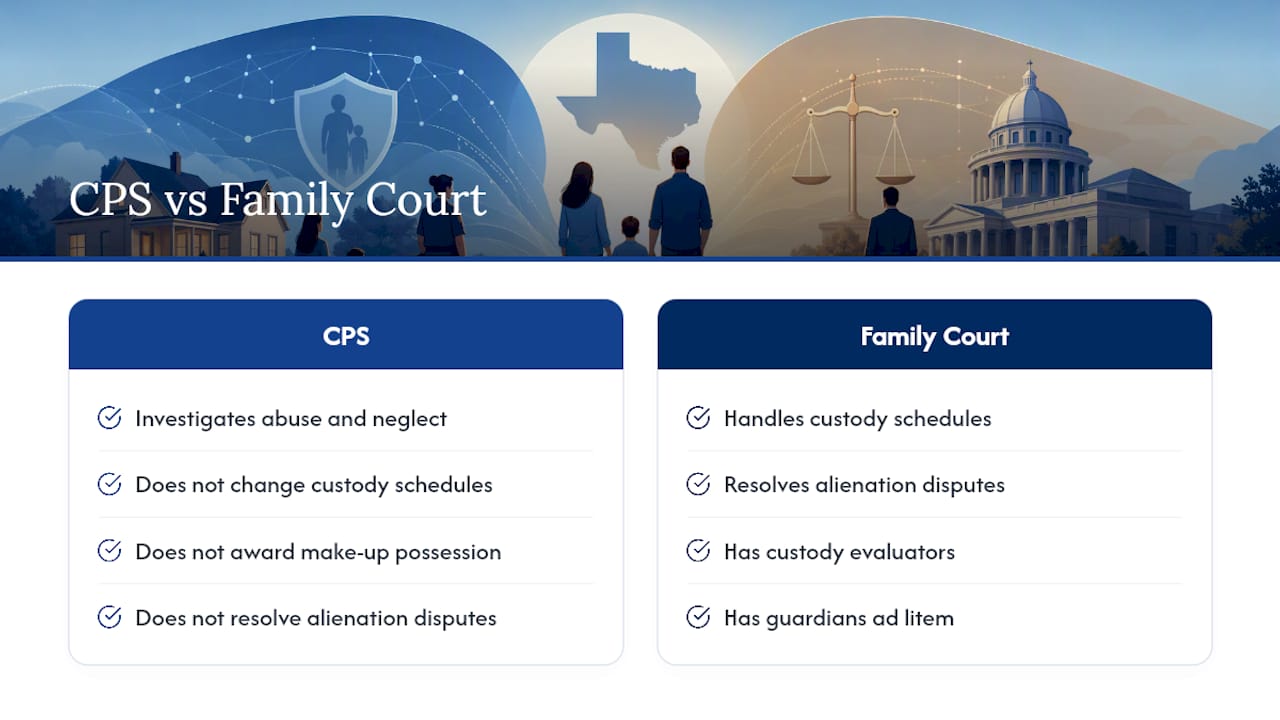
Child Protective Services investigates abuse and neglect. It does not adjust custody schedules, award make-up possession time, or resolve alienation disputes, even when the underlying behavior is troubling.
Family courts are built for exactly that job. Custody evaluators, guardians ad litem, and amicus attorneys exist specifically to investigate parenting dynamics and report their findings to the judge. If you suspect alienation without an accompanying safety threat, that’s the path.
One caution: filing repeated CPS reports without a good-faith basis for abuse concerns can damage your credibility in the underlying custody case, and knowingly false reports carry consequences under §153.013.
How a Texas Family Law Attorney Supports a Targeted Parent
Once you’re facing an alienation pattern, an experienced family law attorney does more than file paperwork. Anna Din’s office starts by triaging your case: reviewing your documentation, advising whether enforcement or modification fits your situation, and coordinating with neutral evaluators or therapists who can add credible, independent findings to your file.
From there, the work moves into court: drafting enforcement motions, modification petitions, or contempt filings, then presenting your evidence in a way that lines up with the Family Code factors judges actually apply. That can include seeking court-ordered therapy, requesting changes to conservatorship, or pursuing attorney fee awards when the other parent’s conduct warrants it.
Local knowledge matters here too. Familiarity with how Harris County courts handle these petitions, and experience requesting court-appointed investigators or guardians ad litem, often shapes how quickly and effectively a case moves.
Keep the Child Central While You Document
The strongest parents in these cases aren’t the loudest. They’re the calmest. Put your child’s stability first, resist the urge to retaliate, and let your documentation, not your anger, make your case. CPS is a safety tool, not a custody weapon.
Get legal advice early. Alienation patterns are far easier to address before a child’s relationship with you has deteriorated for months. If your situation feels urgent, a confidential conversation with an attorney costs you far less than waiting.
— Giri
Talk to a Family Law Attorney in The Woodlands or Harris County
If you’re watching an alienation pattern unfold, waiting rarely helps your case, and it never helps your child. Some family law offices provide Texas parents focused attention on their specific documentation, court, and child, with representation built around family law cases.

An initial consultation with our office typically includes a review of your incident log and communications, a clear read on whether enforcement or modification fits your situation, and a plan for next steps, including whether a custody evaluator or guardian ad litem should get involved. We represent parents throughout The Woodlands, Houston, and the surrounding Harris County communities in child custody matters, including modification and enforcement petitions tied to alienation. If safety is also a concern, we handle protective order petitions alongside custody work. Reach out through our contact page to schedule a consultation and bring your documentation with you.
Sources
- Parental Alienation in Texas — What It Is and What Courts Do About It
- Can Parents Lose Custody for Parental Alienation: Learn How it Works
- Parental Alienation in Texas: Legal Remedies and Court Actions
This article is general information, not a substitute for advice from a qualified lawyer. Consult a qualified legal professional about your own circumstances before acting on anything here.
FAQ
Can Parental Alienation Change a Custody Order in Texas?
Yes. Texas courts can modify conservatorship when well-documented alienation shows a material and substantial change affecting the child’s best interest.
Is Parental Alienation a Crime in Texas?
No, alienation itself isn’t a criminal offense, but related conduct like violating custody orders or making knowingly false reports carries legal consequences under the Family Code.
What Evidence Proves Parental Alienation in Court?
Contemporaneous logs, preserved communications, missed possession records, school or medical records, and neutral evaluator or guardian ad litem reports carry the most weight.
Should I Call CPS if I Suspect Alienation?
Only if you have a good-faith belief of abuse or neglect. CPS doesn’t adjust custody arrangements, and unfounded reports can hurt your credibility later.
Does HB 3783 Change How Courts Handle Reunification Therapy?
Yes. Effective September 1, 2025, it restricts courts from ordering coercive or isolating reunification programs while preserving their authority to order evidence-based, child-safe therapeutic support.
Recommended
Questions About Your Situation?
Every family is different. Schedule a confidential consultation with Anna Din to discuss your options.
Schedule a Consultation