Postnuptial Agreement in Texas: What Married Couples Need to Know
August 3, 2026 · Law Office of Anna Din PLLC

A properly executed postnuptial agreement is valid and enforceable in Texas. Your first move is straightforward: put the agreement in writing, have both spouses sign it, confirm that signing is voluntary, and give each party at least 7–14 days to review the final document with independent counsel.
The statutory foundation is Texas Family Code Chapter 4 (Subchapter B), which authorizes spouses to partition or exchange community property by written agreement at any time during the marriage. Sections 4.102 through 4.106 set the formalities; Section 4.105 defines the two grounds on which a court can refuse to enforce the agreement.
Key points before you read further:
- Texas law recognizes postnuptial agreements as a form of marital property agreement, not a separate legal category.
- The agreement must be in writing and signed by both spouses.
- Courts will not enforce provisions covering child custody or child support.
- Retirement plan waivers require separate, plan-specific forms filed with each plan administrator.
- Voluntariness and full financial disclosure are the two factors courts scrutinize most closely.
This article is general legal information, not legal advice for your specific situation. Confirm current rules with a qualified Texas family law attorney.
Table of Contents
- What is a postnuptial agreement and how does it differ from a prenup?
- What Texas law requires for a valid postnuptial agreement
- What provisions Texas courts will and will not enforce
- How Texas courts test voluntariness and unconscionability
- How to create a postnuptial agreement in Texas: a step-by-step checklist
- Frequent mistakes that cause Texas courts to set aside postnuptial agreements
- Postnuptial vs. prenuptial agreement: which one fits your situation?
- Practical next steps before you sign anything
- Key Takeaways
- A practitioner’s perspective on what actually matters
- How the Law Office of Anna Din helps you create a solid postnuptial agreement
- Useful sources for further reading
- FAQ
What is a postnuptial agreement and how does it differ from a prenup?
A postnuptial agreement (sometimes called a partition and exchange agreement in Texas) is a written contract signed by both spouses after the wedding. Under Texas Family Code §§ 4.102–4.103, it can convert community property into separate property, alter how income from separate property is treated, allocate debts, and set spousal maintenance terms.

The core difference from a prenuptial agreement is timing. A prenup is signed before the wedding; a postnup is signed after. Once properly executed, the enforceability standards under Texas law are nearly identical for both. Courts apply the same voluntariness and disclosure tests regardless of which document you have.
Common reasons married couples create a postnuptial contract in Texas:
- One spouse starts or acquires a significant business interest after marriage.
- A spouse receives a large inheritance or gift and wants to protect it as separate property.
- The couple’s income or debt picture shifts substantially.
- Estate planning goals require a clear property classification.
- The spouses want to resolve financial disputes without divorcing.
- One spouse is taking on significant debt (such as a business loan) and the other wants protection.
What Texas law requires for a valid postnuptial agreement
Texas Family Code Chapter 4 is the governing statute. Sections 4.102 through 4.106 cover partition and exchange agreements between spouses; Section 4.105 sets out the enforcement rules a court applies when one party challenges the agreement.
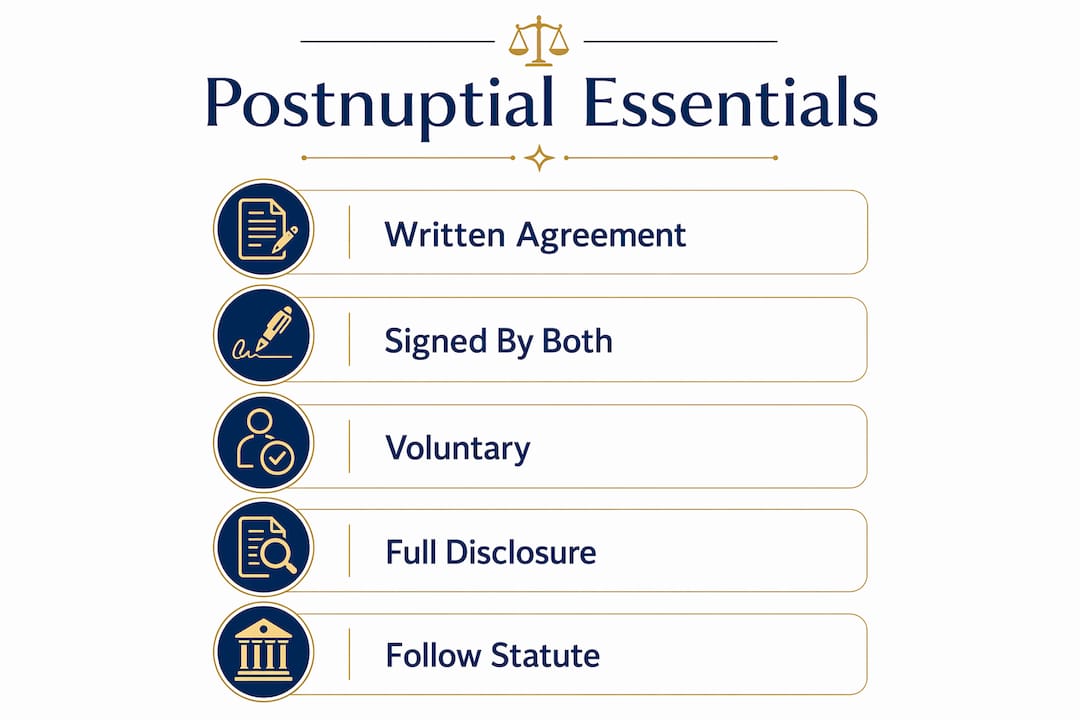
Core formalities
| Requirement | Details | Statutory Basis |
|---|---|---|
| Written form | The agreement must be a written document. | Tex. Fam. Code § 4.104 |
| Both signatures | Both spouses must sign the agreement. | § 4.104 |
| Voluntariness | Signing must be free from duress, fraud, or undue influence. | § 4.105(a)(1) |
| Disclosure or waiver | Adequate financial disclosure, or a knowing written waiver of it, is required. | § 4.105(a)(2) |
| Notarization | Not legally required, but creates a presumption of voluntariness and aids recording. | § 4.106(b) |
| Recording | Required for constructive notice when real property is affected. | § 4.106(b) |
Steps that strengthen enforceability
- Separate attorney representation for each spouse (the proposing spouse paying for the other’s counsel is a recognized and effective tactic).
- Detailed financial disclosure schedules attached as exhibits, including account numbers and current valuations.
- A written acknowledgment that each party had adequate time and opportunity to consult counsel.
- Notarization of signatures.
- Recording in county deed records when real property is involved.
What the agreement cannot do
Child custody and child support terms are unenforceable in a postnuptial agreement. Texas courts determine those issues based on the child’s best interest at the time of any proceeding, and no contract can override that standard. Any provision designed to defraud creditors is void as to those creditors, regardless of what the agreement says.
What provisions Texas courts will and will not enforce
Texas courts are generally willing to enforce well-drafted marital property agreements. Knowing the boundaries up front saves you from drafting clauses that will be struck at the worst possible moment.
Permitted provisions:
- Partitioning specific community property assets into one spouse’s separate property.
- Exchanging community property interests between spouses.
- Recharacterizing income from separate property so it remains separate rather than becoming community property.
- Allocating specific debts to one spouse.
- Setting spousal maintenance terms, including amount and duration.
- Protecting a business interest from community property claims.
- Directing how separately classified property will pass at death.
Off-limits or unenforceable:
- Child custody and child support terms — courts will not honor these regardless of what the agreement says.
- Provisions intended to hinder, delay, or defraud creditors.
- Blanket waivers of all rights with no specific asset identification.
Pro Tip: Be specific. Name each account, property address, and retirement plan by its full title and account number. Vague language like “all financial accounts” invites a court to find the provision unenforceable for lack of clarity.
How Texas courts test voluntariness and unconscionability
Under Texas Family Code § 4.105, a court will refuse to enforce a postnuptial agreement if the challenging spouse proves either of two things:
- Involuntary execution — the agreement was signed under duress, fraud, or undue influence.
- Unconscionability plus inadequate disclosure — the agreement was unconscionable when signed, and the challenging party was not provided a fair and reasonable disclosure of the other spouse’s property and financial obligations, did not voluntarily waive that disclosure in writing, and did not have adequate knowledge of the other’s finances.
Voluntariness is fact-specific. Courts look at the timing of presentation, whether pressure was applied, whether independent counsel was available, and whether the signing party had a reasonable window to review the document. Presenting the agreement and demanding a signature the same day is one of the fastest ways to lose in court.
Unconscionability, by contrast, is decided by the court as a matter of law, not by a jury. The burden of proof rests on the party challenging the agreement, which means a properly executed agreement with full disclosure is genuinely difficult to overturn. A Texas Court of Appeals reinforced this point when it reversed a trial court’s finding of unenforceability in a case where the record lacked sufficient evidence of involuntariness or unconscionability.
Pro Tip: Practitioners recommend 7–14 days for each spouse to review the final agreement and consult independent counsel. Document that window in writing. It is one of the clearest signals to a court that signing was voluntary.
How to create a postnuptial agreement in Texas: a step-by-step checklist
Pre-drafting
- Compile a full financial disclosure packet: recent tax returns, bank and investment account statements, retirement account balances, real estate appraisals, business valuations, and a current debt schedule.
- List every asset and debt you want the agreement to address, with account numbers and approximate values.
- Agree on your objectives before drafting begins — partition, debt allocation, spousal maintenance, or some combination.
Drafting
- Identify each asset precisely by name, account number, and current value in the body of the agreement or in attached exhibits.
- State explicitly how future income from separate property will be treated.
- Include spousal maintenance terms with specific amounts and durations if applicable.
- Attach financial disclosure schedules as signed exhibits.
Execution
- Both spouses sign the written agreement.
- Have signatures notarized, even though Texas law does not require it — notarization supports voluntariness and aids recording.
- Document in writing that each spouse had the opportunity to consult independent counsel and was given at least 7–14 days to review.
- Preserve original signed copies for both spouses in a secure location.
After signing
- Retitle accounts and assets as the agreement directs.
- For retirement plans, execute plan-specific ERISA waivers and file them with each plan administrator. A general waiver in the agreement itself is not sufficient for ERISA-governed plans.
- Record the agreement in the county deed records where real property is located to provide constructive notice to purchasers and creditors.
- Update beneficiary designations on life insurance policies and retirement accounts to match the agreement’s intent.
For guidance on protecting retirement assets specifically, the firm’s resource on retirement and divorce covers the mechanics in detail.
Frequent mistakes that cause Texas courts to set aside postnuptial agreements
Even couples with good intentions can undermine an otherwise solid agreement through avoidable execution errors. These are the patterns that most often lead to a successful challenge:
- Rushed signing. Presenting the agreement and signing it the same day is the single strongest evidence of duress. Allow the full 7–14 day review window and document it.
- Vague or incomplete financial disclosure. Schedules that list “various bank accounts” without account numbers or current balances give a court reason to find disclosure inadequate under § 4.105.
- Skipping ERISA compliance. A general waiver in the postnuptial agreement will not override an ERISA plan’s beneficiary designation. Each plan requires its own compliant waiver form filed directly with the plan administrator.
- Broad, blanket waivers. Clauses that waive “all community property rights” without identifying specific assets are frequently challenged and sometimes struck entirely.
- Failing to retitle or record. An agreement that partitions real property but is never recorded in the county deed records may not bind good-faith purchasers or creditors. Retitling and recording are the steps that make the agreement real in practice.
- Ignoring beneficiary designations. Life insurance and retirement accounts pass by beneficiary designation, not by will or marital agreement. Update them separately.
Postnuptial vs. prenuptial agreement: which one fits your situation?
The timing difference is the most practical distinction. A prenuptial agreement is signed before the wedding; a postnuptial agreement is signed after. Once properly executed, both are subject to nearly the same enforceability standards under Texas Family Code Chapter 4.
| Factor | Prenuptial Agreement | Postnuptial Agreement |
|---|---|---|
| Timing | Before marriage | After marriage |
| Governing statute | Tex. Fam. Code Chapter 4 | Tex. Fam. Code §§ 4.102–4.106 |
| Enforceability tests | Voluntariness, disclosure | Voluntariness, disclosure, unconscionability |
| Best use case | Pre-marriage property protection | Post-marriage financial changes |
| Recording required | Only if real property affected | Only if real property affected |
| ERISA waivers | Needed for retirement plans | Needed for retirement plans |
When a postnuptial agreement makes more sense:
- A significant inheritance or business acquisition occurred after the wedding.
- Income or debt levels have shifted substantially since marriage.
- The couple wants to resolve a financial dispute without divorcing.
- Estate planning goals require a clear property classification that did not exist at the time of marriage.
Alternatives and complements to consider:
- Amending an existing prenuptial agreement rather than creating a new document.
- Using a revocable living trust to direct how separately classified property passes at death.
- Updating wills and beneficiary designations to reflect the couple’s current intentions.
- Retitling accounts and property directly, where no formal agreement is needed.
A postnuptial agreement can also be amended or revoked after execution. Any amendment or revocation must meet the same formalities as the original: written, signed by both spouses, and voluntary. Courts apply the same § 4.105 tests to amendments.
Practical next steps before you sign anything
If you are ready to move forward, the most protective thing you can do right now is prepare before you contact an attorney, not after.
Immediate actions:
- Compile your financial disclosure packet (tax returns, account statements, retirement balances, property appraisals, business valuations, debt schedule).
- Write down your objectives: which assets you want to partition, how you want income treated, and whether spousal maintenance terms are part of the discussion.
- Do not sign any draft agreement until you have had independent legal review and the full 7–14 day window.
What to bring to your consultation:
- Complete financial disclosure packet for both spouses.
- Any existing draft agreement.
- Business formation documents and recent valuations if a business is involved.
- Recent tax returns (two to three years).
- A list of retirement accounts and current plan administrators.
- Proposed retitling instructions for any real property.
When to hire counsel:
Retain a Texas family law attorney before drafting begins, not after. Filing ERISA waivers and recording deeds are legal steps with real consequences if done incorrectly. The Law Office of Anna Din handles drafting, negotiation, independent review, ERISA follow-through, and recording assistance for married couples in The Woodlands, Houston, and surrounding Texas communities. Contact the firm to schedule a consultation and get a clear picture of what your agreement needs to accomplish.
Key Takeaways
A valid Texas postnuptial agreement requires a written, signed, voluntary document with full financial disclosure — and follow-through steps like ERISA waivers and deed recording are what make it enforceable in practice.
| Point | Details |
|---|---|
| Statutory foundation | Texas Family Code §§ 4.102–4.106 govern all postnuptial partition and exchange agreements. |
| Core formalities | Written form, both signatures, voluntariness, and adequate financial disclosure are required under § 4.104–4.105. |
| Review window | Allow 7–14 days for independent review to reduce duress claims and support voluntariness. |
| ERISA compliance | A general waiver in the agreement is not enough; file plan-specific waivers with each retirement plan administrator. |
| Local counsel | Lawofficeofannadin assists with drafting, ERISA waivers, recording, and implementation for couples in The Woodlands and Houston. |
A practitioner’s perspective on what actually matters
The couples who come in with the most trouble are not the ones who skipped the agreement entirely. They are the ones who signed something quickly, without independent review, and with financial schedules that were vague or incomplete. Courts are not looking for a reason to throw out a postnuptial agreement. The burden of proof sits with the party challenging it, and a well-documented agreement with full disclosure is genuinely hard to overturn. What I see undone in litigation is almost always a process failure, not a substantive one.
The review window to allow sufficient time is not a formality. It is the clearest evidence you can create that both spouses signed freely. Notarization costs almost nothing and adds a meaningful presumption of voluntariness. Detailed schedules with account numbers and current valuations take time to prepare, but they are what close the door on a § 4.105 disclosure challenge. And the ERISA step is the one most couples overlook entirely until it is too late. A general waiver in the agreement does not touch the plan’s beneficiary designation. You need a separate, plan-compliant form filed directly with the administrator.
If you are considering a postnuptial agreement, the Law Office of Anna Din can walk you through the full process, from the disclosure packet to the final recording, so the agreement you sign is the one that holds.
How the Law Office of Anna Din helps you create a solid postnuptial agreement
Married couples in The Woodlands, Houston, and surrounding Texas communities have a local resource for the full postnuptial process. Lawofficeofannadin provides drafting and negotiation, independent review for each spouse, business valuations, ERISA and retirement plan follow-through, and recording and retitling assistance — all under one roof, so nothing falls through the cracks after signing.

A consultation with the firm covers the document checklist, a clear explanation of fee structure for drafting and execution, and a step-by-step plan for implementation. You will leave knowing exactly what the agreement needs to say, what follow-up steps are required, and what to expect at each stage. The firm’s family law practice covers the full range of marital property matters, and the team is experienced in the specific follow-through steps — ERISA waivers, deed recording, beneficiary updates — that make a postnuptial agreement effective in practice, not just on paper. Schedule a consultation with Lawofficeofannadin to get started.
Useful sources for further reading
- Texas Family Code Chapter 4 — the primary statutory text governing partition and exchange agreements between spouses, including §§ 4.102–4.106 and the § 4.105 enforcement rules.
- USLegal: Texas Postnuptial Agreement Law — plain-language summary of the writing and signature formalities under § 4.104 and recording requirements under § 4.106(b).
- LegalClarity: Postnuptial Agreement in Texas — practical guidance on disclosure schedules and ERISA retirement plan waiver requirements.
- 14th Court of Appeals opinion on postnuptial enforceability — appellate decision illustrating how Texas courts weigh voluntariness and disclosure evidence.
- Law Office of Anna Din — local firm handling marital and premarital agreements, drafting, ERISA follow-through, and recording for couples in The Woodlands and Houston.
- When a postnuptial agreement affects real property, check the county deed records where the property is located to confirm recording and constructive notice. When retirement plans are involved, request the plan-specific waiver form directly from each plan administrator.
FAQ
Are postnuptial agreements legally valid in Texas?
Yes. Texas Family Code Chapter 4 (Subchapter B) expressly authorizes spouses to partition or exchange community property by written agreement at any time during the marriage, making postnuptial agreements fully enforceable when properly executed.
What can make a Texas postnuptial agreement unenforceable?
A court will set aside the agreement if the challenging spouse proves involuntary signing or unconscionability combined with inadequate financial disclosure under § 4.105. Rushing execution, skipping independent counsel, and using vague financial schedules are the most common triggers.
Does a postnuptial agreement cover child custody in Texas?
No. Child custody and child support terms are unenforceable in any marital agreement in Texas. Courts determine those issues based on the child’s best interest at the time of the proceeding, and no contract can override that standard.
How long should each spouse have to review the agreement?
Practitioners recommend a minimum of 7–14 days for each spouse to review the final document and consult independent counsel. That review window is one of the clearest signals to a court that signing was voluntary and free from duress.
Does a postnuptial agreement automatically cover retirement accounts?
No. A general waiver in the agreement is not sufficient for ERISA-governed retirement plans. Each plan requires its own plan-compliant waiver form filed directly with the plan administrator to override the existing beneficiary designation.
Recommended
Questions About Your Situation?
Every family is different. Schedule a confidential consultation with Anna Din to discuss your options.
Schedule a Consultation