12 Questions to Ask Your Divorce Lawyer at the First Meeting

Ask these 12 questions in your first meeting with a divorce lawyer, and you will leave knowing the attorney’s fees, a realistic timeline, and the three actions to take before your next appointment. That is the single goal of an initial consultation: not to resolve everything, but to walk out with enough information to make clear, confident decisions in the days that follow.
Here is the checklist. Each question is written so you can read it aloud directly from this page.
- Is my case likely contested or uncontested? Knowing this early shapes every cost and timeline estimate you will hear.
- What is your experience with cases like mine? Ask specifically about custody disputes, high-asset divorces, or protective orders if those apply to you. The initial meeting is an interview, and the attorney’s trial experience and family law focus matter.
- How is custody decided in this state, and what is the standard the court uses? The answer tells you whether you are negotiating or litigating.
- How will our marital property be divided? Texas is a community property state; most others use equitable distribution. The rule changes your negotiating position entirely.
- Are retirement accounts involved, and will we need a QDRO? A Qualified Domestic Relations Order is required to split most retirement plans without triggering taxes or penalties.
- Is spousal support likely, and what factors will the court weigh? Duration of marriage, income gap, and earning capacity are the usual drivers.
- What is your hourly rate, and what retainer do you require? Get the number before you leave; do not assume you can ask later.
- What is your best, likely, and worst-case estimate for total cost? A range is more useful than a single number.
- How long will this take from filing to final decree? Ask for both the settlement path and the trial path.
- What documents do you need from me, and by when? This gives you a concrete first task.
- Is mediation or collaborative divorce an option in my situation? These paths often cost less and move faster than litigation.
- If there is a safety concern, what emergency orders can be filed immediately? Ask this even if you are unsure whether your situation qualifies.
Pro Tip: If your consultation is 30 minutes or less, ask questions 1, 7, 8, 9, and 12 first. Email the rest afterward — most attorneys will respond in writing, and that response is often not billed at the same rate as in-person time.
Key Takeaways
Walking into a divorce consultation with 12 targeted questions, six essential documents, and a clear understanding of fees and timeline gives you the information you need to make confident decisions in the 48 hours that follow.
| Point | Details |
|---|---|
| Prioritize 5 questions first | If time is short, ask about case type, fees, cost estimate, timeline, and safety orders before anything else. |
| Bring six essential documents | Tax returns, pay stubs, bank statements, mortgage docs, retirement statements, and existing court orders give the attorney what they need to assess your case. |
| Understand billing mechanics | Ask about hourly rate, retainer rules, billing increments, and costs beyond attorney fees (court fees, experts, process servers). |
| Avoid three early mistakes | Do not move money, delete records, or post on social media before you have legal guidance. |
| Law Office of Anna Din | The firm structures consultations to cover fit, case triage, fees, and next steps in 45 minutes, serving The Woodlands and surrounding Texas communities. |
Table of Contents
- Why these questions matter at your first divorce consultation
- Questions to ask your divorce lawyer, organized by topic
- What to ask about fees, retainers, and billing
- Documents to bring to your consultation
- If safety is a concern: questions and immediate steps
- Common mistakes to avoid early and how to reduce costs
- What happens after you hire the lawyer
- How the Law Office of Anna Din structures a consultation
- What an attorney actually wants you to know before you walk in
- The Law Office of Anna Din is ready to help you prepare
- Sources
- FAQ
Why these questions matter at your first divorce consultation
A first consultation with a divorce attorney serves two distinct purposes, and most people only prepare for one of them.
The first purpose is screening: you are deciding whether this attorney is the right fit for your case, your communication style, and your budget. The second is scoping: the attorney is assessing the complexity of your situation, identifying the pressure points, and forming an early strategy. A strong consultation covers likely outcomes, strategic options, and the major pressure points so you leave with a realistic plan, not just a stack of business cards.
Most consultations run 30 to 60 minutes. Some firms offer a free 15-minute call before a paid session; others charge a flat consultation fee ranging from $100 to $350. Paid consultations tend to be more substantive because the attorney has committed time and expects you to come prepared.
Simple checklists and targeted questions increase the value of a paid consultation because they help attorneys give more precise estimates and strategy advice. That is not a soft benefit. In a 45-minute meeting, a prepared client can cover twice the ground of an unprepared one.
Pro Tip: If you have 15 minutes, focus entirely on fit and fees. If you have 30 minutes, add custody and property basics. A full hour lets you work through the complete checklist above, including safety questions and timeline.
Questions to ask your divorce lawyer, organized by topic
The 12-question checklist gives you a script. This section gives you the reasoning behind each cluster and the follow-up questions that sharpen the attorney’s answers.
Case basics and attorney experience
The must-ask question here is: “What percentage of your practice is devoted to family law, and have you handled cases with the same issues as mine?” The initial meeting is an interview, and the attorney’s trial experience and caseload composition tell you whether they are a specialist or a generalist who occasionally handles divorces.
Follow-up questions to ask:
- Who in the office will actually handle my case day to day?
- Have you taken cases like mine to trial, or do most settle?
- What do you see as the biggest pressure point in my situation?
- Is my case more likely contested or uncontested, and what would change that?
Custody and children
Ask: “How does this court typically decide custody, and what standard does the judge apply?” The answer varies by jurisdiction. In Texas, courts use the “best interest of the child” standard and generally favor joint managing conservatorship unless there is a reason not to. Understanding the local default tells you how much you need to fight for versus what you will likely receive without a battle.
- Can temporary custody orders be put in place before the final decree?
- How is child support calculated here, and what income is included?
- What parenting plan language does this court prefer?
- If my spouse and I disagree on custody, what does the litigation path look like?
For Texas-specific custody factors, the child custody attorney resources at the Law Office of Anna Din explain what local courts actually weigh.
Finances and property division
The must-ask question: “Does this state follow community property or equitable distribution rules, and how does that affect my situation?” Ask whether your state follows community property or equitable distribution rules because that single fact controls how courts divide marital property and what “fair” means in your jurisdiction. Texas is a community property state, which means most assets and debts acquired during the marriage are split 50/50 unless there is a compelling reason to deviate.
Follow-up questions:
- What counts as separate property, and how do I prove it?
- Is my spouse’s business a marital asset, and how would it be valued?
- Do we have retirement accounts, and will a QDRO be needed? Retirement accounts often require a QDRO to implement a split without triggering taxes or penalties, and asking about it early prevents long delays later.
- Are there hidden-asset concerns, and how does discovery address them?
For a deeper look at how retirement and investment accounts are treated, see how divorce affects retirement and investments.
Spousal support
Ask: “Is spousal support likely in my case, and what factors will the court weigh?” Courts typically consider the length of the marriage, the income gap between spouses, each party’s earning capacity, and whether one spouse left the workforce to raise children. Tax treatment matters too: under current federal law, alimony paid under post-2018 agreements is not deductible for the payer and not taxable for the recipient, which affects how proposals are structured.
- How long would support likely last?
- Is a lump-sum payment preferable to monthly payments in my situation?
- What triggers modification or termination of support?
Process and alternatives
Ask: “What strategy do you recommend for my case, and why?” A good consultation should leave you with a realistic sense of likely outcomes and strategy options, including whether mediation or collaborative divorce makes sense. These alternatives often cost significantly less than litigation and preserve more control over the outcome.
- What does the discovery process look like, and how long does it typically take?
- What experts might be needed (business valuator, custody evaluator, forensic accountant)?
- If we go to trial, what is the realistic timeline from filing to verdict?
State-specific note: Texas requires a 60-day waiting period after filing before a divorce can be finalized, even for uncontested cases. Contested cases routinely take 12 to 18 months or longer.
What to ask about fees, retainers, and billing
Three questions belong at the top of every fee conversation.
First: “What is your hourly rate, and what is the hourly rate for associates and paralegals who may work on my case?” Second: “How much is the retainer, and what happens when it runs low?” Third: “What is your best, likely, and worst-case estimate for total fees?” A range is more honest than a single number, and an attorney who refuses to give one is worth noting.
Beyond the hourly rate, ask about billing mechanics. Most firms bill in 6-minute increments (one-tenth of an hour), but some use 15-minute minimums. A 3-minute phone call billed at a 15-minute minimum adds up quickly over a year-long case. Ask about court fees, process server fees, custody evaluation fees, and expert witness costs because those costs sit outside the attorney’s hourly rate and can be substantial.
Cost-management strategies worth asking about directly:
- Can discrete tasks (drafting a parenting plan, preparing a financial affidavit) be handled for a flat fee?
- Can I use a paralegal for document gathering and organization to reduce attorney time?
- Is limited-scope representation available if I want to handle some parts myself?
- What is your policy on billing for emails and short calls?
On communication: ask how quickly the attorney or their team responds to messages, whether the firm uses a client portal, and which forms of communication are billed. Some firms bill every email; others include brief status updates in the retainer.
Pro Tip: Do not sign a retainer agreement at the first consultation unless you are facing an emergency. Take the fee agreement home, read it carefully, and ask a follow-up question in writing before committing. A reputable attorney will not pressure you to sign on the spot.
Documents to bring to your consultation
Financial planning before filing helps preserve options; gathering the right documents before the consultation lets the attorney assess your case quickly and give you more precise estimates.
The six documents every client should bring, regardless of case complexity:
- Last two years of tax returns (joint and individual if filed separately)
- Recent pay stubs for both spouses, if available
- Three months of bank statements for all accounts
- Mortgage documents or lease agreement showing the marital home
- Retirement account statements (401(k), IRA, pension)
- Any existing court orders (custody, support, protective orders)
| Category | Essential | Useful | Optional |
|---|---|---|---|
| Personal ID | Driver’s license, passport | Social Security cards | Birth certificates |
| Income | Pay stubs, tax returns (2 yrs) | W-2s | Bonus/commission records |
| Assets | Bank statements, retirement statements | Investment account statements | Vehicle titles |
| Debts | Mortgage statement, credit card statements | Student loan documents | Medical debt records |
| Legal agreements | Prenuptial/postnuptial agreement, existing court orders | Prior separation agreements | Correspondence with spouse’s attorney |
| Real property | Mortgage docs, deed | Property tax records | HOA documents |
If you own a business or have complex compensation, bring additional records: business tax returns for the last two years, any buy-sell agreements, stock option or RSU grant letters, and a recent profit-and-loss statement. Business valuation is one of the most contested and expensive parts of a high-asset divorce, and the attorney needs a baseline to estimate the scope.
For a complete pre-filing checklist tailored to Texas, the before-filing checklist walks through every document category with explanations of why each matters.
If safety is a concern: questions and immediate steps
If domestic violence, threats, or child safety concerns exist, lead with that information the moment you sit down. Do not wait for the attorney to ask.
The must-ask question: “Is an emergency protective order or a temporary custody order appropriate in my situation, and what are my filing options right now?” Protective orders and emergency relief can be filed quickly when there is credible evidence of danger, and a family law attorney can walk you through the threshold your jurisdiction requires.
Immediate actions to discuss with the attorney:
- How to preserve evidence of threats or incidents (screenshots, photos, written records)
- Whether to contact law enforcement before or after filing
- How to request emergency temporary custody if children are at risk
- Safe communication: ask whether email is secure, whether the firm uses encrypted messaging, and how to send documents without your spouse seeing them
Sample language to use in the consultation: “I want to make sure you understand that I have safety concerns. Can we talk about what emergency orders are available and how quickly they can be put in place?” Being direct about urgency helps the attorney triage correctly.
Pro Tip: If you are concerned your spouse monitors your devices, use a private browsing window for all research, and consider calling the attorney from a phone your spouse does not have access to. Ask the firm’s intake staff about secure document submission before your appointment.
Common mistakes to avoid early and how to reduce costs
Three mistakes consistently make divorces more expensive and more complicated.
Moving money without legal guidance. Transferring funds out of joint accounts, closing credit cards, or liquidating investments before consulting an attorney can look like dissipation of marital assets. Courts notice. Moving money, hiding assets, or making emotional, irreversible decisions before consulting a lawyer creates legal and financial risks that are often harder to undo than the original problem.

Poor document preservation. Deleting texts, emails, or financial records, even ones that seem unflattering, can constitute spoliation of evidence. Save everything and let your attorney decide what is relevant.
Oversharing on social media. Posts, photos, and check-ins become exhibits. A photo from a vacation taken during the marriage can be used to argue lifestyle; a post about a new relationship can affect support calculations in some states.
Practical money-saving strategies to discuss with your attorney:
- Batch your communications. Send one organized email with multiple questions instead of five separate messages. Each message is a billing event.
- Ask whether mediation is appropriate early. Mediators typically charge $150–$300 per hour split between both parties, which is often less than two attorneys billing simultaneously.
- Request flat fees for discrete tasks: drafting a parenting plan, preparing a financial affidavit, or reviewing a settlement proposal.
- Do your own document gathering. Attorneys bill for time spent chasing records you could retrieve yourself.
- Coordinate with a financial planner early. Early financial planning preserves options and reduces rushed, costly decisions during settlement. The financial planning before divorce guide from the Law Office of Anna Din covers the Texas-specific steps in detail.
Do-not-do list:
- Do not make large purchases or take on new debt without your attorney’s knowledge.
- Do not sign any agreement your spouse presents without having your attorney review it first.
- Do not discuss the case details with mutual friends or family members who could be called as witnesses.
- Do not use joint accounts to pay your attorney’s retainer without understanding how that will be treated in the property division.
What happens after you hire the lawyer
Three administrative steps happen immediately after you sign a retainer agreement: you sign the engagement letter, pay the retainer deposit, and transfer the initial set of documents the attorney requested. Those three steps open the file and allow the attorney to begin work.

Within the first 30 days, your attorney will typically expect you to complete a financial disclosure worksheet, gather the documents from the checklist above, and begin keeping a parenting log if custody is contested. The parenting log, a simple daily record of who has the children, where they are, and any notable incidents, becomes useful evidence if temporary orders are disputed.
| Milestone | Uncontested path | Negotiated settlement | Contested trial |
|---|---|---|---|
| Filing and service | Week 1–2 | Week 1–2 | Week 1–2 |
| Temporary orders (if needed) | Week 2–4 | Week 2–6 | Week 2–6 |
| Discovery | Minimal or none | 1–3 months | 3–6 months |
| Settlement negotiation | 1–2 months | 3–6 months | Ongoing through trial |
| Mediation | Optional | Usually required | Usually required before trial |
| Final decree | 60 days after filing | 6–12 months | 12 to 18 months |
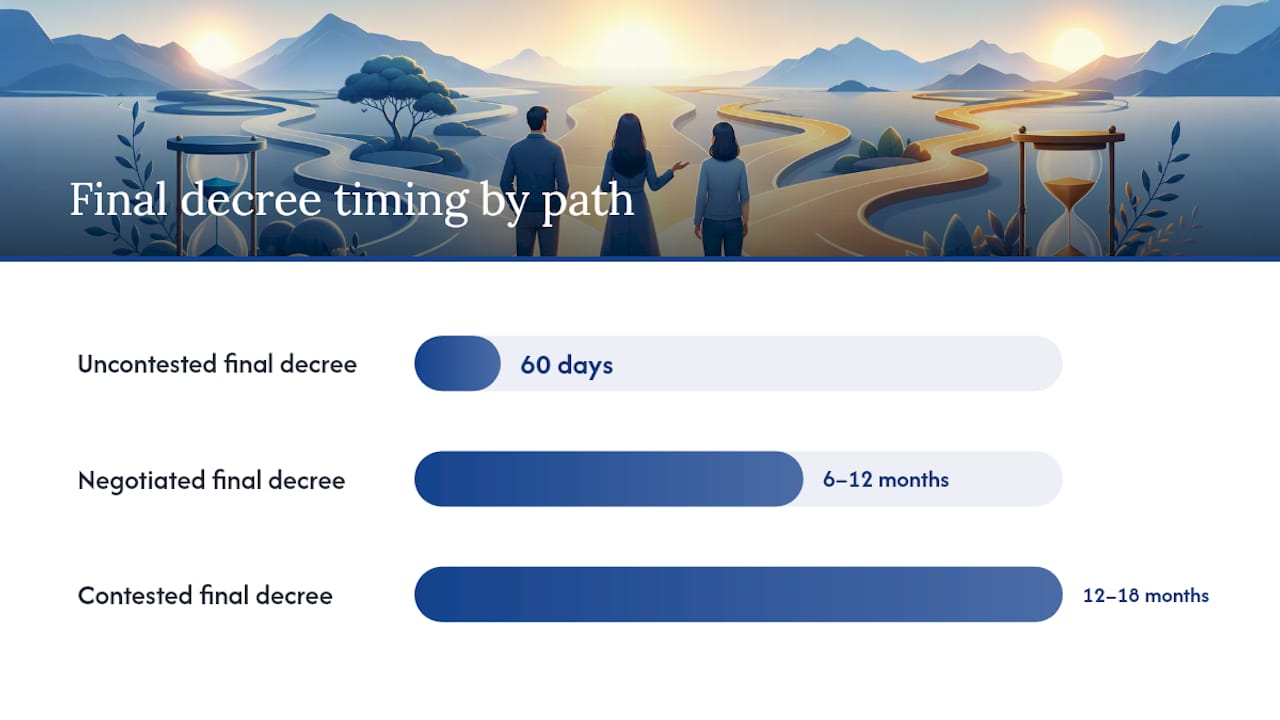
In Texas, the 60-day mandatory waiting period applies to every case. For a detailed walkthrough of the local filing process, the step-by-step divorce guide for The Woodlands covers the procedural sequence from petition to final decree.
Strategic timing matters. An attorney may recommend filing immediately if there is a risk of asset dissipation, a safety concern, or a pending relocation. In other situations, waiting a few weeks to gather documents and complete financial planning produces a stronger opening position. Ask your attorney directly: “Is there any reason to file sooner rather than later, or to wait?”
Pro Tip: Change your passwords and update your beneficiary designations on life insurance and retirement accounts as soon as you have legal counsel. These are lawful protective steps your attorney will likely recommend in the first meeting.
How the Law Office of Anna Din structures a consultation
A typical 45-minute consultation at the Law Office of Anna Din follows a consistent sequence: fit questions first, then case triage, then fee discussion, then immediate next steps.
The first 10 minutes focus on fit. Anna Din asks about the client’s situation at a high level, explains her approach to family law representation, and gives the client a chance to ask about her experience with similar cases. The initial meeting is an interview that works both ways, and the firm treats it that way.
The next 20 minutes cover case triage. The attorney identifies the key issues (custody, property, support, safety), asks about the documents the client has brought, and flags the pressure points that will drive cost and timeline. State rules on community property fundamentally change negotiation strategies, and the firm explains which model applies and what typical local outcomes look like.
The final 15 minutes cover fees, retainer structure, and next steps. The client leaves with a written list of documents to gather, a realistic cost range, and a clear answer to the question: “What do I do in the next 48 hours?”
The firm’s divorce attorney practice page outlines the full scope of representation, from uncontested filings to contested trials. The success stories section shows outcomes in custody and divorce cases the firm has handled in The Woodlands and surrounding communities.
Client checklist the firm typically provides at the end of the consultation:
- Gather the six essential documents (tax returns, pay stubs, bank statements, mortgage docs, retirement statements, court orders)
- Complete the financial disclosure worksheet
- Begin a parenting log if custody is at issue
- Change passwords and update beneficiary designations
- Schedule a follow-up call within two weeks
Sample first-month timeline the firm uses as a planning guide:
- Week 1: Sign engagement letter, pay retainer, transfer initial documents
- Week 2: File petition (if proceeding) or complete financial disclosure
- Week 3–4: Temporary orders hearing, if needed
- Week 4–6: Begin discovery or settlement discussions
What an attorney actually wants you to know before you walk in
The most useful thing you can do before a divorce consultation is decide to be completely honest, even about the facts that feel embarrassing or complicated. An attorney cannot protect you from information they do not have. A financial mistake, a past legal issue, or a complicated relationship history will come out during discovery anyway. Hearing it from you first gives your attorney time to address it strategically rather than react to it defensively.
Three tactical tips for the meeting itself:
First, frame difficult facts plainly. Do not soften or minimize. If there was domestic violence, say so directly. If you moved money, say so and explain why. The attorney’s job is to work with the facts as they are, not as you wish they were.
Second, ask about confidentiality at the start of the meeting. Everything you say in a consultation is protected by attorney-client privilege, even if you do not hire the attorney. That protection exists so you can speak freely. Use it.
Third, do not make decisions in the room. The consultation is for gathering information. You are not obligated to hire the attorney on the spot, agree to a strategy, or commit to a filing date. Take notes, go home, and decide when you are not under pressure.
The Law Office of Anna Din is ready to help you prepare
Preparing for a divorce consultation is one of the most productive things you can do for your case, and the Law Office of Anna Din is built around making that first meeting count. Anna Din’s practice focuses on divorce representation, child custody and support, protective orders, and financial planning before filing, all delivered with the kind of direct, personalized communication that makes a complicated process feel manageable.

In an initial consultation, the firm will assess whether your case is contested or uncontested, identify the key legal issues, outline a realistic cost and timeline range, and give you a concrete list of next steps. You will not leave with vague reassurances. You will leave with a plan.
To schedule a consultation, visit the divorce attorney page or call the firm directly. If you have documents to share ahead of time, the intake team can advise on secure submission. The firm serves clients in The Woodlands, Houston, and surrounding Texas communities, including Fairfield and Hockley.
Sources
The sources below informed this checklist and offer deeper reading on specific topics, from QDRO mechanics to custody standards and financial planning before filing.
- What Questions to Ask a Divorce Lawyer at Your Consultation - LegalClarity
- Issues to Discuss With Your Divorce Attorney - FindLaw
- 15 Best Questions for Divorce Consultation - Terence M. Hoffman, LLC
- What Questions to Ask a Divorce Lawyer: 18 Questions for the Initial Consultation - Mitmunk
- Financial Planning for Divorce - Laurel Wealth Planning
This article is general information, not a substitute for advice from a qualified lawyer. Consult a qualified legal professional about your own circumstances before acting on anything here.
FAQ
What are the most important questions to ask a divorce attorney?
Ask about case type (contested vs. uncontested), fees and retainer structure, a realistic cost range, timeline, and whether emergency orders are needed. Those five questions cover the decisions you will face in the first week.
What are common mistakes people make early in a divorce?
Moving money out of joint accounts, deleting financial records, and posting on social media are the three most common early mistakes. Each can be used against you in court or in settlement negotiations.
What are common money mistakes people make during divorce?
Failing to account for costs beyond attorney fees (court filing fees, expert witnesses, custody evaluators), not gathering financial documents before the consultation, and making large purchases or taking on new debt without legal guidance are the mistakes that most consistently inflate total costs.
How can you save money before and during a divorce?
Batch your attorney communications, gather your own documents, ask about flat fees for discrete tasks, and explore mediation early. Coordinating with a financial planner before filing, as the financial planning guide from the Law Office of Anna Din outlines, can also reduce costly last-minute decisions during settlement.
How do I know if a divorce lawyer is the right fit for my case?
Ask directly about their trial experience, the percentage of their practice devoted to family law, and who will handle your case day to day. A lawyer who answers those questions clearly and without deflection is demonstrating the transparency you will need throughout the process.
Recommended
Questions About Your Situation?
Every family is different. Schedule a confidential consultation with Anna Din to discuss your options.
Schedule a Consultation