Revocable vs Irrevocable Trust: Your 2026 Decision Guide
August 3, 2026 · Law Office of Anna Din PLLC
TL;DR:
- A revocable trust allows control and flexibility during life while avoiding probate at death. An irrevocable trust provides asset protection, estate tax reduction, and Medicaid benefits but sacrifices control. Proper funding and timing are essential for trust effectiveness, especially for Medicaid planning and tax purposes.
A revocable trust keeps you in control of your assets during your lifetime and avoids probate at death. An irrevocable trust permanently transfers ownership out of your estate, which can protect assets from creditors and reduce estate tax exposure. The core trade-off is simple: control versus protection. If your primary goal is probate avoidance and flexibility, a revocable trust usually fits. If you need Medicaid planning, creditor protection, or estate tax reduction, an irrevocable trust is typically the right tool.
Two rules shape nearly every trust decision in 2026. First, the federal estate tax exemption is $15 million per individual, meaning most families will not owe federal estate tax under current law. Second, 42 U.S.C. § 1396p imposes a 60-month look-back period for Medicaid long-term care eligibility. Transfers into an irrevocable trust within that five-year window are treated as gifts and can trigger a penalty period of ineligibility. Know both numbers before you sign anything.
Key rule: The $15 million federal estate tax exemption and the 60-month Medicaid look-back are the two figures that most directly determine which trust type belongs in your plan.
This article provides general information about trust planning, not legal or tax advice. Confirm current rules with a licensed attorney or CPA before making decisions.
Table of Contents
- How do revocable and irrevocable trusts compare?
- What is a revocable trust and how does it work?
- What is an irrevocable trust and what types exist?
- How do the key differences actually play out?
- What are the tax and reporting rules for each trust type?
- How does the Medicaid five-year look-back work?
- How do you fund a trust, and what mistakes should you avoid?
- Which trust should you choose for your situation?
- What does it cost and how long does it take?
- Can you change or undo a trust after it is created?
- Key Takeaways
- Why the conventional wisdom on trust planning often misleads people
- How Lawofficeofannadin helps you build the right trust plan
- Useful sources for further reading
- FAQ
How do revocable and irrevocable trusts compare?
| Dimension | Revocable Trust | Irrevocable Trust |
|---|---|---|
| Control / ability to change | Full control; amend or revoke anytime | Permanent; changes require beneficiary consent, decanting, or court action |
| Asset protection / creditor protection | None; assets remain reachable by creditors | Strong when properly structured; assets outside grantor’s estate |
| Estate tax impact | Assets included in taxable estate | Assets can be removed from taxable estate |
| Income tax / reporting | Grantor’s SSN; no separate filing required | Separate tax entity; EIN required; Form 1041 if gross income exceeds $600 |
| Medicaid / long-term care | No protection; assets counted as available | Can protect assets if funded more than 60 months before application |
| Probate avoidance | Yes, when fully funded | Yes, when fully funded |
| Cost & complexity | Lower; simpler drafting | Higher; more complex drafting and ongoing administration |
| Best use cases | Probate avoidance, incapacity planning, privacy | Estate tax reduction, Medicaid planning, creditor protection |
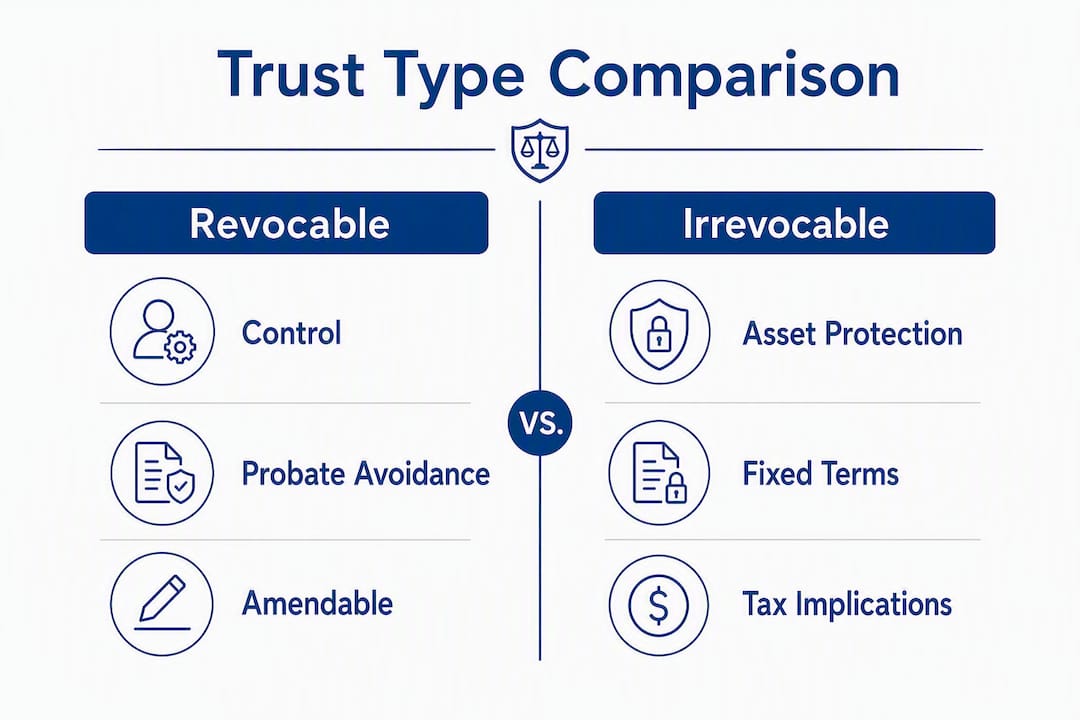
Readers focused on keeping things simple and maintaining flexibility should look closely at the revocable column. Those with estates approaching or exceeding $15 million, long-term care concerns, or creditor exposure will find the irrevocable column more relevant to their planning goals.
What is a revocable trust and how does it work?
A revocable trust, often called a living trust, is a legal arrangement you create during your lifetime. You transfer assets into the trust, name yourself as trustee, and retain full authority to change the terms, swap beneficiaries, or dissolve the trust entirely. Because you keep control, the IRS treats the trust as transparent for tax purposes: it uses your Social Security number, and typically no separate tax return is required.
The primary reason people create revocable trusts is probate avoidance. When you die, assets held in a properly funded revocable trust pass directly to your named beneficiaries without going through the probate court process. Consider a $500,000 home titled in your revocable trust: at your death, your successor trustee transfers the deed to your beneficiaries according to the trust document, typically within weeks, without a court filing, without public disclosure, and without probate fees. The same home titled only in your personal name would require a probate proceeding that can take months and cost thousands of dollars in court and attorney fees.
Revocable trusts also serve as an incapacity plan. If you become unable to manage your affairs, your named successor trustee steps in immediately, without the delay and expense of a court-supervised guardianship or conservatorship.
Advantages and limitations at a glance:
- Probate avoidance when the trust is fully funded
- Successor trustee takes over seamlessly at incapacity or death
- Privacy — trust terms do not become public record the way a probated will does
- Multi-state real estate can be held in one trust, avoiding ancillary probate in each state
- No asset protection — creditors can still reach trust assets during your lifetime
- No estate tax shelter — assets remain in your taxable estate
- No Medicaid protection — assets count as available resources for eligibility purposes
- Requires funding — assets not transferred into the trust still go through probate
The absence of asset protection is the most commonly misunderstood limitation. A revocable trust is not a shield. It is a management and distribution tool.
What is an irrevocable trust and what types exist?
An irrevocable trust permanently transfers ownership of assets out of your hands. Once funded, you generally cannot take assets back, change beneficiaries at will, or dissolve the trust without the consent of beneficiaries or a court order. That loss of control is the price of the protections the structure provides.
When properly drafted, assets in an irrevocable trust are no longer part of your taxable estate, cannot be reached by your personal creditors, and may be protected from Medicaid recovery. The trust becomes a separate legal and tax entity, requiring its own Employer Identification Number and, in most cases, its own annual tax return.
Several subtypes serve distinct planning goals:
- Medicaid Asset-Protection Trust (MAPT): Holds assets, typically a home, outside your countable resources for Medicaid eligibility purposes. Must be funded more than 60 months before you apply for benefits.
- Qualified Personal Residence Trust (QPRT): Transfers your home into an irrevocable trust while you retain the right to live there for a set term. If you survive the term, the home passes to beneficiaries at a reduced gift-tax value. If you die during the term, the home returns to your taxable estate, eliminating the benefit. The survival risk is real and must be weighed carefully.
- Irrevocable Life Insurance Trust (ILIT): Holds a life insurance policy outside your estate so the death benefit is not subject to estate tax.
- Charitable Remainder Trust (CRT) / Charitable Remainder Unitrust (CRUT): Provides income to you or other beneficiaries for a term, then transfers the remainder to a designated charity, generating a partial charitable deduction.
- Spousal Lifetime Access Trust (SLAT): Allows one spouse to make a gift to an irrevocable trust for the benefit of the other, removing assets from the taxable estate while preserving some indirect access.
Trade-offs to weigh:
- Asset protection from personal creditors once the look-back or fraudulent-transfer period passes
- Estate tax reduction for estates above the federal exemption
- Medicaid planning when funded well in advance
- Loss of control is permanent and practical — you may not be able to refinance a home in the trust or redirect assets for emergencies without beneficiary consent or court involvement
- Step-up in basis may be lost for assets in a non-grantor irrevocable trust, creating capital gains exposure for heirs
- Drafting complexity is high; a poorly drafted trust can fail to deliver any of the intended benefits
How do the key differences actually play out?
Control and ability to change
With a revocable trust, you are the trustee and the beneficiary during your lifetime. You can amend the document on a Tuesday and revoke it on a Wednesday. That flexibility is genuinely valuable, especially when family circumstances change through marriage, divorce, or the birth of children.

An irrevocable trust locks in the terms. Practitioners describe this as a permanent loss of practical control: you may not be able to refinance a mortgaged property held in the trust, extract equity for an emergency, or redirect assets without beneficiary consent or a court petition. That is not a theoretical limitation. It is a real constraint that affects day-to-day financial decisions.
Asset protection and creditor protection
A revocable trust provides no protection from your creditors. Because you retain control, the law treats the assets as yours. An irrevocable trust, once properly funded and past any applicable fraudulent-transfer period, places assets beyond the reach of your personal creditors. This distinction matters for business owners, medical professionals, and anyone with significant liability exposure.
Estate tax impact
Assets in a revocable trust are included in the grantor’s taxable estate. Properly structured irrevocable trusts remove assets from the estate. With the 2026 federal exemption at $15 million per person, most families will not face federal estate tax under current law. But the exemption is scheduled to revert to roughly half that amount after 2025 under the Tax Cuts and Jobs Act sunset provisions unless Congress acts. Families with significant wealth should plan now rather than wait.
Practitioner note: “Simply labeling a trust ‘irrevocable’ doesn’t guarantee tax or asset-protection results; retained powers can cause grantor taxation or estate inclusion, so drafting must match objectives precisely.” — IRC §§ 671–677, grantor trust rules
Income tax and reporting
The IRS grantor trust rules under IRC §§ 671–677 determine who pays income tax on trust earnings. A revocable trust is always a grantor trust: all income flows to your personal return. An irrevocable trust can also be a grantor trust if you retain certain powers, such as the power to substitute assets or to direct income to yourself. When that happens, you pay income tax on trust earnings even though you no longer own the assets. That outcome can be intentional (a tax-efficient way to make gifts) or accidental (a drafting trap that defeats asset protection).
Medicaid and long-term care
The 60-month look-back under 42 U.S.C. § 1396p applies to transfers into irrevocable trusts. A revocable trust offers no Medicaid protection at all because you retain control and the assets are counted as available resources.
Probate avoidance
Both trust types avoid probate when properly funded. This is one area where the two structures perform identically. The difference is that a revocable trust achieves probate avoidance without sacrificing control, while an irrevocable trust adds protection at the cost of flexibility.
Cost and complexity
Revocable trusts are less expensive to draft and administer. Irrevocable trusts require more precise drafting, separate tax identification, and ongoing administration. The cost difference is real, but it should not be the deciding factor. A poorly drafted irrevocable trust that fails to deliver its intended protections costs far more in the long run.
What are the tax and reporting rules for each trust type?
Estate tax
The 2026 federal estate tax exemption is $15 million per individual. Assets in a revocable trust are included in your taxable estate at death. Assets in a properly structured irrevocable trust are not, provided you did not retain powers that trigger estate inclusion under IRC §§ 2036–2038.
A straightforward illustration: if you have a $20 million estate and transfer $6 million into a properly structured irrevocable trust, your taxable estate drops to $14 million, potentially below the current exemption. The same $6 million in a revocable trust remains fully taxable.
Tax filing note: An irrevocable trust that is not a grantor trust must obtain an EIN and file Form 1041 if its gross income exceeds $600 in a tax year. Estimated tax payments are required if the trust’s tax liability exceeds $1,000.
Income tax treatment
| Trust Type | Tax ID | Annual Filing | Who Pays Income Tax |
|---|---|---|---|
| Revocable (grantor trust) | Grantor’s SSN | No separate return | Grantor |
| Irrevocable (grantor trust) | May use grantor’s SSN or EIN | Grantor trust statement or separate return | Grantor |
| Irrevocable (non-grantor trust) | EIN required | Form 1041 if gross income > $600 | Trust (compressed tax brackets) |
Irrevocable non-grantor trusts face compressed income tax brackets. In 2026, trust income above a relatively low threshold reaches the top federal rate, which means retaining income inside the trust is often tax-inefficient. Distributing income to beneficiaries in lower brackets is a common strategy to manage this.
Basis considerations
Transferring a home into an irrevocable non-grantor trust can cause heirs to lose the step-up in cost basis they would receive if the property passed through the estate. That lost step-up can mean a larger capital gains tax bill when heirs eventually sell. Drafting the trust as a grantor trust preserves the step-up but may affect other protections. This is one of the most consequential drafting decisions in irrevocable trust planning.
How does the Medicaid five-year look-back work?
Federal law under 42 U.S.C. § 1396p requires state Medicaid agencies to review asset transfers made within the 60 months before an application for long-term care benefits. Any transfer into an irrevocable trust during that window is treated as a disqualifying gift.
How the penalty is calculated: The penalty period equals the value of the transferred assets divided by the state’s average monthly cost of nursing-home care. If you transferred $120,000 and your state’s average monthly nursing-home cost is $8,000, the penalty period is 15 months of ineligibility.
The penalty clock does not start on the date of the transfer. According to Texas HHS Medicaid guidelines, the penalty period begins when the applicant files for benefits and would otherwise be eligible but for the transfer. This timing can create a gap where assets transferred years ago still trigger a penalty period requiring private payment for care.
Common Medicaid planning mistakes to avoid:
- Transferring during a crisis. Funding an irrevocable trust after a diagnosis or hospitalization almost always falls within the look-back window and provides no protection.
- Piecemeal funding. Each asset transferred into the trust starts its own five-year clock. Funding the trust in installments means some assets may not be protected when a crisis occurs.
- Misunderstanding when the penalty starts. Many families assume the five-year clock runs from the transfer date. It runs from the application date, which can extend the exposure period significantly.
- Ignoring liquidity. During a penalty period, you must pay privately for care. Without liquid assets outside the trust, that gap can be financially devastating.
Statutory exceptions exist for transfers to a spouse, a blind or disabled child, or a caretaker child who lived in the home and provided care that delayed institutionalization. These exceptions are narrow and fact-specific.
The practical lesson is clear: Medicaid planning with an irrevocable trust must begin at least five years before you anticipate needing long-term care. Waiting until a health crisis forces the issue is almost always too late.
Warning: Practitioners repeatedly find that clients who attempt last-minute irrevocable transfers to qualify for Medicaid are surprised when those transfers fail to help. Timing and documentation are the critical failure points.
How do you fund a trust, and what mistakes should you avoid?
Signing a trust document is only the first step. An unfunded trust is a legal shell that accomplishes nothing. Every asset you want the trust to govern must be formally transferred into it.
Funding checklist:
- Real estate: Record a new deed transferring title from your name to the trust. In Texas, this typically requires a warranty deed or quitclaim deed filed with the county clerk.
- Bank and brokerage accounts: Contact each financial institution to retitle accounts in the trust’s name or add the trust as a payable-on-death beneficiary where retitling is not possible.
- Retirement accounts (IRAs, 401(k)s): Do not transfer ownership into the trust. Instead, review and update beneficiary designations carefully. Naming a trust as an IRA beneficiary has complex tax consequences and requires specific drafting. See the firm’s guidance on how divorce affects retirement accounts for related considerations.
- Life insurance: Update beneficiary designations to reflect the trust or a separate ILIT if estate tax planning is involved.
- Business interests: Transfer LLC membership interests or corporate shares by amending operating agreements and updating the company’s records.
- Vehicles: Most planners leave vehicles out of trusts due to title and insurance complications; a pour-over will can capture them at death.
- Tangible personal property: Use a personal property memorandum or assignment document to transfer items like jewelry, art, or collectibles.
Most common funding mistakes:
- Failing to fund at all. The trust document is signed, filed away, and never used. Assets pass through probate as if the trust never existed.
- Retaining powers that defeat protection. For irrevocable trusts, keeping the right to direct investments, change beneficiaries, or use trust assets for your own benefit can trigger grantor trust status or estate inclusion.
- Inconsistent titling. Some accounts are retitled; others are not. The untitled assets go through probate, creating exactly the outcome the trust was meant to prevent.
- Late transfers for Medicaid planning. Funding an irrevocable trust within five years of applying for Medicaid provides no protection and triggers a penalty.
Pro Tip: When funding an irrevocable trust for Medicaid planning, transfer assets in a single, well-documented transaction rather than in installments. Each transfer starts its own five-year clock, and piecemeal funding leaves later-transferred assets exposed if a health crisis occurs before five years pass. Document the intent and date of each transfer clearly, because Medicaid caseworkers and courts will scrutinize both.
Which trust should you choose for your situation?
The right answer depends on your specific goals, asset level, health status, and state of residence. Here is a decision framework organized by common objectives.
-
Your primary goal is probate avoidance and incapacity planning. A revocable trust is the standard recommendation. You keep full control, your successor trustee steps in at incapacity, and assets pass to beneficiaries without probate.
-
You want privacy. A revocable trust keeps your asset distribution private. A probated will becomes a public record. Either trust type achieves this; the revocable trust does it with less complexity.
-
You need creditor protection. An irrevocable trust, properly structured and funded outside any fraudulent-transfer period, places assets beyond the reach of personal creditors. A revocable trust provides none.
-
Your estate exceeds or approaches the federal exemption. With the 2026 exemption at $15 million per person, most families are below the threshold. But if your estate is large, or if the exemption reverts after a potential legislative change, an irrevocable trust structure (ILIT, SLAT, or similar) may reduce estate tax exposure.
-
You are planning for Medicaid and long-term care. A Medicaid Asset-Protection Trust funded more than 60 months before application is the primary tool. The earlier you act, the more assets you can protect. A revocable trust does nothing for Medicaid eligibility.
-
You are an older adult with a modest estate and a primary residence. This is the most common Medicaid planning scenario. Transferring the home into a Medicaid Asset-Protection Trust at least five years before anticipated need can protect it from Medicaid estate recovery while preserving the right to live there during your lifetime, depending on how the trust is drafted.
A note on state law: Trust law varies by state. Texas, for example, has specific rules governing trust formation, modification, and the rights of creditors. The Medicaid penalty calculation uses Texas-specific average nursing-home costs. Always confirm that your planning strategy accounts for the law in your state of residence.
What does it cost and how long does it take?
Setting realistic expectations about cost and timeline prevents unpleasant surprises and helps you budget for professional help.
Typical cost ranges:
- Revocable trust (drafting only): Attorney fees generally range from a few hundred dollars for simple online documents to several thousand dollars for a comprehensive plan drafted by an experienced estate attorney. A full revocable trust package with a pour-over will, powers of attorney, and healthcare directives typically falls in the mid-range.
- Irrevocable trust (drafting): More complex drafting means higher fees. Specialized trusts like QPRTs, ILITs, or Medicaid Asset-Protection Trusts require careful attention to tax and eligibility rules.
- Funding assistance: Recording fees for real estate deeds vary by county. Financial institutions may charge account retitling fees. If you use an attorney to assist with funding, expect additional hourly charges.
- Ongoing administration for irrevocable trusts: Annual tax preparation for Form 1041 adds a recurring cost. Budget for CPA fees each year the trust has reportable income.
Timeline:
- Drafting: A straightforward revocable trust can be drafted and signed within two to four weeks of the initial attorney consultation. A complex irrevocable trust may take four to eight weeks or longer, depending on the attorney’s workload and the complexity of the plan.
- Funding: Retitling real estate and financial accounts can take an additional two to six weeks after signing, depending on institutional processing times.
- Medicaid protection: The five-year look-back clock starts on the date each asset is transferred. Protection for that asset does not begin until 60 months have passed. There is no shortcut.
Budget for professional help from both an attorney and a CPA when planning an irrevocable trust. The tax consequences of drafting choices, particularly around grantor trust status and basis, require coordinated advice that neither professional can provide alone.
Can you change or undo a trust after it is created?
Revocable trusts
Changing a revocable trust is straightforward. You can amend specific provisions through a trust amendment, or you can revoke the entire trust and start over. Most trust documents include a simple revocation procedure: a signed, notarized revocation document delivered to the trustee. At your incapacity, your successor trustee takes over under the terms you set. At your death, the trust becomes irrevocable and the successor trustee distributes assets according to the document.
Irrevocable trusts
Modifying an irrevocable trust is difficult by design. The options that exist are limited and often expensive:
- Beneficiary consent (non-judicial settlement agreement): In many states, all beneficiaries can agree in writing to modify certain trust terms without court involvement. Texas has adopted provisions allowing this for some modifications.
- Decanting: Some states allow a trustee to “pour” assets from an older irrevocable trust into a new trust with updated terms, effectively modifying the plan. Texas has a decanting statute, but its scope is limited.
- Court reformation: A court can modify an irrevocable trust if circumstances have changed in ways the grantor did not anticipate, or if the modification serves the trust’s original purpose. This is the most expensive and time-consuming option.
Practitioner caution: Attempting to modify an irrevocable trust after the fact is costly, uncertain, and sometimes impossible. The better approach is to draft the trust with enough flexibility built in from the start, including trustee discretion provisions and trust protector roles, so that future adjustments can be made within the document’s own framework rather than through litigation.
State law governs all of these remedies. What is available in Texas may not be available in another state, and vice versa. Consulting local counsel before attempting any modification is not optional.
Key Takeaways
A revocable trust gives you control and avoids probate; an irrevocable trust sacrifices control to gain asset protection, estate tax reduction, and Medicaid planning potential, but only when funded at least 60 months before you need benefits.
| Point | Details |
|---|---|
| Control vs. protection | Revocable trusts keep you in control; irrevocable trusts trade control for creditor and tax protection. |
| Estate tax threshold | The 2026 federal exemption is $15 million per person; irrevocable trusts can remove assets from the taxable estate. |
| Medicaid look-back | The 60-month rule under 42 U.S.C. § 1396p means Medicaid planning must start at least five years before anticipated need. |
| Funding is mandatory | An unfunded trust of either type accomplishes nothing; retitling assets is as important as signing the document. |
| Lawofficeofannadin | The firm assists clients in The Woodlands and Houston with trust drafting, funding, and coordinated Medicaid and estate planning. |
Why the conventional wisdom on trust planning often misleads people
Most articles on this topic present the revocable-versus-irrevocable choice as a clean binary: pick one, sign the document, and you are protected. The reality is more nuanced, and the gap between what people expect and what actually happens is where most planning failures occur.
The most common misconception is that signing an irrevocable trust document is the same as being protected. It is not. Protection begins when assets are properly transferred into the trust and only matures after the applicable look-back or fraudulent-transfer period passes. A client who signs a Medicaid Asset-Protection Trust on a Monday and suffers a stroke on the following Friday has accomplished nothing for Medicaid purposes. The document exists, but the protection does not.
The second misconception is that a revocable trust is “good enough” for most people. For probate avoidance and incapacity planning, that is often true. But many clients with modest estates and a primary residence are unknowingly exposed to Medicaid estate recovery, which can claim a home after death to reimburse the state for long-term care costs. A revocable trust does not prevent that. An irrevocable trust funded years in advance does.
In a Texas family-law context, trust planning intersects with divorce, property division, and child support in ways that most estate-planning guides ignore. Assets held in a properly structured irrevocable trust before marriage may be treated differently in a divorce than assets in a revocable trust or held outright. That distinction matters for clients who are planning ahead, not just reacting to a crisis.
The practical takeaway: do not choose a trust type based on cost or simplicity alone. Choose based on what you actually need the trust to do, then draft it precisely enough to do it.
How Lawofficeofannadin helps you build the right trust plan
Estate planning decisions carry real financial and legal consequences, and the difference between a well-drafted trust and a poorly structured one can be measured in lost assets, unexpected tax bills, or Medicaid ineligibility at the worst possible moment.

Lawofficeofannadin serves individuals and families in The Woodlands and Houston who need clear, practical guidance on trust drafting, funding, and coordination with Medicaid and tax planning. The firm works with clients to identify which trust structure fits their goals, prepares the documents with the precision that irrevocable planning requires, and assists with the funding steps that most clients overlook. For tax-sensitive irrevocable trust work, the firm coordinates directly with CPAs to make sure drafting choices and tax reporting align.
Whether you are starting with a basic revocable trust for probate avoidance or planning a Medicaid Asset-Protection Trust that needs to be funded years before you anticipate needing care, the right time to act is before a health crisis or a family-law event forces your hand. You can review the firm’s wills and estate planning services or schedule a consultation directly to discuss your situation with an attorney who understands both the estate-planning and family-law dimensions of your plan.
Useful sources for further reading
The following primary and practitioner sources were used in preparing this guide and are recommended for deeper technical research:
- IRS: What’s New — Estate and Gift Tax: Current federal estate tax exemption figures and updates.
- IRS Instructions for Form 1041: Filing thresholds, estimated payment rules, and reporting requirements for irrevocable trusts
- Congress.gov CRS Report: Trusts — Income, Estate, and Gift Tax Issues: Congressional Research Service analysis of trust taxation, including the 40% estate tax rate and current exemption.
- IRS Trust Primer (TEGE): IRS educational overview of grantor trust rules, revocable and irrevocable trust taxation, and estate inclusion principles
FAQ
Is it better to have an irrevocable trust or a revocable trust?
It depends on your goals. A revocable trust is better for probate avoidance and incapacity planning because you keep full control. An irrevocable trust is better for asset protection, Medicaid planning, or reducing estate tax exposure, but only when funded well in advance and drafted precisely.
Is it wise to put your house in an irrevocable trust?
It can be, particularly for Medicaid planning, but the decision carries trade-offs. Transferring your home into an irrevocable trust can protect it from Medicaid estate recovery if done more than 60 months before you apply for benefits, but it may cause heirs to lose a step-up in cost basis and can complicate refinancing.
What is the five-year rule for irrevocable trusts?
Under 42 U.S.C. § 1396p, Medicaid reviews asset transfers made within the 60 months before an application for long-term care benefits. Transfers into an irrevocable trust during that window are treated as disqualifying gifts and trigger a penalty period of ineligibility calculated by dividing the transfer value by the state’s average monthly nursing-home cost.
Why would you not want an irrevocable trust?
The permanent loss of control is the primary reason. Once assets are transferred, you generally cannot access them for emergencies, refinance property held in the trust, or change the plan without beneficiary consent or court action. For most people with modest estates and no immediate creditor or Medicaid concerns, a revocable trust provides the same probate-avoidance benefit with far greater flexibility.
Do both trust types avoid probate?
Yes, when properly funded. Both a revocable trust and an irrevocable trust pass assets to beneficiaries outside of probate, provided the assets are actually titled in the trust’s name before death. An unfunded trust of either type does not avoid probate.
Recommended
Questions About Your Situation?
Every family is different. Schedule a confidential consultation with Anna Din to discuss your options.
Schedule a Consultation