Same-Sex Divorce in Texas: Your 2026 Legal Guide
August 3, 2026 · Law Office of Anna Din PLLC

Same-sex couples can get divorced in Texas, and the Texas Family Code applies to your marriage exactly as it does to any other. Following the Supreme Court’s 2015 ruling in Obergefell v. Hodges, Texas must recognize same-sex marriages and process divorces under the same statutes. Before you file, confirm three things: at least one spouse has lived in Texas for six months and in the filing county for 90 days (Tex. Fam. Code §6.301), and a mandatory 60-day waiting period applies before any final decree can be entered.
Your immediate next steps:
- Confirm residency: six months in Texas, 90 days in your county
- Gather key financial documents (bank statements, deeds, retirement accounts)
- Identify any parentage gaps (adoption decrees, birth certificates, assisted-reproduction records)
- Schedule a consultation with a family law attorney before filing
Table of Contents
- What residency rules and grounds apply to same-sex divorce in Texas?
- How does the Texas divorce process work, step by step?
- How do Texas community-property rules affect your assets?
- What parental rights do same-sex parents have in Texas?
- What complications come up most often in same-sex divorces?
- How long does a Texas divorce take, and what does it cost?
- What should you do before you file for divorce?
- Key Takeaways
- What same-sex divorce cases actually require
- How Lawofficeofannadin can help you move forward
- Useful sources and further reading
- FAQ
What residency rules and grounds apply to same-sex divorce in Texas?
Texas residency requirements are straightforward: one spouse must have been domiciled in Texas for at least six months and a resident of the filing county for at least 90 days immediately before filing. Active-duty military members can satisfy this requirement if Texas is their home state of record.
Grounds for divorce in Texas:
- Insupportability (no-fault): The most common ground, used when the marriage has become insupportable due to discord or conflict with no reasonable expectation of reconciliation.
- Cruelty: Physical or mental cruelty that makes living together insupportable.
- Adultery
- Felony conviction (with at least one year served)
- Abandonment for at least one year
- Living apart for at least three years
- Confinement to a mental hospital with little prospect of recovery
Fault grounds matter beyond the courtroom. A judge can consider fault when dividing community property, potentially awarding a larger share to the non-at-fault spouse under Tex. Fam. Code §7.001.
Filing fees vary by county, typically ranging from roughly $250 to $350 for the original petition. Fee waivers are available if you qualify based on income.
How does the Texas divorce process work, step by step?
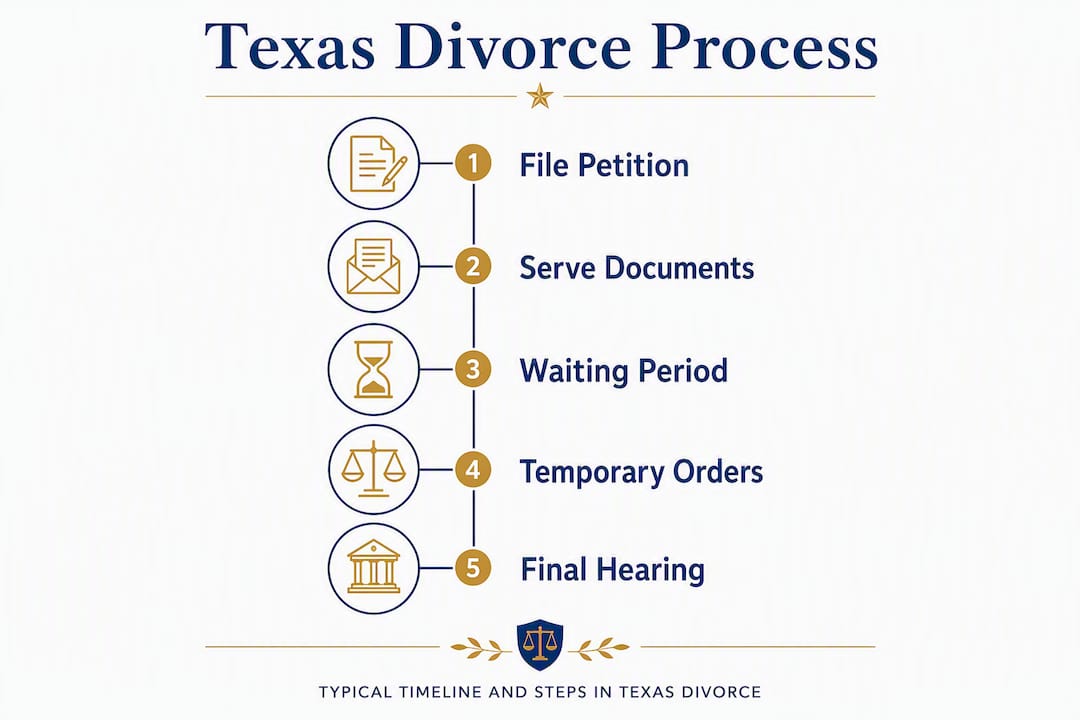
The procedural path is the same for every married couple in Texas. Here is what to expect from filing to final decree.
- File the Original Petition for Divorce in the district court of your county. Pay the filing fee or request a waiver.
- Serve your spouse via a process server, sheriff, or an agreed waiver of service.
- Wait out the mandatory 60-day period. Texas law prohibits a final decree before this window closes, except in narrow family-violence situations.
- Request temporary orders if needed for financial support, exclusive use of the home, child custody, or a protective order.
- Exchange financial disclosures and complete discovery if the case is contested.
- Attend mediation. Many Texas counties require it before a contested hearing.
- Reach a settlement or proceed to trial. An agreed final decree can be submitted once the 60 days have passed.
- Final decree signed by the judge. The divorce is legally complete.
| Step | Typical Timing | What to Prepare |
|---|---|---|
| File petition | Day 1 | Petition, filing fee, ID |
| Serve spouse | Days 1–14 | Process server or waiver |
| Temporary orders | Days 1–30 | Financial affidavit, parenting plan |
| 60-day waiting period | Days 1–60 | Gather documents, negotiate |
| Mediation | Days 45–90 | Settlement proposals |
| Final decree | Day 61 minimum | Signed agreement or trial |
Uncontested divorces typically resolve shortly after the mandatory waiting period. Contested matters often run several months, and high-conflict cases can extend over one to two years.
Pro Tip: File for temporary orders early if you share a home, have children, or have joint accounts. These orders prevent a spouse from draining accounts or relocating children while the case is pending.
How do Texas community-property rules affect your assets?
Texas presumes that all assets and debts acquired during the marriage are community property subject to a “just and right” division under Tex. Fam. Code §3.002 and §7.001. Separate property, which includes assets owned before the marriage, gifts, and inheritances, stays with the original owner — but you bear the burden of proving it.

For same-sex couples, the complication is timing. Many couples lived together, bought property, and built businesses before marriage equality arrived in 2015. Assets acquired during that period are generally separate property, but growth during the marriage or commingling of funds creates disputes that require careful tracing. A retirement account opened before the marriage but contributed to during it, for example, may have both separate and community components.
Documents to gather now:
- Bank and investment account statements going back to the marriage date
- Deeds, titles, and mortgage records with acquisition dates
- Retirement account statements showing pre- and post-marriage balances
- Business formation documents, tax returns, and valuation records
- Records of any gifts or inheritances received
Pro Tip: If a business or retirement account straddles your marriage date, consider retaining a forensic accountant or valuation expert early. The cost of proper tracing is almost always less than the cost of losing a contested hearing over undocumented assets.
What parental rights do same-sex parents have in Texas?
Legal parenthood and day-to-day parenting are not the same thing in a Texas courtroom. Texas courts apply the best-interest standard under Tex. Fam. Code §153.002, but they rely on legal parentage documentation when deciding conservatorship and possession. Years of caregiving do not automatically confer legal rights if formal parentage was never established.
Texas courts generally rely on legal recognition, not only emotional ties, when deciding custody and visitation. A non-legal parent who has raised a child for years may still face significant barriers without an adoption decree or parentage order.
Steps to protect your parental rights before or during divorce:
- Locate and secure the child’s birth certificate and any adoption decrees.
- If you are not listed on the birth certificate and no adoption occurred, consult an attorney about a parentage action immediately.
- Gather evidence of caregiving: school records, medical authorizations, photos, and financial contributions.
- Request temporary custody orders at the time of filing to preserve the status quo.
- If there are safety concerns, seek emergency protective orders before filing.
If both spouses are legal parents, child support follows the standard Texas income-based guidelines. If only one spouse holds legal parentage, the other parent’s rights to custody and visitation are at serious risk without court intervention.
What complications come up most often in same-sex divorces?
The legal process is identical for same-sex and opposite-sex couples, but certain fact patterns appear repeatedly in LGBTQ divorce cases in Texas.
- Disputed property timelines: When a couple lived together for years before marrying, determining when an asset became marital property requires dated records, bank statements, and sometimes expert testimony.
- Commingled accounts: Joint accounts used before and during the marriage blur the community/separate property line. Tracing requires transaction-level documentation.
- Missing parentage paperwork: Many couples who had children before 2015 never completed a second-parent adoption. During divorce, this gap can leave one parent without enforceable rights.
- Informal marriage claims: Texas recognizes common-law marriage under Tex. Fam. Code §2.401. If a couple met the requirements before formal marriage equality, the effective marriage date could be earlier than the license date, affecting property division.
The relationship history of many same-sex couples requires nuanced analysis of when property was acquired and how parental rights were established — analysis that goes well beyond what a standard divorce checklist covers.
Red flags that mean you should hire an attorney before filing: missing adoption paperwork, business ownership that spans the pre-marriage period, any history of family violence, or a spouse who has already retained counsel.
How long does a Texas divorce take, and what does it cost?
| Divorce Type | Typical Timeline | Estimated Cost Range |
|---|---|---|
| Uncontested (no children) | Shortly after the 60-day waiting period | Variable |
| Uncontested (with children) | A few months | Variable |
| Contested | Several months up to a year or more | Variable |
| High-conflict / complex assets | Often over a year | Variable |
The 60-day waiting period is the statutory floor. In practice, even agreed divorces often take longer due to paperwork, scheduling, and court availability.
Ways to reduce cost:
- Agree on as many issues as possible before filing
- Use mediation to resolve disputes without a trial
- Provide complete financial disclosures early to avoid prolonged discovery
- Consider limited-scope representation for discrete tasks if budget is a concern
What should you do before you file for divorce?
Preparation before filing reduces surprises and protects your rights from day one.
Document inventory:
- Last three years of bank and credit card statements
- Two years of tax returns (joint and individual)
- Recent pay stubs and employer benefit statements
- Deeds, titles, mortgage statements, and lease agreements
- Retirement account statements (401(k), IRA, pension)
- Business records, partnership agreements, and tax filings
Parental protection items:
- Birth certificates for all children
- Adoption decrees or parentage orders
- Assisted-reproduction agreements or donor contracts
- Any existing custody or guardianship orders
- Make secure copies of all critical documents and store them outside the shared home.
- Photograph or screenshot current balances in all joint accounts.
- Change passwords on personal email, financial accounts, and cloud storage.
- Identify a safe place for children and pets if the home situation becomes unsafe.
- Review your credit report to identify any accounts you may not know about.
Pro Tip: Preserve evidence of financial contributions made before the marriage: dated receipts, renovation invoices, signed loan agreements, and photos with timestamps. This documentation is often decisive in tracing separate property.
The Law Office of Anna Din provides a 2026 filing guide for The Woodlands and a practical pre-filing checklist that walk through county-specific steps and required documents.
Key Takeaways
Same-sex couples in Texas have the same divorce rights as any other married couple, but relationships that predate Obergefell require careful documentation of property timelines and parental rights to avoid costly disputes.
| Point | Details |
|---|---|
| Residency requirement | One spouse must live in Texas for 6 months and in the filing county for 90 days. |
| Mandatory waiting period | Texas law imposes a mandatory 60-day waiting period from the date the petition is filed before a court may grant a divorce. Uncontested cases often resolve shortly after this minimum period, but the precise timeline can vary depending on paperwork and court scheduling. |
| Community property rules | Assets acquired during the marriage are presumed community property; pre-marriage assets require documentation to protect as separate property. |
| Parental rights risk | Non-legal parents without an adoption decree or parentage order face significant custody barriers; act before filing. |
| Lawofficeofannadin | The Law Office of Anna Din handles contested and uncontested divorces, custody, parentage, and protective orders for same-sex couples in The Woodlands and surrounding areas. |
What same-sex divorce cases actually require
Most guides focus on the procedural sameness of same-sex divorce, and that framing is accurate as far as it goes. The Texas Family Code does not distinguish. But the practical reality for many couples is that their legal marriage is a fraction of their actual relationship. A couple together since 2005 who married in 2015 has ten years of financial history that sits outside the community property presumption entirely.
That gap is where cases get complicated and where preparation matters most. The couples who navigate divorce most cleanly are those who documented their finances throughout the relationship, completed parentage steps when children arrived, and understood that legal marriage and lived partnership are not the same thing in a courtroom. The ones who struggle are those who assumed that years of commitment would speak for themselves.
Hiring an attorney early is not a sign that the divorce will be contentious. It is a sign that you understand what is at stake.
How Lawofficeofannadin can help you move forward
Facing a same-sex divorce with complex assets, children, or safety concerns is exactly where experienced legal counsel makes a concrete difference. The Law Office of Anna Din represents same-sex couples in The Woodlands, Houston, and surrounding Texas communities across the full range of family law matters: contested and uncontested divorce, child custody and support, parentage and adoption work, and protective orders.

In a first consultation, the firm reviews your residency status, identifies any parentage gaps, and maps out a property timeline specific to your relationship history. Bring your key financial documents, any existing custody or adoption paperwork, and a list of your questions. The firm’s success stories include securing custody rights for parents whose legal standing was initially unclear.
To schedule a consultation with the Law Office of Anna Din, visit the divorce attorney page or contact the firm directly.
This article provides general legal information, not legal advice. Consult a qualified Texas family law attorney for guidance specific to your situation.
Useful sources and further reading
- Tex. Fam. Code §6.301 — Residency requirements for filing divorce in Texas
- Tex. Fam. Code §6.702 — Mandatory 60-day waiting period
- Texas Law Help: Same-Sex Divorce in Texas — Plain-language guide with forms for uncontested same-sex divorces
- Texas State Law Library: LGBT Law Guide — Authoritative index of Texas statutes and resources for LGBTQ legal matters
- Law Office of Anna Din: 2026 Woodlands Filing Guide — County-specific step-by-step filing instructions
- Law Office of Anna Din: Pre-Filing Checklist — Practical document and action checklist before you file
Consult a licensed Texas family law attorney for advice specific to your case. If you are ready to speak with someone now, contact the Law Office of Anna Din directly.
FAQ
Can same-sex couples get divorced in Texas?
Yes. Following Obergefell v. Hodges, Texas recognizes same-sex marriages and processes divorces under the same Texas Family Code rules that apply to all married couples.
How long does a same-sex divorce take in Texas?
The minimum time for divorce in Texas is 60 days due to the statutory waiting period required after filing. The fastest possible final decree is shortly after this waiting period, though practical scheduling may result in a slightly longer timeline.
What happens to assets we acquired before we were legally married?
Assets acquired before the marriage date are generally separate property. However, commingling funds or contributing to those assets during the marriage can create community property claims that require documentation to resolve.
What if only one of us is the legal parent of our child?
The non-legal parent faces significant risk in custody proceedings. Texas courts rely on formal parentage documentation, so filing a parentage action or completing an adoption before or during the divorce is strongly advised.
Does it matter that we were married in another state?
No. The federal Respect for Marriage Act requires all states to recognize same-sex marriages from other states. As long as one spouse meets Texas residency requirements, you can file for divorce in Texas regardless of where you married.
Recommended
Questions About Your Situation?
Every family is different. Schedule a confidential consultation with Anna Din to discuss your options.
Schedule a Consultation