Second Marriage Prenup: Protect Your Kids and Assets
July 29, 2026 · Law Office of Anna Din PLLC

Yes, a second marriage prenup is strongly recommended when you have children from a prior relationship, own a business, hold retirement savings, or carry debt. In Texas, where assets acquired during marriage are generally presumed community property, the stakes are especially high. Without a written agreement, your premarital home, investment accounts, and inheritance plans for your children can all become entangled with your new spouse’s legal claims. The single most important next step is to schedule a consultation with a family law attorney and begin gathering your financial documents now.
Before your first prenup meeting, bring:
- A complete list of assets you own today (real estate, accounts, business interests, retirement funds)
- A summary of existing debts (mortgages, student loans, support obligations, credit lines)
- Current beneficiary designation forms for life insurance, 401(k)s, and IRAs
Table of Contents
- Why a second marriage prenup matters more than most people expect
- What to include in a second-marriage prenup: key clauses and protections
- What prenups cannot do, and when courts will set them aside
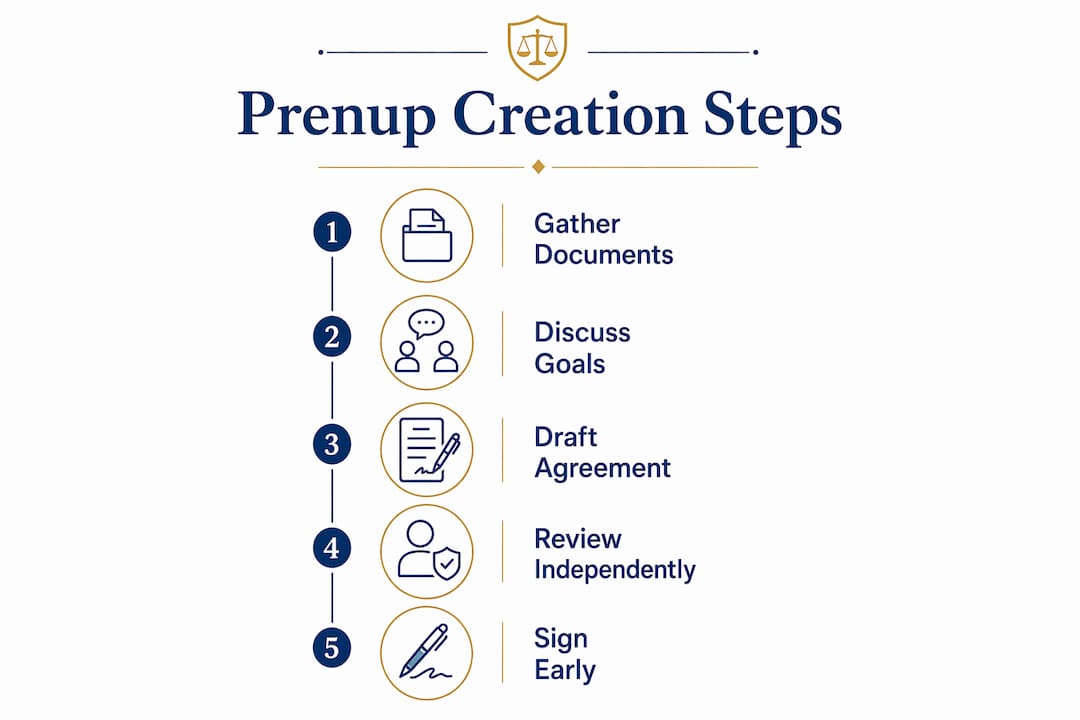
- How to create and sign a prenup: a practical timeline
- How your prenup fits with wills, trusts, and beneficiary forms
- Common mistakes that can undermine your prenup
- Key Takeaways
- A practitioner’s perspective on second-marriage prenups
- How the Law Office of Anna Din helps with prenups for second marriages
- Useful sources and further reading
- FAQ
Why a second marriage prenup matters more than most people expect
Second marriages carry financial complexity that first marriages rarely do. You may be walking in with a paid-off home, a retirement account built over decades, children who expect to inherit, and perhaps an ongoing child support or alimony obligation. A prenuptial contract for a second marriage addresses all of those realities in writing before the wedding, when both parties are thinking clearly and without adversarial pressure.

The blended-family risk is real and specific. Without a prenup, assets you intended for your children can unintentionally benefit your new spouse. Texas is one of nine community property states, meaning that income earned and property acquired during the marriage generally belongs equally to both spouses. If you deposit your paycheck into a joint account and use it to pay down a premarital mortgage, your spouse can develop a community interest in that home. The same logic applies to renovations: marital funds used to improve premarital real estate can cloud the title and create claims your children never anticipated.
Business owners face a parallel problem. If your company grows in value during the marriage, your spouse may argue that the increase is community property, even if you founded the business years before you met. Prior alimony obligations also matter: a prenup can clarify that your existing support payments are your separate responsibility and will not drain marital funds your new spouse expects to share.
Consider a straightforward scenario: a parent with two children from a prior marriage remarries without a prenup. After ten years, the marriage ends. The surviving or divorcing spouse may have a legal claim to half of the retirement savings accumulated during those ten years, assets the parent had mentally earmarked for the children’s college funds. A prenuptial agreement, drafted properly, prevents that outcome.
Family-law practitioners increasingly see prenups as communication tools, not just divorce plans. The process of drafting one forces both parties to disclose finances, discuss expectations, and agree on how they will handle money together. That conversation alone reduces conflict later.
Pro Tip: Start the prenup conversation at least three to six months before the wedding. Courts look more favorably on agreements negotiated without time pressure, and early discussions signal that neither party felt coerced.
What to include in a second-marriage prenup: key clauses and protections
A well-drafted prenuptial agreement for a second marriage covers more ground than a first-marriage agreement typically does. The following protections are the ones most relevant to blended families and business owners.
Core clauses to prioritize:
- Separate property designation. Identify every asset you own today by name, account number, and approximate value. The prenup should state explicitly that these remain your separate property and that income or appreciation from them does not automatically become community property.
- Inheritance earmarks for children. Specify which assets are reserved for children from your prior relationship, including the home, investment accounts, or family heirlooms.
- Business-ownership protections. State that your ownership interest, and any increase in its value attributable to your own efforts, remains separate. For Texas business owners, this is one of the most contested areas in divorce; a business valuation clause can prevent years of litigation.
- Retirement-account treatment. Clarify what portion of each retirement account is premarital and what portion, if any, will be treated as community property. Coordinate this with beneficiary designations.
- Debt allocation. Assign existing debts to the party who incurred them. This protects your new spouse from your prior obligations and vice versa.
- Spousal support clauses. You may limit or waive spousal maintenance, subject to Texas law. Be aware that courts will scrutinize waivers that leave one spouse without any means of support.
Negotiation checklist:
- Each party should retain independent legal counsel before signing.
- Both parties must provide complete financial schedules, including account statements, property appraisals, and business valuations.
- Agree on which assets are truly separate and which will be treated as marital going forward.
- Decide how you will handle future income, particularly if one spouse plans to reduce work to care for children.
- Coordinate the prenup language with your wills, trusts, and beneficiary forms before the wedding.
Beneficiary-designation coordination deserves special attention. A prenup clause stating that your IRA goes to your children means nothing if the IRA’s beneficiary form still names your new spouse. The prenup and the beneficiary form must align, and updating one without the other is one of the most common and costly oversights in second-marriage financial planning.
What prenups cannot do, and when courts will set them aside
Understanding the legal limits of a prenuptial agreement is just as important as knowing what to include. Courts in Texas and across the U.S. will refuse to enforce provisions that cross specific legal lines.
What a prenup cannot do:
- Determine child custody or parenting time arrangements
- Set or waive child support obligations (the right of a child to support cannot be adversely affected by a premarital agreement under Tex. Fam. Code § 4.003(b))
- Include terms that violate public policy or impose criminal penalties
- Waive a spouse’s right to government benefits in a way that shifts costs to the state
Enforceability requirements under Texas law:
Under Tex. Fam. Code § 4.002, a prenuptial agreement must be in writing and signed by both parties. Oral agreements are unenforceable, full stop. Beyond that, Tex. Fam. Code § 4.006 allows a court to set aside an agreement if the challenging party proves it was signed involuntarily, or that it was unconscionable at signing and the party was not given fair and reasonable financial disclosure and did not knowingly waive that right in writing.
Texas is a community property state, which means the default rules are aggressive. In a community-property state, you control only 50% of assets acquired during the marriage. That legal reality should shape how you structure every clause in the agreement, particularly around income, real estate, and retirement contributions made after the wedding date.
Even premarital real estate can become legally complicated. If you use marital earnings to pay the mortgage or fund renovations on a home you owned before the marriage, your spouse may develop a community interest in that property. A well-drafted prenup includes reimbursement and credit clauses that address exactly this scenario.
Pro Tip: Never sign a prenup the day before or the day of the wedding. Courts scrutinize last-minute signings for duress. Aim to have both parties sign at least 30 days before the ceremony, with each party having had independent legal review.
How to create and sign a prenup: a practical timeline
Getting a prenup right is a process, not a single meeting. Here is a realistic timeline for second-marriage couples.
Step-by-step process:
- Months 3–6 before the wedding. Begin the conversation with your partner. Agree in principle on the goals: protecting children, allocating debt, defining separate property. Each party retains independent legal counsel at this stage.
- Months 2–3 before the wedding. Exchange full financial disclosures. Both parties provide asset schedules, recent account statements, business valuation reports, existing court orders (child support, custody, alimony), and beneficiary designation forms.
- Month 2 before the wedding. Attorneys draft the agreement. Negotiation happens here. If a business valuation is needed, a certified business appraiser may be engaged. For complex estates, a CPA or financial planner may assist.
- 30+ days before the wedding. Both parties review the final draft with their own attorneys, ask questions, and request any changes. No one should sign under time pressure.
- Signing. Both parties sign in front of a notary. Some attorneys recommend two witnesses as well, though Texas does not mandate witnesses for prenups. Keep signed originals in a secure location and provide copies to both attorneys.
Document checklist for the disclosure exchange:
| Document | Purpose |
|---|---|
| Real estate deeds and mortgage statements | Establish premarital property values |
| Bank and investment account statements | Document separate assets |
| Business ownership records and valuation | Support business-protection clauses |
| Retirement account statements | Clarify premarital balances |
| Existing court orders (support, custody) | Disclose ongoing obligations |
| Beneficiary designation forms | Coordinate with prenup and estate plan |
| Tax returns (last 2–3 years) | Verify income and asset claims |
Cost expectations: In Texas, a straightforward prenuptial agreement typically costs between $500 and $1,500. The average flat fee is around $860, but complex agreements involving business valuations, multiple properties, or extended negotiation can reach $3,000–$10,000. Hiring a business appraiser or CPA adds to that total, but those costs are modest compared to contested divorce litigation.
For second-marriage couples managing retirement accounts and investments, getting the prenup right upfront is far less expensive than untangling commingled assets later.
How your prenup fits with wills, trusts, and beneficiary forms
A prenup alone does not protect your children’s inheritance. It must work in coordination with your estate plan, and the two documents can contradict each other in ways that courts resolve against your wishes.

Beneficiary designations on retirement accounts and life insurance override wills. If your 401(k) still names your ex-spouse or your new spouse as beneficiary, that designation controls regardless of what your will or prenup says. Updating beneficiary forms is not optional; it is the most direct way to protect your children.
Trusts offer a layer of protection that neither a prenup nor a will can fully replicate. A QTIP trust (Qualified Terminable Interest Property trust) allows you to provide income to your surviving spouse during their lifetime while preserving the principal for your children. A testamentary trust created in your will can accomplish similar goals. For children with special needs or spendthrift concerns, a dedicated trust structure is worth the additional cost.
Steps to align your estate plan with your prenup:
- Audit every beneficiary designation form: retirement accounts, life insurance, payable-on-death bank accounts, and transfer-on-death investment accounts.
- Update your will to acknowledge the prenup and confirm your intent for specific assets.
- Work with your attorney to determine whether a revocable living trust, QTIP trust, or testamentary trust fits your situation.
- Review the prenup language alongside your estate documents to confirm there are no contradictions.
- Revisit all documents after any major life event: a child’s birth, a death in the family, or a significant change in assets.
A forced-election provision is another tool worth discussing with your attorney. It gives your surviving spouse a clear choice: either accept the assets designated for them in the estate plan, or assert their statutory community-property rights. This reduces the risk of probate litigation between your spouse and your children after you are gone. For a deeper look at family financial planning that coordinates these moving parts, a financial planner familiar with blended families can complement your legal team.
Pro Tip: When selecting a trustee, avoid naming your new spouse as sole trustee over assets intended for your children from a prior relationship. A neutral co-trustee or a corporate trustee reduces the potential for post-death conflict.
Common mistakes that can undermine your prenup
Even well-intentioned prenuptial agreements fail when the process is rushed or incomplete. These are the mistakes that come up most often in second-marriage situations.
Mistakes to avoid:
- Signing too close to the wedding. Courts view last-minute signings as potential duress. The closer to the ceremony, the harder it is to prove the agreement was truly voluntary.
- Incomplete financial disclosure. Hiding or undervaluing assets is the single fastest way to get a prenup thrown out. Courts take disclosure seriously under Tex. Fam. Code § 4.006, and a judge who finds concealment will likely void the entire agreement.
- One attorney for both parties. An attorney cannot ethically represent both sides of a negotiation. Each party needs independent counsel to protect their own interests and to demonstrate the agreement was not one-sided.
- Ignoring beneficiary forms. As noted above, a prenup clause and a contradicting beneficiary form create a conflict the prenup will often lose. Update the forms before the wedding.
- Failing to value the business correctly. A vague business-protection clause without a current valuation leaves room for dispute. Get a formal appraisal from a certified business valuator.
- Omitting debt allocation. Failing to address existing debts means courts apply default rules, which may hold both spouses responsible for obligations one party brought into the marriage.
Red flags during negotiation:
- One party refuses to disclose financial information
- Pressure to sign quickly, without time to review
- One attorney is presented as representing “both of you”
- Clauses that address child custody or child support (these are unenforceable and signal a poorly drafted agreement)
- Terms that are grossly one-sided with no reasonable justification
If you see any of these signs, pause and get independent legal advice before proceeding. The financial planning steps you take before any major legal event matter enormously to the outcome.
Key Takeaways
A second marriage prenup is the most direct way to protect your children’s inheritance, your business, and your premarital assets under Texas community-property law.
| Point | Details |
|---|---|
| Start early | Begin discussions several months out and aim to finalize well before the wedding day. |
| Full disclosure is required | Tex. Fam. Code § 4.006 allows courts to void agreements where fair financial disclosure was not provided. |
| Coordinate with estate documents | Update beneficiary forms and wills to match prenup intent; designations override wills. |
| Know the limits | Prenups cannot bind child custody or child support; those decisions belong to the court. |
| Lawofficeofannadin | The Law Office of Anna Din drafts prenuptial agreements for second-marriage couples in The Woodlands, Houston, and surrounding Texas communities. |
A practitioner’s perspective on second-marriage prenups
The conventional wisdom about prenups is that they are pessimistic, that drafting one signals a lack of trust or a prediction of failure. That framing misses what actually happens in practice.
The couples who benefit most from a prenuptial agreement are not the ones planning to divorce. They are the ones who care deeply about their children’s financial future and want to be honest with their new partner about what they are bringing into the marriage. The prenup conversation, done well, is one of the most productive financial discussions a couple can have before the wedding. It surfaces assumptions, clarifies expectations, and forces both parties to think concretely about money in a way that most couples never do.
What gets overlooked in most discussions of second-marriage prenups is the estate-planning dimension. People focus on divorce protection and miss the fact that a prenup also governs what happens when one spouse dies. In Texas, without a prenup and a coordinated estate plan, a surviving spouse may have community-property claims that override what the deceased intended for their children. That is not a hypothetical; it is a predictable outcome of Texas default law.
The clients who come in most prepared are the ones who have already thought through their goals: which assets are for the children, which are for the marriage, and what a fair outcome looks like for both parties. That clarity makes the drafting process faster, less contentious, and more likely to produce an agreement that holds up.
How the Law Office of Anna Din helps with prenups for second marriages
Second-marriage prenups require more than a standard template. They require an attorney who understands blended-family dynamics, Texas community-property rules, and how a prenup fits into a broader estate plan.

The Law Office of Anna Din works with clients in The Woodlands, Houston, and surrounding Texas communities to draft prenuptial agreements that protect children, clarify financial boundaries, and hold up in court. The firm’s approach starts with a thorough asset audit, moves through full financial disclosure, and coordinates the final agreement with your wills and beneficiary designations. For business owners, the firm can help structure business-protection clauses that reflect a current valuation and prevent future disputes.
Before your first meeting, gather your asset list, recent account statements, existing court orders, and beneficiary forms. That preparation makes the consultation more productive and the drafting process faster. To get started, visit the firm’s prenup and family law services page or contact the office directly to schedule a consultation.
Useful sources and further reading
The following primary sources and practice guides support the claims in this article. Bring relevant statutes to your attorney meeting if you want a more detailed discussion of any specific provision.
- Texas Family Code Chapter 4 (Tex. Fam. Code §§ 4.002, 4.003, 4.006): Governs prenuptial agreement formalities, permissible content, and enforceability in Texas. Available at the Texas Constitution and Statutes portal.
- Texas State Law Library, Marital Agreements Guide: A curated guide to Texas premarital and marital property agreements, including links to the State Bar of Texas’s early-decision article on prenups. Available at guides.sll.texas.gov.
- Divorce.law Texas Prenup Guide: Covers cost ranges, enforceability requirements, and community-property considerations for second marriages in Texas. Backs the cost figures and disclosure requirements cited in this article.
- Texas Estate Planning, Second-Marriage Mistakes: Source for beneficiary-designation override rules and coordination requirements. Backs the estate-planning integration section.
- McNair Dallas Law, Second Marriage Tightrope: Source for the forced-election provision strategy and community-property entanglement risks. Backs the estate-planning and enforceability sections.
- Haugen Law Firm, Second Marriages and Prenups: Source for the practitioner insight that prenups function as communication tools in second marriages.
FAQ
Should I get a prenup for my second marriage?
Yes, particularly if you have children from a prior relationship, own a business, or hold significant premarital assets. A prenup protects your children’s inheritance and clarifies financial boundaries before the marriage begins.
Can a prenup decide child custody or child support?
No. Under Texas law, prenuptial agreements cannot bind child custody arrangements or set child support obligations. Those decisions are made by a court based on the child’s best interests at the time of the proceeding.
Who benefits most from a prenuptial agreement?
Both parties benefit from the financial clarity a prenup provides, but it is especially valuable for anyone entering a second marriage with children, a business, retirement savings, or existing debt obligations.
How long does a second marriage last compared to a first?
Research on remarriage outcomes varies, and no single figure applies universally. What matters more for your planning is that second marriages often involve greater financial complexity, which makes a prenup and a coordinated estate plan more important, not less.
What makes a prenup enforceable in Texas?
A Texas prenup must be in writing, signed by both parties, and supported by full financial disclosure. Under Tex. Fam. Code § 4.006, a court can void an agreement that was signed involuntarily or that was unconscionable at signing without adequate disclosure.
This article provides general legal information, not legal advice. Consult a qualified family law attorney to confirm how current Texas law applies to your specific situation.
Recommended
Questions About Your Situation?
Every family is different. Schedule a confidential consultation with Anna Din to discuss your options.
Schedule a Consultation