Texas Summer Possession Checklist: 30–42 Days & April Deadlines
Under the Texas Standard Possession Order, the noncustodial parent gets 30 days of extended summer possession if the parents live 100 miles or less apart, or 42 days if they live farther apart than that. The possessory parent must send written notice by April 1 to claim specific dates. The custodial parent can designate one weekend by April 15. Missing these deadlines results in fixed default dates taking effect automatically.
TL;DR:
- If parents live more than 100 miles apart, the noncustodial parent is entitled to 42 days of extended summer possession, with up to 21 days of that for the custodial parent’s own family time if proper notice is given.
- The possessory parent must send written notice by April 1 to select specific summer dates; missing this deadline generally results in default dates from June 15 or July 1, depending on distance.
- For parents within 50 miles, summer possession is limited to 30 days, with some flexibility for splitting into two periods if they are between 51 and 100 miles apart.
- A delay or failure to send timely written notice can cause parents to lose control over summer scheduling, with courts enforcing fixed default dates and standard exchange times.
- Parents should verify their specific custody order, as deviations from the standard rules frequently occur, especially in modified or specialized arrangements.
Table of Contents
- Understanding Summer Possession Under the Texas Standard Possession Order
- How Distance Between Parents Changes the Summer Schedule
- Notice Deadlines and What Happens if You Miss Them
- Handling the Real-World Problems That Come Up Every Summer
- A Practitioner’s Checklist for Every Texas Summer
- Why Parents Get This Part of Custody Law Wrong
- How the Law Office of Anna Din Can Help With Summer Possession Questions
- Where to Verify These Rules Yourself
- Sources
- FAQ
Understanding Summer Possession Under the Texas Standard Possession Order
The Standard Possession Order (SPO) is the schedule Texas courts apply by default in most custody cases involving a child age three or older. It governs weekends, Thursday visits, holidays, and one of its most valuable features for noncustodial parents: extended summer time.
Summer possession exists to rebalance the calendar. A noncustodial parent who only sees a child every other weekend during the school year gets a substantial block of consecutive time in the summer, often doubling or tripling their annual overnights in a single stretch. That is the whole point of the provision.
Two versions of the SPO summer schedule matter here:
- The election schedule — what happens when the possessory parent sends timely written notice choosing specific dates.
- The default schedule — the fallback dates that apply automatically if no notice is sent.
Both versions live inside Texas Family Code Chapter 153, and the exact language matters because courts enforce it literally. Before you plan anything, pull your actual custody order. Many Texas orders track the SPO closely but not exactly. Some add supervised exchange requirements, restrict overnight guests, or modify the standard 30/42-day framework entirely. Your order controls, not the general statute.
How Distance Between Parents Changes the Summer Schedule
Distance is the single biggest variable in Texas summer possession planning, and it changes both the number of days available and how those days can be structured.
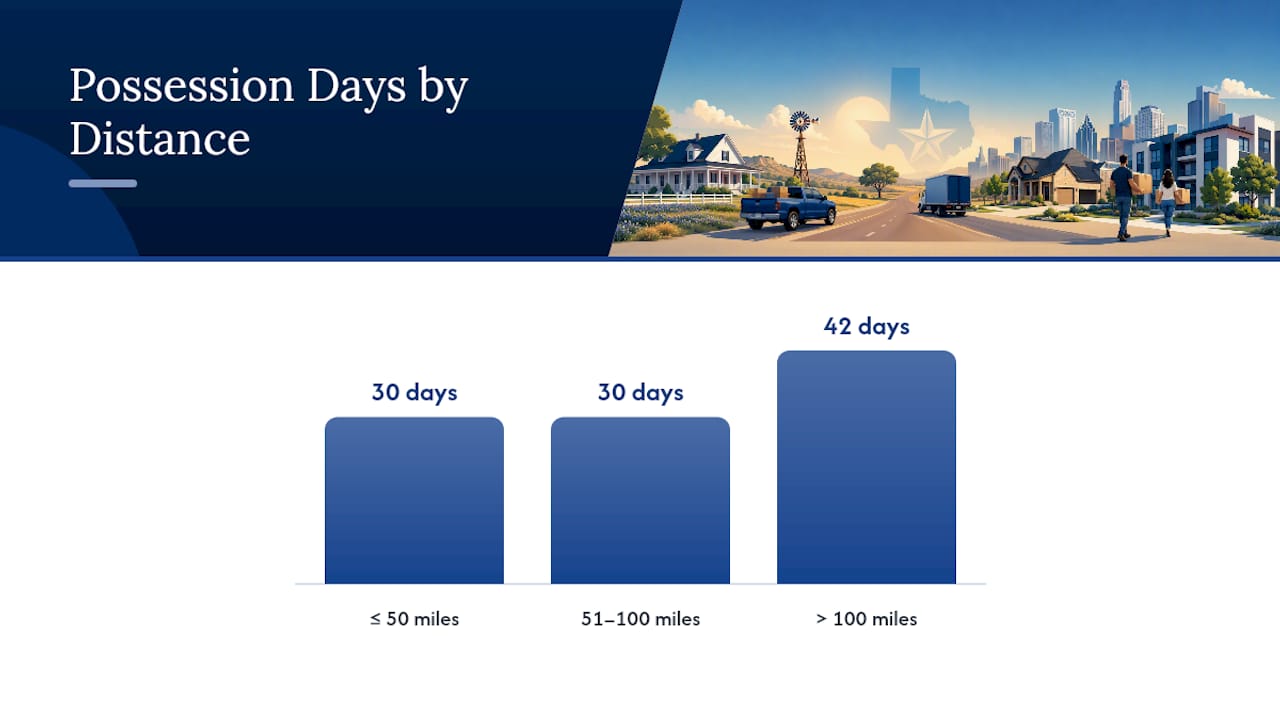
50 miles or less apart. When parents live within 50 miles of each other, the Texas Attorney General’s guidance confirms the noncustodial parent gets 30 days of extended summer possession, subject to special beginning and ending time rules under §153.3171. Because the parents are close, courts also expect more flexibility around Thursday visits and weekend exchanges continuing through the summer unless the parent exercising extended possession opts out of them for that period.
51 to 100 miles apart. Parents within this distance range may split the extended summer possession into two separate periods, each lasting at least a week.
The 42-day rule exists for a reason. When parents live more than 100 miles apart, the noncustodial parent typically sees the child far less during the school year because of travel logistics. The statute compensates with 42 days instead of 30, plus expanded rights for the custodial parent to claim up to 21 days of that period for their own family time, provided they give proper notice.
More than 100 miles apart. Beyond the extra 12 days, the default dates shift too. That distinction shows up clearly in the notice and default rules below, and it is one of the most commonly missed details when parents relocate mid case.
| Distance between parents | Summer entitlement | Can split into two periods? |
|---|---|---|
| 50 miles or less | 30 days | Limited, subject to §153.3171 |
| 51–100 miles | 30 days | Yes, two periods of 7+ days each |
| Over 100 miles | 42 days | Yes, with different default dates |
Notice Deadlines and What Happens if You Miss Them
Two dates drive almost everything about summer possession planning in Texas: April 1 and April 15.
April 1 is the deadline for the possessory parent to send written notice designating the specific dates for their extended summer period. Miss it, and you lose the ability to choose your own dates. That single date determines whether a parent controls their summer schedule or has it assigned to them by default.
April 15 is the deadline for the custodial parent to designate one weekend during the noncustodial parent’s summer period for their own possession, again by written notice.
If neither parent sends timely notice, defaults kick in automatically:
- 30-day default: July 1 at 6 p.m. through July 31 at 6 p.m.
- 42-day default: June 15 through July 27, following the dates outlined in Texas summer visitation guidance.
- Standard exchange time: Pickup and drop-off default to 6 p.m. on the start and end dates unless your order specifies otherwise.
Written notice needs to be delivered in a way you can prove later. Certified mail with return receipt requested remains the gold standard because it creates a dated, signed record. A documented message through a recognized co-parenting app, or an in-person hand delivery with a signed receipt, also works. Email alone is riskier since it is easier for the receiving parent to claim they never saw it.
Pro Tip: Send your April 1 notice in writing even if you and your co-parent already talked about summer plans by phone or text. Say the exact dates, cite the applicable Family Code section, and request written acknowledgment. A verbal agreement with no paper trail is worth very little if a dispute lands in front of a judge later.
Handling the Real-World Problems That Come Up Every Summer
Most summer possession conflicts fall into a handful of predictable categories, and each one has a reasonably clear path forward.
You missed the April 1 deadline. This happens more often than you’d think, especially to parents juggling new jobs or relocations. Your first move should be reaching out to the other parent in writing to propose dates and get their agreement documented. A missed deadline does not automatically forfeit your summer time if the other parent agrees to work with you, but if they decline and insist on the default schedule, you are likely stuck with it absent a court order saying otherwise.
Travel and camp plans. Crossing state lines or flying with a child generally does not require the other parent’s written consent under a standard order, but getting it anyway avoids disputes at the airport or camp check in. International travel is different: passport applications for minors require both parents’ consent in most cases, so build that into your April planning if a trip abroad is part of your summer.
Exchanges fail or a parent refuses possession. Document everything: text messages, missed exchange times, and any statements made at the pickup location. According to TexasLawHelp’s guidance on visitation orders, courts strongly prefer that parents attempt to resolve disputes directly before litigation, and well-documented efforts at cooperation carry weight if you eventually need to file an enforcement motion. For a single missed exchange, judges often order makeup time rather than immediate intervention, which is one more reason contemporaneous records matter.

Considering a modification. Courts will only change a standing order if you can show a material and substantial change in circumstances and that the change serves the child’s best interest. If your situation has shifted, our guide on modifying a child custody order in Texas walks through what that standard actually requires.
A Practitioner’s Checklist for Every Texas Summer
Family law offices see the same handful of mistakes every spring, almost always tied to timing rather than substance. Here is the checklist worth running through every year, regardless of how many summers you’ve already navigated.
- Pull your actual signed order and confirm it mirrors the SPO before assuming any of these rules apply exactly as written.
- Mark April 1 and April 15 on your calendar in February, not March, and send written notice with several days of buffer before the deadline.
- Keep every travel itinerary, camp registration, and emergency contact document in writing, and save your delivery receipts.
- Consult an attorney if a deadline passes with no agreement, if enforcement becomes necessary, if international travel is planned, or if either parent is proposing a relocation that could shift the distance calculation entirely.
Pro Tip: If you and your co-parent live near the 50 mile or 100 mile boundary, get the distance calculation in writing early. A move of a few miles can shift which set of rules applies to your entire summer.
Why Parents Get This Part of Custody Law Wrong
Most confusion around summer possession does not come from the statute itself. Texas Family Code Chapter 153 is more precise than people expect. The confusion comes from parents assuming their order works like a generic online summary when it actually contains custom language a judge approved for their specific case.
The conventional advice, “just follow the SPO,” undersells how often orders deviate from it, especially in cases involving supervised exchanges, geographic restrictions, or negotiated settlements. I’d argue the single highest leverage action any parent can take is reading their own order line by line every February, before the April deadlines arrive, rather than relying on memory from a prior summer.
The other place conventional wisdom falls short: treating the April 1 deadline as a formality. It is the whole game. Parents who send timely, documented notice retain control over their summer. Parents who let it slide lose that control to the default schedule, whether or not that outcome fits their actual travel or work plans. If you take one thing from this guide, prioritize the calendar reminder over the legal theory.
— Giri
How the Law Office of Anna Din Can Help With Summer Possession Questions
If your summer possession plans hit a snag, whether that’s a missed notice deadline, a co-parent who won’t cooperate on exchange dates, or a situation that has changed enough to warrant revisiting your order, Lawofficeofannadin has spent years handling exactly these disputes for families across The Woodlands and Houston.

The firm drafts formal written designations that meet the certified mail standard courts expect, prepares enforcement motions when a co-parent refuses to honor possession dates, and handles custody modification petitions when circumstances, like a job relocation or a change in the child’s needs, genuinely shift. When you come in for a consultation, bring your current custody order, any written communications about summer plans, and a rough sense of the dates you’re trying to protect or contest. Anna Din’s approach centers on getting ahead of deadlines rather than reacting after a dispute has already escalated. If April 1 or April 15 already passed without notice, or you’re facing an exchange refusal, schedule a consultation about your custody matter before the summer schedule locks into place.
Where to Verify These Rules Yourself
For the statutory language itself, read Texas Family Code Chapter 153 directly, particularly §153.312, §153.313, and §153.3171. The Texas Attorney General’s parenting time overview summarizes the schedule with sample calendars, and TexasLawHelp offers plain-language guidance on enforcement and modification standards.
This article is general information, not a substitute for advice from a qualified lawyer. Consult a qualified legal professional about your own circumstances before acting on anything here.
Sources
- Parenting time schedule — 50 miles apart or less (Texas Attorney General)
- Standard Possession Order and Parenting Time (Texas Access)
- Texas Family Code — Chapter 153 (Statutes of Texas)
- My sticker calendar visitation (Texas Attorney General PDF)
FAQ
What are the rules for summer possession in Texas?
The noncustodial parent gets 30 days of extended summer possession if parents live 100 miles or less apart, or 42 days if they live farther apart, with written notice due by April 1.
What is the Texas Standard Possession Order for 2026?
The SPO framework itself hasn’t changed structurally; it remains governed by Texas Family Code Chapter 153, so the same 30/42-day summer rules, April notice deadlines, and default dates apply this year as in prior years.
How does summer custody work in Texas?
The possessory parent designates summer dates by written notice before April 1, the custodial parent can claim one weekend by April 15, and if no notice is sent, fixed default dates and 6 p.m. exchange times apply automatically.
What is the new standard possession order in Texas?
There is no newly restructured SPO; parents should instead confirm their own signed order matches the statutory SPO, since courts enforce the specific language of each order rather than a generic template.
Can a custody order be modified if summer possession isn’t working?
Yes, but only if you can show a material and substantial change in circumstances and that the change serves the child’s best interest, a standard our custody modification guide explains in more detail.
Recommended
Questions About Your Situation?
Every family is different. Schedule a confidential consultation with Anna Din to discuss your options.
Schedule a Consultation