Transfer on Death Deed Texas: 2026 Guide for Families
August 3, 2026 · Law Office of Anna Din PLLC
TL;DR:
- A Transfer on Death Deed in Texas allows property transfer to beneficiaries without probate, but only if recorded properly before death. The deed must meet legal requirements, including notarization, specific property description, and survivorship rules, or it becomes invalid. It does not protect against liens or Medicaid claims, and family circumstances like divorce or joint ownership can produce unexpected results.
A Transfer on Death Deed (TODD) in Texas transfers your named interest in real property directly to your chosen beneficiaries at death, bypassing probate for that asset. Governed by Texas Estates Code Chapter 114, the deed must be in writing, notarized, and recorded in the county where the property sits before you die.
Key facts to know from the start:
- Probate avoidance: The property passes to beneficiaries without a court proceeding, saving time and estate costs.
- Beneficiary survivorship: Your beneficiary must survive you by at least 120 hours for the transfer to take effect.
- Liens and mortgages follow the property: A TODD does not clear existing debts. Beneficiaries inherit the property subject to any outstanding mortgage, lien, or valid creditor claim.
- MERP exposure: The Texas Medicaid Estate Recovery Program can pursue non-probate assets, so a TODD may not shield the property from Medicaid recovery.
- Recording is mandatory: An unrecorded deed is legally ineffective, no matter how carefully it was drafted.
Pro Tip: Record the deed at the county clerk’s office in the county where the property is located. If your situation involves divorce, community property, or a pending Medicaid application, schedule a review with a family-law and estate-planning attorney before relying on a DIY form.
Table of Contents
- Is a transfer on death deed right for your family?
- Texas legal requirements for a valid Transfer on Death Deed
- How does a TODD interact with probate, creditors, and Medicaid?
- Common pitfalls: divorce, joint ownership, homestead, and lenders
- How to create, record, and revoke a Texas TODD: step-by-step
- What are the alternatives to a Transfer on Death Deed?
- Key Takeaways
- Why TODDs deserve careful thought in family-law planning
- The Law Office of Anna Din helps with TODDs and family-law planning
- FAQ
- Useful sources
Is a transfer on death deed right for your family?
A TODD works best for straightforward situations: a single owner, a clear beneficiary, limited debts, and no urgency for heirs to sell or refinance immediately after death. If avoiding probate on one property is your primary goal and your life circumstances are uncomplicated, a TODD is a low-cost, low-friction option worth considering.
Caution is warranted in several scenarios. Active mortgages, significant creditor exposure, likely Medicaid claims, community-property disputes, or a pending divorce all change the calculus. If you plan to protect a homestead, manage Medicaid exposure, or preserve quick access to equity for heirs, an attorney review is the right first step rather than a downloaded form.
Texas legal requirements for a valid Transfer on Death Deed
To be effective under Texas Estates Code Chapter 114, your TODD must satisfy every item on this checklist:
- Written document. The deed must be in writing. Oral agreements or informal notes have no legal effect.
- Legal property description. Use the formal legal description from your existing deed or county deed records. Do not use the tax parcel description or mailing address alone, as tax-roll information is often inaccurate.
- Beneficiary identification. Include the full name and address of each primary and alternate beneficiary.
- Death-transfer statement. The deed must explicitly state that the transfer occurs at the owner’s death.
- Owner’s signature before a notary. Sign and acknowledge the deed before a notary public. Do not sign in advance.
- Recording before death. File the original with the county clerk in the county where the property is located during your lifetime. A deed signed but never recorded is void.
After recording, keep a copy in a secure location. Review the deed after any major life event: marriage, divorce, the death of a named beneficiary, or a property sale.
How does a TODD interact with probate, creditors, and Medicaid?
A TODD transfers title outside probate, but it does not guarantee clear, immediate marketable title. Outstanding mortgages, liens, and valid creditor claims run with the property and become the beneficiary’s responsibility.
Practitioners commonly reference a two-year window after death during which creditor claims can surface against the estate. Title insurance underwriters treat the property as legally vulnerable during that period, which means a beneficiary who wants to sell or refinance may find that lenders and title companies will not proceed until the window closes. The practical delay can be just as long as a straightforward probate proceeding.
On the Medicaid side, Texas HHS guidance confirms that MERP can pursue non-probate assets to recover long-term care costs. A TODD does not necessarily protect the property from those claims. If Medicaid eligibility or long-term-care recovery is a real possibility for you or a family member, discuss alternatives with an attorney before recording a TODD.
After the owner’s death, beneficiaries must file an Affidavit of Death in the county deed records to establish legal title. Without that filing, the beneficiary cannot sell, refinance, or use the property as collateral.
Pro Tip: If heirs will need to sell or refinance quickly, ask your attorney whether a Lady Bird deed or revocable living trust would give title companies greater comfort and reduce the post-death waiting period.
Common pitfalls: divorce, joint ownership, homestead, and lenders
TODDs can produce unexpected outcomes when family circumstances are anything but simple.
- Divorce and community property. If you and your spouse own the property together, both of you must sign the TODD. A divorce judgment recorded in the county deed records before the owner’s death automatically revokes the TODD as to the ex-spouse, but only if that judgment is recorded in time. Failing to update a TODD after a divorce can leave property to an unintended person.
- Surviving spouse and homestead rights. Under the Texas Constitution, Article XVI, Section 52, a surviving spouse retains a constitutional right to occupy the homestead for life, regardless of who is named as TODD beneficiary. The beneficiary may hold bare legal title but cannot move in, force a sale, or collect rent until the surviving spouse dies, permanently moves out, or establishes a new homestead elsewhere.
- Joint tenancy complications. If the property is held in joint tenancy with right of survivorship, that survivorship right generally overrides the TODD. The deed may sit in county records with no practical effect unless a very specific sequence of deaths occurs.
- Title company and lender hesitation. Heirs frequently discover they cannot refinance or sell during the creditor-exposure window because title insurers will not issue a clean policy. This is one of the most common post-death surprises.
A Power of Attorney cannot execute or revoke a Transfer on Death Deed on the grantor’s behalf. If the owner loses mental capacity after recording a TODD, the deed remains as recorded. Family members who want to change it may need court action. Plan for incapacity with alternative instruments before that situation arises.
How to create, record, and revoke a Texas TODD: step-by-step
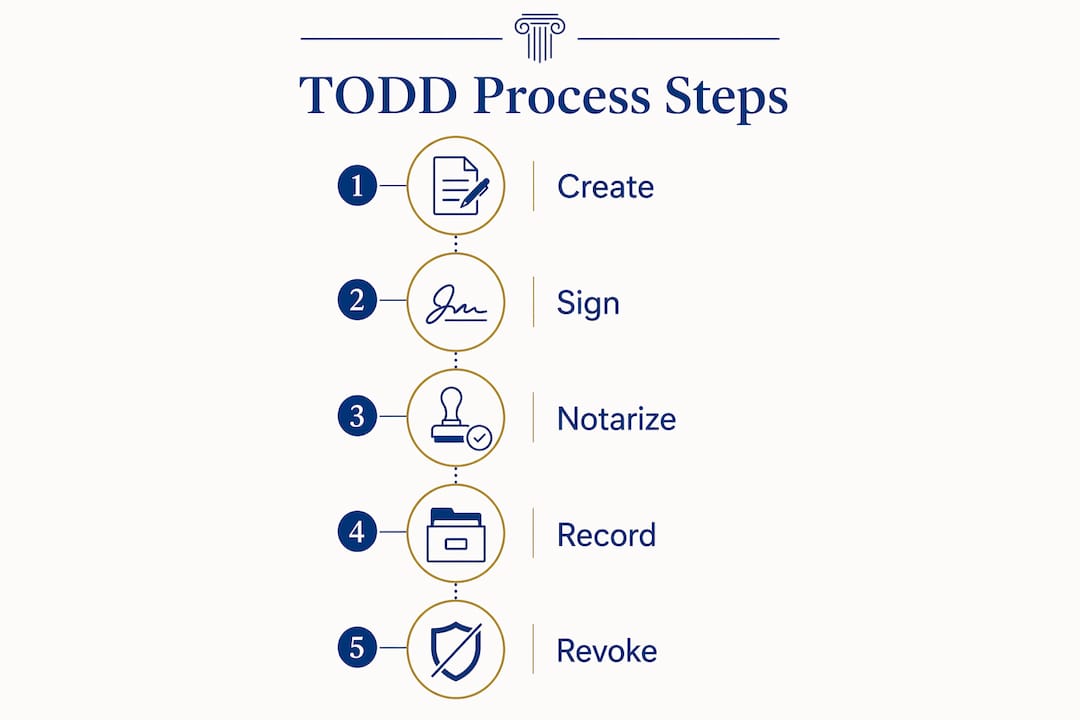
- Draft the deed. Include the owner’s name exactly as it appears on the current deed, the formal legal property description, beneficiary names and addresses, and an explicit statement that transfer occurs at death.
- Name primary and alternate beneficiaries. Always designate an alternate in case the primary beneficiary does not survive you by the required period.
- Sign before a notary. Do not sign or date the deed until you are in front of a notary public.
- Record at the county clerk’s office. Bring the original and at least one copy, along with personal identification. Recording fees vary by county; check the current fee schedule with your local clerk before you go.
- Store a copy securely. Keep a copy with your other estate documents and inform trusted family members or your attorney.
- After the owner’s death. The beneficiary files a signed, notarized Affidavit of Death with the county clerk where the property is located. Title does not legally transfer until that filing is complete.
- To revoke or update. Record a cancellation of the TODD, or record a new TODD naming different beneficiaries, at the same county clerk’s office. A later will does not override a recorded TODD.
Pro Tip: Coordinate your TODD with your wills and family planning documents. A TODD overrides a conflicting will provision for that specific property, so contradictory instructions create disputes rather than clarity.
What are the alternatives to a Transfer on Death Deed?
A TODD is one tool among several. Enhanced life estate deeds and revocable living trusts often address the weaknesses a TODD cannot.
| Feature | TODD | Lady Bird Deed | Revocable Living Trust |
|---|---|---|---|
| Avoids probate | Yes | Yes | Yes |
| Can be altered via Power of Attorney | No | Generally yes | Yes |
| Medicaid estate recovery exposure | Possible | Possible | Varies by structure |
| Title insurance likelihood post-death | Delayed (creditor window) | Often faster | Generally fastest |
| Incapacity planning | Limited | Limited | Strong |
| Complexity and cost | Low | Low to moderate | Moderate to high |
When to choose each:
- TODD: Simple estate, single owner, clear beneficiary, no creditor concerns, no urgency to sell after death.
- Lady Bird deed: Similar simplicity to a TODD but often preferred by title companies; useful when heirs may need quicker access to sale proceeds.
- Revocable living trust: Best for owners needing incapacity planning, multiple properties, blended families, or coordinated homestead and community-property management.
If you are facing divorce, a pending Medicaid application, a mortgage balance, or multiple beneficiaries who may disagree, schedule an attorney review before choosing any of these tools.
Key Takeaways
A Transfer on Death Deed in Texas avoids probate for the named property but does not eliminate liens, creditor claims, or Medicaid estate recovery exposure.
| Point | Details |
|---|---|
| Recording is mandatory | A TODD signed but not recorded before death is legally void under Texas Estates Code Chapter 114. |
| Survivorship rule requiring beneficiaries to outlive the owner by a set time | Beneficiaries must survive the owner by 120 hours or the transfer fails and the property enters probate. |
| Creditors and title delays | Creditor claims can surface for up to two years post-death, often delaying title insurance and any sale or refinance. |
| Medicaid recovery risk | Texas MERP can pursue non-probate assets; a TODD may not protect the property from long-term-care recovery claims. |
| Lawofficeofannadin | The Law Office of Anna Din prepares and records TODDs and coordinates them with divorce, homestead, and estate-planning needs for families in The Woodlands and Houston. |
Why TODDs deserve careful thought in family-law planning
Most guides present a Transfer on Death Deed as a simple, low-cost win. And for the right client, it is. But the cases that land on an attorney’s desk are rarely the simple ones.
What gets overlooked is how often a TODD interacts with an ongoing or anticipated divorce. A spouse who records a TODD without the other’s knowledge, or who forgets to update one after a separation, can inadvertently direct a family home to the wrong person. Texas community-property rules and homestead protections add layers that a standard TODD form does not address. The deed may be perfectly valid and still produce a result nobody wanted.
The other underappreciated risk is incapacity. A Power of Attorney cannot execute or revoke a TODD, which means a deed recorded years earlier can become locked in place precisely when circumstances have changed most. Families who plan only for death, and not for the years before it, often face the harder problem.
A TODD used selectively, as part of a broader plan that includes a will, a review of community-property status, and a clear incapacity strategy, is a genuinely useful tool. Used in isolation, it can create the very disputes it was meant to prevent.
The Law Office of Anna Din helps with TODDs and family-law planning
Families in The Woodlands and Houston dealing with property transfers, divorce, or estate planning deserve guidance that accounts for the full picture, not just the deed itself.

Lawofficeofannadin prepares, reviews, and records Transfer on Death Deeds and coordinates them with your existing wills, divorce proceedings, and family-law matters. The firm’s review covers beneficiary coordination, homestead and community-property issues, lien and mortgage exposure, and incapacity planning alternatives such as Lady Bird deeds and revocable trusts. If you have a pending divorce or a mortgage on the property, those factors need to be addressed before the deed is recorded, not after. You can review the firm’s family-law practice or schedule a consultation to discuss your specific situation with an attorney who understands both estate planning and Texas family law.
This article provides general legal information, not legal advice. Confirm current rules and how they apply to your situation with a qualified attorney or the relevant Texas authority.
FAQ
What makes a Transfer on Death Deed invalid in Texas?
A TODD is void if it is not recorded in the county deed records before the owner’s death, or if it lacks a notarized signature or a proper legal property description, per Texas Estates Code Chapter 114.
Does a TODD override a will in Texas?
Yes. A properly recorded TODD controls the disposition of that specific property regardless of what a later will says. To change the beneficiary, you must record a new TODD or a cancellation.
Can a Transfer on Death Deed protect property from Medicaid recovery?
Not necessarily. Texas HHS guidance confirms that MERP can pursue non-probate assets, including property transferred by a TODD, to recover long-term care costs.
How does a beneficiary claim property after the owner dies?
The beneficiary files a signed, notarized Affidavit of Death with the county clerk where the property is located. Legal title does not transfer until that affidavit is recorded.
Can a Power of Attorney create or revoke a TODD?
No. Under Texas law, a TODD cannot be created by a person acting under a Power of Attorney. That agent may cancel an existing TODD, but cannot execute a new one on the owner’s behalf.
Useful sources
| Resource | What it covers |
|---|---|
| Texas Estates Code Chapter 114 | Governing statute for TODDs: validity requirements, owner rights, survivorship rule, and revocation |
| Texas Law Help — TODDs | Plain-language guide, forms, Affidavit of Death instructions, and cancellation process |
| Texas State Law Library — Transfer Property After Death | Forms and county-recording guidance for TODDs and related instruments |
| Texas HHS — Medicaid Estate Recovery Program | Official MERP guidance on non-probate asset recovery |
| County clerk’s office (county where property is located) | Current recording fee schedule, Affidavit of Death forms, and cancellation forms |
Recommended
Questions About Your Situation?
Every family is different. Schedule a confidential consultation with Anna Din to discuss your options.
Schedule a Consultation