Proving Adultery Can Shift Texas Divorce Splits Toward 60/40
Yes. Under Texas law, adultery is a civil fault ground under Tex. Fam. Code §6.003, and proving it can shift how a judge divides property, awards spousal maintenance, and, in rare cases, weighs custody. It doesn’t automatically win you a bigger share of the estate or sole custody. Courts still require solid evidence and a clear link between the affair and the harm it caused before adultery moves the needle on your outcome.
TL;DR:
- Proving adultery in Texas requires concrete evidence such as witness testimony, financial records, electronic messages, or photographic proof, not suspicion or gossip.
- Evidence of an affair must meet the preponderance standard, meaning it is more likely than not that the affair occurred, often relying on patterns like travel, financial transactions, or private investigation reports.
- Proven adultery can influence property division by justifying a larger share for the innocent spouse if a causal link shows financial or emotional harm, typically around 60/40 in the split.
- Fault allegations like adultery can strengthen or weaken maintenance and custody outcomes depending on timing, severity, and whether the evidence supports the claim.
- Falsely accusing a spouse of adultery can lead to sanctions, attorney’s fees, or credibility issues; strong evidence is essential before making such claims in court.
Table of Contents
- What Does Adultery Mean Under Texas Law?
- What Evidence Proves Adultery in a Texas Divorce?
- Can Adultery Affect How Property Gets Divided?
- Does Adultery Affect Spousal Maintenance in Texas?
- Does an Affair Affect Child Custody in Texas?
- How Do You File for Divorce on Adultery Grounds in Texas?
- What Are the Risks of Alleging Adultery You Didn’t Prove?
- When Should You Bring in a Texas Family Lawyer?
- What Happens If Someone Falsely Accuses Their Spouse of Adultery?
- How Does a Prenup Change the Adultery Conversation?
- An Editor’s Take on Fault Versus Focus
- How Anna Din Can Help With Your Adultery Divorce Case
- Key Statutes and Resources
- Sources
- FAQ
What Does Adultery Mean Under Texas Law?
Texas defines adultery narrowly. Under Tex. Fam. Code §6.003, it means voluntary sexual intercourse between your spouse and someone who is not you. A judge can grant a divorce in your favor as the innocent spouse if you prove it happened. That’s the entire statutory definition, and it matters because Texas courts hold petitioners to it strictly.
A few things to keep straight from the start:
- Adultery is a civil matter in Texas, not a crime. No one goes to jail over it.
- You can file on adultery as a fault ground, or you can file for insupportability (Texas’s no-fault option), which requires no proof of wrongdoing at all.
- Most Texans choose insupportability because it’s faster and cheaper, even when infidelity is the real reason the marriage ended.
- Fault and no-fault grounds can be pled together in the same petition, giving you flexibility as the case develops.
What Evidence Proves Adultery in a Texas Divorce?
Texas courts don’t accept suspicion, gut feelings, or a friend’s tip as proof. You need evidence that meets the preponderance of the evidence standard, meaning it’s more likely than not that the affair happened. That’s a lower bar than the criminal standard, but it still requires something concrete.
Judges in Texas typically weigh these categories of proof:
- Direct testimony from a witness who observed the relationship, including the other party in some cases.
- Documentary evidence, such as hotel receipts, credit card statements, or travel records that place your spouse with someone else at suspicious times.
- Electronic evidence, including texts, emails, or social media messages, obtained through lawful means.
- Photographic or video evidence showing conduct consistent with an affair.
- Private investigator reports, when the investigator’s methods stayed within legal bounds.
Texas courts have also accepted circumstantial evidence when it’s “clear and positive,” meaning the pattern of facts leaves little room for innocent explanation. Flirty texts alone rarely clear that bar. A pattern of overnight stays, financial records showing a second household, and witness testimony together usually do.
Pro Tip: Never hire someone to install a GPS tracker or record conversations without consent. Illegally obtained evidence can get thrown out of court, and you could face civil or criminal liability yourself. Stick to lawful documentation and let your attorney guide the discovery process.
Can Adultery Affect How Property Gets Divided?
Texas is a community property state, and Tex. Fam. Code §7.001 requires courts to divide that property in a manner that is “just and right.” That standard gives judges real discretion, and proven adultery is one of the factors, known as the Murff factors, that can justify awarding one spouse a larger share.
The Murff factors include things like each spouse’s earning capacity, health, education, and fault in the breakup of the marriage. Adultery falls under that last category, but a judge won’t punish a cheating spouse just to punish them. The court looks for a causal link: did the affair drain marital funds, or did it directly cause the breakdown of the marriage?
Common scenarios that move a judge toward a disproportionate split:
- Marital funds spent on gifts, travel, or a second residence for the affair partner.
- Evidence that the affair, not general incompatibility, precipitated the separation.
- A significant gap in the spouses’ post-divorce earning capacity, compounded by the fault finding.
Practitioner guides note that disproportionate awards in adultery cases are sometimes illustrated by splits around 60/40, though the actual number always depends on the trial record. If you’re worried about how a spouse’s spending on an affair intersects with retirement accounts or investments, it helps to understand how divorce affects retirement assets before you get to trial.
Does Adultery Affect Spousal Maintenance in Texas?
Spousal maintenance in Texas isn’t automatic. You have to meet specific eligibility criteria under Chapter 8 of the Texas Family Code, which considers factors like the length of the marriage, each spouse’s ability to earn income, and, yes, fault in the breakup.
Here’s how adultery typically plays out:
- If you’re the spouse seeking maintenance and your spouse committed adultery, that fault can strengthen your case, especially when combined with a long marriage or limited earning capacity.
- If you committed the adultery, it can work against you. A judge may reduce or deny your maintenance request based on that conduct.
- Timing matters. An affair that occurred years before separation, unconnected to the marriage’s collapse, carries less weight than one that directly triggered the breakup.
- Adultery does not override the statutory eligibility requirements. If you don’t otherwise qualify for maintenance, proving fault won’t create eligibility out of nothing.
Does an Affair Affect Child Custody in Texas?
Texas custody decisions run entirely on the best interest of the child standard. An affair, standing alone, almost never decides who gets primary custody. Judges care about parenting capacity, stability, and safety, not who was unfaithful.
That said, affair-related conduct can become relevant when it overlaps with the child’s welfare:
- Exposing children to an affair partner in ways that create instability or confusion.
- Neglecting parenting duties because of time or money diverted to the relationship.
- Financial instability caused by the affair that affects the child’s home environment.
- Any overlap with abuse, substance use, or unsafe conditions tied to the new relationship.
If you plan to raise these issues in a custody dispute, frame them around the child’s wellbeing, not moral judgment. Courts tune out accusations that sound like retaliation. For a fuller picture of what judges actually weigh, see what Texas courts consider when deciding child custody.
How Do You File for Divorce on Adultery Grounds in Texas?
Filing on fault grounds follows the same basic procedural rules as any Texas divorce, with a few added layers once you plead adultery.
- Confirm residency. You or your spouse must have lived in Texas for at least six months and in the county where you file for at least 90 days.
- File your petition naming adultery as a ground, alongside or instead of insupportability.
- Wait out the mandatory 60-day period before a Texas court can finalize any divorce, fault or no-fault.
- Expect expanded discovery. Pleading adultery typically means more depositions, subpoenas, and document requests, which stretches your timeline and raises legal fees.
If your case doesn’t hinge on recovering assets or affecting maintenance, insupportability is often the more practical route. For a full walkthrough of the filing process, review this step-by-step guide to filing for divorce in The Woodlands.
What Are the Risks of Alleging Adultery You Didn’t Prove?
Pleading adultery you can’t back up rarely helps your case and often hurts it. The opposing side will raise defenses like outright denial, questioning the timing of the alleged affair, or simply pointing out that your evidence falls short of the preponderance standard.
Consider these risks before you allege fault:
- Wasted discovery costs. Fault claims that don’t hold up still trigger expensive depositions and document exchanges.
- Privacy and legal exposure. Chasing evidence through illegal surveillance, hacking accounts, or unauthorized recordings can expose you to civil liability or criminal charges.
- Credibility damage. Judges remember when a party overreaches on fault claims without proof, and it can color how they view your other requests in the case.
Pro Tip: Before you plead adultery, run a cost-benefit check with your attorney. Ask what specific financial or custody outcome you’re trying to achieve, and whether your current evidence can realistically get you there. If the answer is unclear, insupportability may get you to the same result faster and cheaper.
When Should You Bring in a Texas Family Lawyer?
Contested assets, disputed custody, or evidence that needs to be gathered and preserved quickly are all signals that it’s time to call an attorney. A Texas family lawyer can help you lock down financial records before they disappear, build a discovery plan, and frame your case around the Murff factors that actually move judges. Legal guidance often shapes the entire trajectory of a fault-based case.
What Happens If Someone Falsely Accuses Their Spouse of Adultery?
Texas courts don’t take false adultery allegations lightly, though the consequences work differently than most people expect. There’s no standalone criminal charge for falsely accusing a spouse of cheating in a divorce filing. The exposure comes through the civil process itself.
If you plead adultery and can’t support it with evidence meeting the preponderance standard, the court simply won’t grant the divorce on that ground. Your case typically proceeds on insupportability instead, so the practical penalty is usually a wasted claim rather than a court sanction. But the risks run deeper than a denied pleading.
A spouse who makes adultery allegations in bad faith, purely to gain leverage in settlement talks or to damage the other party’s standing, can face pushback from the court. Judges have discretion to award attorney’s fees against a party who pursued claims without a good-faith basis, particularly if the allegations appear designed to harass rather than to prove a legitimate fault ground. Discovery abuse tied to unfounded claims, like excessive subpoenas or depositions built around an accusation with no evidentiary support, can also draw sanctions under Texas civil procedure rules.
There’s also a reputational cost that doesn’t show up in a court order. False adultery claims can affect how a judge weighs your credibility on every other contested issue in the case, from property division to custody. If you’re considering an adultery claim and you’re not confident in your evidence, talk through the realistic risks with your attorney before you file. It’s rarely worth the exposure.
How Does a Prenup Change the Adultery Conversation?
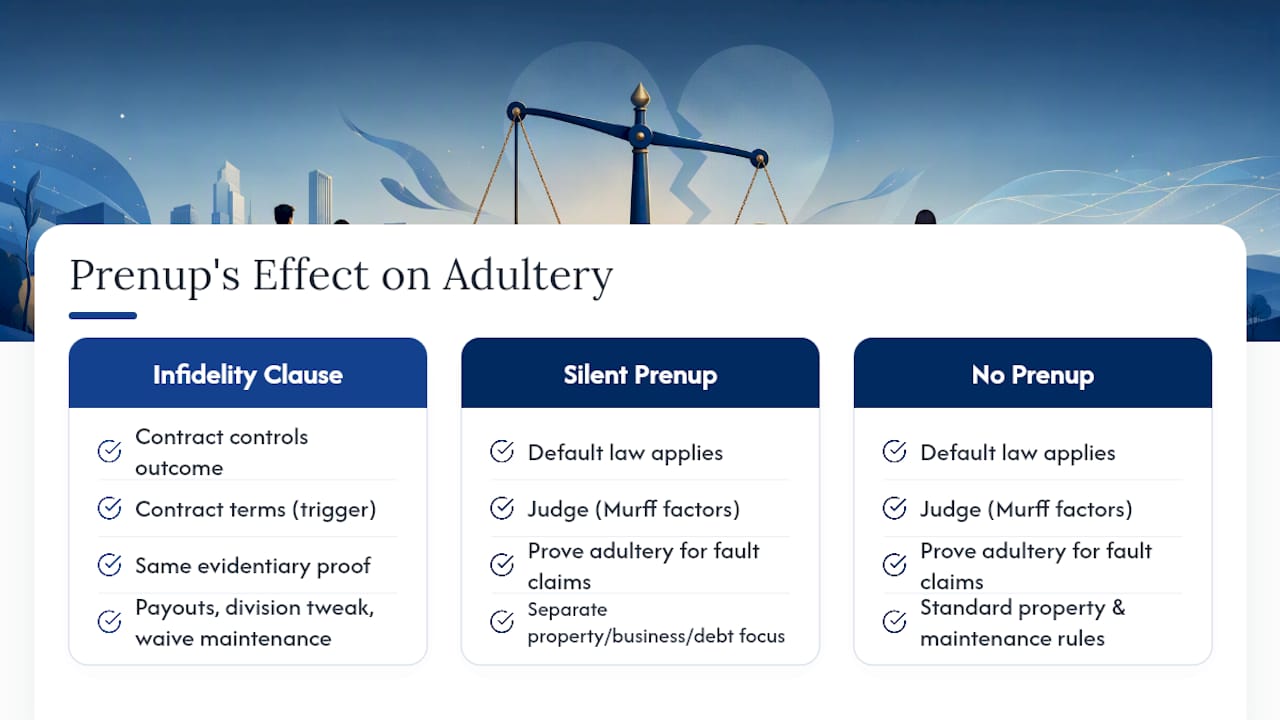
Premarital and marital agreements can reshape how adultery plays out in a Texas divorce, sometimes dramatically. Many Texas prenups include what’s known as an infidelity clause, a provision that spells out specific financial consequences if one spouse commits adultery during the marriage. These clauses might set a fixed dollar payout, adjust the property division formula, or waive certain maintenance rights for the unfaithful spouse.
When a valid prenup contains an infidelity clause, it can override the default Murff-factor analysis courts would otherwise use. Instead of a judge weighing fault alongside earning capacity and health, the contract itself dictates the outcome, provided it was properly executed and isn’t unconscionable. That makes proving adultery still relevant, but the fight shifts from “how should a judge divide this” to “did the triggering event described in our contract actually occur.”
Not every prenup addresses adultery at all. Many focus purely on separate property protection, business interests, or debt allocation without touching fault-based conduct. If your prenup is silent on infidelity, the standard Murff analysis and the statutory maintenance rules still apply just as they would without a contract in place.
Couples negotiating a prenup should think carefully about whether to include an infidelity clause, since enforcing one later requires the same evidentiary proof as any adultery claim. If you’re unsure whether your marital agreement addresses this issue, or you’re negotiating one now, review your document with an attorney who can flag gaps before they matter.
An Editor’s Take on Fault Versus Focus
Here’s the tension nobody says out loud: pursuing adultery as a fault ground can win you real financial ground, but it almost always costs more time, more money, and more emotional wear than a no-fault filing. That tradeoff is worth naming honestly instead of pretending the “correct” choice is always to fight for fault.
My take, after working through the statutes and case patterns: pursue adultery when the financial stakes are large and your evidence is genuinely strong, not because you want vindication. When kids are involved, keep the fight centered on their stability, not on settling scores. Every case is different, and a consult with a Texas family attorney will tell you far more than any general guide can.
— Giri
How Anna Din Can Help With Your Adultery Divorce Case
Building a fault-based case in Texas takes more than knowing the statute. It takes a strategy for gathering admissible evidence, framing the Murff factors persuasively, and knowing when fault litigation is worth the added cost and when it isn’t. The Law Office of Anna Din works with Woodlands-area clients on exactly this calculation, weighing your specific financial picture and custody concerns against the realistic gains of pursuing adultery as a ground.

If you’re heading into a consult, bring what you have: financial records, any documented evidence of the affair, a list of marital assets, and your questions about custody or maintenance. A Texas divorce attorney can tell you within that first conversation whether your evidence supports a fault claim or whether your energy is better spent elsewhere. Preserve what evidence you have now, then schedule a consultation to map out your next move before deadlines start working against you.
Key Statutes and Resources
For direct statutory language, review Tex. Fam. Code §6.003 on adultery, Chapter 6 on divorce procedure, and Chapter 8 on spousal maintenance eligibility.
This article is general information, not a substitute for advice from a qualified lawyer. Consult a qualified legal professional about your own circumstances before acting on anything here.
Sources
FAQ
What Are the Consequences of Adultery in a Marriage Under Texas Law?
Adultery can lead to a disproportionate division of community property, affect spousal maintenance eligibility, and, when tied to a child’s welfare, factor into custody decisions, but it requires proof meeting the preponderance standard.
What Should I Do if My Husband Cheated and Had a Baby With Another Woman?
Document the timeline and any financial resources diverted to that relationship, since this can strengthen a disproportionate property claim, and talk to an attorney about how it may affect paternity, support, and custody arrangements involving the other child.
What Is the 10-Year Rule in Divorce in Texas?
The “10-year rule” refers to marriages lasting 10 years or longer, which can qualify a spouse for spousal maintenance under Texas’s maintenance statute even without proving fault, though eligibility still depends on additional financial factors.
How Long Do Cheaters Stay With the Person They Cheated With?
There’s no legal data tracking this, and it has no bearing on a Texas divorce case. What matters legally is whether the affair caused financial harm or contributed to the marriage’s breakdown, not how long the relationship afterward lasted.
Do I Need a Lawyer to Prove Adultery in Texas?
You aren’t legally required to hire one, but proving adultery involves evidentiary rules, discovery strategy, and Murff-factor arguments that are difficult to navigate alone, which is why most petitioners work with a family law attorney.
Recommended
Questions About Your Situation?
Every family is different. Schedule a confidential consultation with Anna Din to discuss your options.
Schedule a Consultation