Judge Ordered Attorney Fees in Texas Divorce: §6.708, Local Costs

Each spouse in a Texas divorce normally pays their own attorney out of pocket, since Texas follows the American Rule on legal costs. But that isn’t the whole story: Texas judges have statutory authority to order one spouse to pay part or all of the other’s fees when circumstances justify it. If you’re worried about affording representation, your first move should be documenting your finances and, if needed, filing a motion for temporary attorney fees.
TL;DR:
- Judges in Texas can order one spouse to pay all or part of the other’s legal fees if justified, especially in cases of income disparity or bad-faith conduct.
- Typical attorney fees range from $200 to $500 per hour, with uncontested divorces often costing $500 to $3,000 in flat fees, while contested cases can exceed tens of thousands of dollars.
- Requesting temporary fee assistance requires documented proof of financial need, filed early in the case, and based on the other spouse’s ability to pay.
- Enormous cost drivers include discovery disputes, custody conflicts, and business valuations, which significantly increase billable hours in contentious cases.
- Proactive financial documentation and exploring mediation or limited-scope legal services can help control overall legal costs.
Table of Contents
- What Does Texas Law Say About Attorney Fees in Divorce?
- How Much Does a Divorce Attorney Cost in Texas?
- Who Pays Attorney Fees in a Texas Divorce?
- Can You Get Temporary Help Paying Your Attorney?
- What Drives the Cost of a Texas Divorce Up?
- How Can You Lower Your Legal Costs?
- How Does Law Office of Anna Din Help With Fee Planning?
- What Clients Get Wrong About Attorney Fees
- Get Clear Answers About Your Own Legal Costs
- Where to Verify These Statutes and Fees
- Sources
- FAQ
What Does Texas Law Say About Attorney Fees in Divorce?
The starting point for every fee question in a Texas divorce is Tex. Fam. Code §6.708. This statute lets a court award “reasonable and necessary” attorney’s fees and expenses to either spouse and, notably, allows the judge to order payment directly to the attorney rather than routing it through the client. The public-law text of §6.708 confirms that once a judge orders fees paid directly to counsel, the attorney can enforce that order in their own name, almost like collecting on a separate judgment.
“Reasonable and necessary” is a factual finding, not a formality. Judges typically expect evidence such as itemized billing records, an attorney’s testimony about hours worked and hourly rate, and proof that the work was tied to the actual issues in the case.
A few related statutes matter just as much as §6.708 itself:
- §6.502 allows a court to grant temporary orders, including interim attorney fees, while the case is pending.
- §9.106 lets a court award fees connected to enforcing a prior divorce decree, such as when one spouse ignores a property division or support order.
- Fee awards under all of these provisions remain discretionary. A judge can decide the amount, the timing, or deny the request entirely based on the financial picture presented.
How Much Does a Divorce Attorney Cost in Texas?
Texas divorce attorneys generally bill in one of three ways: hourly, flat fee, or a hybrid retainer arrangement. Hourly billing is the most common model for contested cases, and rates in Texas typically run between about $200 and $500 per hour, with Houston-area attorneys often landing in the $250 to $450 range depending on experience and case complexity. Smaller counties outside major metro areas tend to sit at the lower end of that scale.
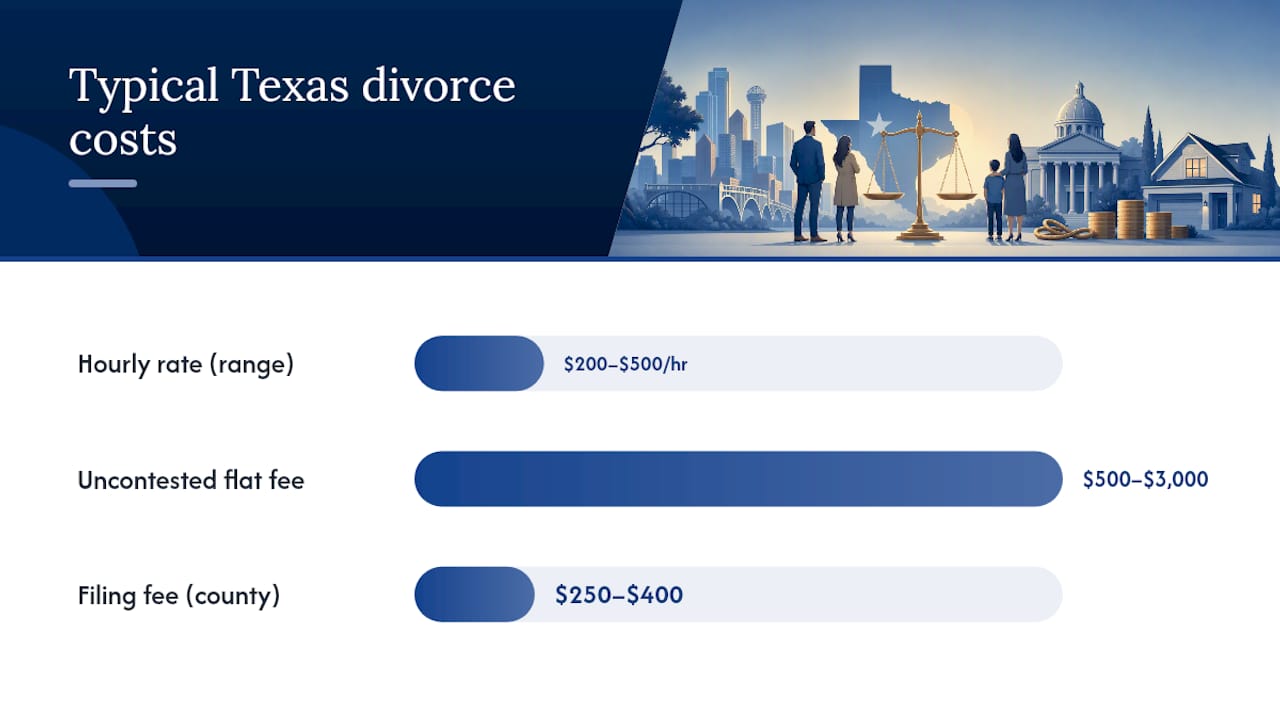
Statistic Callout: Uncontested divorces in Texas commonly carry flat fees ranging from $500 to $3,000, according to Divorce.law’s Texas cost guide. Contested cases rarely fit a flat fee because the hours required are unpredictable.
Most attorneys require a retainer, an upfront deposit drawn down as work is billed, rather than a true flat rate for anything beyond a simple divorce. Expect the retainer conversation to include:
- The initial retainer amount and whether it’s refundable if unused.
- Hourly rates for the attorney versus paralegals or associates.
- Separate charges for court costs, deposition transcripts, expert witnesses, and copying or filing fees.
Filing fees themselves vary by county. Many Texas counties charge $250 to $400 to file a divorce petition, and Harris County filings often land near $350, while some smaller counties charge closer to $250. If you’re filing in the Houston area, our Texas divorce costs guide for 2026 breaks down local numbers in more detail.
Who Pays Attorney Fees in a Texas Divorce?
Courts don’t shift fees automatically. A judge has to find a specific reason to order one spouse to cover part of the other’s legal bill. Based on how Texas courts commonly apply §6.708, the most frequent grounds include:
- Income disparity. When one spouse earns significantly more or controls most of the marital assets, a judge may order that spouse to contribute to the other’s fees so both sides can litigate on more even footing.
- Bad-faith conduct. Hiding assets, refusing to produce financial records, or manufacturing unnecessary delay can lead a judge to shift fee responsibility as a consequence, according to guidance from McConathy Law.
- Enforcement actions. Under §9.106, if one spouse has to go back to court to force compliance with the divorce decree, the noncompliant spouse often ends up paying the enforcing spouse’s attorney fees.
To request a fee award, your attorney files a motion, often as part of the divorce petition or a later motion for temporary orders, and attaches financial evidence: income statements, asset disclosures, and sometimes an affidavit explaining why you lack access to marital funds. At the hearing, expect the judge to weigh both spouses’ ability to pay against the reasonableness of the requested amount. The outcome may be a lump-sum award, ongoing monthly support toward legal costs, or an allocation folded into the final division of community debts.
Can You Get Temporary Help Paying Your Attorney?
If your spouse controls the bank accounts, temporary orders under §6.502 are often the fastest way to close that gap. Courts evaluate three things when deciding a temporary-fee request: your immediate financial need, the other spouse’s ability to pay, and the likelihood that your case has merit. Practitioner guidance from McConathy Law notes that acting early, before your spouse has time to restrict access to joint funds, makes a real difference in outcomes.
Bring these documents when you meet with your attorney about a temporary-fees motion:
- Recent pay stubs and bank statements for both spouses, if available.
- A written list of joint and separate assets and debts.
- A short affidavit describing why you can’t currently afford representation.
Pro Tip: File your temporary-fees motion as early as possible, even before your first hearing. Waiting gives a controlling spouse more time to move or hide liquid assets, and judges respond better to requests made before a financial gap becomes a crisis.
What Drives the Cost of a Texas Divorce Up?
Most of the cost difference between a simple divorce and an expensive one comes down to how much fighting happens over evidence, not the divorce itself. The biggest cost drivers include:
- Discovery disputes. Formal requests for documents, interrogatories, and depositions all add billable hours, especially when one side resists producing records.
- Custody conflicts. Contested conservatorship or possession schedules often require custody evaluations, guardian ad litem involvement, and multiple hearings.
- Business valuations. Divorces involving a family business typically require a forensic accountant or valuation expert, which adds thousands of dollars beyond attorney fees. Our guide on protecting a business in a Texas divorce covers this in more depth.
- Enforcement or modification actions filed after the divorce, which restart the fee clock even after the original case closes.
Statistic Callout: Based on typical Texas hourly ranges of $200 to $500 per hour, a straightforward uncontested divorce might total a few hundred to a few thousand dollars in legal fees, a moderately contested case with some custody or property disputes often runs into the low-to-mid five figures, and a high-conflict case involving business valuations or extensive discovery can climb well beyond that. Every additional hour of discovery, every deposition, and every expert witness converts directly into billable time.
How Can You Lower Your Legal Costs?
You have more control over your final bill than most people realize. Consider these approaches before assuming litigation is your only path:
- Mediation. A mediator helps both spouses reach agreement outside court, often at a fraction of the cost of a trial.
- Collaborative law. Both spouses and their attorneys commit to negotiating in good faith without going to court, which usually reduces the hours billed.
- Limited-scope representation. Some attorneys will handle a specific piece of your case, like reviewing a settlement agreement, rather than full representation.
- Uncontested filing. If you and your spouse agree on the major issues, a flat-fee uncontested divorce keeps costs predictable.
Ask any attorney you consult these questions before signing a retainer: What’s your estimated total hours for a case like mine? What specifically is covered in the retainer versus billed separately? What triggers additional charges?
Pro Tip: Ask your attorney to put a rough hour estimate in writing after your first consult. It won’t be exact, but it gives you a real number to budget against instead of an open-ended guess.
How Does Law Office of Anna Din Help With Fee Planning?
Anna Din’s office works with Texas clients on the financial side of divorce as much as the legal strategy, because the two are inseparable. Before your first filing, our Financial Planning Before Divorce guide walks through how to organize your income, assets, and debts, exactly the kind of documentation a judge wants to see in a temporary-fees motion.
If you’re still deciding whether to file, our before-filing checklist covers the practical steps to take first. When you’re ready to talk, bring:
- Recent pay stubs and bank or asset statements.
- A written list of what you own and owe.
- Your completed before-filing checklist, if you’ve started one.
We serve clients in the Texas area, and every consult begins with a review of what your specific case may cost.
What Clients Get Wrong About Attorney Fees
The regret I hear about most often isn’t the size of the final bill. It’s how long people wait to write down what they actually own, earn, and owe. That delay costs real money once a case is underway, because attorneys spend billable hours reconstructing financial pictures that clients could have documented for free in a weekend. If your finances feel uncertain, a short, focused consult early on is worth far more than it costs.
— Giri
Get Clear Answers About Your Own Legal Costs
A general cost guide can only tell you so much. What actually matters is what your case, your assets, and your county will cost, and that’s a conversation, not a formula. Lawofficeofannadin brings a personalized, transparent approach to that conversation: clients get a clear read on likely fees, whether a temporary-fees motion makes sense, and what documents to gather before the first hearing, without vague estimates or surprise billing later.

If you’re weighing whether to file, start with a consult through our divorce and marital law practice page. Bring your pay stubs, a list of assets and debts, and any paperwork from your spouse’s side if you have it. From there, we can talk through realistic fee ranges for your situation and whether requesting a temporary-fee order makes sense before you go further. Reach out through our contact page to schedule a time that works for you.
Where to Verify These Statutes and Fees
- Tex. Fam. Code §6.708: the actual statute authorizing fee awards.
- Texas eFile Self-Help Portal: forms and steps for pro se or limited-scope filings.
- TexasLawHelp: guidance on fee waivers for low-income filers.
This article is general information, not a substitute for advice from a qualified lawyer. Consult a qualified legal professional about your own circumstances before acting on anything here.
Sources
- Tex. Fam. Code Chapter 6 (Statutes at Large) - Texas Legislature
- Texas Family Code - FAM § 6.708. Attorney’s Fees, Court Costs, and Expenses
- Divorce
- Texas eFile Self-Help Portal
FAQ
How Much Does a Good Divorce Attorney Cost in Texas?
Rates typically run between $200 and $500 per hour depending on experience and location, with Houston-area attorneys often falling between $250 and $450. Uncontested divorces with flat fees commonly range from $500 to $3,000, while contested cases usually bill hourly because the total hours are unpredictable.
What Is the 10-Year Rule in a Texas Divorce?
This phrase usually refers to spousal maintenance eligibility, not attorney fees. Texas law allows courts to consider awarding spousal maintenance when a marriage has lasted long enough and the requesting spouse can’t meet basic needs, though eligibility depends on several other factors as well.
Who Loses More Financially in a Divorce?
There’s no universal answer since outcomes depend on income disparity, asset division, and who ends up paying legal fees. A spouse with less access to marital funds during the case often faces the steepest early costs, which is exactly why Texas allows courts to award temporary attorney fees under §6.502 to level that gap.
What Should You Avoid Doing During a Texas Divorce?
Avoid hiding assets, ignoring discovery requests, or delaying court filings, since Texas judges can treat this kind of conduct as grounds for shifting attorney fees onto the noncompliant spouse. Also avoid waiting too long to document your finances, since early records matter if you need to request a fee award later.
Does Law Office of Anna Din Offer Help With Attorney Fee Motions?
Yes. Anna Din’s office assists Texas clients with financial documentation and temporary-fee motions as part of divorce representation, and current fee information is available by scheduling a consult through the divorce and marital law practice page.
Recommended
Questions About Your Situation?
Every family is different. Schedule a confidential consultation with Anna Din to discuss your options.
Schedule a Consultation