Texas Divorce Costs in 2026: What You’ll Actually Pay
September 8, 2026 · Law Office of Anna Din PLLC

A straightforward, uncontested Texas divorce with no children and minimal shared assets can cost as little as $300–$500 in total, covering only the filing fee and service of process. At the other end, a contested divorce involving children, real estate, and business interests routinely runs $15,000–$30,000 or more, and high-asset cases with forensic experts can push well past that. Knowing where your situation falls before you file is the most practical thing you can do.
Quick cost snapshot by scenario:
- DIY uncontested, no children, simple assets: a total covering only the filing fee and service of process
- Uncontested with attorney help, no children: an amount typically ranging in the lower thousands for attorney-assisted uncontested divorces without children
- Uncontested with attorney, minor children: an amount generally higher when attorney assistance includes minor children
- Contested, children and standard assets: costs commonly reaching into the mid five-figure range or more for contested cases with children and standard assets
- High-asset or business-owner contested case: costs that can run well into six figures for high-asset or complex business-owner contested cases
The estimates above draw on the Texas court filing fee schedule, the Texas Family Code, and guidance published by Texaslawhelp. Separating your total into three distinct buckets — court costs, attorney fees, and third-party vendor costs — keeps the numbers from blurring together as your case progresses.
Key Takeaways
A DIY uncontested Texas divorce costs $300–$500 in court fees alone, while contested cases with children and business assets commonly reach $15,000–$42,000 or more depending on expert and attorney needs.
| Point | Details |
|---|---|
| Filing fees vary by county | Most Texas counties charge $250–$400 for an original petition; check your district clerk’s schedule for exact figures. |
| Conflict level drives total cost | Contested cases with discovery and experts routinely cost commonly reaching into the mid five-figure range or more for contested cases with children and standard assets; agreement before filing keeps costs near $300–$500. |
| Three cost buckets to track | Separate court costs, attorney fees, and third-party vendor costs to budget accurately and avoid conflating filing fees with total case cost. |
| Fee waivers are available | Under Tex. R. Civ. P. 145, filers at or below 125% of the federal poverty guidelines may suspend most court costs with a sworn statement. |
| Lawofficeofannadin provides local cost guidance | The firm offers consultations in The Woodlands and Houston to help you estimate your specific case costs and choose the right representation path. |
Table of Contents
- How much does divorce cost in Texas at the courthouse?
- Which divorce path fits your situation and budget?
- How do Texas attorneys bill, and what should you budget?
- What actually drives costs up beyond the basics?
- How do costs accumulate over the timeline of a Texas divorce?
- How can you reduce what you pay for a Texas divorce?
- Sample budgets for three common Texas divorce scenarios
- What should you do before you file in Texas?
- What family-law attorneys actually see that clients miss
- Lawofficeofannadin offers local guidance on what your divorce will actually cost
- Sources
- FAQ
How much does divorce cost in Texas at the courthouse?
Filing fees are the first check you write, and they vary more than most people expect. Texas district clerks combine state-mandated consolidated costs under Tex. Gov’t Code Chapter 51 with county-specific clerk additions, so the total on your receipt depends on where you file. Most counties charge filing fees generally in the range of a few hundred dollars for an original divorce petition, with larger counties such as Harris charging near the higher end of typical amounts.
Beyond the petition itself, several line items add predictable costs to almost every case:
- Service of process: A constable or private process server charges separately to deliver the petition to your spouse. Fees vary by county and server.
- Citation issuance: The clerk charges a separate fee to issue the citation document.
- Certified copies: Each certified copy of the final decree carries a per-copy and sometimes per-page charge.
- E-filing surcharge: Texas requires electronic filing in most courts; the e-filing vendor adds a transaction fee on top of the clerk’s fee.
- Per-motion fees: In contested cases, each additional motion filed may carry its own filing charge.
The Bexar County fee schedule illustrates exactly how these line items stack: filing, certified copies, per-page copy charges, and miscellaneous fees each appear as separate entries. Your county’s district clerk publishes the same breakdown, and the Texas Office of Court Administration maintains a statewide reference at txcourts.gov.
One practical shortcut: if your spouse is willing to sign a notarized Waiver of Service after you file, you eliminate the service-of-process charge entirely. That single step can save $75–$150 or more depending on your county.

Which divorce path fits your situation and budget?
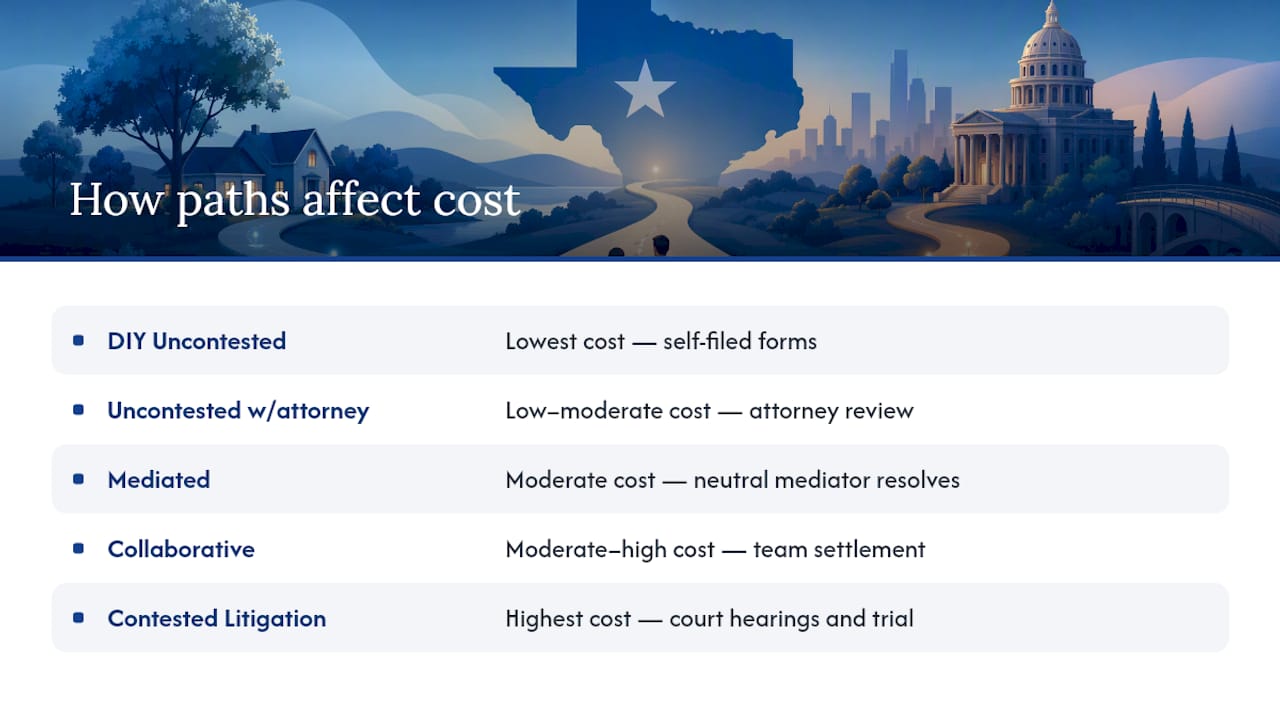
The path you choose shapes your total cost more than any other single decision. Here is how the five main options compare in Texas.
DIY uncontested filing
Total cost: $300–$500. You complete the forms yourself, file at the courthouse, and serve your spouse (or use a signed waiver). eFileTexas offers a guided self-help interview that walks you through the paperwork at no charge. This path works only when both spouses agree on every issue and there are no children, no real estate, and no retirement accounts to divide.
Uncontested with attorney assistance
Total cost: $1,500–$8,000, depending on whether children are involved. An attorney drafts or reviews the final decree, catches errors that could require a costly amendment later, and files everything correctly the first time. Flat-fee packages for straightforward uncontested cases are common in Texas and offer predictable pricing.
Mediated divorce
Total cost: $3,000–$15,000 all-in. A neutral mediator helps both spouses reach agreement on disputed issues before a judge ever gets involved. Mediator fees typically run $250–$500 per hour, with full mediation packages commonly totaling $1,000–$3,000. Each spouse usually retains an attorney to review the agreement, adding to the total but keeping costs well below full litigation.
Collaborative divorce
Total cost: $5,000–$25,000. Both spouses hire collaboratively trained attorneys and commit in writing to resolve everything outside court. Financial neutrals and child specialists may join the process. Costs are higher than mediation but lower than contested litigation, and the process tends to preserve co-parenting relationships better.
Contested litigation
Total cost: $15,000–$30,000 or more. When spouses cannot agree, a judge decides. Discovery, hearings, and expert witnesses drive costs rapidly. Cases involving custody disputes, business interests, or significant real estate routinely exceed $30,000.
Pro Tip: Before you assume your case must be contested, ask your attorney whether a single mediation session could resolve the sticking points. Many cases that start as contested settle at mediation for a fraction of the litigation cost.
How do Texas attorneys bill, and what should you budget?
Attorney fees are the largest and most variable line item in most Texas divorces. Understanding the billing model before you sign an engagement letter lets you budget accurately and avoid surprises.
Common billing models:
- Hourly rate: You pay for every hour (or fraction) your attorney works. Texas family law attorneys charge hourly rates that vary widely by market and experience level, with mid-range rates often near several hundred dollars per hour.
- Retainer: You pay a lump sum upfront that the attorney draws against at their hourly rate. Retainers for contested cases often start at $3,000–$5,000 and are replenished as the balance depletes.
- Flat fee: A fixed price for a defined scope of work, most common in uncontested cases. Flat fees for a simple uncontested divorce with no children typically range $1,000–$2,500.
- Limited-scope representation: You hire the attorney for specific tasks only, such as reviewing a proposed decree or coaching you before a hearing. You handle the rest yourself. This is one of the most cost-effective options for cases that are mostly agreed.
Estimating your exposure — a sample calculation:
- Assume a moderately contested case: two hearings, some document discovery, and one mediation session.
- Your attorney bills several dozen billable hours at mid-range hourly rates can total several thousand dollars in attorney fees.
- Add the filing fee ($350), mediator fee ($1,500), and certified copies ($50).
- Total: approximately $7,900 before any expert costs.
Add a custody dispute or a business to value, and that number climbs quickly. The calculation above is a floor, not a ceiling, for contested matters.
What actually drives costs up beyond the basics?
Conflict level between spouses is the single most significant driver of total divorce cost, according to FindLaw’s Texas divorce overview. Every hour spent arguing over an issue in court is an hour billed by at least one attorney, often two. Beyond conflict itself, several specific cost drivers catch clients off guard.
High-impact cost drivers:
- Discovery: Written interrogatories, requests for production, and depositions each require attorney preparation, execution, and review. Each deposition requires significant attorney preparation and review time, which can quickly accumulate billable hours.
- Expert witnesses: Expert witness fees and valuations often match senior attorney hourly rates and are a major source of unexpected mid-case expenses in high-asset cases.
- Business valuations: A certified business appraiser typically charges $3,000–$10,000 or more depending on the complexity of the business.
- Forensic accounting: Tracing separate property, identifying hidden assets, or analyzing business income for support purposes adds its own fee line.
- Custody evaluations: A court-appointed psychologist or social worker conducting a full custody evaluation commonly charges $3,000–$7,000.
- Guardian ad litem: An attorney appointed to represent the children’s interests bills at their own hourly rate, paid by one or both parties.
- QDRO drafting: Dividing a retirement account requires a Qualified Domestic Relations Order, which a specialist typically drafts for $1,000–$1,500.
Pro Tip: Ask your attorney at the outset to identify which experts are likely to be needed in your case and to estimate their fees. Request a focused discovery plan that limits depositions to witnesses whose testimony is genuinely disputed. Agreeing on a deposition cap early can save thousands.
How do costs accumulate over the timeline of a Texas divorce?
Texas law requires a minimum 60-day waiting period between filing and the date a judge can sign a final decree. That floor applies to every case, but the actual timeline varies widely.
- Day 1 — Filing: Pay the petition filing fee ($250–$400) and service-of-process fee (or arrange a waiver). Your retainer is drawn for the attorney’s drafting time.
- Days 1–30 — Temporary orders: If either spouse requests temporary orders for support, custody, or use of the home, a hearing is scheduled quickly. Temporary-orders hearings are common early cost accelerators; negotiating temporary arrangements outside court often saves significant legal fees. Each hearing consumes preparation and court time.
- Weeks 4–12 — Discovery: Document requests, interrogatories, and depositions occur here. This is where retainers are most rapidly depleted in contested cases.
- Weeks 8–16 — Expert work: Appraisers, forensic accountants, and custody evaluators complete their work and submit reports. Their invoices arrive as separate bills.
- Weeks 12–20 — Mediation: Most Texas courts require or strongly encourage mediation before trial. Mediator fees are paid at or after the session.
- Final decree — Closing costs: Certified copies of the signed decree, any QDRO filing, and name-change documentation carry their own fees.
An uncontested case can close in 61–90 days. A contested case with discovery and a trial date commonly takes 12–18 months, and every additional month means additional attorney hours.
How can you reduce what you pay for a Texas divorce?
Reducing your total cost is largely about reducing conflict, reducing attorney hours, and using available resources strategically.
Practical cost-reduction strategies:
- Agree before you file. Reaching a full agreement with your spouse before the petition is filed eliminates discovery, hearings, and most attorney hours.
- Use eFileTexas for DIY cases. The eFileTexas self-help interview guides self-represented filers through form preparation at no charge.
- Choose limited-scope representation. Hire an attorney to review your proposed decree or coach you for a specific hearing rather than full representation.
- Request a flat-fee package. Many Texas family law attorneys offer flat fees for uncontested divorces. Ask specifically before assuming hourly billing is the only option.
- Mediate early. Scheduling mediation before discovery begins saves the cost of gathering evidence to support positions that may be abandoned at the table anyway.
- Sign a Waiver of Service. A notarized waiver from your spouse eliminates the service-of-process fee.
How to request a fee waiver:
- Determine whether you qualify. Under Tex. R. Civ. P. 145, you may file a sworn Statement of Inability to Afford Payment of Court Costs if your income is at or below 125% of the federal poverty guidelines or you receive public benefits such as Medicaid, SNAP, or SSI.
- Complete the standard form available through texaslawhelp.org.
- File the statement with your petition. Acceptance suspends most court costs while the statement stands.
For low-income filers who need legal help beyond forms, Texas Legal Aid organizations and law school clinics offer free or reduced-cost consultations. A one-hour limited-scope review by a licensed attorney often costs $150–$300 and can catch errors that would cost far more to fix later.
Sample budgets for three common Texas divorce scenarios
Thinking through your costs in concrete line items prevents the most common budgeting mistake: confusing the filing fee with the total case cost.
Scenario A: DIY uncontested, no children, simple assets
Scenario B: Uncontested with attorney, minor children, standard assets
| Line Item | Estimated Cost |
|---|---|
| Petition filing fee | $300–$400 |
| Attorney flat fee or hours | $2,500–$5,000 |
| Mediation (if needed) | $1,000–$2,000 |
| Certified copies and misc. fees | $50 |
| Total | a total cost generally in the several thousands for uncontested cases with children and attorney involvement |
Scenario C: Contested, children, one business interest
| Line Item | Estimated Cost |
|---|---|
| Petition filing fee | $300–$400 |
| Attorney fees (retainer + hours) | $10,000–$30,000 |
| Business valuation | $3,000–$10,000 |
| Custody evaluation | $3,000–$7,000 |
| Mediation | $1,500–$3,000 |
| QDRO drafting | $1,000–$1,500 |
| Misc. court and copy fees | $250–$400 |
| Total | a total cost commonly reaching into the five-figure range or higher for contested cases with children and business interests |
Documents to gather that directly reduce attorney time:
- Last two years of federal tax returns
- Three to six months of pay stubs for both spouses
- Bank and investment account statements (all accounts)
- Retirement account statements (401(k), IRA, pension)
- Deeds and mortgage statements for all real property
- Vehicle titles
- Business financial statements if either spouse owns a business
- Life and health insurance policy summaries
Arriving at your first consultation with these documents organized can reduce the time your attorney spends gathering information, which translates directly into lower fees. For more on protecting your financial position during this process, the financial planning guide published by Lawofficeofannadin covers retirement accounts, QDROs, and asset protection in detail.
What should you do before you file in Texas?
Preparation before filing is one of the highest-return investments you can make. Every hour your attorney spends locating documents you could have brought is an hour billed at their full rate.
Essential documents to collect:
- Pay stubs and employer benefit summaries
- Bank, brokerage, and retirement account statements
- Deeds, mortgage statements, and property tax records
- Vehicle titles and loan statements
- Recent tax returns (federal and state)
- Business financial statements and ownership records
- Insurance policies (health, life, auto, homeowners)
- Any existing prenuptial or postnuptial agreements
Decisions to make before your first consultation:
- Custody arrangement. Consider what schedule you believe serves your children’s best interests. Reviewing what Texas courts consider in custody decisions before your consultation helps you have a focused conversation with your attorney.
- The family home. Decide whether you want to keep it, sell it, or negotiate a buyout. Have a current mortgage statement and a rough sense of market value ready.
- Mediation preference. Decide whether you are open to mediation before litigation. Communicating this preference early can shape your attorney’s strategy and your budget.
- Support expectations. Think through whether spousal maintenance or child support will be an issue and gather income documentation for both parties if possible.
The pre-filing checklist at Lawofficeofannadin walks through each of these steps in detail and is a useful companion to this guide.
What family-law attorneys actually see that clients miss
The cost surprises that hit clients hardest are almost never the filing fee. They are the temporary-orders hearing scheduled in week three, the deposition the other side insists on, and the business valuation nobody budgeted for.

Clients who arrive at their first consultation with organized financial records and a clear sense of their priorities consistently spend less. Not because their cases are simpler, but because their attorney spends time on strategy rather than document retrieval. The difference between a client who emails a clean folder of statements and one who says “I’ll get those to you later” can easily be $1,000–$2,000 in billable time over the course of a case.
Communication habits matter just as much. Sending one organized email with several questions costs far less than five separate calls asking one question each. Ask your attorney at the outset how they prefer to communicate and what turnaround time you should expect. That conversation alone tends to reduce friction and unnecessary billing.
When does hiring a full-representation attorney pay for itself? Almost always when the case involves contested custody, significant assets, a business interest, or any history of domestic violence. The cost of a mistake in those situations, whether a poorly drafted decree or a missed asset, routinely exceeds the cost of proper representation.
Lawofficeofannadin offers local guidance on what your divorce will actually cost
Knowing the ranges is useful. Knowing where your specific case falls within those ranges requires a conversation with someone who practices Texas family law in your county.

Lawofficeofannadin serves clients in The Woodlands, Houston, and surrounding communities, handling both contested and uncontested divorces, custody arrangements, and the full range of family law matters that affect your financial picture during and after a divorce. The firm offers consultations structured to give you a realistic cost estimate for your situation, not a generic range pulled from a website. You can bring your financial documents, describe your circumstances, and leave with a clear sense of what representation will cost and what the likely path forward looks like.
To schedule a consultation or request a limited-scope review of documents you have already prepared, visit the divorce attorney services page or contact the firm directly. Readers in the Houston area can also connect through the Houston office location.
Sources
These official and authoritative resources let you verify current fees, download forms, and check statutes directly.
- District Court civil court filing fees — Texas Office of Court Administration
- What does a divorce cost in Texas? Fees and factors — LegalClarity
- Filing Fees — Bexar County (fee schedule)
FAQ
What is the cheapest way to get divorced in Texas?
A DIY uncontested filing is the least expensive path, typically costing only $300–$500 in filing and service fees. Both spouses must agree on all terms, and the eFileTexas self-help tool can guide you through the paperwork at no charge.
What is a wife entitled to in a divorce in Texas?
Texas is a community property state, meaning most assets and debts acquired during the marriage are divided in a manner the court finds “just and right,” which often approximates an equal split. Each spouse retains their separate property, which includes assets owned before marriage or received as gifts or inheritance.
What is the 10-year rule for divorce in Texas?
Under the Texas Family Code, a spouse married for 10 or more years may be eligible to receive spousal maintenance (alimony) if they lack sufficient property to meet minimum reasonable needs and meet one of the qualifying conditions, such as a disability or having been the primary caregiver of a child with a disability. The 10-year threshold is a minimum, not a guarantee of support.
What should you not do during a Texas divorce?
Avoid hiding assets, making large financial transfers, or removing children from their established residence without a court order, as any of these actions can result in sanctions, contempt findings, or an unfavorable ruling on property or custody. Keeping communication with your spouse in writing and following temporary orders precisely protects your position throughout the case.
How much does a contested divorce with children cost in Texas?
A contested divorce involving children typically costs $15,000–$30,000 or more, with custody evaluations ($3,000–$7,000) and additional attorney hours for custody hearings adding substantially to the base litigation cost. Cases that proceed to trial or involve a business valuation can increase costs significantly.
This article provides general legal information about Texas divorce costs and is not a substitute for advice from a licensed Texas family law attorney. Fee schedules and statutes change; verify current figures with your county district clerk or a qualified attorney before making financial decisions.
Recommended
Questions About Your Situation?
Every family is different. Schedule a confidential consultation with Anna Din to discuss your options.
Schedule a Consultation