Avoid Contempt: Meet Texas Relocation Rules Before Moving a Child
If your custody order includes a geographic restriction, you generally cannot move your child outside that area without an agreed modification or a court order. If your order has no restriction, you still must follow any notice terms in your decree. Either way, do not move first. Read your order carefully, document your reasons, and talk to a family law attorney before you pack a single box.
TL;DR:
- Moving a child out of a restricted geographic area without court approval or agreement risks contempt, child return orders, or custody modification.
- To modify a geographic restriction, you must prove a material and substantial change in circumstances, supported by specific evidence like a job offer or safety concerns.
- Moves within the same county rarely raise issues unless explicitly restricted, but crossing county or state lines generally requires notification or a court order.
- If the order has no restrictions, you still need to follow notice provisions and notify relevant authorities before relocating.
- Unauthorized moves can lead to court sanctions, damage credibility, and potentially result in custody being shifted to the other parent.
Table of Contents
- Texas Law on Relocation With a Child: Geographic Restrictions and the Modification Standard
- What Counts as Relocation Under Texas Custody Orders?
- How Do You Get Permission to Relocate With a Child in Texas?
- What Evidence Do Texas Courts Weigh in Relocation Cases?
- Responding to a Relocation: Options for the Other Parent
- What Happens if You Relocate Without Permission?
- Military Moves, International Relocation, and Special Needs Children
- Common Mistakes Parents Make in Relocation Disputes
- When to Talk to a Family Law Attorney About Relocation
- How Law Office of Anna Din Helps With Texas Relocation Cases
- Sources
- FAQ
Texas Law on Relocation With a Child: Geographic Restrictions and the Modification Standard
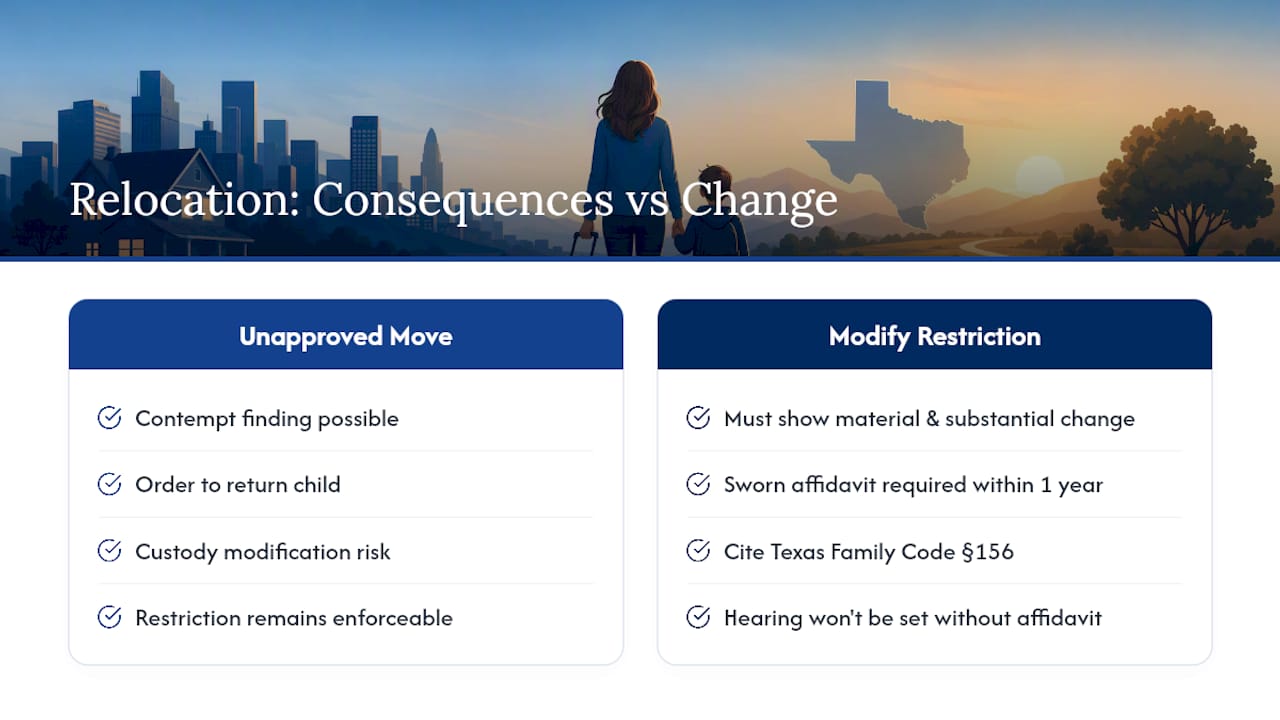
A geographic restriction limits where the parent with primary custody may live with the child, usually to a specific county or a group of contiguous counties. That restriction stays fully enforceable until a court changes it, even if your circumstances have shifted or the other parent seems unlikely to object. Moving a child outside the restricted area without an agreed or court-ordered modification can expose you to a contempt finding, an order to return the child, or a modification of custody itself.
To change the restriction, you generally need to show a “material and substantial change in circumstances” under Texas Family Code §156. If you’re asking to modify who has the exclusive right to designate the child’s primary residence within one year of the existing order, the law requires a sworn affidavit alleging specific facts, such as an environment that endangers the child. Courts won’t even set a hearing without one.
What Counts as Relocation Under Texas Custody Orders?
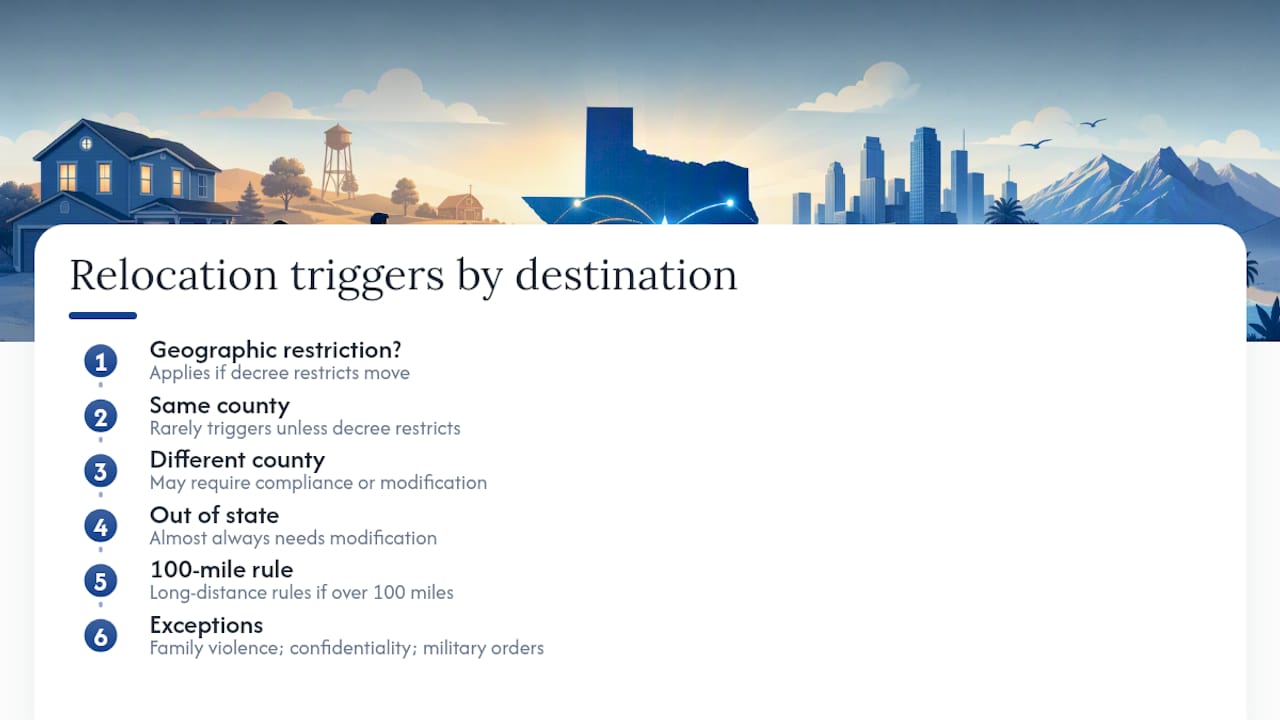
Whether your move triggers these rules depends on distance and destination, not just intent. Many Texas orders use a 100 mile threshold to decide whether the Standard Possession Order’s long-distance provisions kick in, even absent a formal geographic restriction.
A move within the same county rarely raises issues unless your decree specifically restricts it. Moving to a different Texas county, especially one outside a restricted region, or moving out of state entirely, almost always requires either compliance with the restriction or a modification. Exceptions exist for family violence situations, address confidentiality programs, and active military orders, each of which can change how courts apply the standard rules.
How Do You Get Permission to Relocate With a Child in Texas?
The path forward depends on whether your order already restricts your location and whether the other parent agrees.
- Check your order first. If a geographic restriction applies, file a petition to modify before you move. If both parents agree on the new arrangement, an agreed modification is faster, cheaper, and far less risky than a contested case.
- File the right paperwork. A contested case typically requires a petition to modify and, if you’re within one year of the current order and seeking to change primary residence rights, a sworn affidavit stating specific statutory grounds.
- Serve the other parent. Formal service starts the clock on their response window and triggers the court’s jurisdiction over the modification.
- Request temporary orders when needed. These set interim possession schedules and travel-cost arrangements while the case is pending, which prevents emergency disputes from erupting mid-move.
- Attend the hearing. Expect the judge to weigh the evidence discussed below before ruling.
If no restriction exists, you still must follow your decree’s notice provisions and typically notify the OAG Child Support Division of your new address. Contested modifications often take several months from filing to final hearing, so start the process well before your intended move date. Moving before the court rules, even when you believe you’re in the right, is one of the fastest ways to damage your credibility with the judge.
What Evidence Do Texas Courts Weigh in Relocation Cases?
Judges deciding relocation disputes focus on the child’s stability above almost everything else. The continuity of schooling, relationships, and daily routine carries enormous weight, so a relocation plan that shows how the move preserves or improves that stability starts from a stronger position than one that doesn’t address it at all.
Material and substantial changes that commonly support a modification include a documented job offer with a meaningful pay increase, a new spouse’s relocation for work, a need to be near extended family for childcare support, or evidence that the current arrangement has become unsafe or unworkable.
Courts tend to find these forms of evidence persuasive:
- A written job offer or employment contract with salary and start date
- School enrollment information or comparison data for the destination district
- Housing arrangements, such as a signed lease or purchase agreement
- Affidavits from teachers, counselors, or family members supporting the child’s current stability or the benefits of the move
- Medical or educational assessments when the child has ongoing care needs
Pro Tip: Judges respond to specifics, not intentions. A one-page summary attaching your job offer, the new school’s ratings, and a proposed possession calendar will do more for your case than pages of argument about why the move feels right.
Responding to a Relocation: Options for the Other Parent
If you’re the parent being left behind, you have real legal tools. Filing a formal answer preserves your right to contest the move, and you can request temporary orders to keep the existing schedule in place while the case is pending. If the other parent has already moved the child without permission, emergency relief, including a request for immediate return, may be available.
Once a long-distance arrangement is confirmed, the Standard Possession Order’s special provisions typically apply for parents living more than 100 miles apart:
- The noncustodial parent can elect either the standard weekend schedule or one weekend per month, with proper notice
- Extended summer possession expands from the standard arrangement to an extended period during the summer months
- Notice deadlines, often April 1 or April 15 depending on the order, govern which schedule applies for the coming year
- Courts frequently order pick-up points at a midway location, allocate travel costs, and add virtual visitation to bridge the physical distance
Because relocation increases the nonmoving parent’s travel expenses, the parent who moves faces a rebuttable presumption that they’ll bear those increased costs. Reviewing a Standard Possession Order breakdown before your hearing helps you understand what schedule you’re likely to end up with.
What Happens if You Relocate Without Permission?
Moving a child without required permission carries real consequences. Courts can hold the moving parent in contempt, order the immediate return of the child, or use the unauthorized move as grounds to modify custody entirely, sometimes shifting primary residence to the other parent.
Beyond the immediate order, an unauthorized move tends to damage credibility in every future hearing. Judges remember parents who acted unilaterally, and that history can shape how skeptically the court views later requests. If you’re the harmed parent, preserving communication records and moving quickly to file for emergency relief gives you the strongest position to seek the child’s return or a favorable modification.
Military Moves, International Relocation, and Special Needs Children
Active military duty gets distinct treatment. Deployment and temporary military orders can allow temporary relinquishment of custody without it counting against the deployed parent in a later modification fight, and courts generally return to the prior arrangement once deployment ends.
International moves draw heavier scrutiny, since enforcing a Texas order across a border is far harder than within the state. Expect courts to require passport controls, detailed consent language, and a stronger showing of the child’s best interest before approving a move abroad.
For children receiving special education or ongoing medical care, bring documentation showing the move won’t disrupt services, such as IEP records, therapy schedules, and confirmation of comparable providers at the destination.
Common Mistakes Parents Make in Relocation Disputes
- Moving before a geographic restriction is modified, instead of filing first
- Skipping written notice, even when the decree doesn’t explicitly demand it
- Posting hostile comments online about the other parent or the case, which opposing counsel can and does use as evidence
- Relying on verbal agreements instead of documenting communication through email or text
When to Talk to a Family Law Attorney About Relocation
Contact an attorney if your order restricts location, the other parent objects, or logistics involve military duty, international travel, or special needs. Bring your custody order, communication logs, job offer, school and medical records, and travel-cost estimates to your first meeting.
— Giri
How Law Office of Anna Din Helps With Texas Relocation Cases
Relocation disputes rarely come down to one clean legal question. They usually involve a restriction that needs modifying, a skeptical co-parent, and a moving date that won’t wait for the court calendar. Experienced family law attorneys can assist you through that timeline by drafting petitions or affidavits as needed, requesting temporary orders to protect possession schedules while cases are pending, and negotiating agreed modifications when both parents agree.

A first consultation focuses on your actual order, not a generic checklist: what your geographic restriction says, whether your timeline falls inside that one-year affidavit window, and what evidence will carry the most weight with your specific court. Everything you share stays confidential, and Anna Din’s team has handled these disputes throughout The Woodlands, Houston, and the surrounding Texas communities. If you’re facing a contested move or trying to stop one, schedule a consultation with a child custody attorney before you or the other parent takes any irreversible step.
This article is general information, not a substitute for advice from a qualified lawyer. Consult a qualified legal professional about your own circumstances before acting on anything here.
Sources
- Geographic restrictions | TexasLawHelp
- Texas Constitution and Statutes — Family Code §156.102
- Standard Possession Order and Parenting Time | Texas Access
- How to change a custody agreement in Texas: Grounds and steps - LegalClarity
FAQ
How far can a custodial parent move in Texas?
It depends entirely on your order. If a geographic restriction applies, you’re limited to that specific county or region until a court modifies it; if no restriction exists, you can move but must still follow your decree’s notice requirements.
Can I move out of state with my child without the father’s permission in Texas?
Not if a geographic restriction is in place. You need either his agreement through an agreed modification or a court order approving the move before relocating out of state.
Is Texas a 50/50 state for child custody?
No. Texas courts use a best-interest standard and typically order a Standard Possession Order rather than presuming an automatic equal split, though parents can agree to an equal schedule.
What happens to child support when I move out of state in Texas?
Child support obligations continue regardless of relocation, though courts may reallocate increased travel costs between the parents, and the moving parent often faces a rebuttable presumption of covering those added expenses.
Do I need a lawyer to modify a geographic restriction?
You aren’t required to have one, but given the affidavit requirements and evidentiary standards involved, working with a family law attorney experienced in Texas custody modifications significantly improves your odds of a smooth outcome.
Recommended
Questions About Your Situation?
Every family is different. Schedule a confidential consultation with Anna Din to discuss your options.
Schedule a Consultation