Standard Possession Order in Texas: What Parents Need to Know
August 6, 2026 · Law Office of Anna Din PLLC
A Texas Standard Possession Order (SPO) is the statute-backed default parenting-time schedule that applies when parents cannot agree on custody terms. Defined under Tex. Fam. Code § 101.029, it prescribes weekend, weeknight, holiday, and summer possession based primarily on how far apart the parents live. For most families, the SPO means the noncustodial parent gets the 1st, 3rd, and 5th weekends of each month, Thursday evenings during the school year, alternating holidays, and 30 days in summer — all of which shift when the parents live more than 100 miles apart. If you are a Texas parent trying to understand what schedule a court will likely order, or whether your current order matches the statutory default, this article walks through every key rule.
Statutory basis: The SPO schedule lives in Subchapter F, Chapter 153 of the Texas Family Code. Courts presume the SPO is in the best interest of any child age three or older under Tex. Fam. Code § 153.252.
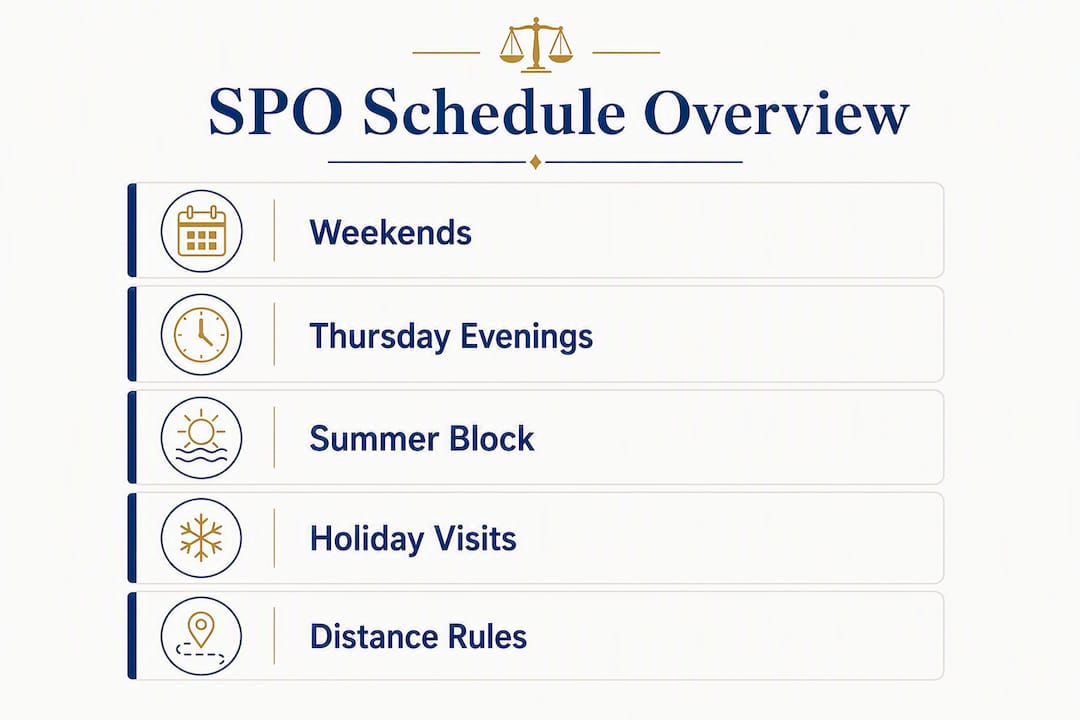
Core schedule at a glance:
- Weekends: 1st, 3rd, and 5th weekends of each month (Friday 6 PM to Sunday 6 PM, or school-dismissal to school-resumption)
- Thursday evenings: 6 PM to 8 PM during the school year (for parents 100 miles or less apart)
- Holidays: Alternating each year between parents
- Summer: 30 days for parents 100 miles or less apart; and 42 days when parents live more than 100 miles apart
- Distance trigger: The schedule changes meaningfully once parents live more than 100 miles apart
Table of Contents
- What does the standard possession order schedule actually look like?
- What is the standard possession order and why does Texas law create a default schedule?
- Exact SPO terms broken down by distance
- How do SPO rules apply when a child is under three?
- How holidays, school breaks, and special days work under the SPO
- Where and how custody exchanges happen under the SPO
- How to get, modify, or enforce a possession order in Texas
- What Texas courts consider when adopting or varying the SPO
- Attorney-level practical tips for using the SPO effectively
- Key Takeaways
- What parents often overlook about the SPO
- How the Law Office of Anna Din helps with possession orders and custody matters
- Useful official sources and forms
- FAQ
What does the standard possession order schedule actually look like?
The SPO is built around three distance bands. Knowing which one applies to your situation tells you almost everything about your schedule.
Parents 50 miles or less apart (the most common scenario):
- Noncustodial parent has the 1st, 3rd, and 5th weekends each month
- Thursday evenings during the school year (6 PM to 8 PM)
- Alternating spring break, Thanksgiving, and Christmas
- 30 days of summer possession, with the noncustodial parent designating the dates by April 1 each year
- Roughly 35–40% of the year goes to the noncustodial parent under this default schedule
Parents 51–100 miles apart:
- The noncustodial parent can choose between the default schedule above or an “election” option
- The election option typically replaces Thursday evenings with an extended first-weekend visit
- Summer possession remains 30 days
Parents more than 100 miles apart:
- Thursday evening visits are removed or significantly reduced
- Weekend possession may be limited to one weekend per month by election
- Summer possession increases to 42 days, and written notice deadlines (April 1 and April 15) govern when and how that summer block is exercised
Statistic callout: Under the default SPO for parents 100 miles or less apart, the noncustodial parent receives roughly 35–40% of the year’s parenting time, according to the Office of the Attorney General.
Pro Tip: If you are the noncustodial parent in the 51–100 mile band, the election option can give you a longer first-weekend visit in exchange for dropping Thursday evenings. Review both options carefully before your order is finalized — changing it later requires a modification proceeding.
What is the standard possession order and why does Texas law create a default schedule?
The SPO is Texas’s answer to a predictable, conflict-reducing baseline. Rather than leaving every custody dispute to open-ended negotiation or judicial discretion, the legislature created a defined schedule that courts apply automatically when parents cannot agree. The statutory definition at Tex. Fam. Code § 101.029 ties the SPO directly to the schedule in Subchapter F, Chapter 153 — conservatorship, possession, and access.
The core logic is stability. A child benefits from knowing in advance when they will be with each parent. The SPO removes day-to-day negotiation by design, which reduces the friction that often escalates into conflict. Courts presume this schedule serves a child’s best interest once the child turns three.
SPO vs. an agreed possession order:
- An SPO is the court-ordered default. It applies automatically when parents do not reach a written agreement.
- An agreed possession order is a custom schedule both parents negotiate and the court approves. It can be more flexible, but it must still serve the child’s best interest.
- Under OAG guidance, parents with an SPO may still agree between themselves to any schedule that works — the SPO’s default terms govern only when they fail to reach a mutual agreement in advance.
The practical takeaway: the SPO is a floor, not a ceiling. Parents who communicate well can always do more. The SPO protects the parent who cannot get the other to cooperate.
Exact SPO terms broken down by distance
Parents 50 miles or less apart
This is the full default schedule most Texas parents encounter.

| Possession Period | Noncustodial Parent’s Time |
|---|---|
| Regular weekends | 1st, 3rd, and 5th weekends (Fri. 6 PM to Sun. 6 PM, or school-dismissal to school-resumption) |
| Thursday evenings | 6 PM to 8 PM during the school year |
| Spring break | Alternates each year |
| Thanksgiving | Alternates each year |
| Christmas | Alternates annually between two periods around Christmas (exact dates depend on the order) |
| Summer | 30 days, designated by April 1 written notice |
| Child’s birthday | Typically 2 hours on or near the birthday |
The April 1 deadline for summer designation is firm. If the noncustodial parent misses it, the custodial parent may designate the summer schedule instead.
Key mechanics:
- “School” under TFC § 153.3101 means the primary or secondary school where the child is enrolled, or the public school district where the child primarily resides if not enrolled. This definition matters when a parent moves the child to a different district mid-year.
- Weekend possession begins at school dismissal on Friday (or 6 PM if school is not in session) and ends at school resumption Monday morning (or 6 PM Sunday if school is not in session).
Parents 51–100 miles apart
The OAG’s guidance for the 51–100 mile band gives the noncustodial parent a choice between two options at the time the order is established:
- Default option: Same 1st/3rd/5th weekend and Thursday evening schedule as the ≤50-mile band
- Election option: Drop Thursday evenings; extend the first-weekend visit to begin Thursday at 6 PM instead of Friday
Summer possession stays at 30 days. The election must be made when the order terms are settled; it cannot be changed informally later.
Parents more than 100 miles apart
Distance changes the schedule significantly. Tex. Fam. Code § 153.311 et seq. reduces midweek visits and increases summer possession to 42 days to compensate.
- Thursday evening visits are removed
- Weekend possession may be limited to one weekend per month if the noncustodial parent elects that option
- Summer possession is 42 days, designated by written notice by April 1; the custodial parent may designate an uninterrupted 30-day block by April 15 if the noncustodial parent does not give timely notice
- Spring break goes to the noncustodial parent every year (not alternating)
The April 1 and April 15 notice deadlines are not suggestions. Missing them shifts control of the summer schedule to the other parent.
How do SPO rules apply when a child is under three?
The SPO’s presumption of best interest applies to children age three and older. For children under three, Tex. Fam. Code § 153.252 does not automatically extend that presumption, and judges exercise broader discretion to craft a schedule suited to the child’s developmental needs.
Courts will often still use the SPO framework as a starting point, but they may modify it substantially for infants and toddlers. Common adjustments include:
- Shorter, more frequent visits rather than full weekends
- No overnight visits initially, with a graduated path toward overnights as the child grows
- More frequent exchanges to maintain attachment with both parents
- A built-in review date so the schedule can be updated as the child ages
If parents agree on a schedule for a child under three, the court will generally approve it as long as it serves the child’s best interest. When parents disagree, the judge decides based on the child’s specific circumstances, not a statutory default. Bringing a detailed proposed schedule to court, supported by evidence of your involvement in the child’s daily care, strengthens your position considerably.
How holidays, school breaks, and special days work under the SPO
Holiday possession overrides the regular weekend schedule. When a holiday falls on a weekend that would otherwise belong to one parent, the holiday possession terms control.
Standard holiday rotation (typical alternating pattern):
- Thanksgiving: Noncustodial parent in odd-numbered years; custodial parent in even-numbered years (or vice versa, depending on the order’s language)
- Christmas/Winter break: Split into two periods; parents alternate which period they receive each year
- Spring break: Alternates annually for parents 100 miles or less apart; goes to the noncustodial parent every year for parents more than 100 miles apart
- Father’s Day and Mother’s Day: Each parent has possession on their respective holiday, regardless of the regular schedule
- Child’s birthday: Typically 2 hours of possession on or near the birthday for the parent who does not have regular possession that day
Summer possession under the SPO is not automatic. For the 30-day summer block (parents ≤100 miles apart), the noncustodial parent must designate the specific dates in writing by April 1. The 30 days do not have to be consecutive unless the order specifies otherwise, which gives some flexibility for travel or work schedules.
For the expanded 42-day summer block (parents >100 miles apart), the same April 1 deadline applies, and the custodial parent’s April 15 counter-designation right kicks in only if the noncustodial parent misses the deadline.
Pro Tip: Birthdays and school events are not automatically covered by the SPO. If you want guaranteed possession for a child’s birthday or graduation, negotiate that language into your agreed order before it is signed — adding it later requires a formal modification.
Where and how custody exchanges happen under the SPO
The SPO does not name a specific exchange location by default. Most orders use the child’s school as the exchange point during the school year, which reduces direct parent-to-parent contact and keeps transitions predictable for the child.
Typical exchange logistics:
- During the school year, the noncustodial parent picks up at school dismissal on Friday and returns the child at school resumption on Monday morning
- When school is not in session, exchanges typically happen at 6 PM at a neutral or agreed location
- For Thursday evening visits, the noncustodial parent picks up at 6 PM and returns the child by 8 PM
Transportation and travel costs:
- For parents 100 miles or less apart, the order typically requires the noncustodial parent to handle pickup and the custodial parent to handle return, or vice versa depending on the order’s language
- For long-distance cases (>100 miles), the noncustodial parent generally bears the cost of transportation to exercise possession
- Courts may restrict international travel or require passport surrender in cases involving family violence or flight risk
The SPO’s definition of “school” under TFC § 153.3101 can create complications when a parent enrolls the child in a new school district mid-year. That change can shift which calendar dates count as school vacation and may require a discrete modification request.
Pro Tip: Keep a written exchange log — date, time, location, and who was present. Dated photos or location-stamped receipts from exchanges are often the most decisive evidence in a possession-denial dispute.
How to get, modify, or enforce a possession order in Texas
Getting an SPO in your order
- File the appropriate petition. A possession order is established as part of a Suit Affecting the Parent-Child Relationship (SAPCR) or a divorce proceeding. TexasLawHelp provides plain-language guidance and references sample forms, including FM-CHIL-306, a standard possession order form.
- Propose the SPO or a custom schedule. If both parents agree, submit an agreed order for the judge’s approval. If they disagree, the court applies the SPO as the default.
- Attend the hearing. Bring documentation of your involvement in the child’s life, your proposed schedule, and any evidence relevant to the child’s best interest.
Modifying an existing possession order
Modification requires showing a material and substantial change in circumstances since the last order was signed. You can learn more about the legal standards and timing in when you can modify a child custody order in Texas. Common qualifying changes include a parent’s relocation, a significant change in the child’s needs, or a pattern of violations.
- File a Petition to Modify the Parent-Child Relationship in the court that issued the original order
- Mediation is often required before the court will set a contested hearing
- The court applies the best-interest standard, not just the change-in-circumstances test
Enforcing a possession order
If the other parent is denying possession or repeatedly returning the child late, you have several options:
- Motion to Enforce: File in the original court. The court can hold the violating parent in contempt, impose fines, or award makeup possession time.
- Law enforcement: A certified copy of your possession order is enforceable by police if the other parent refuses to comply during a scheduled exchange.
- Documentation: Exchange logs, text messages, and written election notices (especially the April 1/April 15 summer deadlines) are often decisive evidence in enforcement proceedings.
Pro Tip: Always send summer possession election notices by certified mail and keep the return receipt. If a dispute arises months later, that receipt is your proof of timely notice.
What Texas courts consider when adopting or varying the SPO
Courts start with the SPO as the presumed best-interest schedule for children three and older. Deviating from it requires a specific reason, and if you request written findings, the court must state those reasons on the record under Tex. Fam. Code § 153.258.
Factors that can lead a court to vary from the SPO:
- A history of family violence or child abuse (courts may restrict or supervise possession under Texas protective order law)
- A child’s special medical, educational, or emotional needs that the standard schedule does not accommodate
- A parent’s work schedule that makes the default times impractical
- Geographic distance that makes the standard exchange points unworkable
- The child’s own preferences, given weight as the child gets older
Family violence and safety:
Texas law takes family violence seriously in custody proceedings. A finding of family violence can result in supervised visitation, restricted overnight stays, or a complete denial of unsupervised possession. If you are in a situation involving domestic violence, connecting with a family law attorney experienced in protective orders before your hearing is critical.
Understanding what Texas courts actually consider when deciding child custody gives you a fuller picture of how judges weigh these factors in practice.
Attorney-level practical tips for using the SPO effectively
- Put elections in writing and calendar the deadlines. The April 1 summer designation deadline and the April 15 counter-designation deadline are the two most commonly missed dates in SPO cases. Set calendar reminders in January so you have time to send certified-mail notice.
- Use a shared digital calendar. Apps like OurFamilyWizard or TalkingParents create a timestamped record of communications and schedule changes. Courts view this documentation favorably.
- Understand the difference between agreement and modification. You and the other parent can informally agree to swap weekends or adjust a holiday — but that informal agreement is not enforceable. Only a written, court-approved modification changes the legal order.
- Request written findings if the court varies from the SPO. If a judge deviates from the standard schedule without explaining why, request written findings immediately. That omission can support an appeal or an enforcement argument.
- Bring the right documents to your consultation. Your current order, a calendar showing missed or disputed exchanges, and copies of any written election notices give an attorney the clearest picture of your situation fastest.
Questions to ask a family law attorney:
- Does my current order match the statutory SPO, or has it been customized?
- What evidence do I need to support a modification request?
- How does my distance from the other parent affect my summer possession rights?
- What are my enforcement options if the other parent denies possession?
Pro Tip: High-conflict cases, situations involving family violence, and long-distance moves all benefit significantly from attorney representation. The SPO’s rigid structure can work for or against you depending on the facts — knowing which requires a case-specific analysis.
Key Takeaways
The Texas Standard Possession Order gives the noncustodial parent a substantial portion of the year’s parenting time under the default schedule for parents living 100 miles or less apart, with the schedule shifting materially once distance exceeds 100 miles.
| Point | Details |
|---|---|
| Default schedule applies at 100 miles or less | Noncustodial parent gets 1st/3rd/5th weekends, Thursday evenings, alternating holidays, and 30 summer days. |
| Distance over 100 miles changes summer possession | Summer increases to 42 days; Thursday visits are removed; written notice by April 1 is required. |
| Under-3 presumption does not apply | Courts use broader discretion for children under three; the SPO presumption begins at age three under Tex. Fam. Code § 153.252. |
| Elections and deadlines are binding | Missing the April 1 summer designation deadline shifts schedule control to the other parent. |
| Lawofficeofannadin can help | The Law Office of Anna Din handles SPO establishment, modification, and enforcement for families in The Woodlands, Houston, and surrounding Texas communities. |
What parents often overlook about the SPO
The SPO is frequently described as a “standard” schedule, which leads many parents to assume it is fair by default. That framing misses something important. The SPO is a statutory compromise, not a tailored solution. It was designed to reduce litigation, not to match the specific rhythms of any particular family.
What this means in practice: a parent who works nights, a child with a demanding extracurricular schedule, or a family where one parent travels frequently for work will all find that the SPO creates friction rather than reducing it. The statute’s rigidity is intentional, as the OAG notes, because a predictable default removes day-to-day negotiation. But predictable and optimal are not the same thing.
The parents who fare best under the SPO are the ones who treat it as a floor and negotiate an agreed order that reflects their actual lives. The parents who struggle are the ones who accept the SPO passively and then spend years fighting over the gaps it does not address — birthday language, school events, travel notice requirements, and what happens when the child’s school changes districts mid-year.
One more thing worth saying plainly: the SPO’s election deadlines (April 1 and April 15 for summer possession) catch more parents off guard than almost any other provision. Missing one deadline does not just cost you a scheduling preference. It can hand the other parent control of the entire summer block. That is not a technicality. It is the statute working exactly as written.
How the Law Office of Anna Din helps with possession orders and custody matters
Navigating a possession order is rarely just about reading the statute. The schedule that looks clear on paper often creates real disputes the moment a parent moves, a child changes schools, or one parent stops cooperating. The Law Office of Anna Din works with parents in The Woodlands, Houston, and surrounding Texas communities to establish, modify, and enforce possession orders that actually protect their time with their children.

Whether you need an SPO written into a new order, want to modify an existing schedule after a move or a change in circumstances, or need to enforce an order the other parent is ignoring, the firm provides direct, case-specific guidance at every step. Anna Din’s practice covers child custody and support, enforcement proceedings, and protective orders for families dealing with family violence.
What to bring to your consultation:
- A copy of your current court order (or the proposed order if none exists yet)
- A calendar or log of missed, disputed, or late exchanges
- Copies of any written election notices you have sent or received
- Records of relevant communications with the other parent
To schedule a consultation and get a clear picture of your options, visit the Law Office of Anna Din’s custody practice page or reach out directly through the firm’s contact page.
Useful official sources and forms
Every fact in this article traces back to Texas statutes and official agency guidance. These are the primary sources worth bookmarking:
- Texas Family Code, Chapter 153 (Subchapter F) — the full statutory text governing possession and access, including the SPO schedule
- Office of the Attorney General — Parenting Time Schedule — plain-language OAG overview of the SPO by distance band
- OAG — 51 to 100 Miles Apart — specific guidance on the election option for the 51–100 mile band
- TexasLawHelp — Child Visitation and Possession Orders — plain-language guide with references to sample forms including FM-CHIL-306
- Tex. Fam. Code § 101.029 — Statutory definition of “standard possession order”
- Law Office of Anna Din — Contact and Consultation — for parents ready to speak with a Texas family law attorney about their specific situation
This article provides general legal information about Texas possession orders, not legal advice for any specific case. Possession order rules can vary based on your court, your order’s language, and your circumstances. Confirm current rules with the Texas Family Code or a qualified Texas family law attorney.
FAQ
What does a standard possession order include in Texas?
A Texas SPO includes the 1st, 3rd, and 5th weekends each month, Thursday evenings during the school year (for parents 100 miles or less apart), alternating holidays, and 30 days of summer possession — all governed by Subchapter F, Chapter 153 of the Texas Family Code.
What is the standard possession order for parents more than 100 miles apart?
When parents live more than 100 miles apart, Tex. Fam. Code § 153.311 removes Thursday evening visits, may limit weekend possession to one per month by election, increases summer possession to 42 days, and gives the noncustodial parent spring break every year.
Is 50/50 custody standard in Texas?
No. The default SPO gives the noncustodial parent roughly 35–40% of the year’s parenting time, not an equal split. A 50/50 schedule requires either a court order specifically granting equal possession or a written agreement both parents negotiate and the court approves.
Can parents change the SPO schedule without going back to court?
Parents can informally agree to swap days or adjust a holiday, but that informal agreement is not legally enforceable. Only a written modification approved by the court changes the binding terms of the order, as the OAG confirms.
Does the SPO apply to children under three?
The statutory presumption that the SPO serves a child’s best interest applies to children age three and older under Tex. Fam. Code § 153.252. For children under three, judges exercise broader discretion and often order shorter, more frequent visits rather than the full default schedule.
Recommended
Questions About Your Situation?
Every family is different. Schedule a confidential consultation with Anna Din to discuss your options.
Schedule a Consultation