Texas Divorce Process: File Under §§6.301 & 6.702 With eFileTexas
One spouse must have lived in Texas for the required residency period and in the filing county for the legally mandated minimum time before a Texas court will accept a divorce petition. Once you file, state law imposes a mandatory 60-day waiting period before a judge can sign your decree. The fastest realistic finish for an uncontested divorce occurs shortly after the mandatory 60-day waiting period; contested cases involving property disputes or custody fights typically take several months to over a year.
TL;DR:
- A spouse must have lived in Texas for at least six months and in the filing county for 90 days before petitioning for divorce.
- The mandatory 60-day waiting period begins the day after filing and cannot be shortened unless a family violence conviction or protective order is present.
- Uncontested divorces typically complete within 61 to 90 days, while contested cases with disputes can take six months to over a year.
- Filing must follow a strict sequence, including serving the spouse correctly, paying fees, and submitting approved forms either by paper or e-filing.
- Finalizing a divorce requires a court review of property, custody, and support terms, with the possibility of temporary orders and careful post-decree steps.
Table of Contents
- What Are the Residency Rules for Filing a Texas Divorce?
- How Long Does the 60-Day Waiting Period Actually Take?
- How Do You File for Divorce in Texas Step by Step?
- Which Forms Do You Need, and Can You E-File in Texas?
- What Temporary Orders and Fee Options Are Available Before Finalization?
- What Happens at the Final Hearing?
- How Does Texas Divide Property, Custody, and Support?
- What Should You Do Immediately After the Divorce Is Final?
- When Procedural Mistakes Cost Texas Families the Most
- How Lawofficeofannadin Handles Your Texas Divorce Filing
- Sources
- FAQ
What Are the Residency Rules for Filing a Texas Divorce?
Before you draft a single form, confirm you meet Texas’s jurisdictional threshold. Under Texas Family Code §6.301, at least one spouse must have been domiciled in Texas for the six months immediately before filing, and a resident of the specific county where the suit is filed for at least 90 days. This is not a technicality a judge can overlook. Residency requirements are jurisdictional, meaning a court that lacks proof of residency generally cannot hear the case at all, no matter how willing both spouses are to proceed.
A few practical wrinkles come up often:
- Active-duty military members stationed in Texas can count that time toward residency even if their permanent home is elsewhere.
- A nonresident spouse can still be named as a respondent if the filing spouse meets the residency rule.
- Filing in the wrong county usually means a transfer motion, added cost, and lost time, so verify your county eligibility with the district clerk before you file.
If you’re unsure which county applies, the Woodlands filing guide walks through the local venue questions Harris County and Montgomery County residents run into most.
How Long Does the 60-Day Waiting Period Actually Take?
The clock on your case starts the day after you file, not the day you sign paperwork or reach an agreement with your spouse. Texas Family Code §6.702 bars a court from granting a divorce until 60 days have passed, and this rule applies whether both spouses agree on every term or are fighting over custody.
Only two narrow exceptions allow a judge to skip ahead: a family violence conviction or deferred adjudication against the respondent, or an active protective order tied to family violence. Outside those circumstances, no amount of cooperation shortens the wait.
Statistic Callout: Family law resources confirm the 60-day rule holds in nearly all filings. A simple, uncontested divorce with no property or custody disputes typically finalizes in 61 to 90 days. A contested divorce involving discovery, appraisals, or a custody evaluation routinely stretches to 6 to 18 months, sometimes longer if the court’s docket is backed up.
How Do You File for Divorce in Texas Step by Step?
Filing itself is mechanical once you understand the sequence. Here’s the order Texas courts expect:
- Draft and file the Original Petition for Divorce with the district clerk in your qualifying county, stating the grounds (most commonly “insupportability,” Texas’s no-fault ground) and what you’re asking for regarding property, children, and support.
- Pay the filing fee, which varies by county, or file an Affidavit of Inability to Pay Court Costs if you cannot afford it.
- Serve your spouse. Options include personal service through a sheriff or constable, a private process server, or a signed Waiver of Service.
- Wait for a response. Your spouse generally has until the Monday after 20 days from service to file an Answer; if they don’t respond, you may be able to pursue a default judgment after the 60-day period passes.
Pro Tip: Never sign a Waiver of Service before the petition has actually been filed with the court. A waiver signed too early is not legally effective, and that mistake alone has delayed finalization for filers who thought they were saving time.
A signed waiver eliminates the need for formal service and often keeps the case moving faster toward the 60-day mark.
Which Forms Do You Need, and Can You E-File in Texas?
Texas courts recognize a specific set of Supreme Court-approved forms for agreed divorces involving no children and no significant property. TexasLawHelp hosts toolkits for several case types, including divorces with children, agreed divorces without children, and cases where the other spouse won’t cooperate.
For submission, eFileTexas is the primary e-filing portal in most Texas counties and walks filers through a guided interview for family cases. A few things to keep in mind:
- E-filing is free to use, but county filing fees still apply and must be paid at submission.
- Keep your file-stamped copy; it’s your proof of the exact filing date that starts the 60-day clock.
- Attach any required documents, such as a proposed decree or an Affidavit of Inability to Pay, in the format your county clerk specifies.
Readers preparing documents before they file should also review the pre-filing legal checklist and this general divorce checklist, which covers financial documentation many filers overlook.
What Temporary Orders and Fee Options Are Available Before Finalization?
You don’t have to wait 60 days for every kind of relief. A judge can issue temporary orders soon after filing to cover the gap between the petition and decree.
- Temporary support orders address who pays bills, who stays in the home, and interim child support.
- Temporary possession orders set a short-term custody and visitation schedule while the case is pending.
- Temporary restraining orders protect property, finances, or personal safety during the case.
If cost is a barrier, an Affidavit of Inability to Pay Court Costs lets qualifying filers request a fee waiver. If you’re in immediate danger, don’t wait on the divorce timeline at all. A protective order can be requested separately and may move faster than the underlying divorce case.
What Happens at the Final Hearing?
The final hearing, often called a “prove-up,” is where a judge confirms your case meets legal requirements before signing the decree. For most uncontested cases, this is brief.
- The petitioner testifies (or submits a sworn affidavit, depending on the county) confirming residency, the grounds for divorce, and that the terms in the decree are fair and agreed.
- The judge reviews the proposed decree for property division, conservatorship, and support terms.
- If everything checks out, the judge signs the decree, and the divorce is final.
Some Texas counties accept a written prove-up affidavit in place of live testimony, which speeds things along considerably, while others still require an in-person appearance. The Texas State Law Library notes this variation directly, so confirm your county’s practice before you assume a quick affidavit will suffice. Continuances usually happen when paperwork is incomplete, a spouse contests a term at the last minute, or the court’s docket runs long that day.
How Does Texas Divide Property, Custody, and Support?
Texas is a community property state, meaning most assets and debts acquired during the marriage are presumed jointly owned, regardless of whose name is on the account. Separate property, generally what you owned before marriage or received as a gift or inheritance, stays with the original owner if you can prove it.
- Courts divide community property in a manner they consider “just and right,” which is not always a 50/50 split.
- Custody, called conservatorship in Texas, and possession schedules are decided based on the child’s best interest, considering stability, each parent’s involvement, and any history of family violence.
- Child support amounts are typically calculated using guidelines from the Texas Attorney General’s child support resources.
- Retirement accounts often require a Qualified Domestic Relations Order (QDRO) to divide legally, and complex estates may need professional valuations or expert reports.
Statistic Callout: Because community property presumptions apply broadly, even accounts held in one spouse’s name alone are often subject to division unless separate-property status is proven. Readers navigating pensions or investment accounts should review what happens to a pension in divorce before finalizing terms. Spousal maintenance, Texas’s version of alimony, is not automatic. It’s awarded only when specific statutory conditions are met, such as a marriage lasting 10 years or longer combined with an inability to meet minimum reasonable needs, or in family violence cases.
What Should You Do Immediately After the Divorce Is Final?
Your decree isn’t the finish line. A short administrative checklist protects you from complications down the road.
- Request several certified copies of the final decree from the district clerk.
- Use certified copies to update your driver’s license, Social Security records, and financial account titles.
- File any QDRO paperwork promptly to secure your share of retirement accounts.
- Record property transfers with the county if real estate changed hands.
Pro Tip: Order certified copies the same week your decree is signed. Banks, title companies, and the Social Security Administration all ask for them, and delays here often stall a name change or refinance for weeks.
If either party later violates the decree, enforcement through contempt proceedings is available, and custody or support terms can be modified if circumstances materially change.
When Procedural Mistakes Cost Texas Families the Most
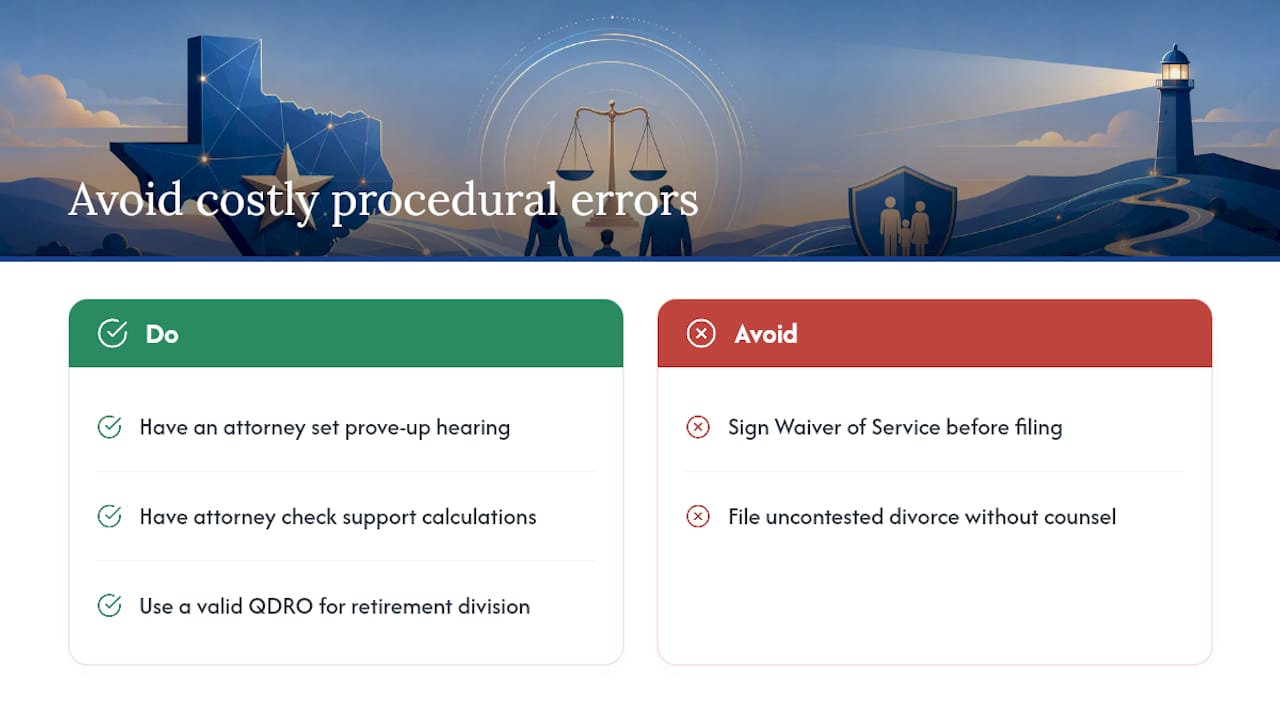
The single most common error we see is a spouse signing a Waiver of Service before the petition is actually filed, which voids the waiver and restarts the clock on formal service. Families who try to handle an uncontested divorce entirely on their own often discover this only after a clerk rejects their paperwork, costing weeks they didn’t need to lose.
Attorney involvement tends to matter most where it’s least expected: setting the prove-up hearing quickly, catching a miscalculated support figure, or making sure a retirement account actually gets divided through a valid QDRO instead of a decree that says the right thing but never gets executed.
— Giri
How Lawofficeofannadin Handles Your Texas Divorce Filing
Filing correctly the first time is what actually saves you weeks, not just knowing the statutes. Some legal practitioners have guided filers through petitions, temporary orders, and final hearings without the delays that come from a rejected waiver or an incomplete form.

Legal practitioners can handle the filing process, request temporary support or possession orders while your case is pending, negotiate custody and support terms, and represent clients at the final prove-up hearing to avoid continuances over missed details. If you’re weighing whether to handle your case alone or want a clear read on your timeline and options, visit the divorce attorney practice page or reach out through the contact page to schedule a consultation before your 60 days start ticking.
This article is general information, not a substitute for advice from a qualified lawyer. Consult a qualified legal professional about your own circumstances before acting on anything here.
Sources
- Texas Family Code §6.301 — General residency rule for divorce suit
- FAM § 6.702 — Waiting period (FindLaw)
- TexasLawHelp — Divorce in Texas
- Efiletexas
FAQ
How long does a divorce usually take in Texas?
An uncontested divorce with no disputes typically finalizes 61 to 90 days after filing, due to the mandatory 60-day waiting period under Family Code §6.702. Contested cases involving property or custody disputes often take 6 to 18 months.
What is a wife entitled to in a divorce in Texas?
Texas is a community property state, so a wife is generally entitled to a “just and right” share of property and debt acquired during the marriage, not necessarily an even split. Spousal maintenance is only available if specific statutory conditions are met, such as a marriage of 10 years or longer combined with financial need.
What is the 10-year rule in divorce in Texas?
The 10-year rule refers to spousal maintenance eligibility. A marriage lasting 10 years or longer allows a spouse to qualify for maintenance based on need, even without a family violence finding, though the court still weighs other factors before awarding it.
What should you avoid doing during a divorce in Texas?
Avoid signing a Waiver of Service before the petition is filed, since it’s not legally effective until after filing. Also avoid hiding assets or making major financial moves without disclosure, since Texas courts treat undisclosed community property harshly during division.
Can you speed up the 60-day waiting period in Texas?
No, except in narrow cases involving a family violence conviction or an active protective order against the respondent. Agreement between spouses does not shorten the statutory waiting period set by Family Code §6.702.
Recommended
Questions About Your Situation?
Every family is different. Schedule a confidential consultation with Anna Din to discuss your options.
Schedule a Consultation