Court Tested Temporary Orders for Divorce: 14 Day TRO, What to File
Divorce temporary orders are short-term court rulings that set custody, support, home possession, and asset restraints while your divorce case is pending. You get them by filing a motion, by agreeing with your spouse through a stipulation, or through emergency ex parte relief if there’s immediate danger. Your next move is simple: gather your financial documents and a proposed order, or talk to an attorney about which path fits your situation.
TL;DR:
- Temporary orders often last until the final divorce decree or a new court hearing, usually remaining in effect for several months to over a year.
- Requests for emergency ex parte relief are granted only when there’s immediate danger or risk of asset disappearance, typically lasting around 14 days before a full hearing.
- Filing involves submitting a specific motion with supporting evidence and serving the other party; incomplete paperwork or improper service can delay proceedings.
- Judges prioritize narrow and detailed requests with clear dollar amounts and documented reasons, as vague or broad motions tend to be denied or delayed.
- Temporary orders can be modified if circumstances change, and violations may lead to fines, attorney’s fees, or even jail, depending on the severity of the breach.
Table of Contents
- What Are Temporary Orders and What Do They Cover?
- Who Can Request Temporary Orders and When?
- How Do You Actually File for Temporary Orders?
- What Happens at a Temporary Orders Hearing?
- How Long Do Temporary Orders Last, and What If Things Change?
- Common Mistakes to Avoid at Your Temporary Orders Hearing
- How Lawofficeofannadin Helps With Temporary Orders
- What the Procedure Actually Rewards
- Talk to Lawofficeofannadin About Your Temporary Orders
- Where to Find Official Forms and Local Rules
- Sources
- FAQ
What Are Temporary Orders and What Do They Cover?
Temporary orders are provisional court directives. They’re legally binding, but they only govern the period between your filing date and your final decree, which FindLaw notes can range from a few months to a year or more depending on how contested the case is.
Courts issue several categories of temporary relief, and most divorce cases involve at least one:
- Temporary custody and parenting time — who the kids live with and the visitation schedule while the case is active
- Temporary child support — interim payments based on current income
- Temporary spousal support — short-term maintenance for a lower-earning spouse
- Exclusive possession of the home — who stays in the marital residence
- Asset restraints (ATROs) — orders blocking either spouse from selling, hiding, or transferring marital property
- Temporary attorney’s fees — court-ordered contribution toward legal costs
Some states apply Automatic Temporary Restraining Orders the moment a divorce petition is filed, meaning the asset restraints kick in without a separate motion. Others require you to formally request them, so check your local rules before assuming any protection is automatic.
Who Can Request Temporary Orders and When?
Either spouse can ask for temporary orders, and how you ask depends on whether you and your spouse agree.
If you’re on the same page about interim arrangements, you can file a stipulation, a signed agreement both parties submit to the court. This skips the hearing entirely and typically resolves faster than a contested motion.
If you can’t agree, or if there’s an urgent financial or custody issue, you file a motion for temporary orders. This requires a hearing where a judge reviews your request.
When there’s immediate danger, physical safety, threats, or a real risk that assets will disappear, you can seek an ex parte order, sometimes called a temporary restraining order (TRO). Courts grant these without notifying the other party first, but only on a showing of immediate, irreparable harm. According to Texaslawhelp, a TRO often lasts around 14 days and must be followed by a full hearing before any longer-term relief is granted.
- Mutual agreement: file a stipulation, no hearing needed
- No agreement, no emergency: file a standard motion
- Immediate danger or asset risk: request ex parte/TRO relief
Pro Tip: Before filing anything, check your county clerk’s self-help page or contact the family law facilitator’s office. Local rules on automatic restraints and required forms vary significantly between counties, and getting this wrong can delay your hearing by weeks.
How Do You Actually File for Temporary Orders?
Filing for temporary orders follows a fairly consistent sequence, though local forms and deadlines vary by county.
- Draft your motion and a proposed order. Include a focused affidavit or declaration explaining exactly why you need relief now, not later. Vague requests slow everything down.
- Collect supporting evidence. Pay stubs, recent bank statements, your lease or mortgage statement, school records, and, if safety is a concern, police reports or CPS records.
- File at the family court clerk’s office. Follow your county’s specific form requirements. Missing a required attachment is one of the most common reasons hearings get delayed.
- Serve the other party. You must provide formal notice and obtain proof of service, unless your request qualifies as emergency ex parte relief, which the California Courts self-help guidance confirms is typically decided without prior notice to the other side.
- Prepare for the hearing timeline. Ex parte requests can be decided the same day. Routine temporary-orders hearings usually happen within a few weeks to a few months, depending on your county’s caseload. Response deadlines for the other party also vary by state, so confirm yours early.
Custody-related motions in some states also require a proposed parenting plan or proof you’ve completed a parenting class, according to California’s self-help custody filing guidance. Financial requests generally call for a financial declaration and your most recent pay stubs.
If you’re still assembling your financial picture before you even file, a financial planning checklist for divorce can help you organize documents ahead of the motion stage, which saves real time once you’re at the clerk’s window.
Walk into the hearing with a signed proposed order in hand. Judges move faster on requests they can approve as written rather than requests they have to redraft from scratch.
What Happens at a Temporary Orders Hearing?
Temporary orders hearings move quickly. Most last well under an hour, and judges are focused on one question: what does this family need right now, not what’s fair in the long run.
Expect the judge to weigh stability and credible documentation over legal theory. A clear declaration paired with a practical, narrowly written proposed order tends to land better than an exhaustive argument about who’s ultimately entitled to what.
Judges generally consider factors similar to those in custody litigation more broadly, including each parent’s current involvement and the child’s routine, a point echoed in analysis of what judges look for in custody cases.
Outcomes from a temporary orders hearing usually fall into one of a few buckets:
- The judge signs an order on the spot from the bench
- The judge issues a temporary order after reviewing submitted evidence
- The judge continues the hearing and asks for more documentation
- The judge denies the request outright, often because it was too broad or unsupported
How Long Do Temporary Orders Last, and What If Things Change?
Temporary orders generally stay in effect until your final decree or until the court sets a new hearing date. They aren’t permanent, and they aren’t frozen in place either.
If your circumstances shift, a job loss, a move, a change in the child’s needs, you can file a motion to modify the existing temporary order. You don’t have to wait for the final decree to ask for an adjustment.
Enforcement matters too. Temporary orders are binding court mandates, and violating one can trigger a motion to show cause or contempt proceedings, according to Illinois Courts’ guidance on temporary order enforcement. Consequences can include:
- Additional attorney’s fees awarded against the violating party
- Fines
- In extreme or repeated cases, jail time
- Emergency enforcement hearings for protective order violations
If you’re dealing with a protective order that’s been violated, understanding the enforcement process matters just as much as getting the original order in place.
Here’s what often gets overlooked: judges frequently look at how well a temporary arrangement worked when deciding final orders. The Utah Courts’ guidance points out that if a temporary custody or support arrangement functioned smoothly, courts tend to carry it forward into the final decree. That’s a strong reason to treat your temporary order proposal seriously from the start, not as a placeholder you’ll fix later.

Common Mistakes to Avoid at Your Temporary Orders Hearing
Temporary hearings aren’t the venue for relitigating your entire marriage. Judges expect narrow, practical requests, and FindLaw’s guidance on temporary orders makes clear these hearings exist to stabilize the household, not to resolve complex property division.
The most common mistakes readers run into:
- Trying to argue final property division at the temporary stage. Save that fight for later.
- Submitting incomplete financial disclosures. Missing documents almost always mean a continuance.
- Writing a vague proposed order. Judges are far more likely to sign something specific about dollar amounts, dates, and pickup times than an open-ended request.
- Botching service on the other party. If service isn’t done correctly, your hearing can get pushed back regardless of how strong your evidence is.
Pro Tip: Build a simple document folder before your hearing: pay stubs, bank statements, lease or mortgage records, and your signed proposed order. Reviewing a pre-filing legal checklist the week before your hearing catches gaps while you still have time to fix them.
How Lawofficeofannadin Helps With Temporary Orders
The firm focuses on family law matters including temporary restraining orders and temporary orders in divorce cases. This local focus can offer familiarity with how courts tend to handle these hearings, from paperwork expectations to scheduling patterns.
Typical assistance includes case assessment, drafting motions and proposed orders, gathering and organizing financial evidence, and representation at emergency and routine hearings. If you’re considering a consultation, bring your financial records, any existing custody arrangements, and a rough timeline of the events driving your request. Most readers walk away from that first conversation with a clearer sense of which path, motion, stipulation, or emergency relief, actually fits their case.
What the Procedure Actually Rewards
The biggest misconception about divorce temporary orders is that they’re a preview of the final outcome. They’re not. They’re a stopgap, and treating them like a dress rehearsal for your final property settlement is where a lot of readers waste time and money arguing points the judge has no interest in hearing at this stage.
What the research actually supports is narrower and more useful: judges reward specificity. A proposed order with exact dollar figures, exact pickup times, and a documented reason for urgency gets signed faster than a well-argued but vague request. Conventional advice tends to focus on “winning” the temporary hearing, when the smarter priority is building an arrangement stable enough that the judge simply keeps it in place at the final decree.
If you take one thing from this guide, make it this: prepare your temporary order request as if it might become permanent, because it often does. That means fewer dramatic asks and more careful, realistic ones. The paperwork discipline you bring to this early stage tends to shape the rest of your case more than most people expect going in.
— Giri
Talk to Lawofficeofannadin About Your Temporary Orders
Lawofficeofannadin is a direct option for readers who’d rather not navigate motion drafting, evidence gathering, and hearing prep alone while also managing a divorce. Working with an experienced family law attorney can help ensure your proposed order is properly prepared, your financial documentation is organized, and that you are represented at the hearing.

Services relevant to temporary orders include emergency temporary restraining order filings, drafting and filing motions for temporary custody or support, and full hearing representation through the divorce attorney practice area. Readers dealing with safety concerns can also review the firm’s work on protective orders. Consultations typically start with a review of your situation, your goals for the temporary period, and what documentation you’ll need to bring. If you’re ready to move forward, schedule a consultation to talk through your specific timeline and next steps.
Where to Find Official Forms and Local Rules
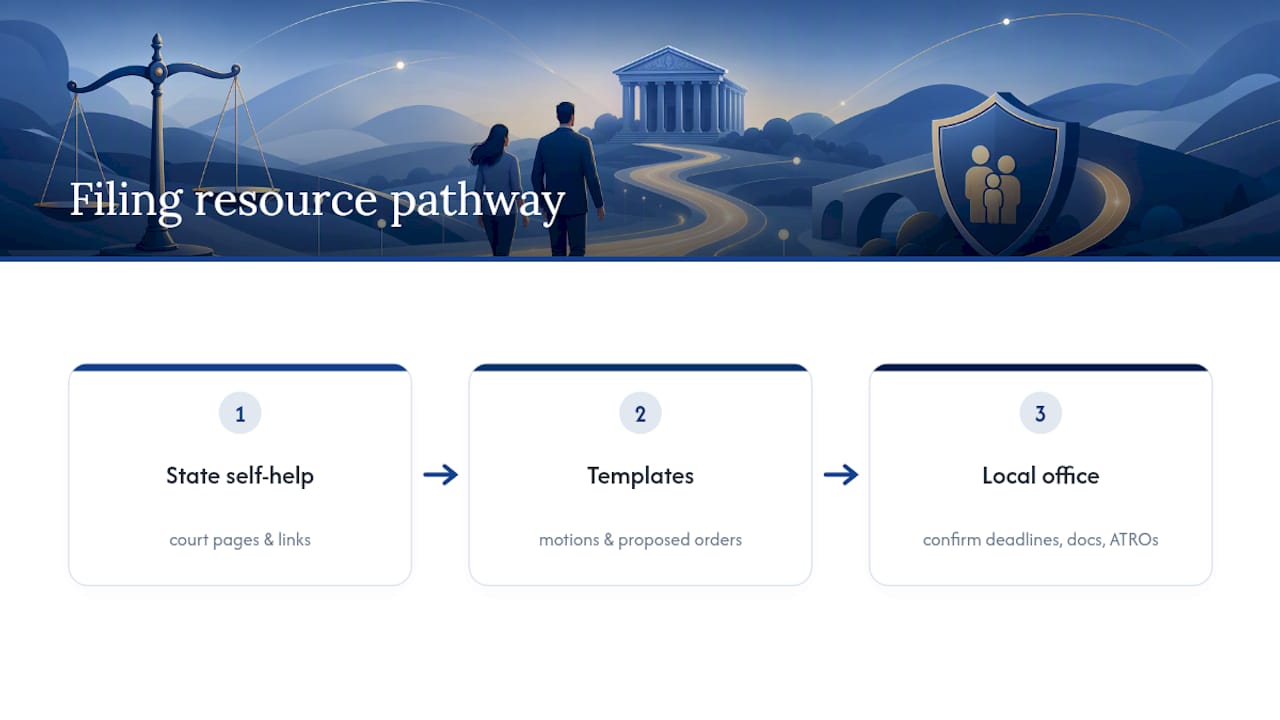
For state-specific forms and filing instructions, start with your state’s court self-help pages, most link directly to the required motion and proposed order templates. The California Courts self-help center and FindLaw’s overview of temporary orders are solid starting points for understanding the process nationally. Beyond that, contact your county clerk or family law facilitator directly. They can confirm local deadlines, required attachments, and whether ATROs apply automatically in your jurisdiction.
This article is general information, not a substitute for advice from a qualified lawyer. Consult a qualified legal professional about your own circumstances before acting on anything here.
Sources
- Family Court Decisions: Temporary Orders - FindLaw
- Utah Courts — Motion for Temporary Order guidance
- Texaslawhelp
FAQ
What Are Temporary Orders in a Texas Divorce?
Temporary orders in a Texas divorce set short-term rules for custody, child and spousal support, use of the home, and asset restraints while the case is pending, and they remain in effect until the final decree or a new court date.
How Long Does a Temporary Order Last in Texas?
A temporary order generally lasts until the final divorce decree is signed or the court modifies it, while an emergency temporary restraining order typically lasts around 14 days until a full hearing is held.
What Is a Temporary Orders Hearing in a Divorce Case?
A temporary orders hearing is a short court proceeding where a judge reviews requested interim relief, such as custody or support, and either signs a proposed order, asks for more evidence, or denies the request.
What Restrictions Apply to a Temporary Order in a Divorce Case?
Temporary orders are generally limited to addressing immediate needs, custody, support, home possession, and asset protection, rather than resolving final property division, and courts expect requests to be specific and narrowly framed rather than open-ended.
Can Temporary Orders Be Changed Before the Final Decree?
Yes. Either party can file a motion to modify a temporary order if circumstances change, such as a job loss or a shift in a child’s needs, without waiting for the final divorce decree.
Recommended
Questions About Your Situation?
Every family is different. Schedule a confidential consultation with Anna Din to discuss your options.
Schedule a Consultation