61 Day Minimum: Texas Divorce Timeline and Waiting Period Checklist
Texas law sets 61 days as the earliest possible date for a final divorce decree, under the mandatory 60-day waiting period in Tex. Fam. Code § 6.702. In practice, uncontested divorces typically finalize in 61 to 90 days, contested cases run 6 to 12 months, and complex or high-conflict cases can stretch 12 to 24 months or longer. A documented history of family violence can shorten or waive the waiting period. If your timeline feels uncertain, consulting with an experienced family law attorney can help you understand where your case stands and what comes next.
TL;DR:
- Uncontested divorces in Texas can be finalized as early as 61 days after filing, but most take 61 to 90 days if both parties cooperate.
- Contested cases commonly last between 6 to 12 months, with complex or high-conflict cases extending beyond a year.
- Filing delays often stem from service issues, missing paperwork, or waiting for court dates, particularly in counties with heavy caseloads.
- Mediating disputes early and preparing temporary orders during the waiting period can significantly reduce overall case duration.
- In cases with family violence or protective orders, the 60-day waiting period can be waived, allowing faster resolution if conditions are met.
Table of Contents
- Texas Divorce Process: Stage-by-Stage Timeline
- Where You File and the 60-Day Waiting Period
- What Speeds Up or Slows Down Your Case
- What Happens at the Final Hearing?
- Your Checklist for the First 60 Days
- How We Use the Waiting Period to Your Advantage
- When It’s Time to Bring in an Attorney
- Sources
- FAQ
Texas Divorce Process: Stage-by-Stage Timeline
Every Texas divorce moves through the same basic stages, but the time spent at each one depends heavily on whether both spouses agree on the outcome.
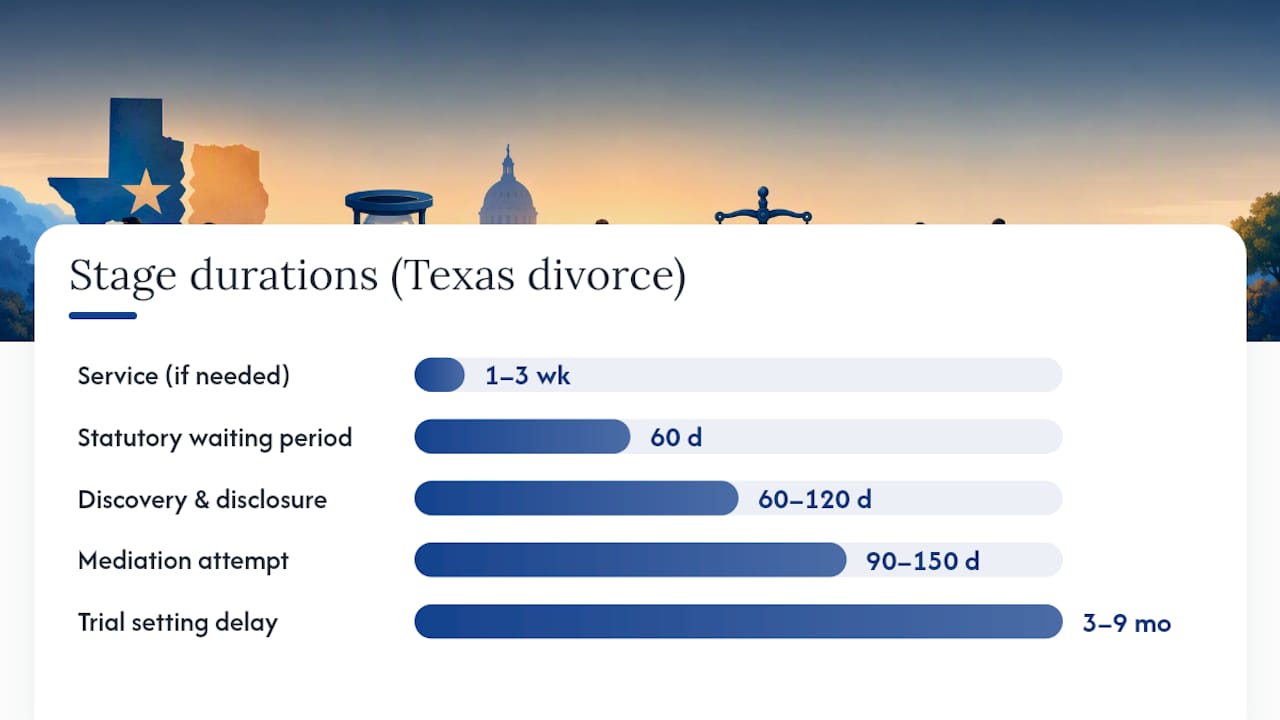
Filing and service. Your divorce timeline in Texas begins the moment the original petition gets a file stamp from the district clerk. That date starts the 60-day statutory clock, so it’s worth filing as early as possible once you’re ready to move forward. If your spouse doesn’t sign a waiver of service, a process server or sheriff must formally serve them, which can add one to three weeks depending on how easy they are to locate.
The waiting period. Nothing legally stops during these 60 days. Spouses can negotiate, exchange financial disclosures, attend mediation, or ask the court for temporary orders. Many Texas counties also have administrative backlogs that push the earliest hearing date slightly past day 60, even when both parties are ready.
Uncontested resolution. If you and your spouse agree on every issue, custody, property, and support, your attorney can typically schedule a short “prove-up” hearing right after the waiting period ends. Courts with lighter dockets sometimes finalize these cases within a day or two of the 61-day mark.
Contested stages. Disagreement adds discovery, temporary order hearings, mediation sessions, and possibly a trial setting. Here’s roughly how contested cases break down:
- Discovery and financial disclosure: often 60 to 120 days
- Mediation attempt (mandatory in many Texas counties): typically scheduled within 90 to 150 days of filing
- Trial setting, if mediation fails: can add another 3 to 9 months depending on the county’s docket
Post-decree tasks. Once the judge signs the final decree, work isn’t quite finished. Deed transfers, retirement account divisions through a Qualified Domestic Relations Order, and income withholding orders for child support often take another 30 to 60 days to process.
Where You File and the 60-Day Waiting Period
Before you can even open a case, Texas requires you to meet residency thresholds. At least one spouse must have lived in Texas for six months and in the county where you’re filing for 90 days, under Tex. Fam. Code § 6.301 and § 6.302. Miss either requirement and the court will dismiss your petition, costing you weeks you don’t have to lose.
Once you clear residency and file, the 60-day waiting period under Tex. Fam. Code § 6.702 begins running from the clerk’s file stamp date, not the date you signed the petition or the date your spouse was served. A court cannot grant your divorce before day 60, and the earliest realistic decree date is day 61.
A few practical notes worth keeping in mind:
- Filing fees vary by county, typically $300 to $400, and most Texas counties now accept petitions through eFileTexas
- If your spouse is served rather than signing a waiver, make sure the Return of Service is filed with the court. Missing paperwork here is one of the most common causes of delay
- Narrow exceptions to the 60-day rule apply when the respondent has a family-violence conviction or an active protective order against them, as described in Justia’s reproduction of § 6.702
If a protective order is part of your situation, understanding how it interacts with your divorce timeline matters before you file, not after.
What Speeds Up or Slows Down Your Case
Some factors are baked into your case from day one; others are choices you and your spouse make along the way.
- Mediation. Texas courts frequently order mediation before trial, and it’s often scheduled within the 60-day waiting period itself. The State Bar of Texas notes that resolving issues through negotiation avoids the uncertainty of a trial outcome, and successful mediation is one of the fastest ways to move from contested to finalized.
- Temporary orders. When spouses can’t agree on interim custody, support, or who stays in the house, either party can request temporary orders covering child support, possession schedules, use of property, and attorney’s fees while the case is pending. Getting a hearing set for temporary orders can itself take two to four weeks.
- Discovery and asset valuation. Dividing a business, complex investment accounts, or real estate holdings requires formal discovery and sometimes forensic accounting. That work alone routinely adds months to a case involving significant assets.
- Custody evaluations and docket backlog. Contested custody disputes may require a court-appointed evaluator, parenting classes, or expert testimony, each adding weeks to months. Busier counties also mean longer waits for available trial dates.
- Cooperation and preparation. Cases where both spouses show up with organized financial records and a genuine willingness to settle consistently move faster than cases where documents trickle in or positions keep shifting.
Pro Tip: Push for mediation early rather than waiting for the court to order it. Settling even two or three of the biggest disputed issues before trial prep begins can shave months off your case.
For high-asset families in particular, alternative dispute resolution often protects privacy and speeds resolution compared to a public trial.
What Happens at the Final Hearing?
The prove-up. For uncontested cases, the final hearing is usually brief, often 10 to 15 minutes. One spouse testifies to basic facts: that the marriage is irretrievably broken, that residency requirements are met, and that the settlement agreement is fair. Some counties, following flexibility introduced during the pandemic, now allow prove-up by affidavit instead of live testimony, but this varies by county, so confirm with your local clerk.
Contested trials. If your case doesn’t settle, getting an actual trial date can take months after mediation fails, depending on the county’s civil docket. Multi-day trials are common when custody and significant property are both disputed, and preparation, exhibits, witness lists, expert reports, often takes weeks before the trial date itself.
After the decree is signed. Once the judge signs your final decree, you’re not entirely done:
- Certified copies need to be requested and distributed to banks, employers, and title companies
- Retirement division orders (QDROs) must be drafted and submitted separately to plan administrators
- Name changes and deed transfers typically need to be filed within the following weeks
Your Checklist for the First 60 Days
The waiting period isn’t dead time. Use it well and you’ll walk into your final hearing prepared instead of scrambling.
Right away:
- Gather your driver’s license, Social Security card, and marriage certificate
- Pull the last two to three years of tax returns, plus recent pay stubs and bank statements
- Collect retirement account statements, property deeds, and any existing loan documents
Within the 60-day window: 4. Complete any court-ordered parenting class if children are involved 5. Draft a temporary orders request if you and your spouse can’t agree on interim custody or support 6. Prepare a settlement proposal if you’re aiming for an uncontested resolution at day 61
Call an attorney sooner rather than later if:
- Your case involves a business, significant retirement accounts, or real estate that needs professional valuation
- There’s any history of family violence or safety concerns
- Custody is contested and you’re worried about losing time with your children during the process
Typical timeline bands: Uncontested divorces often finalize in 61 to 90 days; contested cases commonly run 6 to 12 months; complex, high-conflict cases can extend past a year.
The Law Office of Anna Din’s pre-filing checklist walks through exactly which documents to have ready before your first meeting with counsel.
How We Use the Waiting Period to Your Advantage
The 60-day wait isn’t wasted time. The waiting period can be used to open settlement talks early, prepare temporary orders when a client needs immediate stability, and get financial disclosures moving before either side loses momentum. Consistent communication helps avoid surprises, and documents are requested in the order that can speed up a case. If you want a clearer picture of your own timeline, our checklists are a good place to start.
— Giri
When It’s Time to Bring in an Attorney
A missed deadline, an incomplete Return of Service, or a poorly drafted temporary order request can add weeks to a timeline that should have taken two months. Hiring an experienced family law attorney can help avoid guesswork in Texas divorce procedure. Such attorneys handle filing mechanics, push for temporary orders when stability is needed, and provide representation at contested hearings to keep cases on track.

Our divorce and marital law practice covers everything from uncontested filings to fully contested trials, and we also handle related matters that often surface during a divorce timeline: child custody and support disputes, protective orders, and postdivorce planning. If your case involves any safety concerns, our guide on family-violence exceptions to the waiting period explains how that can change your filing strategy. Ready to see where your case actually stands? Contact our office to schedule a consultation and get a realistic timeline for your specific situation.
Sources
Check Tex. Fam. Code § 6.702 for the statutory waiting period and Texas State Law Library guidance for filing procedure. Your county clerk’s office can confirm current filing fees and local hearing-setting practices, since these details vary across Texas counties.
This article is general information, not a substitute for advice from a qualified lawyer. Consult a qualified legal professional about your own circumstances before acting on anything here.
- FindLaw — Texas Family Code § 6.702
- Texas State Law Library — Filing for divorce
- TexasLawHelp — Divorce in Texas
- State Bar of Texas — Family law guidance on mediation and negotiation
FAQ
How Long Does a Divorce Take in Texas at Minimum?
The absolute earliest a Texas court can finalize a divorce is 61 days after filing, due to the mandatory 60-day waiting period under Tex. Fam. Code § 6.702.
What Is the Quickest Divorce Possible in Texas?
An uncontested divorce with a signed waiver of service, complete settlement paperwork, and full cooperation can close as fast as day 61, though most uncontested cases finalize within 61 to 90 days.
Can the 60-Day Waiting Period Be Waived?
Yes, but only in narrow circumstances involving documented family violence, such as an active protective order or a family-violence conviction against the respondent spouse.
How Long Does a Contested Divorce Take in Texas?
Contested divorces typically take 6 to 12 months, and cases involving complex assets, custody evaluations, or trial delays can extend to 12 to 24 months or more.
Do I Need a Lawyer for a Texas Divorce Timeline Issue?
You’re not legally required to hire one, but an attorney can prevent the paperwork errors and missed deadlines that most often stretch a case beyond its expected timeline. The Law Office of Anna Din handles filings, temporary orders, and contested representation for Texas divorce cases.
Recommended
Questions About Your Situation?
Every family is different. Schedule a confidential consultation with Anna Din to discuss your options.
Schedule a Consultation