Emergency Protective Order Texas: Get Immediate Protection
TL;DR:
- An emergency protective order in Texas is a short-term criminal order issued at arrest without a hearing. It creates an immediate legal barrier to protect victims before a civil protective order can be obtained. Violation of the order is a criminal offense punishable by fines and jail time.
If you are in immediate danger in Texas, an emergency protective order (EPO) is the fastest legal tool available to put distance between you and the person who harmed you. Under Texas Code of Criminal Procedure Art. 17.292, a magistrate can issue this order at the time of arrest, before the defendant is ever released from custody. You do not need to go to court yourself. You do not need to file paperwork. Tell the responding officer you want protection, and the process can begin that night.
If you are in danger right now:
- Call 911 and ask the officer to request a magistrate’s order of emergency protection when the arrest is made.
- Tell the magistrate or jail staff directly that you need protection before the defendant is released.
- Contact your county DA’s victim services unit or the Texas Advocacy Project for immediate guidance.
- Violation of an EPO is a criminal offense under Texas Penal Code §25.07, carrying penalties up to a $4,000 fine and one year in jail.
Table of Contents
- What an emergency protective order in Texas actually is
- When a magistrate must issue an EPO versus when it’s discretionary
- How long an EPO lasts and what comes next
- How to request an EPO right now: a step-by-step guide
- What an EPO prohibits and the penalties for violating it
- How an EPO compares to other protective orders in Texas
- Safety steps and documents to collect after an incident
- When a family-law attorney can make a real difference
- Key Takeaways
- Why acting fast on an EPO matters more than most people realize
- How Lawofficeofannadin supports clients through protective-order matters
- Useful sources and official forms
- FAQ
What an emergency protective order in Texas actually is
A magistrate’s order of emergency protection, commonly called an EPO or MOEP, is a short-term criminal court order issued at or shortly after an arrest. Its purpose is to create an immediate legal barrier between you and the person arrested, covering the period before a civil court can step in with longer-term protection.
The controlling statute is Art. 17.292 of the Texas Code of Criminal Procedure. That article gives a magistrate the authority, and in certain situations the duty, to issue the order before the defendant is released on bond. No hearing is required. You do not have to appear in court for the order to be issued.
This distinction matters. Many people assume protective orders only apply in domestic relationships. Texas law does not require that connection for an EPO. The order is designed to complement bond conditions, adding a criminal enforcement layer on top of whatever release terms the magistrate sets.
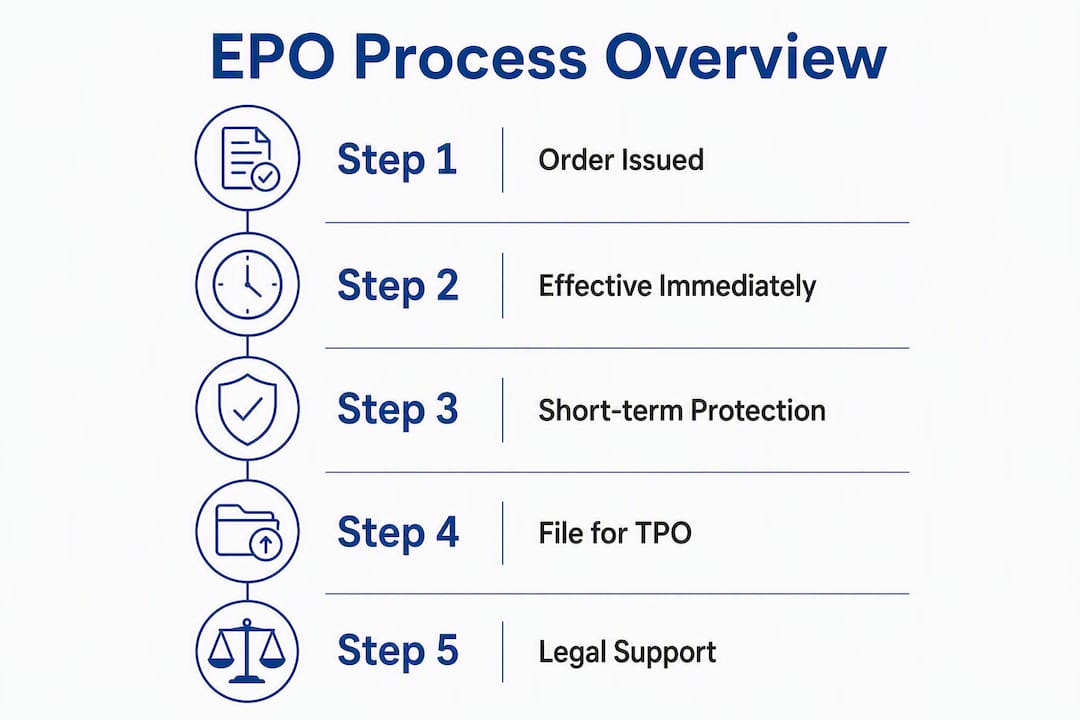
One common misconception is that an EPO replaces long-term protection. It does not. An EPO is a bridge, covering days or weeks while you pursue a temporary ex parte order or a final civil protective order through the family court.
When a magistrate must issue an EPO versus when it’s discretionary
Texas law draws a clear line between situations where issuance is mandatory and situations where it is left to the magistrate’s judgment.
Mandatory issuance — the magistrate has no discretion:
- The arrest involved family violence, AND the offense caused serious bodily injury to the victim.
- The arrest involved family violence, AND the defendant used or exhibited a deadly weapon during the offense.
In either of those situations, the magistrate must issue the order. There is no weighing of circumstances.
Discretionary issuance — the magistrate may issue an EPO:
- Arrest for family violence (without serious bodily injury or a deadly weapon).
- Arrest for sexual assault or aggravated sexual assault.
- Arrest for indecent assault.
- Arrest for stalking.
- Arrest for trafficking.
In discretionary cases, the order can be requested by the victim, the victim’s guardian, a peace officer, or the prosecutor. The magistrate can also issue one on their own initiative. If you are in a discretionary situation and no one has requested an order, speak up. Ask the officer, the jail staff, or the DA’s office to make the request.
A practical example: if your partner was arrested after hitting you with a belt buckle and you required stitches, that likely meets the serious bodily injury threshold, making issuance mandatory. If the arrest was for a shove that left no injury, the magistrate has discretion, and your request or the officer’s request becomes the deciding factor.

How long an EPO lasts and what comes next
Duration depends on the category of offense that triggered the arrest.
Duration at a glance: Discretionary EPOs typically last between 31 and 61 days. Mandatory EPOs tied to deadly weapon arrests last between 61 and 91 days, and some categories can extend up to 121 days under recent statutory amendments.
The order takes effect the moment it is issued, not when it is served on the defendant. Under Art. 17.292, the magistrate must promptly send copies to local law enforcement and to you as the protected person. Law enforcement then enters the order into statewide systems so that any officer who runs the defendant’s name can see the active order.
The Office of Court Administration (OCA) provides standardized Magistrate Order for Emergency Protection (MOEP) forms that courts are required to use, with updated forms effective September 1, 2025, including Spanish-language versions and guidance for entry into the Texas Crime Information Center (TCIC).
An EPO is short-term by design. Before it expires, you should consider filing for a temporary ex parte protective order or a final protective order in civil court. Attorneys commonly use the EPO’s evidentiary record, including the arrest report and any documented injuries, to support those civil filings.
How to request an EPO right now: a step-by-step guide
At the scene or during the arrest
- Call 911. When officers arrive, tell them clearly that you want an emergency protective order.
- Ask the officer to request the MOEP. Officers can and do make this request to the magistrate on your behalf.
- Request your victim’s rights notification. Texas law requires officers to provide this; it outlines your rights and available services.
- Provide a brief statement. Describe what happened, any injuries, and whether a weapon was involved. This information directly affects whether issuance is mandatory or discretionary.
If the arrest already happened
- Contact the magistrate’s court or municipal court where the defendant will appear for their initial hearing.
- Call the county jail and ask whether an EPO has been issued. If not, ask to speak with the magistrate on duty.
- Contact the county DA’s victim services unit. They can request the order on your behalf and confirm whether one is already in place.
- Reach out to the Texas Advocacy Project for procedural guidance specific to your county.
After the order is issued
- Confirm the defendant was served and that the order is entered into law enforcement systems.
- Request your own certified copy of the order and keep it with you at all times.
- Photograph the order and store a copy in a secure cloud account or with a trusted person.
Information and evidence to have ready:
- Police report number and responding officer’s name.
- Dates, times, and locations of all incidents.
- Photographs of injuries or property damage.
- Medical records or ER visit documentation.
- Names and contact information of any witnesses.
- Saved text messages, voicemails, or emails from the defendant.
Resources available to you now: your local DA’s victim services office, the OCA standardized forms page, and the Texas Advocacy Project.
What an EPO prohibits and the penalties for violating it
A magistrate issuing an EPO can order the defendant to:
- Have no contact with you, your children, or other protected persons, whether in person, by phone, by text, or through a third party.
- Stay away from your home, workplace, school, or any other location the order specifies.
- Refrain from stalking, harassing, or threatening you.
- Surrender any firearms and have their concealed-handgun license suspended.
- Submit to GPS monitoring when authorized under the statute.
Violation carries real criminal consequences. Under Texas Penal Code §25.07, violating an EPO is a Class A misdemeanor, punishable by a fine of up to $4,000 and up to one year in jail. If the act of violation is itself a separate felony, the defendant faces a minimum two-year prison sentence.
Enforcement works through the criminal system. If the defendant contacts you, shows up at your home, or violates any term of the order, call 911 immediately. Officers can arrest for a violation without a warrant if they have probable cause to believe the order was breached. Document every violation with dates, times, screenshots, and witness information, and report each one to the DA’s office.
For a detailed breakdown of enforcement steps after a violation, see Protective Order Violation in Texas: What You Must Know.
How an EPO compares to other protective orders in Texas
People often use “restraining order” and “protective order” interchangeably, but Texas law treats them as distinct tools with different procedures, durations, and enforcement mechanisms. Confusing them can delay the protection you need.
| Order Type | Who Issues It | Hearing Required? | Typical Duration | Enforcement |
|---|---|---|---|---|
| EPO (MOEP) | Magistrate at arrest | No | 31–61 days (discretionary); 61–91 days (mandatory—deadly weapon); some extend to 121 days under new law | Criminal (arrest/prosecution) |
| Temporary Ex Parte Order (TPO) | Civil district or county court | No (ex parte) | Up to 20 days (renewable) | Civil contempt + criminal |
| Final Protective Order | Civil court after hearing | Yes | Up to 2 years (longer in some cases) | Civil contempt + criminal |
| Restraining Order | Civil court (divorce/custody) | Usually yes | Per court order | Civil contempt only |
The EPO is criminal in nature and issues before release. The temporary ex parte protective order is a civil order a judge can grant without the other party present, typically lasting up to 20 days while a full hearing is scheduled. A final protective order follows a hearing where both sides can appear and can last up to two years, or longer in cases involving serious bodily injury or a deadly weapon.
A restraining order, by contrast, is typically issued in the context of civil litigation like divorce or custody and carries only civil contempt enforcement, not criminal prosecution. It is generally weaker than a protective order for safety purposes.
The Travis County Law Library’s plain-language comparison also covers peace bonds, which are a separate remedy available when no crime has been committed but a threat exists. If you are unsure which order fits your situation, the Texas State Law Library and your local DA’s office can help you identify the right path.
Once your EPO is in place, use that window to file for a TPO or final protective order in civil court. An attorney can use the EPO’s evidentiary record, including the arrest documentation, to support those filings.
Safety steps and documents to collect after an incident
An EPO is a legal tool, not a physical barrier. Pairing it with a concrete safety plan is what actually keeps you safer.
Immediate safety steps:
- Stay with a trusted friend, family member, or at a local shelter if returning home feels unsafe.
- Contact a local victim advocate or the National Domestic Violence Hotline (1-800-799-7233) for safety planning support.
- Change locks and security codes if the defendant had access to your home.
- Notify your children’s school and your workplace that the order is in place and provide them a copy.
- Keep your phone charged and with you at all times.
Documents and evidence to collect and preserve:
- Certified copy of the EPO (carry one, store one digitally).
- Police report number and the name of the responding officer.
- Photographs of injuries, property damage, or the scene.
- Medical records from any ER visit or treatment.
- Screenshots of threatening texts, emails, or social media messages.
- Names and contact information of any witnesses.
- A written log of each incident with dates, times, and descriptions.
Store copies with a trusted person and in a secure cloud account the defendant cannot access. Each documented violation strengthens any future criminal prosecution or civil protective-order hearing. For broader legal preparation, the Texas divorce legal checklist also covers documentation steps relevant when an EPO intersects with a pending separation.
When a family-law attorney can make a real difference
An EPO gets you through the first weeks. What happens after it expires is where legal representation becomes critical.
You should strongly consider hiring a family-law attorney if:
- The defendant has violated the order or you expect they will.
- Your situation involves children and custody arrangements are at risk.
- You need to file for a temporary ex parte order or a final protective order and want the strongest possible evidentiary presentation.
- The protective order intersects with a pending or anticipated divorce.
- You need to modify or extend an order after the EPO period ends.
An attorney can communicate directly with prosecutors, request modifications or extensions of existing orders, file civil protective orders in family court, prepare and organize your evidence, and coordinate with victim-services advocates. When custody is involved, the stakes are especially high. A family-law attorney can connect the protective-order record to your custody case, which can affect conservatorship and visitation terms significantly.
Pro Tip: Bring your police report number, a copy of the EPO, any photos or medical records, and a written timeline of incidents to your first attorney consultation. The more organized your documentation, the faster your attorney can assess your options and act.
If you need to understand your rights around modifying or extending an order after the EPO window closes, the partner resource Modification of a Restraining Order: Your Legal Guide provides useful procedural context.
Key Takeaways
A Texas emergency protective order is a criminally enforceable order issued at arrest under Art. 17.292, with discretionary orders lasting between 31 and 61 days, mandatory (deadly weapon) orders lasting between 61 and 91 days, and some recent amendments allowing durations up to 121 days in specific categories, and violation carries penalties up to a $4,000 fine and one year in jail.
| Point | Details |
|---|---|
| Statutory basis | Art. 17.292 of the Texas Code of Criminal Procedure governs all EPOs in Texas. |
| Mandatory vs. discretionary | Serious bodily injury or a deadly weapon makes issuance mandatory; other family violence arrests are discretionary. |
| Duration by category | Discretionary EPOs last between 31 and 61 days; mandatory (deadly weapon) EPOs last between 61 and 91 days, with some categories extending up to 121 days under recent amendments. |
| Violation penalties | A Class A misdemeanor under Penal Code §25.07: up to $4,000 fine and up to one year in jail; felony conduct raises the minimum to two years. |
| Next step with Lawofficeofannadin | The Law Office of Anna Din helps clients file for temporary and final protective orders, enforce EPO terms, and address related custody or divorce matters. |
Why acting fast on an EPO matters more than most people realize
The gap between an EPO and a final protective order is where most victims are most vulnerable. An EPO covers days or weeks. A final protective order can cover years. But getting from one to the other requires filing in civil court, attending a hearing, and presenting evidence, all while managing the emotional weight of what just happened.
What I see repeatedly in family-law practice is that victims who act within the EPO window, who use those 31 to 91 days (depending on the statutory category) to file for a temporary ex parte order and begin building their civil case, end up in a far stronger position than those who wait. The EPO’s arrest record, the police report, the documented injuries: all of that becomes the foundation of the civil case. Waiting for the EPO to expire before consulting an attorney means starting from scratch under time pressure.
There is also a custody dimension that surprises many clients. When a protective order is in place, it directly affects what a Texas family court can order regarding conservatorship and visitation. Acting quickly on the legal track does not just protect your physical safety. It shapes the custody outcome for your children.
The order alone is not enough. Pair it with a safety plan, document everything, and get legal counsel before the clock runs out.
How Lawofficeofannadin supports clients through protective-order matters
When an EPO has been issued and you are looking at the next 30 to 90 days, the decisions you make now carry long-term consequences for your safety, your custody arrangement, and your divorce proceedings. Lawofficeofannadin provides direct legal support for each of those tracks.

The firm’s protective-order representation covers the full sequence: confirming the EPO is properly served and entered into law enforcement systems, filing for a temporary ex parte order while the EPO is active, preparing evidence for a final protective order hearing, and addressing any custody or divorce filings that run parallel to the protective-order case. Clients in The Woodlands, Houston, and surrounding communities receive direct attorney access, not a paralegal intake process.
At a first consultation, bring your police report, a copy of the EPO if you have it, any photographs or medical records, and a written timeline of incidents. The firm works with clients on urgent timelines. To schedule a consultation or ask a question about your situation, contact the Law Office of Anna Din directly.
Useful sources and official forms
The sources below are the authoritative starting points for Texas EPO law, standardized forms, and victim-advocacy guidance.
| Resource | What It Covers | Best For |
|---|---|---|
| Texas Code of Criminal Procedure Art. 17.292 | Full statutory text governing EPO issuance, duration, and service | Confirming legal requirements and magistrate duties |
| OCA Standardized MOEP Forms | Official court forms (updated September 1, 2025), including Spanish versions | Obtaining or reviewing the actual order form |
| Texas State Law Library — Protective Orders Guide | Plain-language overview of all Texas protective order types | Understanding differences between order types |
| Texas Penal Code §25.07 | Criminal penalties for violating a protective or emergency order | Reporting a violation or understanding enforcement |
| Travis County Law Library — PO vs. Restraining Order vs. Peace Bond | Side-by-side comparison of Texas protective tools | Choosing the right order type for your situation |
| Harris County DA — Obtaining a Protective Order | County-level procedural guidance and victim services | Houston-area victims seeking local DA support |
| Lawofficeofannadin — Protective Orders Practice Page | Attorney representation for EPOs, TPOs, and final protective orders | Hiring legal counsel in The Woodlands or Houston area |
This article provides general legal information about Texas emergency protective orders and is not a substitute for advice from a licensed attorney. Laws and procedures can change; confirm current requirements with the Texas courts or a qualified family-law attorney.
FAQ
What is the difference between a protective order and a restraining order in Texas?
A protective order is a civil or criminal court order specifically designed to protect victims of family violence, sexual assault, or stalking, and carries criminal enforcement. A restraining order is typically issued in civil litigation such as divorce and is enforced only through civil contempt, making it a weaker safety tool.
How is an EPO different from a restraining order?
An EPO is issued by a magistrate at the time of arrest, requires no hearing, and is criminally enforceable under Texas Penal Code §25.07. A restraining order requires a civil court filing and a hearing, and violation does not automatically trigger criminal prosecution.
How long is an EPO valid in Texas?
Discretionary EPOs last between 31 and 61 days; mandatory EPOs tied to arrests involving a deadly weapon last between 61 and 91 days, and some categories can extend up to 121 days under recent statutory amendments.
How many types of protective orders are there in Texas?
Texas has three primary protective order types: the magistrate’s order of emergency protection (EPO/MOEP), the temporary ex parte protective order (TPO), and the final protective order issued after a full court hearing. Peace bonds are a separate, lesser-used remedy for situations where no crime has occurred but a credible threat exists.
What should you do if someone violates an EPO in Texas?
Call 911 immediately, document the violation with dates, times, and any evidence, and report it to the DA’s office. Officers can arrest for a violation without a warrant if probable cause exists, and prosecution can proceed under Penal Code §25.07.
Recommended
Questions About Your Situation?
Every family is different. Schedule a confidential consultation with Anna Din to discuss your options.
Schedule a Consultation