What a Texas Living Will Covers and How to Make One

A Texas living will, formally the Directive to Physicians and Family or Surrogates, lets you record your medical-treatment wishes under Tex. Health & Safety Code Chapter 166. Here is what to do right now:
- Download the official Texas HHS living-will form.
- Sign it in front of two qualified witnesses, or have it notarized instead.
- Give signed copies to your physician and the surrogate you trust to speak for you.
Key Takeaways
A valid Texas living will requires a written directive signed with two qualified witnesses or a notary, and it works best alongside a named medical power of attorney.
| Point | Details |
|---|---|
| Use the official form | Download the Texas HHS Directive to Physicians form rather than relying on unofficial templates. |
| Sign it correctly | Use two qualified witnesses or notary acknowledgment under Tex. Health & Safety Code §166.032. |
| Be specific, not vague | Write actual medical scenarios instead of general phrases like “no extraordinary measures.” |
| Pair it with an MPOA | A medical power of attorney names a decision maker for situations your directive doesn’t cover. |
| Get legal help for complex cases | Lawofficeofannadin can draft, review, and help distribute directives for families with disputed dynamics or complex estates. |
This article is general information, not a substitute for advice from a qualified doctor. Consult a qualified healthcare professional about your own circumstances before acting on anything here.
Table of Contents
- What Does a Living Will in Texas Actually Do?
- Who Actually Needs One?
- How Do You Create a Valid Living Will in Texas?
- When Does It Take Effect, and How Do You Change It?
- Living Will vs. Medical Power of Attorney vs. DNR
- Where to Get Forms and Who Should See Them
- Why the Standard Advice on Living Wills Falls Short
- How Anna Din’s Office Can Help With Your Directive
- Sources
- FAQ
What Does a Living Will in Texas Actually Do?
“Living will” is the common nickname for the Directive to Physicians and Family or Surrogates, and the two terms mean the same document in Texas. Chapter 166 lets any competent adult put treatment preferences in writing, and the law does not require a single standardized form. You can use the state’s version, adapt it, or add your own language, as long as it meets the statute’s signing rules.
There are limits worth understanding upfront. The directive has restricted effect if you are pregnant, and your own expressed wishes at the time of treatment can override what you wrote earlier. Texas Medical Association guidance also stresses that a directive is meant to guide a conversation between you and your doctor, not function as a blanket refusal of care. It tells your care team what you would want in specific circumstances, not a flat “do not treat.”
Who Actually Needs One?
Any competent adult can benefit from a directive, but some situations make it genuinely urgent:
- You’re facing major surgery or a new serious diagnosis.
- You manage a chronic illness that could progress to a medical crisis.
- You’re aging and want to settle these decisions before a health event forces the issue.
- You or a family member are noticing early signs of cognitive decline.
A written directive reduces the guesswork and the arguments among family members during a crisis, and it gives your physician a clear record of your values instead of a hallway debate. It works best paired with a medical power of attorney naming someone to act when you cannot speak for yourself, which we’ll cover shortly.
How Do You Create a Valid Living Will in Texas?
Texas law is specific about form, but flexible about wording. Follow these steps to make sure yours holds up:
- Spell out your preferences. State specific choices, not vague hopes. “No prolonged mechanical ventilation without reasonable chance of recovery” holds up better than “nothing heroic.”
- Sign correctly. You have two valid options under §166.032: sign in front of two qualified witnesses, or sign with notary acknowledgment. Notarization is not required if you use two witnesses.
- Check witness eligibility. At least one witness must meet the qualifications in §166.003, and certain people are disqualified, including your attending physician, an employee of that physician, and anyone who stands to inherit from your estate. Skipping this step is the most common reason a directive later gets challenged.
- Distribute copies. Give copies to your attending physician, your hospital, your designated agent, and close family members. Ask your doctor’s office to add it to your medical record so it’s on hand when it matters.
Pro Tip: Keep a card in your wallet noting where your directive is stored and who holds a copy. Paramedics and ER staff cannot honor a document they cannot find.
When Does It Take Effect, and How Do You Change It?
Your directive only becomes active once your attending physician certifies that you meet the conditions Chapter 166 describes, generally a terminal or irreversible condition where you can no longer make your own decisions. At that point, the physician and your named agent, if you have one, apply the directive to guide treatment choices.
Revoking or updating it is straightforward. You can destroy the document, sign a written revocation, or revoke it orally in front of a witness. Whatever method you use, tell your physician and update the copies you have distributed. An outdated directive sitting in a drawer somewhere does nothing for you.

Living Will vs. Medical Power of Attorney vs. DNR
These three documents get confused constantly, but they do different jobs:
- Living will (directive): States your specific treatment preferences in writing, for physicians to follow directly.
- Medical power of attorney: Names a person to make decisions on your behalf when you cannot, covering situations your directive did not anticipate.
- Out-of-hospital DNR: A separate, EMS-focused order with its own execution requirements, relevant only outside a hospital setting.
None of these substitutes for the others. Pairing a living will with a medical power of attorney closes the gaps a written directive alone cannot cover, since no document can anticipate every possible scenario.
Where to Get Forms and Who Should See Them
Start with the official Texas HHS form and the plain-language explanations at TexasLawHelp if you want a walkthrough before you sign anything.
- Keep the signed original somewhere accessible, not locked away where family cannot find it in an emergency.
- Share copies with your physician, your hospital, and your designated agent, and ask that it be added to your electronic health record.
- Talk to an attorney if your family situation is complicated. Blended families, disputed guardianship, or unclear wishes are exactly where a wills and family planning attorney earns their fee.
Why the Standard Advice on Living Wills Falls Short
Most guides treat a living will like a form to fill out and forget. That’s backward. The real value of a Texas directive comes from specificity, not completion. A checkbox that says “no extraordinary measures” tells your doctor almost nothing useful in the moment it matters most. The people who benefit most from these documents are the ones who write down actual scenarios, not general sentiments.
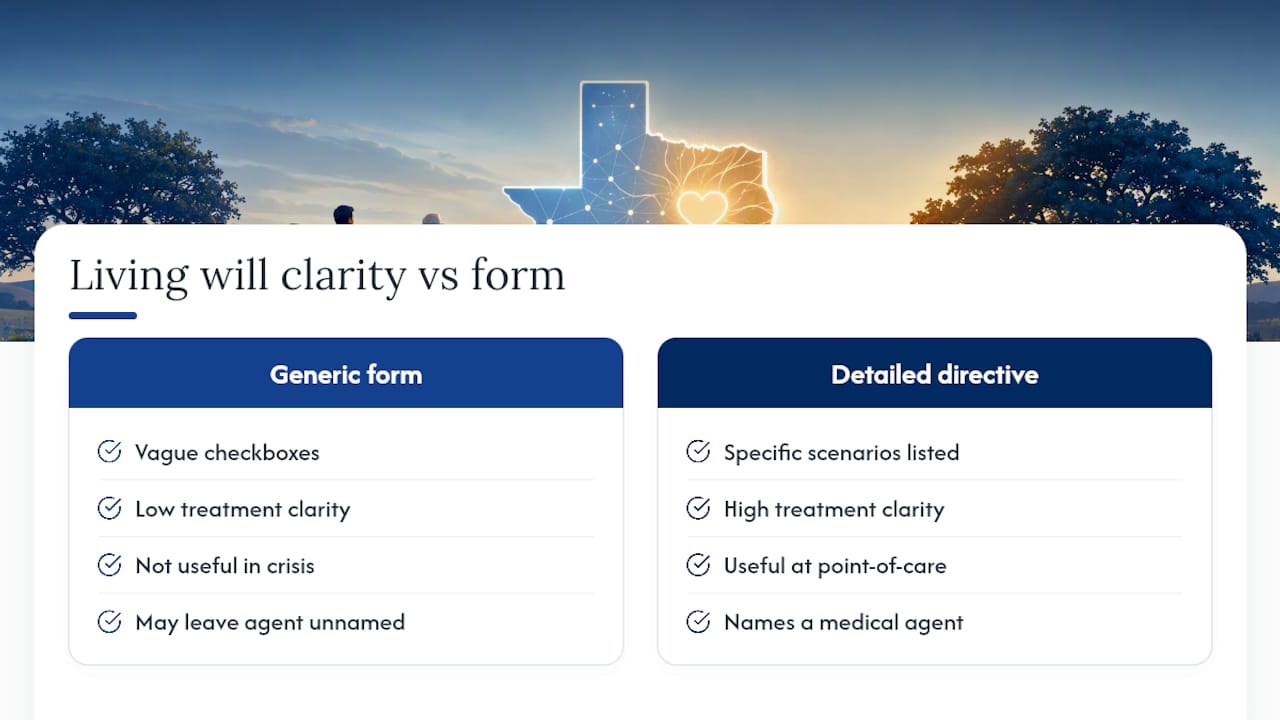
The other gap in conventional advice is treating a living will as a standalone solution. It is not. A directive without a named agent leaves gaps the statute fills with a default priority list of surrogates, and that list might not match who you would actually choose. Pairing your directive with a medical power of attorney is not optional caution. It is the difference between your wishes being interpreted by someone who knows you and being interpreted by whoever the law assigns.
If you take one thing from this: draft your directive with real conditions in mind, name your agent explicitly, and revisit both documents whenever your health or family situation changes.
— Giri
How Anna Din’s Office Can Help With Your Directive
Filling out the HHS form is straightforward for a lot of people, but the moment your family situation gets complicated, a form alone will not protect you. The Law Office of Anna Din handles living-will drafting, broader estate planning, document review, and helping clients notify physicians and hospitals correctly so the directive actually gets followed when it counts.

You should bring in a lawyer when family members disagree about your care, when your estate and guardianship plans overlap with your medical wishes, or when you want directive language more specific than the standard checkboxes allow; see Making & Amending A Will - Simons George Legal for guidance on estate-document practices. Anna Din’s firm has built its reputation on exactly this kind of careful, personalized document work for families throughout The Woodlands and Houston. If you are ready to put a directive and a medical power of attorney in place correctly the first time, visit the wills and family planning practice page to schedule a consultation.
Sources
FAQ
Can I Write My Own Living Will in Texas?
Yes. Chapter 166 does not require the state’s standardized form, so you can draft your own language as long as it meets the statute’s signing and witness requirements.
What Is the Downside of a Living Will?
A living will only covers scenarios you anticipated in writing, so vague or incomplete language can leave gaps. Pairing it with a medical power of attorney fills those gaps by naming someone to decide in situations the document didn’t foresee.
Do I Need a Notary for a Texas Living Will?
No. You can sign in front of two qualified witnesses instead, and notarization is simply an alternative method the statute allows, not a requirement.
Where Can I Get a Free Living Will Form in Texas?
The Texas HHS website offers the official form at no cost, and TexasLawHelp provides free plain-language guidance for filling it out.
Recommended
Questions About Your Situation?
Every family is different. Schedule a confidential consultation with Anna Din to discuss your options.
Schedule a Consultation