Military Divorce in Texas: Rules, Rights, and Filing Steps
Yes, you can file for divorce in Texas even while stationed elsewhere, as long as Texas is your legal domicile. Under Tex. Fam. Code §6.303, time spent outside the state on military orders still counts as Texas residence for filing purposes. Three things matter most from here:
- Domicile evidence. You need documentation showing Texas is your true home base, not just your last posting.
- SCRA stays. The Servicemembers Civil Relief Act can pause proceedings, but it’s a narrow tool, not a shield against the divorce itself.
- Retirement division. The Uniformed Services Former Spouses’ Protection Act lets Texas courts divide disposable retired pay, with the Defense Finance and Accounting Service handling direct payments once a court order qualifies.
Get these three right early, and everything else in a military divorce Texas case tends to fall into place.
Key Takeaways
Military divorce in Texas hinges on proving domicile under §6.303, using SCRA stays narrowly, and drafting retirement orders that meet USFSPA’s technical requirements before DFAS will process them.
| Point | Details |
|---|---|
| Domicile beats duty station | Keep a Texas driver’s license, voter registration, and tax filings current to prove domicile under Tex. Fam. Code §6.303. |
| Use SCRA stays narrowly | Request a pause for a specific hearing rather than the entire case to avoid support arrearages piling up. |
| Retirement orders need precision | Decrees must define disposable retired pay and include certification language DFAS requires for direct payment. |
| Confirm 20/20/20 eligibility early | Full TRICARE and base access after divorce require 20 years of marriage overlapping 20 years of service. |
| Get local counsel involved | Lawofficeofannadin helps Texas military families with domicile disputes, pension division, and custody plans built around PCS orders. |
This article is general information, not a substitute for advice from a qualified lawyer. Consult a qualified legal professional about your own circumstances before acting on anything here.
Table of Contents
- Filing for Military Divorce in Texas: Residency and Jurisdiction Rules
- What the SCRA Actually Protects, and Where It Falls Short
- Dividing Military Retirement: USFSPA, DFAS, and the 10/10 Rule
- Child Custody, PCS Moves, and Deployment-Ready Parenting Plans
- TRICARE, Housing Benefits, and the 20/20/20 Rule After Divorce
- Filing Steps, Timeline, and What a Military Divorce Typically Costs in Texas
- Why Trust This Guide: Local Experience With Military Divorce Cases
- Divorcing While Deployed Overseas: What Changes and What Doesn’t
- How Discharge Status Affects Divorce and Benefit Eligibility
- Dividing the Survivor Benefit Plan and Other Non-Retirement Benefits
- Modifying Orders When Military Status Changes Later
- Filing Without an Attorney: Risks for Pro Se Service Members
- The Gap Between Generic Divorce Advice and Military Reality
- How Lawofficeofannadin Helps With Military Divorce in Texas
- Sources
- FAQ
Filing for Military Divorce in Texas: Residency and Jurisdiction Rules
Texas doesn’t punish service members for following orders. Under §6.303, time a Texas domiciliary spends outside the state while serving in the armed forces still counts as residence here, even if you haven’t set foot in Harris County in three years. The catch is proving domicile in the first place, and that’s where a lot of military divorce Texas cases stall.
Courts look for concrete ties, not verbal assurances. The Texas benchbook on §6.303 confirms judges weigh evidence of intent to return, not just a mailing address.
- Texas driver’s license or state ID, kept current even overseas.
- Voter registration in a Texas county.
- State tax filings listing Texas as your home of record.
- A lease, mortgage, or storage unit maintained in Texas.
- A written statement of intent to return to Texas after service ends.
If your spouse contests jurisdiction, expect the court to scrutinize which of these ties existed before the divorce filing, not ones created afterward. Practical evidence of domicile built over time carries far more weight than a hastily updated address.
Pro Tip: Keep a folder, physical or digital, with copies of your Texas ID, voter card, and most recent state filing. Judges move faster when domicile isn’t a fight.
What the SCRA Actually Protects, and Where It Falls Short
The SCRA gives active-duty service members the right to request a stay of civil proceedings and protects against default judgments if they can’t respond in time. It does not stop a Texas divorce from proceeding on the merits, and it does not change how property, custody, or support gets decided under state law.
To request a stay, you generally need to show your military duties materially affect your ability to participate, usually through a commanding officer’s letter, current orders, and an affidavit explaining the conflict. Courts increasingly expect a narrow, specific ask rather than an open-ended pause.
- Identify the exact hearing or deadline you can’t meet, not the whole case.
- Attach current deployment or PCS orders.
- Include contact information showing you remain reachable for updates.
- Request the shortest stay that solves the actual conflict.
A blanket stay can backfire. Child support keeps accruing during delays, and unresolved custody questions can drag on for months while a case sits paused. Attorneys generally recommend using SCRA stays for specific hearings you truly cannot attend, while cooperating on paperwork and uncontested issues that don’t require your physical presence.
Pro Tip: If you’re deployed and can’t appear, ask your attorney about a limited telephonic or video hearing before requesting a full stay. Courts often prefer it, and it keeps your case moving.
Dividing Military Retirement: USFSPA, DFAS, and the 10/10 Rule
The USFSPA gives Texas courts the authority to treat disposable military retired pay as divisible marital property, the same as a 401(k) or pension. “Disposable” pay means gross retired pay minus specific deductions like disability compensation, and getting that definition wrong in a decree is one of the most common drafting errors attorneys see.
Direct payment from DFAS is a separate issue from division itself. A former spouse can receive payments straight from DFAS only when the marriage lasted at least 10 years overlapping with 10 years of creditable military service, known as the 10/10 rule. Fall short of that threshold, and the retiree becomes responsible for paying their former spouse’s share directly, which creates its own enforcement headaches.
Common drafting mistakes include:
- Vague language that doesn’t specify a percentage or formula tied to disposable retired pay.
- Omitting the certification DFAS requires before it will process direct payments.
- Failing to address what happens if the retiree later waives retired pay for VA disability compensation or civil-service credit, which can reduce or eliminate the former spouse’s award.
- Not building in a 90-day processing window, which is roughly how long DFAS takes to begin payments after receiving a valid order.
A decree should specify the exact percentage or dollar formula, certify USFSPA compliance, and anticipate waiver scenarios with an alternate remedy. Anyone researching how divorce affects retirement and investments beyond the military context will recognize the same principle: vague pension language creates enforcement problems years down the road.
Child Custody, PCS Moves, and Deployment-Ready Parenting Plans
Texas courts don’t penalize a parent for military service, but they do expect a plan that accounts for it. Deployment and PCS orders regularly reshape custody schedules, and judges increasingly favor parenting plans built with contingencies already written in, rather than fights that erupt every time orders change.
- Build in advance notice requirements. A clause requiring 30 to 60 days’ written notice of a PCS gives both parents time to adjust custody logistics before a move happens.
- Add virtual parenting time. Video calls and messaging apps don’t replace physical custody, but courts recognize scheduled video contact as a legitimate way to preserve the parent-child bond during deployment.
- Designate a caretaker for deployment gaps. Naming a grandparent or trusted family member as a temporary custodian avoids last-minute scrambling and keeps custody decisions predictable.
- Spell out exchange logistics. Who pays for travel, where exchanges happen, and how disputes get resolved should all be on paper before a PCS, not negotiated during one.
- Keep your orders and this paperwork together. Deployment orders, the custody decree, and emergency contact information should travel with you, not sit in a drawer at home.
When circumstances change dramatically, a formal modification may be necessary. For smaller adjustments, a written, signed agreement between both parents often resolves things faster than returning to court.
TRICARE, Housing Benefits, and the 20/20/20 Rule After Divorce
Divorce changes more than a marriage. It often changes healthcare, housing access, and shopping privileges overnight. Texas calculates child support and spousal maintenance using the same guidelines applied to civilian income, factoring in base pay, allowances, and special pay as part of gross income.
The bigger shock for many spouses is losing TRICARE and base access the moment the decree is final. Military OneSource outlines the 20/20/20 rule: a former spouse keeps full TRICARE, commissary, and exchange privileges only when the marriage lasted at least 20 years, overlapping with at least 20 years of creditable military service.
- Confirm your marriage and service overlap meet the 20/20/20 threshold before assuming coverage continues.
- If you fall short, ask about the Continued Health Care Benefit Program, which can extend coverage for up to 36 months at your own cost.
- Notify DFAS and TRICARE promptly once the decree is final. Coverage doesn’t update automatically.
- Keep copies of the final decree and marriage/service dates handy. You’ll need them to prove eligibility.
Filing Steps, Timeline, and What a Military Divorce Typically Costs in Texas
Before filing, gather your Leave and Earnings Statement, retirement point statements, current orders, and financial documents alongside proof of Texas domicile. Missing paperwork is the single biggest cause of delay once a case is underway.
- File the original petition in the county where you or your spouse meets residency requirements.
- Request temporary orders if custody, support, or property use needs immediate resolution.
- Complete discovery, exchanging financial records and, where retirement division is contested, retirement point statements.
- Negotiate a settlement or proceed to trial. Most cases settle before trial, but contested custody or high-value pensions often require more time.
- Watch for SCRA pauses. A stay request can add weeks or months if the service member’s duties genuinely conflict with hearing dates.
Costs climb fastest with contested custody, business valuations, or forensic accounting on military pay and allowances. Reviewing a general Texas filing guide helps set expectations, but retirement division and deployment issues almost always benefit from civilian counsel working alongside any JAG assistance.
Pro Tip: JAG attorneys can offer general guidance, but they can’t represent you in a Texas civil divorce. Loop in civilian counsel early, especially if retirement pay or interstate custody is involved.
Why Trust This Guide: Local Experience With Military Divorce Cases
This guide draws on statutory text, federal protections, and the kind of order-drafting details attorneys see go wrong repeatedly, from vague retirement clauses to missed DFAS certifications. Giri and the team at Lawofficeofannadin work with military-connected families across The Woodlands and Houston on:
- Divorce representation, including contested property and retirement division.
- Child custody and support arrangements built around deployment schedules.
- Custody modifications when military orders change the picture.
Before a consultation, bring your LES, most recent retirement statement, current orders, and any existing custody or support orders. It shortens the first conversation considerably.
Divorcing While Deployed Overseas: What Changes and What Doesn’t
Overseas deployment doesn’t freeze a Texas divorce case, but it does change how the process unfolds. The service member still has SCRA rights regardless of location, but those rights depend on someone actually knowing about the case and requesting protection. A deployed spouse who never learns about a filed petition and misses a response deadline is exactly the scenario SCRA’s default-judgment protections exist to prevent.
Service of process becomes the first real hurdle. Overseas addresses, rotating deployment locations, and secure military mail systems all slow down formal notice. Courts expect a good-faith effort at service, and attorneys often coordinate with a command’s legal office to confirm the best current address rather than relying on outdated contact information.

Communication logistics matter just as much. Time zone differences, limited access to secure phone or internet lines, and operational security restrictions can all delay a deployed service member’s ability to review documents or attend a hearing. This is precisely why narrowly tailored stay requests, tied to specific hearings rather than the entire case, tend to work better than open-ended requests. A judge is far more willing to pause one contested hearing than an entire divorce for months at a time.
Power of attorney becomes a practical necessity for many deployed service members. A general or limited power of attorney can allow a trusted person to handle certain logistics, though it typically cannot substitute for the service member’s own testimony on custody or property matters. Setting this up before deployment, rather than scrambling once a petition is filed, saves real time later.
How Discharge Status Affects Divorce and Benefit Eligibility
A service member’s discharge status doesn’t change whether a Texas divorce can proceed, but it can significantly affect what benefits remain on the table by the time the case concludes. Someone divorcing mid-enlistment faces a different benefits picture than someone who has already separated with a less-than-honorable discharge.
Retired pay division under USFSPA assumes the service member actually qualifies for retired pay in the first place. A dishonorable discharge or other-than-honorable separation can eliminate retirement eligibility entirely, which means there’s no disposable retired pay left to divide, regardless of what a decree says. Attorneys drafting orders for a service member nearing the end of their contract need to account for this possibility rather than assuming retirement benefits will exist on schedule.
TRICARE and other benefit programs tied to active-duty or retired status also hinge on discharge characterization. A spouse counting on 20/20/20 rule eligibility needs the underlying service to remain creditable, and a punitive discharge occurring before that eligibility vests can undercut a benefits plan built around it.
For reservists and National Guard members, discharge and retirement timing get more complicated still, since retired pay for many Guard and Reserve members doesn’t begin until age 60 regardless of when service ends. Divorce decrees need to specify whether division applies to future retired pay at that later date, not an assumed immediate payout.
Dividing the Survivor Benefit Plan and Other Non-Retirement Benefits
Retired pay isn’t the only benefit on the table in a military divorce. The Survivor Benefit Plan, which pays a continuing annuity to a designated beneficiary after the service member’s death, often becomes a major point of negotiation, and it’s frequently overlooked until late in the process.
SBP elections matter because retired pay division alone doesn’t guarantee a former spouse anything if the retiree dies first. Without a former-spouse SBP designation written into the decree, a divorced spouse can lose that survivor annuity entirely, even after receiving a share of retired pay for years. Texas decrees involving military retirement should explicitly state whether the former spouse is to be named SBP beneficiary and require the service member to complete the required paperwork within the statutory deadline, generally within one year of the divorce being final.
Beyond SBP, other benefits worth addressing in a comprehensive settlement include Thrift Savings Plan accounts, which function similarly to a civilian 401(k) and require a separate court order for division, and any service-related disability compensation, which generally cannot be divided as marital property under federal law even though it reduces the disposable retired pay available to split. A decree silent on these points tends to generate disputes later, often after the retiree has already remarried or the former spouse has already relied on an assumption that turns out to be wrong.
Modifying Orders When Military Status Changes Later
Divorce decrees aren’t frozen in time, and military careers rarely stay static. Promotions, changes in duty station, medical separations, and shifts from active duty to reserve status can all justify revisiting custody, support, or even retirement division terms after the fact.
Child support modifications in Texas generally require a material and substantial change in circumstances, and a significant change in military pay, whether from a promotion or a medical retirement that reduces income, typically qualifies. Custody modifications follow a similar standard, and a new duty station that disrupts an existing possession schedule is one of the most common triggers for custody order changes among military families.
Retirement division is trickier to modify once finalized. A decree dividing disposable retired pay is generally treated as a final property division, not subject to later modification just because the retiree’s pay changes. This is exactly why the original decree needs to anticipate contingencies, such as future disability waivers, rather than relying on a later modification to fix problems that should have been addressed the first time.
Cooperative written agreements can resolve smaller adjustments without a full court filing, but any change affecting the underlying custody or support order should still be reduced to a signed, enforceable modification rather than an informal understanding between former spouses.
Filing Without an Attorney: Risks for Pro Se Service Members
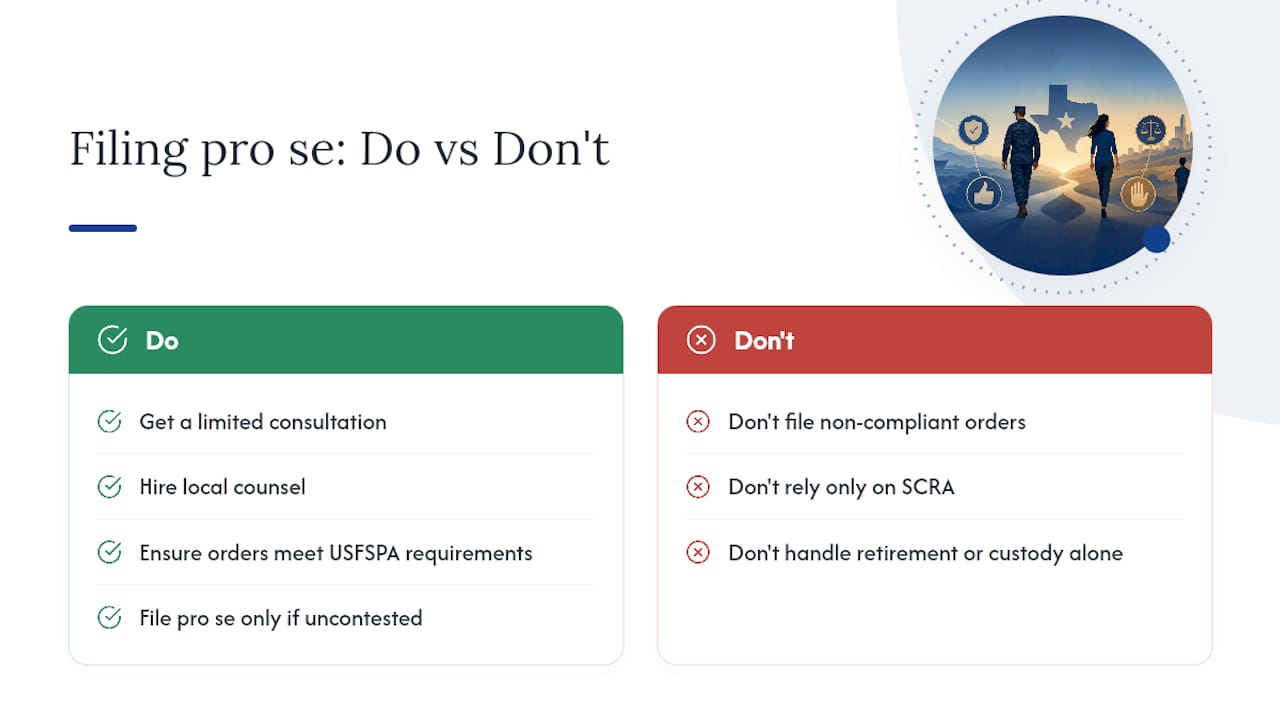
Some service members, particularly those stationed far from Texas or facing tight deployment windows, consider handling their divorce without an attorney. Texas allows self-representation, but military divorces carry enough moving parts that going pro se creates real risk, especially once retirement division or interstate custody enters the picture.
The biggest danger is drafting language that doesn’t meet USFSPA’s technical requirements. DFAS will reject an order that doesn’t clearly define disposable retired pay or include required certifications, and a pro se litigant often doesn’t discover the problem until months after the decree is final, when direct payments never start.
Self-represented service members also face practical hurdles the SCRA doesn’t fully solve. Requesting a stay, responding to discovery, and attending hearings all become harder without local counsel who can appear on your behalf or negotiate scheduling around deployment windows. A civilian attorney can often resolve procedural conflicts through simple communication with opposing counsel, something far harder to manage from overseas or a remote duty station.
For genuinely uncontested cases, with no retirement division, no contested custody, and full agreement between spouses, pro se filing can work. The moment retirement pay, SBP elections, or custody logistics tied to PCS orders enter the conversation, the technical requirements multiply fast enough that most attorneys recommend at least a limited consultation, even for someone planning to handle most of the case alone.
The Gap Between Generic Divorce Advice and Military Reality
Most divorce guides treat military cases as a footnote, a quick mention of SCRA and a link to a pension calculator. That undersells how different these cases actually are. The real complexity isn’t the divorce itself, it’s the layering of federal statutes on top of Texas family law, and the fact that a single drafting error in retirement language can cost a former spouse years of payments before anyone notices.
The conventional advice to “just request an SCRA stay” if deployed is often wrong. A blanket stay frequently does more harm than good, letting support arrearages pile up and leaving custody unresolved for months. The better move, and the one the research consistently supports, is narrowing any stay request to the specific hearing that conflicts with duty, while keeping everything else moving.
If there’s one place readers should focus first, it’s domicile documentation and retirement-order language, not the emotional timeline of the divorce itself. Courts rarely fight over whether a service member can divorce in Texas. They fight over whether the paperwork proves it, and whether the decree actually holds up when DFAS reviews it. Get those two pieces right early, and the rest of the case moves considerably faster.
How Lawofficeofannadin Helps With Military Divorce in Texas
Military divorce cases move faster with a firm that already knows the moving parts: domicile disputes, retirement division language that DFAS will actually accept, and custody plans built around PCS orders instead of fighting them. Lawofficeofannadin has guided Texas families through exactly these issues, combining local courtroom experience with the kind of order drafting that avoids the enforcement problems described above.

If you’re weighing whether to file now or wait until after a deployment ends, or you need a decree that properly addresses SBP elections and disposable retired pay, a consultation is the fastest way to get clear answers. Bring your LES, current orders, and any existing custody paperwork. The firm handles divorce representation for contested and uncontested cases alike, works through pension and retirement division questions specific to military pay, and structures custody arrangements that hold up when orders change. Schedule a consultation through the firm’s contact page to walk through your specific situation and next steps.
Sources
- FindLaw — Tex. Fam. Code §6.303
- Justice
- Military OneSource — Military divorce guide
- Congressional Research Service — USFSPA overview (PDF)
- Texas benchbook — Fam. Code §6.303 (Absence on public service)
FAQ
Can a military spouse get divorced in Texas?
Yes. A military spouse can file for divorce in Texas if either spouse is domiciled here, and time spent outside the state on military orders still counts as Texas residence under §6.303.
What is a military spouse entitled to in a Texas divorce?
A military spouse may be entitled to a share of disposable retired pay under USFSPA, continued TRICARE coverage if the marriage meets the 20/20/20 rule, and standard property division and support under Texas family law.
What is the 20/20/20 rule for military divorce?
The 20/20/20 rule grants a former spouse full TRICARE, commissary, and exchange privileges when the marriage lasted at least 20 years and overlapped with at least 20 years of the service member’s creditable military service.
Is my ex-wife entitled to my military pension if she remarries?
Generally, remarriage doesn’t affect a former spouse’s court-ordered share of disposable retired pay, though it typically ends eligibility for benefits tied to the 20/20/20 rule, such as TRICARE coverage.
Recommended
Questions About Your Situation?
Every family is different. Schedule a confidential consultation with Anna Din to discuss your options.
Schedule a Consultation