Texas Mothers’ Legal Rights: Custody, Visitation, and Support
Texas law gives mothers the same parental rights and duties as fathers under Family Code §151.001. There is no automatic maternal preference and no automatic maternal disadvantage. But rights on paper are not the same as rights you can enforce. Until a court signs a Suit Affecting the Parent Child Relationship (SAPCR) or paternity order, no judge can make the other parent follow a visitation schedule or pay support on a fixed timetable.
If you and your child’s other parent are separated and safety is a concern, do not wait to see how things play out.
- Document every incident with dates, times, and details.
- Call the Texas Parent Helpline for state-backed guidance on custody and safety resources.
- Contact a family law attorney to discuss a protective order or emergency filing.
Pro Tip: Start a dated log today, even before you talk to a lawyer. Courts weigh contemporaneous records far more heavily than memories reconstructed months later.
TL;DR:
- Without a court order, Texas parents have limited enforceability of custody and support rights, making legal action essential to establish definitive arrangements.
- Joint managing conservatorship typically favors shared legal decision-making, but courts can award sole conservatorship if there is evidence of family violence or neglect.
- The Standard Possession Order provides a default visitation schedule for parents within 100 miles, but enforcing missed exchanges requires documentation and possible legal action.
- Parents’ rights, including designation of residence and decision-making, are default legal rights that can be limited or revoked through court proceedings or termination.
- Moving a child outside court-approved boundaries without consent or court approval can result in enforcement and contempt actions, especially if an existing order restricts relocation.
Table of Contents
- What Are a Mother’s Rights Under Texas Family Code §151?
- Joint, Sole, or Possessory: What Kind of Conservator Are You?
- What Does a Standard Possession Order Actually Look Like?
- What Rights Do You Have Without a Court Order?
- How Do Texas Courts Decide What’s Best for the Child?
- Can You Modify or Enforce a Custody Order Later?
- Can a Mother Move a Child Away From the Father in Texas?
- What Should You Do About Family Violence and Safety?
- How Anna Din Helps Mothers Protect Their Parental Rights
- The Real Gap Between the Law and the Courtroom
- Get Direct Legal Support for Your Custody Case
- Key Takeaways
- Useful Statutes and State Resources
- Sources
- FAQ
What Are a Mother’s Rights Under Texas Family Code §151?
Section 151.001 of the Texas Family Code is the starting point for every custody conversation in the state. It does not single out mothers or fathers. It lists the rights and duties that belong to a parent, period, unless a court order or another legal event changes that.
Under the statute, a parent generally has:
- The right to physical possession of the child.
- The right to direct the child’s moral and religious training.
- The right to designate the child’s primary residence.
- The right to consent to medical, dental, and surgical treatment.
- The duty to support the child, including providing food, clothing, shelter, and education.
A parent’s rights and duties exist “unless modified by court order,” which means these statutory defaults can be adjusted, limited, or reassigned once a judge gets involved, a parent relinquishes rights, or a conservator is appointed.
These rights are not permanent guarantees. A judge can limit or reassign them based on the child’s best interest, and a parent can lose them through termination proceedings. If you are unsure how §151.001 applies to your specific situation, read the statute text directly and talk to a family law attorney before assuming anything is settled.
Joint, Sole, or Possessory: What Kind of Conservator Are You?
“Custody” is not a legal term Texas courts actually use. The Family Code talks about conservatorship, and the distinction matters more than most parents realize.
- Joint managing conservatorship (JMC). Both parents share rights to make decisions about the child’s education, medical care, and psychiatric treatment. JMC does not mean equal time. It means shared legal authority, and one parent typically still gets the exclusive right to designate the child’s primary residence.
- Sole managing conservatorship (SMC). One parent holds exclusive decision-making authority. Courts usually reserve this for cases involving family violence, abuse, neglect, or a parent’s incarceration or substance abuse.
- Possessory conservator. This parent retains the right to spend time with the child under a possession schedule but does not share in the major legal decisions.
Judges lean toward joint managing conservatorship as a starting point under Chapter 153, but that presumption weakens fast when there’s documented violence or a pattern of neglect. If you’re heading toward a contested case, our breakdown of joint versus sole custody walks through how courts weigh the evidence.
What Does a Standard Possession Order Actually Look Like?
The Standard Possession Order (SPO) is the default schedule Texas courts apply when parents live within 100 miles of each other, and it exists so families aren’t reinventing the wheel every time. Under the typical SPO:
- The noncustodial parent gets first, third, and fifth weekends of the month.
- Thursday evenings during the school year add a midweek visit.
- Extended summer possession, usually 30 days, is built in.
- Holidays and spring break alternate by year.
Courts can expand this schedule by agreement, and many co-parenting families do exactly that. But if the other parent starts denying scheduled time, you have real options: document the missed exchange, keep copies of texts or emails about it, and file a motion for enforcement if the pattern continues. Contempt findings are possible when a parent willfully violates a possession order.
Pro Tip: Keep a simple log app or notebook with the date, time, what happened, and who witnessed it. A single missed exchange rarely moves a judge. A documented pattern over months usually does.

What Rights Do You Have Without a Court Order?
Plenty of Texas parents raise kids for years with no formal order in place, and both parents technically retain equal rights during that time. The catch is enforceability. Without a signed SAPCR or paternity order, a judge has nothing to enforce, which means there’s no legal visitation schedule and no court-ordered child support, according to TexasLawHelp’s guidance on this exact scenario.
If you need something enforceable, here’s the practical path:
- File a SAPCR if you were never married to the other parent, or a paternity action if parentage isn’t established.
- Request temporary orders early in the case to lock in a schedule and support obligation while the case is pending.
- Gather records, communications, and any evidence of the current caregiving arrangement before you file.
- Consider mediation before litigation if both parents are willing to negotiate.
How Do Texas Courts Decide What’s Best for the Child?
Judges apply a “best interest of the child” standard, and Texas courts have built a fairly consistent list of factors they weigh under Chapter 153:
- The child’s emotional and physical needs, now and in the future.
- Any evidence of danger to the child, physical or emotional.
- Each parent’s parenting abilities and stability of home environment.
- Programs and support systems available to each parent.
- The child’s own preference, generally given real weight once they turn 12.
Documentation wins cases more often than testimony alone. Keep school records, medical files, communication logs, and a written timeline of caregiving history organized before your hearing. Prior family violence or abuse carries outsized weight in these proceedings and can shift a judge toward sole managing conservatorship with restricted or supervised possession for the other parent. For a deeper look at how evaluators build their case files, see our guide on what Texas courts actually consider.
Can You Modify or Enforce a Custody Order Later?
Texas generally bars modification requests within one year of the most recent order unless you can show the child’s circumstances have changed so significantly that the current arrangement has become unworkable, or that the child faces a serious danger requiring immediate action. After that first year, the standard eases to “material and substantial change,” which covers things like a parent’s relocation, a change in the child’s needs, or new safety concerns.
- Confirm your order’s date and whether the one-year window has passed.
- Identify the specific, documented change driving your request.
- File a motion for enforcement if the issue is noncompliance with an existing order, or a modification petition if circumstances have shifted.
- Bring records: missed exchanges, financial statements, school or medical documentation.
Courts expect specifics, not general dissatisfaction. Our article on when you can modify a custody order covers the filing process step by step.
Can a Mother Move a Child Away From the Father in Texas?
Most Texas orders include a geographic restriction, often limiting the child’s primary residence to a specific county or contiguous counties. Moving outside that boundary requires either the other parent’s written consent or a new court order lifting the restriction.
- Moving without permission can trigger enforcement action, contempt findings, and damage your credibility in future hearings.
- Courts generally expect solid evidence before approving a relocation request: a job offer, secured housing, family support in the new area, and a clear best-interest argument for the child.
- Treat the existing order as the rule, not a suggestion, even if the move seems obviously reasonable to you.
If relocation is on the horizon, talk to counsel before you sign a lease or accept a job offer, not after.
What Should You Do About Family Violence and Safety?
If you or your child are in danger, your first calls go to law enforcement and, if needed, DFPS, not to a custody negotiation. Emergency and family violence protective orders exist specifically for this situation, and they can include immediate provisions about the child’s residence and the other parent’s access.
- Request an emergency protective order through law enforcement or the courts if there’s an immediate threat.
- Preserve evidence: photos, medical records, police reports, and messages.
- Family violence findings weigh heavily toward sole managing conservatorship and supervised or restricted possession for the offending parent.
Pro Tip: Save everything before you confront anyone. Screenshots, voicemails, and photos disappear or get deleted faster than you’d expect once a conflict escalates.
How Anna Din Helps Mothers Protect Their Parental Rights
The Law Office of Anna Din represents mothers across The Woodlands, Houston, and surrounding communities in custody disputes, SAPCR filings, custody modifications, enforcement actions, and protective order cases. Anna’s approach centers on clear communication so you understand each step before it happens, not after.
When you come in for a consultation, bring what you have:
- Any existing court orders or filed petitions.
- Texts, emails, or messages relevant to custody or safety concerns.
- Your incident log, if you’ve been keeping one.
- School and medical records that support your case.
Most cases follow a similar arc: consultation, evidence gathering, filing, and a request for temporary orders while the case proceeds. Having your documentation organized before that first meeting saves time and often strengthens your position from day one.
The Real Gap Between the Law and the Courtroom
Most legal guides stop at explaining that Texas law treats mothers and fathers equally. That’s true, but it’s also incomplete, and treating it as the whole story leaves mothers unprepared for what actually happens in a contested case.
Equality under §151.001 means nothing without an enforceable order behind it. I’ve seen the conventional advice, “just work it out between yourselves,” fail mothers who assumed an informal arrangement would hold up if things turned sour. It doesn’t, because there’s nothing for a judge to enforce until a SAPCR exists.
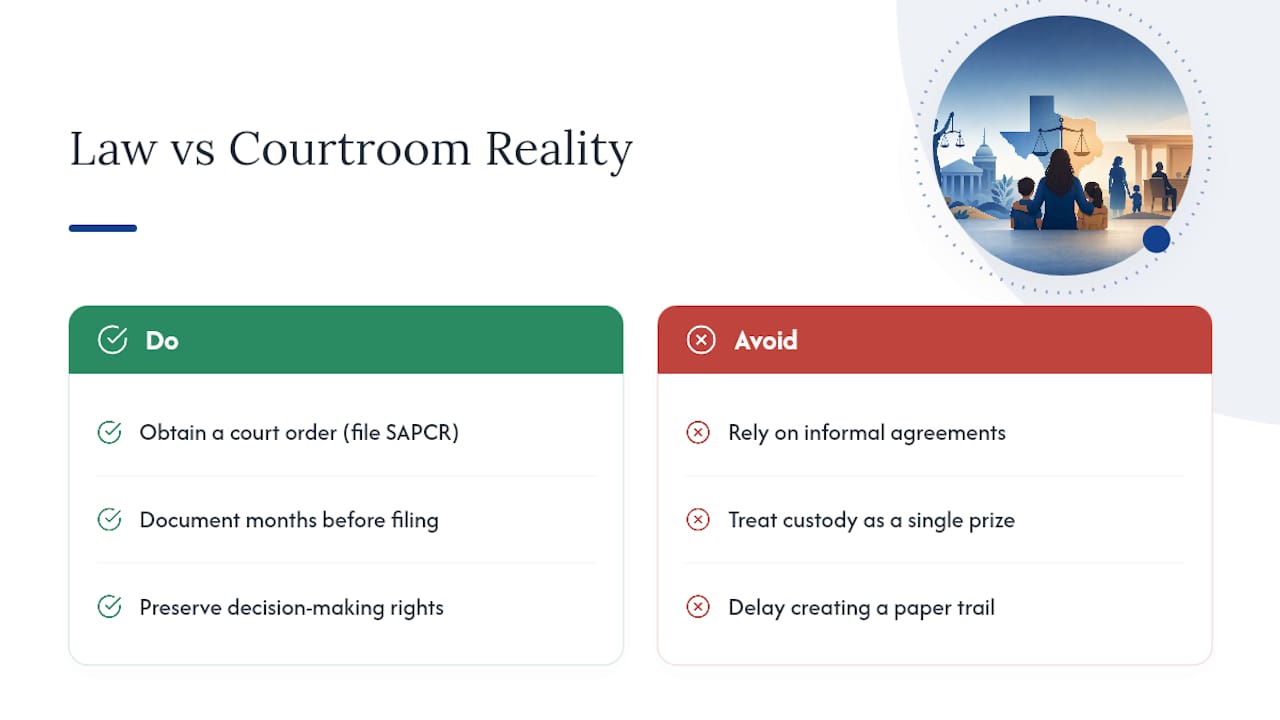
The second overrated idea is that “custody” is a single prize you win or lose. Conservatorship and possession are separate questions, and a mother who loses the fight over primary residence can still hold meaningful decision-making rights as a joint managing conservator. Understanding that distinction changes how you negotiate and what you fight hardest to preserve.
Prioritize documentation before conflict, not during it. The mothers who come out of custody disputes with the strongest outcomes are usually the ones who started their paper trail months before they ever filed anything.
— Giri
Get Direct Legal Support for Your Custody Case
Reading the statute gets you oriented. Getting an enforceable order that actually protects your time with your child and your decision-making authority takes representation that knows how Montgomery County and Harris County courts apply these rules in practice.

Lawofficeofannadin built its family law practice around exactly the situations covered in this guide: SAPCR filings, custody modifications, enforcement actions, and protective orders for mothers who need results, not just information. Anna Din works directly with clients through every stage, from the first consultation to filing temporary orders, so you’re never guessing what happens next. If you’re facing a custody dispute, need to establish a first order, or are dealing with a parent who’s violating an existing schedule, visit the child custody and support practice page to schedule a consultation and start building your case today.
Key Takeaways
Texas mothers hold the same statutory parental rights as fathers, but those rights become enforceable only once a court order exists to back them.
| Point | Details |
|---|---|
| Statutory rights are equal | Family Code §151.001 gives mothers and fathers the same default rights and duties, with no automatic maternal preference. |
| No order means no enforcement | Without a SAPCR or paternity order, courts cannot enforce visitation or support obligations. |
| Conservatorship isn’t one thing | Joint managing, sole managing, and possessory conservator each carry different decision-making and residence rights. |
| Documentation drives outcomes | Courts weigh school, medical, and communication records heavily in custody and enforcement decisions. |
| Get local representation early | Lawofficeofannadin helps Texas mothers file, modify, and enforce custody orders with a clear, step-by-step process. |
Useful Statutes and State Resources
For readers who want to go straight to the source material or need immediate help:
- Texas Family Code §151.001 and Chapter 153 for the statutory framework.
- Texas Parent Helpline for state-backed custody guidance and contact resources.
- TexasLawHelp’s guide on custody without a court order for practical next steps.
- Lawofficeofannadin’s practice areas page for local family law representation.
This article is general information, not a substitute for advice from a qualified lawyer. Consult a qualified legal professional about your own circumstances before acting on anything here.
Sources
- Texas Family Code Section 151.001 - Rights and duties of parent (Justia)
- Texas Family Code Chapter 153 - Conservatorship, possession, access (Texas statutes)
- Parents’ Rights When No Custody Orders Exist (TexasLawHelp)
- Texas Family Code 153: Conservatorship, Possession, and Access (LegalClarity)
- Parental Rights in Texas - Texas Parent Helpline (DFPS)
FAQ
Can a Mother Move a Child Away From the Father in Texas?
Only if the existing order allows it, the other parent gives written consent, or a court approves the move. Moving outside a geographic restriction without permission risks enforcement action and contempt.
What Are My Rights as a Mother in Texas?
You hold the same rights as the father under Family Code §151.001, including possession, decision-making, and consent to medical care, but those rights only become enforceable once a court order is in place.
How Long Does a Mother Have to Be Absent to Lose Her Rights in Texas?
There’s no fixed number of days that automatically strips parental rights. Termination requires a court finding, often tied to abandonment, endangerment, or a documented pattern the court decides meets the legal standard, so speak with a family law attorney about your specific situation.
Can a Father Take His Child Without the Mother’s Consent in Texas?
If no court order exists, both parents technically have equal rights to the child, which makes this a gray area rather than a clear violation. Getting a SAPCR or paternity order in place is the fastest way to establish an enforceable residence and possession schedule, and Lawofficeofannadin can help you file one.
Recommended
Questions About Your Situation?
Every family is different. Schedule a confidential consultation with Anna Din to discuss your options.
Schedule a Consultation