6 Steps to a Court-Ready Parenting Plan in Texas
Texas law requires a parenting plan in every case involving custody, and the Standard Possession Order is the default schedule when parents cannot agree on something else. Fifty-fifty custody is not automatic under Tex. Fam. Code Chapter 153, but parents can reach it through agreement or by presenting evidence that convinces a judge equal time serves the child’s best interest.
TL;DR:
- Parents living within 50 miles of each other are often encouraged to opt for the Expanded Standard Possession Order, which includes overnight visits on Thursdays and Sundays.
- Texas courts require all parenting plans to specify conservatorship, possession schedules, distance-based provisions, child support, and signatures, avoiding vague language like “reasonable visitation.”
- Equal custody arrangements can be achieved through mutual agreement or documented caregiving history, but courts rarely award 50/50 unless specific evidence supports it.
- Contested custody cases involve a 60-day waiting period after filing, and mediation is usually mandatory before trial, with fees typically in the low hundreds.
- Drafting a clear, detailed parenting plan tailored to your family’s situation increases the likelihood it will withstand court challenges and future changes.
Table of Contents
- What Does a Parenting Plan Have to Include in Texas?
- What Is the Standard Possession Order and How Does Distance Change It?
- How Do You Draft an Agreed Parenting Plan Step by Step?
- Is Texas a 50/50 Custody State?
- What Are the Filing Requirements and Timeline for a Texas Custody Case?
- How Do You Modify or Enforce a Texas Parenting Plan?
- What Do We See Most Often at the Law Office of Anna Din?
- Why Most Parenting Plan Templates Fail Texas Families
- Get Help Drafting a Court-Ready Parenting Plan
- Where to Verify the Statutes and Forms
- Sources
- FAQ
What Does a Parenting Plan Have to Include in Texas?
Under Tex. Fam. Code §§ 153.007 and 153.603, every suit affecting the parent-child relationship must produce a parenting plan covering three pillars: conservatorship, possession and access, and child support. Courts will not sign off on a plan missing these pieces, and clerks routinely bounce filings that skip required language.
Conservatorship spells out legal decision-making rights, things like consenting to medical procedures or choosing a school district, separate from possession, which governs the actual calendar of who has the child on which days. Confusing the two is one of the most common drafting mistakes parents make when they try to write their own agreement.
A compliant plan needs:
- Conservatorship terms naming joint or sole managing conservators and specifying which rights (medical, educational, psychiatric) each parent holds independently versus jointly.
- A possession schedule covering regular weekends, Thursday visits, holidays, spring break, summer break, and each child’s birthday.
- Distance-based provisions that adjust pickup times and summer allocation if parents live more than 100 miles apart.
- Child support terms, including who carries health insurance and how uninsured medical costs get split.
- Signatures and certification language required by your county’s local rules, since some Texas courts add their own formatting requirements on top of the state forms.
Leaving any of these blank, or using vague phrases like “reasonable visitation,” is the fastest way to get sent back to the drafting table.
What Is the Standard Possession Order and How Does Distance Change It?
The Texas Attorney General’s Standard Possession Order is the schedule Texas courts default to when parents cannot agree on something better, and it is presumed to serve the child’s best interest for kids age three and older, according to TexasLawHelp.
Under the standard version, the noncustodial parent typically gets:
- First, third, and fifth weekends of each month, from 6 p.m. Friday to 6 p.m. Sunday.
- Thursday evenings during the school year, from 6 p.m. to 8 p.m.
- An extended 30 days of summer possession, plus alternating spring breaks and split holidays.
Distance changes the math substantially. When parents live 50 miles or less apart, many Texas cases now apply the Expanded Standard Possession Order automatically, which extends weekend pickup to Thursday overnight and adds Sunday overnight before school, according to recent practice guidance on drafting agreed plans. When parents live more than 50 miles apart, the possession schedule changes with less frequent mid-week visits and different summer and spring break allocations based on distance tiers, and the AG publishes exact pickup and drop-off language for each distance tier.
Not everything in the SPO is mandatory. Some provisions are elections, meaning a parent must actively choose them in writing, while others apply automatically unless the decree says otherwise. Judges in Harris County and the surrounding area generally expect parents to either adopt the SPO wholesale or explain, clause by clause, exactly what they are changing and why. Our Standard Possession Order guide breaks down which terms fall into each category.
How Do You Draft an Agreed Parenting Plan Step by Step?
Drafting from scratch feels overwhelming, but working in the right order keeps you from missing something a judge will flag later. Follow this sequence:
- Settle conservatorship first. Decide joint or sole managing conservator status before touching the calendar, since possession terms often reference conservatorship language.
- Build the weekly schedule. Start from the SPO or Expanded SPO, then mark any changes both parents agree to.
- Layer in holidays and special days. Assign Thanksgiving, winter break, Easter, and each parent’s Mother’s Day or Father’s Day weekend explicitly.
- Address summer separately. Summer possession often overrides the regular weekly schedule, so state clearly when it starts and ends.
- Write the logistics. Exchange location, transportation responsibility, and notice windows for schedule changes belong in their own section, not buried in the possession calendar.
- Add decision-making and dispute-resolution clauses. Specify how medical or school decisions get made and require mediation before either parent files an enforcement motion.
Vague terms cause more litigation than almost anything else in family law. A plan that says “child will attend a mutually agreed school” invites conflict the moment parents disagree; naming the specific school district (or the process for choosing one) closes that door. The same goes for exchange logistics: state the exact address, the exact time, and who provides transportation.
Pro Tip: Include a “right of first refusal” clause requiring a parent to offer the other parent childcare time before calling a babysitter or relative for extended absences. Courts favor these clauses because they keep both parents actively involved without adding a formal exchange.
If you and the other parent are close to agreement, mediation resolves the remaining gaps faster and cheaper than a contested hearing. If your family’s situation genuinely calls for more time than the SPO offers, and you have the evidence to back it up, it’s worth negotiating for an Expanded SPO before accepting a standard schedule by default.
Is Texas a 50/50 Custody State?
No. Texas does not presume equal time between parents, and no statute creates a 50/50 default. Courts decide possession using the “best interest of the child” standard, and when parents cannot agree, the SPO is what most judges apply, not an even split.
That said, equal time is achievable two ways. The fastest path is mutual agreement: if both parents want a week-on, week-off schedule or another equal arrangement, courts approve it as long as it serves the child’s interests. The harder path is a litigated deviation, where one parent asks the court to order equal time over the other’s objection.
Evidence that tends to help a request for equal or expanded time includes:
- A documented history of both parents sharing caregiving duties, school pickups, and medical appointments before the case began.
- Geographic proximity, particularly living in the same school zone.
- Consistent, verifiable co-parenting communication through logs or a shared app.
Judges are far less likely to order equal time where there’s a documented safety concern, chronic instability in one household, or a pattern of missed exchanges. If your case involves any of those factors, the SPO or a modified version of it is the more realistic outcome, at least initially.
What Are the Filing Requirements and Timeline for a Texas Custody Case?
Texas imposes residency rules before you can file: at least six months of state residency and 90 days in the county where you’re filing. Once filed, Tex. Fam. Code § 6.702 requires a mandatory 60-day waiting period before a court can finalize a divorce, even in agreed cases.
- Agreed cases typically move through the 60-day window with a single hearing once the parenting plan and decree are finalized.
- Contested cases take considerably longer, since they involve discovery, temporary orders, and often mediation before trial.
- Most Texas counties require mediation before a contested custody matter can go before a judge, so bring your draft parenting plan and any supporting records to that session.
- Filing fees vary by county, generally running in the low hundreds of dollars, and clerks typically expect a certified birth certificate for each child named in the suit.
Showing up prepared, plan in hand, records organized, cuts real time off your case regardless of which track it’s on.
How Do You Modify or Enforce a Texas Parenting Plan?
Courts will only modify an existing order if you can show a “material and substantial change” in circumstances since the last order was signed, such as a job relocation, a change in the child’s needs, or a parent’s repeated noncompliance. Emergency modifications and temporary orders are available when a child’s immediate safety is at risk, but they require specific, documented facts, not general concerns.
- Document the change. Keep dated records, texts, co-parenting app logs, school and medical attendance reports, before you file anything.
- File for modification if the change is ongoing, or seek a temporary order if the situation is urgent.
- Use enforcement remedies for one-time violations: courts can order make-up possession time, assess attorney’s fees, or hold a violating parent in contempt.
- Keep a violation log every time an exchange gets missed or a schedule term is violated. Judges respond to patterns, not isolated incidents.
Enforcement and modification are different tools for different problems. A single missed weekend calls for enforcement. A parent who moved two hours away calls for modification, and possibly a new parenting plan of the child custody order entirely.
What Do We See Most Often at the Law Office of Anna Din?
The plans that end up back in court almost always share the same flaw: vague language around exchanges and school designation. “The child will attend school near the primary residence” sounds reasonable until one parent moves, and then nobody agrees on what “near” means anymore. We draft around that by naming the school district specifically and building in a process for what happens if a parent relocates.

We also see parents accept the standard schedule without realizing an Expanded SPO, or a custom arrangement, might better fit two working parents’ calendars. A well-negotiated plan can approximate near-equal time without the cost of a contested best-interest hearing.
If your case involves a safety concern, a proposed relocation, or a schedule too complex for a form template, that’s the point where hiring counsel changes your odds. Our child custody practice works with Harris County families on exactly these situations, from first drafts through contested modification hearings.
Why Most Parenting Plan Templates Fail Texas Families
The conventional advice treats a parenting plan like a form to fill out: pick a schedule, sign it, move on. That approach misses the actual function of the document. A parenting plan is a set of instructions a judge will enforce years from now, often after the parents’ relationship has changed and memories of what they “meant” have faded.
That’s why specificity beats convenience every time. The SPO exists because Texas courts wanted a predictable fallback, not because it’s the ideal schedule for every family. Parents who treat it as a floor, and negotiate up from there based on real caregiving history, tend to end up with plans that survive contact with real life.
My honest read: the parents who do best are the ones who stop asking “what’s fair” and start asking “what will a judge need to see if this ends up disputed in three years.” Write the plan for that judge, not for the version of co-parenting you hope you’ll have.
— Giri
Get Help Drafting a Court-Ready Parenting Plan
Lawofficeofannadin gives Texas parents something a downloaded template can’t: a plan built around how Harris County judges actually rule, not generic language pulled from a form site.

Whether you’re negotiating an agreed plan, pushing for an Expanded SPO, or heading into a contested custody hearing, the firm handles drafting, mediation preparation, and enforcement or modification filings under one roof. If your case also touches divorce, divorce-related custody matters get folded into the same strategy instead of handled as separate problems.
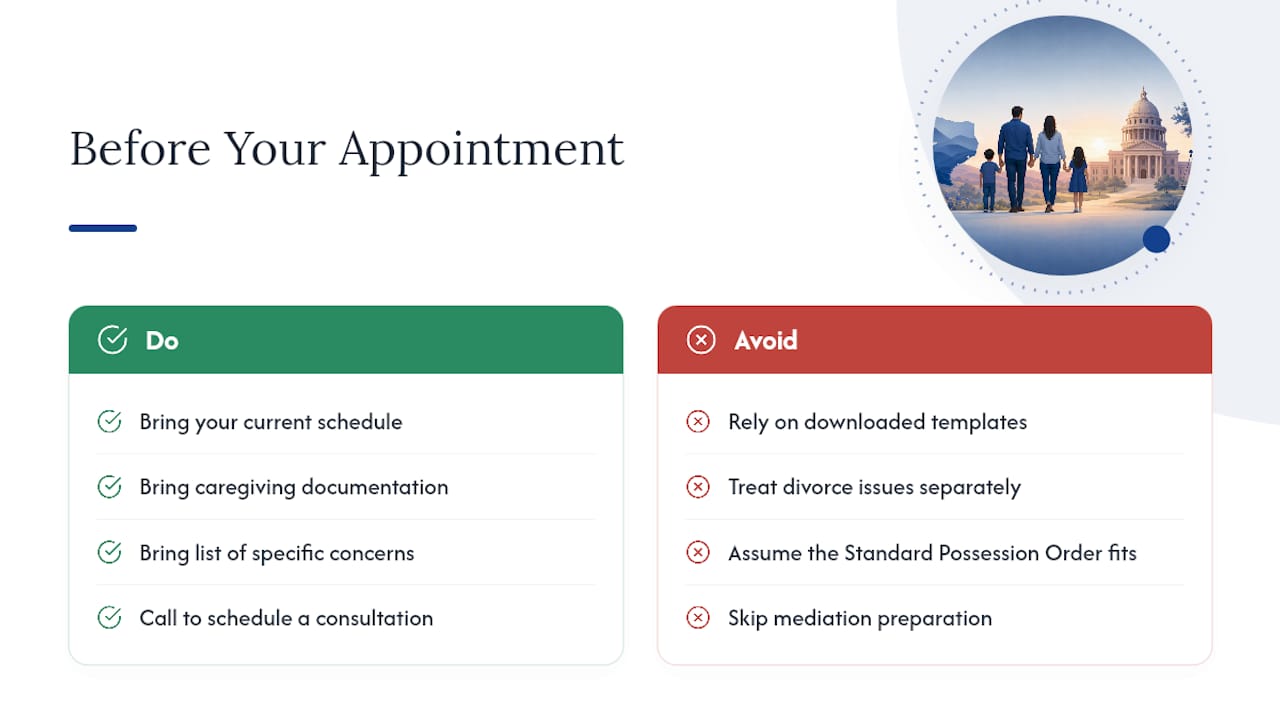
Bring your current schedule, any documentation of caregiving history, and a list of specific concerns (school districts, relocation, holiday conflicts) to your first appointment. The firm will tell you honestly whether the Standard Possession Order fits your family or whether it’s worth negotiating something else. If custody isn’t your only concern, the child custody support page outlines the full range of related services, and reviewing past success stories shows how the firm has handled comparable cases. Parents dealing with tax filing questions tied to custody arrangements can also review this guide to claiming children on taxes as a starting point.
Call the Law Office of Anna Din to schedule a consultation and start building a parenting plan that holds up when it matters most.
Where to Verify the Statutes and Forms
Read the statutory language yourself in Texas Family Code Chapter 153, covering conservatorship and possession requirements. The Attorney General’s parenting time schedule includes downloadable calendars. Sample possession orders and filing guidance are available through TXAccess.
This article is general information, not a substitute for advice from a qualified lawyer. Consult a qualified legal professional about your own circumstances before acting on anything here.
Sources
- Texas Family Code — Chapter 153 (Conservatorship, Possession, and Access)
- Parenting Time Schedule | Office of the Attorney General
- Child visitation and possession orders | TexasLawHelp
- Creating a parenting plan in Texas (guide)
FAQ
Is Texas a 50/50 Custody State?
No. Texas has no statutory presumption for equal possession time; courts default to the Standard Possession Order unless parents agree to something else or a judge finds equal time serves the child’s best interest.
What Is the Standard Custody Schedule in Texas?
The Standard Possession Order gives the noncustodial parent first, third, and fifth weekends, Thursday evenings during the school year, 30 days in summer, and alternating holidays, with terms shifting based on how far apart the parents live.
Is 50/50 Custody Common in Texas?
It’s becoming more common through agreement or Expanded SPO negotiation, but it is not the default outcome in contested cases, especially when parents live far apart or lack a documented shared caregiving history.
Has Texas Changed Its Child Custody Laws Recently?
Texas has updated how the Expanded Standard Possession Order applies in many within-50-mile cases, extending overnight time for the noncustodial parent; check the current statutory text for the version in effect on your filing date.
Do I Need a Lawyer to Write a Parenting Plan in Texas?
Texas doesn’t legally require an attorney to draft a parenting plan, but contested custody, relocation, or safety concerns significantly raise the risk of a plan getting rejected or renegotiated in court, which is when working with the Law Office of Anna Din tends to pay off.
Recommended
Questions About Your Situation?
Every family is different. Schedule a confidential consultation with Anna Din to discuss your options.
Schedule a Consultation