Paternity in Texas: What Fathers Must Do Next

Paternity in Texas means legal fatherhood, and it is not automatic just because your name is on a birth certificate or a DNA test came back positive. If the mother was married when the child was born, her husband is presumed the legal father. If she was not married, you need one of two things: a signed Acknowledgment of Paternity (AOP) or a court order. Without either, you have no enforceable right to custody or visitation, no matter how involved you’ve been.
Here’s what to do right now:
- Find out if an AOP was signed at the hospital or later through Vital Statistics. If it was, you already have legal rights.
- If paternity is disputed, ask the Office of the Attorney General or a court to order genetic testing. Results typically come back in 4 to 6 weeks with about 99% accuracy.
- File a Suit Affecting the Parent-Child Relationship (SAPCR) to get enforceable custody, visitation, and support orders.
- Consult a Texas family law attorney before signing anything if you have any doubts about the child’s parentage.
Pro Tip: An AOP is legally binding the moment it’s filed. Reading it carefully before you sign matters more than signing quickly.
Key Takeaways
Legal fatherhood in Texas requires a signed Acknowledgment of Paternity or a court adjudication; DNA evidence alone confers no custody, visitation, or support rights.
| Point | Details |
|---|---|
| AOP creates instant legal rights | A signed, filed Acknowledgment of Paternity is legally equal to a court order under Family Code §160.305. |
| Rescission window is short | Parents can cancel a signed AOP within 60 days of filing before a related legal case begins. |
| Testing is fast and accurate | Court-ordered genetic tests use a cheek swab and typically return results in 4 to 6 weeks at about 99% accuracy. |
| SAPCR is the enforcement step | Filing a Suit Affecting the Parent-Child Relationship turns established paternity into binding custody and support orders. |
| Anna Din represents fathers directly | The Law Office of Anna Din handles AOP disputes, genetic testing proceedings, and SAPCR filings for Texas fathers. |
Where to Find Forms and File Your Case
- Office of the Attorney General: Paternity for AOP forms and testing requests.
- TexasLawHelp: I need a paternity order for SAPCR filing guidance.
- Texas Family Code §160 for the statute governing presumption and rescission.
- Law Office of Anna Din to schedule a consultation on your specific case.
This article is general information, not a substitute for advice from a qualified lawyer. Consult a qualified legal professional about your own circumstances before acting on anything here.
Table of Contents
- A Texas Attorney’s Take on What Fathers Get Wrong First
- How Anna Din Helps Fathers Establish Paternity and Custody
- Sources
- FAQ
A Texas Attorney’s Take on What Fathers Get Wrong First
Too many fathers treat a DNA test like the finish line. It isn’t. A cheek swab proving biology does not give you the legal right to see your child or stop a support order from favoring the other parent. You need an AOP or a court’s ruling under Texas Family Code §160 to convert that biology into rights.
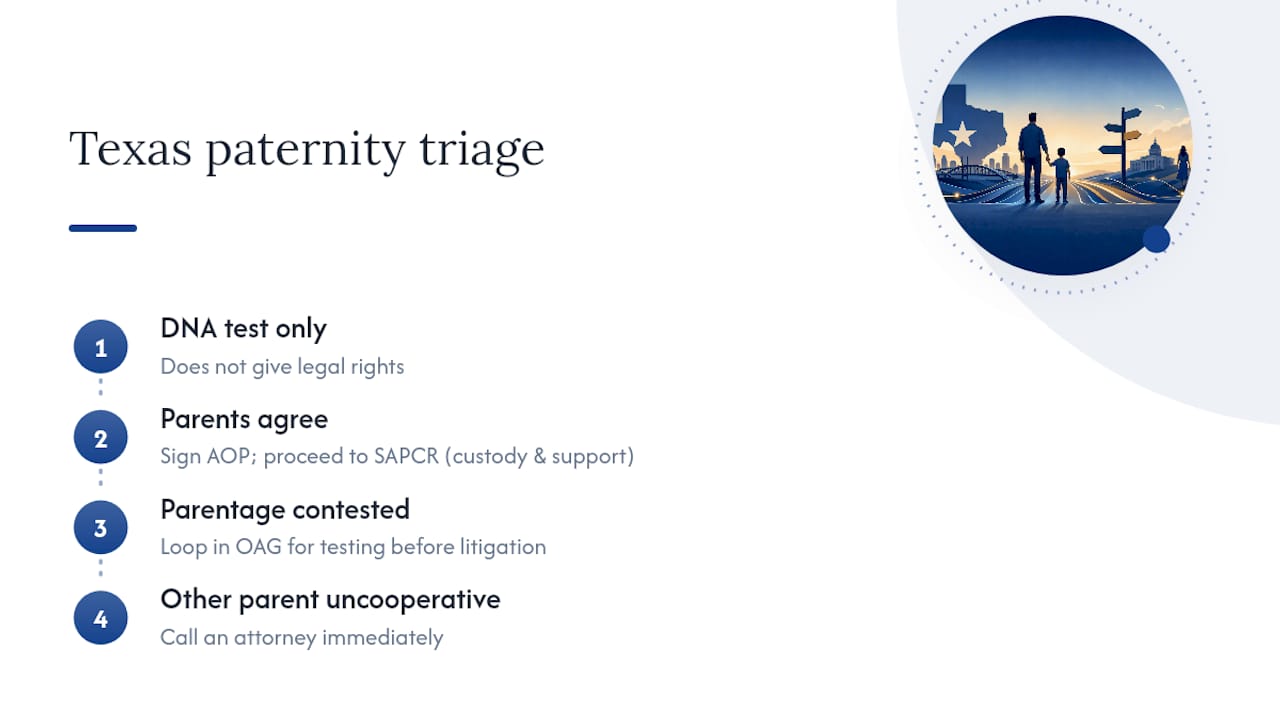
Here’s the triage I give clients: if both parents agree on parentage, sign the AOP and move straight to a SAPCR for custody and support. If parentage is contested, loop in the Office of the Attorney General for testing before spending money on litigation. If the other parent is uncooperative or missing, that’s when you call an attorney immediately, not after months of frustration.
How Anna Din Helps Fathers Establish Paternity and Custody
If you’re staring down a paternity dispute in The Woodlands, Houston, or the surrounding communities, you don’t have to sort through Texas Family Code sections alone. The Law Office of Anna Din represents fathers through every stage of establishing legal fatherhood: filing or challenging an AOP, pursuing genetic testing through the Office of the Attorney General, and filing a SAPCR to secure enforceable custody and possession orders.

An experienced attorney can also handle the trickier situations DIY forms don’t cover well: challenging an AOP after the 60-day rescission window has closed, sorting out jurisdiction when the mother or child lives outside Texas, or negotiating child support alongside a custody arrangement. Anna Din’s firm has a track record of helping concerned parents secure the custody rights they were told were out of reach.
Ready to move forward? Bring your child’s birth certificate, any AOP paperwork already on file, and identification to your first conversation. Reach out through the firm’s divorce and family law page to schedule a consultation and find out exactly where your case stands.
Sources
- Paternity | Office of the Attorney General
- I need a paternity order. | Texas Law Help
- Tex. Fam. Code Section 160.201 (Establishment of parent-child relationship)
FAQ
Does signing a DNA test give me custody rights in Texas?
No. A DNA test only proves biology. You need a signed Acknowledgment of Paternity or a court order to gain enforceable custody or visitation rights.

How long does court-ordered paternity testing take in Texas?
Cheek-swab testing ordered through the Office of the Attorney General or a court typically returns results in 4 to 6 weeks with about 99% accuracy.
Can I cancel an Acknowledgment of Paternity after signing it?
Yes, but only within 60 days of filing with the Vital Statistics Unit and only if no related court case has started; after that, you need a formal court challenge.
What’s the difference between an AOP and a SAPCR?
An AOP establishes legal fatherhood itself, while a Suit Affecting the Parent-Child Relationship secures the actual custody, visitation, and support orders once paternity is confirmed.
When should I hire a family law attorney for a paternity case?
Hire an attorney if paternity is disputed, the other parent is uncooperative, you’re past the AOP rescission window, or jurisdiction involves another state, and the Law Office of Anna Din represents fathers through all of these situations.
Recommended
Questions About Your Situation?
Every family is different. Schedule a confidential consultation with Anna Din to discuss your options.
Schedule a Consultation