Survivor Defined Domestic Violence Safety Plan You Can Use Now
A domestic violence safety plan is a personalized set of practical steps you design to protect yourself and your children, before, during, and after leaving an abusive relationship. If you’re in immediate danger right now, call 911. If you need to talk through your options confidentially, call the National Domestic Violence Hotline at 1-800-799-7233, available 24/7. Whatever you share stays confidential, and any plan built from here is shaped around your specific situation, not a generic script.
TL;DR:
- Safety plans must be tailored to individual risks, including violence escalation signs, threats, and weapons, with frequent review and updates.
- Using secure communication methods, creating strong passwords, and avoiding shared devices are essential for protecting online activity during planning.
- Protecting pets involves identifying safe temporary housing options, storing important records separately, and planning for safe check-ins if immediate departure isn’t possible.
- Legal tools like protective orders require immediate enforcement planning, as they do not physically prevent contact, and legal counsel can help with custody and violation responses.
- Building a support network from hotlines, shelters, legal advocates, and trusted contacts is vital, as relying on multiple resources is more reliable than a single-point plan.
Table of Contents
- What Is a Domestic Violence Safety Plan, and Who Should Define It?
- Step-by-Step Safety Planning: What to Do in Each Phase
- What to Pack: Your Go-Bag Checklist
- How Do You Stay Safe Online While Planning?
- How Do You Build a Plan That Fits Your Situation?
- Where Can You Get Immediate Help and Legal Support?
- Planning for Pets When You Have to Leave
- Custody and Visitation: Safety Planning Doesn’t End at Separation
- Beyond Hotlines: Where Else Can You Find Support?
- When Does Stalking or Harassment Change Your Legal Options?
- Why Legal Counsel Belongs in Your Safety Plan, Not Just Your Aftermath
- Get Legal Help With Protective Orders and Emergency Filings
- Templates and Tools to Build Your Plan Today
- Sources
- FAQ
What Is a Domestic Violence Safety Plan, and Who Should Define It?
You define your safety plan. Not an advocate, not a family member, not this article. A safety plan is a personalized, practical set of action steps that increases safety, and it covers far more than the moment of a violent incident. It has to account for housing, income, childcare, and your emotional health, because those pressures often determine whether a plan is realistic or just theoretical.
This matters because safety planning has to separate two kinds of risk. Victim-defined safety planning distinguishes between batterer-generated risks (the danger created directly by the abuser’s actions) and life-generated risks (poverty, lack of housing, immigration status, disability, or job loss). A plan that ignores the second category can leave you safer from violence but homeless or unable to feed your kids, which is not actually safety.
Leaving is not always the safest option in the short term. For some people, leaving increases the danger. A victim-defined plan can include:
- Strategies for staying safer while still in the relationship
- A phased plan for leaving when the timing and resources are right
- Steps for safety after separation, when risk often spikes rather than drops
Step-by-Step Safety Planning: What to Do in Each Phase
Safety planning breaks into distinct phases, and each one calls for different tools. Appendix D’s sample safety plan organizes these into a sequence you can adapt, not follow rigidly.
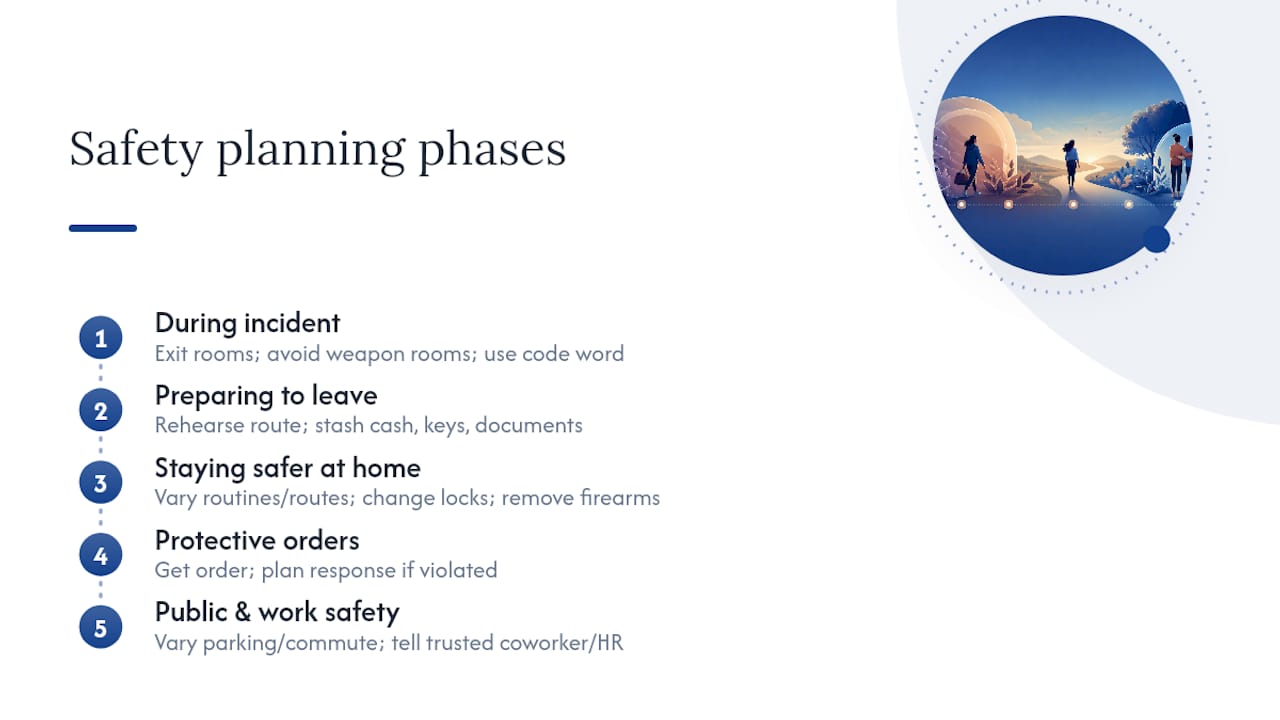
1. During a violent incident. Identify the rooms in your home that have an exit and avoid rooms with weapons, like kitchens. Agree on a code word with your children or a trusted neighbor that signals “call for help.” Teach children how to dial 911 and give them a short, memorized script: their address and “someone is hurting my mom” or the equivalent.

2. Preparing to leave. Rehearse your exit route mentally, and physically if you can. Stash a small amount of cash, a spare set of keys, and copies of documents with someone you trust completely. Identify at least one safe destination, ideally two, in case the first is compromised.
3. Staying safer at home. If leaving isn’t the current plan, change routines: vary your schedule, alter routes to work or school, and change locks if you have any control over them. Where legally possible, removing firearms from the home measurably reduces lethality risk.
4. Protective orders. A protective order can restrict contact and create legal consequences for violations, but it’s a document, not a physical barrier. Build a contingency plan for what you’ll do the moment an order is violated, including who you call first and where you go.
5. Public and work safety. Vary parking spots, vary your commute, and if it’s safe to do so, tell a trusted coworker or HR contact what’s happening so they can help watch for warning signs.
Pro Tip: Practice your escape route the same way you’d practice a fire drill. Muscle memory works better than a plan you’ve only read once.
What to Pack: Your Go-Bag Checklist
A go-bag is the physical version of your plan. It sits packed and ready, so a decision to leave doesn’t get delayed by digging through drawers under stress. Recommended contents include:
- Identification: birth certificates, passports, Social Security cards, and any immigration documents
- Financial records, cash, credit cards, and a spare set of keys
- Copies of protective orders and other legal paperwork
- Medications for you and your children, plus a spare phone and charger
- Comfort items for kids, basic pet supplies if applicable, and a written list of important phone numbers
Store the bag somewhere outside your home if possible, at a trusted friend’s house, in a locker, or with a coworker. Some safety planners recommend disguising it as a disaster or hurricane kit so it doesn’t raise questions if discovered. Keep a duplicate set of key documents in a second location entirely.
How Do You Stay Safe Online While Planning?
Digital traces can undermine an otherwise careful plan. Use a public library computer or a trusted friend’s device when researching resources or shelters, since shared devices and accounts are often monitored by abusers. A few habits reduce exposure:
- Use your browser’s private or incognito mode and clear history afterward
- Create new email and social accounts entirely separate from any shared ones
- Use strong, unique passwords and enable two-factor authentication where available
- Log any incidents with dates and times, and save photos to a secure cloud account or email them to someone you trust rather than storing them only on a shared device
If your phone is linked to a family plan or shared account, assume it can be tracked, and plan around that until you can change carriers or devices safely.
How Do You Build a Plan That Fits Your Situation?
A safety plan only works if it matches your actual risks, not a generic template. Start with a short risk check: Has violence escalated recently? Are there weapons in the home? Has the person threatened to kill you or themselves? These are lethality indicators advocates use to prioritize urgency.
- Identify one or two people you trust completely, and limit who else knows your plans
- Be selective about informal supports; involving too many people can put them at risk too
- Set review triggers, after any incident, after a move, or after a change in custody arrangements
- Rehearse your plan periodically the way you’d rehearse any emergency procedure
Pro Tip: If your situation involves threats to kill, strangulation, or escalating frequency of violence, ask an advocate directly for a formal risk assessment. These tools are built to flag danger you might normalize because you’re living inside it.
Where Can You Get Immediate Help and Legal Support?
Call 911 if you are in immediate physical danger. For everything else, from safety planning to shelter placement, the National Domestic Violence Hotline connects you to trained advocates 24/7, by phone or text, and can refer you to local shelters.
- A protective order can restrict contact, mandate distance, and create grounds for arrest on violation, but enforcement gaps exist and a violation requires a specific response plan
- A family law attorney can help with emergency filings, temporary custody orders, and coordinating protective order requests with a broader legal strategy
- Financial and housing resources, including pre-separation financial planning, matter as much as physical safety steps once you’re weighing whether and when to leave
Planning for Pets When You Have to Leave
Pets complicate safety planning in ways people often underestimate, and abusers know it. Threatening or harming a pet is a common tactic used to control victims who won’t leave an animal behind, and many shelters historically weren’t equipped to take pets, which created a real barrier to leaving.
Start by identifying where your pet can go if you leave suddenly. Some domestic violence shelters now accept pets or partner with foster networks; ask directly when you call a hotline or shelter intake line, since this varies by location and it’s worth confirming rather than assuming. If a shelter can’t house your pet, a trusted friend, family member, or even a boarding facility can serve as a temporary placement.
Keep your pet’s essential records in your go-bag or with a trusted contact: vaccination records, medications, and a photo in case you need to prove ownership later. If a protective order is on the table, some states allow pets to be included in the order’s protections, so ask your advocate or attorney whether that applies where you live.
If leaving with the pet immediately isn’t possible, have a plan for checking on it safely, ideally through someone the abuser doesn’t associate with you, rather than returning yourself.
Custody and Visitation: Safety Planning Doesn’t End at Separation
Shared custody or court-ordered visitation often keeps contact with an abuser alive long after separation, and that’s exactly when many survivors report feeling least prepared. A plan built only around “getting out” misses this entirely.
Exchanges are high-risk moments. Where possible, arrange custody exchanges in public, monitored locations, some courts and police departments designate specific “safe exchange” sites for this reason. If direct contact during handoffs is unavoidable, involve a third party or use a supervised exchange service if the court has ordered one.
Document everything related to custody interactions: missed pickups, threatening messages, violations of custody terms. This record matters if you need to return to court to modify a custody order based on safety concerns. Courts weigh a documented pattern far more heavily than a general claim of fear.
Talk to your children, age-appropriately, about what to do if they feel unsafe during visitation, without putting them in the position of being your messenger or spy. A family law attorney can help build custody terms that include safety provisions, like no-overnight clauses, third-party supervision, or exchange restrictions, tailored to a specific risk pattern rather than boilerplate language.
Beyond Hotlines: Where Else Can You Find Support?
Hotlines are the front door, but sustained safety usually depends on resources beyond that first call. Local domestic violence shelters typically offer more than a bed, many run support groups, legal advocacy programs, and financial literacy workshops specifically for survivors rebuilding independence.
Support groups matter for a reason that’s easy to underestimate: isolation is both a tactic abusers use and a risk factor for staying in danger longer. Group settings, whether run by a shelter, a hospital-based violence intervention program, or a community organization, reduce that isolation and often surface practical information survivors haven’t found elsewhere, like which local judges move quickly on emergency orders or which employers have been flexible about safety accommodations.
Faith communities, workplace employee assistance programs, and school counselors can also serve as safe entry points, particularly for survivors who aren’t ready to call a hotline directly but need somewhere to start. Legal aid organizations, separate from private attorneys, offer no-cost or low-cost help with protective orders and basic filings for those who qualify financially.
The common thread across all of these: none of them replace a personalized plan, but they widen the network of people who can help you execute it. A plan that relies on exactly one point of contact is fragile. A plan supported by a hotline, a support group, an attorney, and one or two trusted people is not.
When Does Stalking or Harassment Change Your Legal Options?
Stalking and harassment after separation are not lesser versions of domestic violence, they’re frequently escalation warning signs, and the law treats them as distinct offenses with their own protective mechanisms.
Document every incident: unwanted contact, following, surveillance, threatening messages, showing up uninvited. Save screenshots, voicemails, and photos with dates and times, since this record often becomes the evidence base for both a protective order and any criminal stalking charge. Most states allow protective orders specifically for stalking or harassment even without a prior domestic relationship requirement, though the exact standard varies by jurisdiction.
Protective orders remain a central tool, but they have limits worth planning around. An order restricts an abuser’s legal ability to contact you; it doesn’t physically stop them from trying. Enforcement depends on law enforcement response time and your own preparedness to report violations immediately rather than waiting to see if the behavior stops on its own. Legal experts generally recommend planning for the possibility of a violation, not just hoping the order deters one.
If harassment escalates or involves digital stalking, like tracking apps, spoofed calls, or persistent social media contact, treat that as evidence too, and consider looping in an attorney who can pursue both civil protective remedies and, where applicable, coordinate with law enforcement on criminal charges.
Why Legal Counsel Belongs in Your Safety Plan, Not Just Your Aftermath
Family law counsel isn’t a replacement for a hotline or shelter, it’s a complement. At Lawofficeofannadin, protective order filings, emergency custody motions, and enforcement after a violation are handled alongside the emotional weight of the situation, because a legal filing that ignores your real risk isn’t actually protective. A first consultation typically clarifies what’s legally possible right now, not just what happens after a divorce is final.
— Giri
Get Legal Help With Protective Orders and Emergency Filings
If your safety plan has reached the point where you need legal action, protective orders, emergency custody arrangements, or enforcement after a violation, Lawofficeofannadin handles these cases directly for families in The Woodlands, Houston, and the surrounding Texas communities.

The firm’s restraining and protective order practice covers filing, enforcement, and violation response, and custody guidance addresses the exchange and visitation risks that persist after separation. For an initial consultation, bring any documentation you have: incident logs, prior police reports, existing custody orders, and copies of any protective orders already in place. Legal action is one piece of a broader safety plan, not the whole plan, but it’s often the piece that turns a temporary safety measure into an enforceable one. Contact the Law Office of Anna Din to schedule a consultation and talk through what legal options fit your situation.
Templates and Tools to Build Your Plan Today
You don’t have to build a safety plan from a blank page. Several vetted templates exist specifically for this purpose:
- The model safety plan in Appendix D walks through every phase covered above, in a format you can fill out and print
- The Hotline’s safety planning guide offers an interactive, victim-defined planning tool
- Local shelters and state victim-services offices typically maintain their own referral directories and printable checklists
Store a copy of your completed plan somewhere secure and separate from shared devices, and keep a second copy with someone you trust.
This article is general information, not a substitute for advice from a qualified lawyer. Consult a qualified legal professional about your own circumstances before acting on anything here.
Sources
- What is a safety plan? — The Hotline
- Safety planning — Seattle City Attorney’s Office
- Appendix D—Sample Personalized Safety Plan For Domestic Violence Survivors — NCBI Bookshelf
- Victim-Defined Safety Planning — VAWnet
FAQ
What should be included in a domestic violence safety plan?
A complete plan covers safety during a violent incident, steps for leaving, safety while staying in the home, protective order strategy, a packed go-bag, digital safety habits, and support contacts, all shaped around your specific risks rather than a fixed checklist.
What should be included in a general safety plan for any risk situation?
Beyond domestic violence contexts, a general safety plan identifies specific risks, lists trusted contacts, defines clear action steps for different scenarios, and gets reviewed regularly as circumstances change.
What does it mean when CPS puts in a safety plan?
A CPS safety plan is a formal agreement outlining specific actions a family must take, such as a parent temporarily leaving the home or a child staying with a relative, to address an identified safety concern before or during an investigation.
How long does a CPS safety plan last in Texas?
CPS safety plans in Texas vary in duration based on the specific case and risk factors involved; they typically remain in place until the agency determines the safety concern has been resolved or the case moves to another phase, so check directly with your assigned caseworker for your specific timeline.
Recommended
Questions About Your Situation?
Every family is different. Schedule a confidential consultation with Anna Din to discuss your options.
Schedule a Consultation