Know the $5,000 Cap: Spousal Maintenance in Texas, Chapter 8 Tips
Spousal maintenance exists in Texas, but courts award it far less often than most people expect. Under Texas Family Code Chapter 8, you must first prove you lack enough property to cover your minimum reasonable needs, then meet one of four narrow eligibility routes: family violence, a marriage of 10 or more years combined with limited earning ability, a disabling condition, or caring for a disabled child. Even when a judge grants maintenance, the payment is capped at a statutory ceiling based on either a fixed dollar amount or a percentage of the paying spouse’s gross monthly income, whichever is lower.
TL;DR:
- Spousal maintenance in Texas is rarely awarded and depends on meeting strict eligibility criteria, including family violence, marriage length, disability, or caring for a disabled child.
- Courts assess minimum needs and earning capacity based on factors like age, health, employment history, and effort to become self-supporting, with documented efforts being crucial.
- Payment caps are set at the lesser of $5,000 per month or 20% of the paying spouse’s gross income, with actual awards often below these limits based on needs and evidence.
- Maintenance duration varies from 5 to 10 years, unless disability or caregiving needs justify indefinite support, and orders can be modified or terminated upon specific triggers.
- Enforcing unpaid maintenance includes income withholding, contempt, liens, or license suspensions, with strict deadlines to prevent arrears from accumulating.
Table of Contents
- What Are the Eligibility Rules for Spousal Maintenance in Texas?
- How Do Courts Decide ‘Minimum Reasonable Needs’ and Earning Ability?
- How Much Spousal Maintenance Can a Texas Court Order?
- How Long Does Spousal Maintenance Last in Texas?
- What Happens When a Spouse Stops Paying Spousal Maintenance?
- When Does Spousal Maintenance End, and Can It Be Modified?
- Contractual Alimony vs. Court-Ordered Maintenance: What’s the Trade-Off?
- Does Property Division Affect Your Eligibility for Maintenance?
- Do You Pay Taxes on Spousal Maintenance in Texas?
- How Do You Apply for Spousal Maintenance in Texas?
- Practitioner Perspective: Common Mistakes and When to Call an Attorney
- How Lawofficeofannadin Can Help With Your Maintenance Claim
- Key Statutes and Resources to Read Next
- Sources
- FAQ
What Are the Eligibility Rules for Spousal Maintenance in Texas?
Texas courts start from a presumption against spousal maintenance. You have to overcome that presumption by showing you cannot meet your own minimum reasonable needs through your property and income, and then by fitting into one of four categories laid out in Texas Family Code Section 8.051.
- Family violence: Your spouse was convicted of, or received deferred adjudication for, a family violence offense against you or your child within two years before the divorce was filed, or during the case itself.
- Marriage of 10+ years: You’ve been married at least a decade and you lack the ability to earn enough income to meet your reasonable needs.
- Incapacitating disability: A physical or mental disability keeps you from earning sufficient income.
- Caring for a disabled child: You’re the custodial parent of a child, from this marriage, who requires substantial care that prevents you from working outside the home.
There’s a lesser known fifth angle worth flagging: if your spouse signed an Affidavit of Support (Form I-864) for you as a sponsored immigrant, that federal contract can create a separate, ongoing support obligation independent of Chapter 8. It’s worth raising with your attorney if immigration sponsorship is part of your history.
How Do Courts Decide ‘Minimum Reasonable Needs’ and Earning Ability?
Judges don’t run a formula here. They weigh a mix of factors to figure out both what you actually need to live on and whether you’re capable of earning it yourself.
- Age and physical or mental health at the time of the hearing.
- Education and employment history, including how long you’ve been out of the workforce.
- Duration of the marriage, which affects both eligibility and expected support.
- Child-care duties that limit your ability to work full-time.
- Efforts to become self-supporting, including job applications, training, or education you’ve pursued.
That last point matters more than people realize. Texas courts expect due diligence. If you haven’t looked for work, applied for job training, or attempted to increase your income, a judge can hold that against you unless a genuine exception (disability, caregiving) applies. “Minimum reasonable needs” typically covers housing, utilities, food, transportation, insurance, and medical costs, not your pre-divorce lifestyle.
Pro Tip: Start a simple spreadsheet the day you consider divorce. Track pay stubs, bank statements, tax returns, medical bills, and every job application you submit. Courts respond to documented effort, not verbal claims about hardship.
How Much Spousal Maintenance Can a Texas Court Order?
Even in a strong case, the payment amount runs into a hard statutory ceiling. Under Texas Family Code Chapter 8, a court cannot order more than the lesser of $5,000 per month or 20% of the paying spouse’s gross monthly income.
“Gross income” for this calculation generally includes:
- Wages, salary, commissions, and bonuses
- Self-employment income
- Rental income, interest, dividends, and retirement or pension distributions
- Unemployment benefits and certain other regular payments
The cap in practice: If a paying spouse earns $30,000 a month, 20% would be $6,000, but the $5,000 statutory ceiling controls, so the maximum order is $5,000. If that same spouse earns $15,000 a month, 20% is $3,000, which comes in under the cap and becomes the effective limit.
Judges still have discretion below that ceiling. Meeting eligibility and hitting the cap doesn’t guarantee the maximum award; the amount awarded reflects the specific needs and evidence in your case.
How Long Does Spousal Maintenance Last in Texas?
Duration under §8.054 ties directly to how long you were married, with a few important exceptions.
- 5-year maximum: Marriages that qualify through the family-violence route, or 10 to under 20 years of marriage.
- 7-year maximum: Marriages of 20 to under 30 years.
- 10-year maximum: Marriages of 30 years or more.
- No fixed cap: Cases involving a spouse’s incapacitating disability or ongoing care for a disabled child, where the court can order maintenance for as long as the disability or caregiving need continues.
Courts typically write a specific end date into the order rather than leaving it open-ended, except in the disability and caregiving exceptions. That end date matters for your financial planning long before it arrives, since payments simply stop on that date unless the underlying condition qualifies for continuation.
What Happens When a Spouse Stops Paying Spousal Maintenance?
Missed payments don’t fix themselves, and Texas gives you several enforcement tools once that happens. Section 8.059 spells out the mechanics, and the Texas Attorney General’s office provides practical guidance for employers and obligees dealing with withholding orders.
- Income withholding directs the paying spouse’s employer to deduct maintenance directly from wages, which is often the fastest fix for ongoing noncompliance.
- Contempt of court can result in fines or jail time for court-ordered maintenance that goes unpaid, though civil contempt ends once the obligor complies, while criminal contempt carries a fixed sentence.
- A money judgment for the arrears lets you pursue collection like any other debt, including liens on property.
- License suspension actions (driver’s, professional) can pressure a noncompliant spouse into paying.
One critical distinction: contempt enforcement only applies to court-ordered maintenance within Chapter 8 limits. If your spouse left Texas, UIFSA lets you register your Texas order in their new state to use that state’s enforcement tools.
Pro Tip: Don’t wait several months hoping payments resume. Arrears accrue interest, and the longer you wait, the harder it becomes to reconstruct a clean payment history for the court.
When Does Spousal Maintenance End, and Can It Be Modified?
Maintenance terminates automatically on several triggers, and either spouse can ask the court to modify an order before then.
- The award period expires as written in the original order.
- Either spouse dies.
- The receiving spouse remarries.
- The receiving spouse enters a long-term dating or romantic cohabiting relationship, which Texas treats similarly to remarriage for maintenance purposes.
Outside those automatic triggers, a court can modify an order if there’s a “material and substantial change in circumstances,” think job loss, a serious medical diagnosis, or a significant income shift for either party. To request a change, you file a motion to modify in the court that issued the original order, supported by financial records showing exactly what changed.
Contractual Alimony vs. Court-Ordered Maintenance: What’s the Trade-Off?
Spouses can agree to alimony that exceeds the statutory caps, but that extra amount comes with a catch: under §8.059(a-1), courts cannot enforce the portion above what Chapter 8 would have allowed through contempt.
- Contractual alimony above the cap functions more like a private contract; if it’s breached, you sue for breach of contract, not contempt.
- Court-ordered maintenance within statutory limits keeps every enforcement tool available, including contempt and license actions.
- Negotiation tip: If you’re accepting an agreed order above the caps, insist on strong contract remedies (attorney’s fees, acceleration clauses) since contempt won’t back you up.
Does Property Division Affect Your Eligibility for Maintenance?
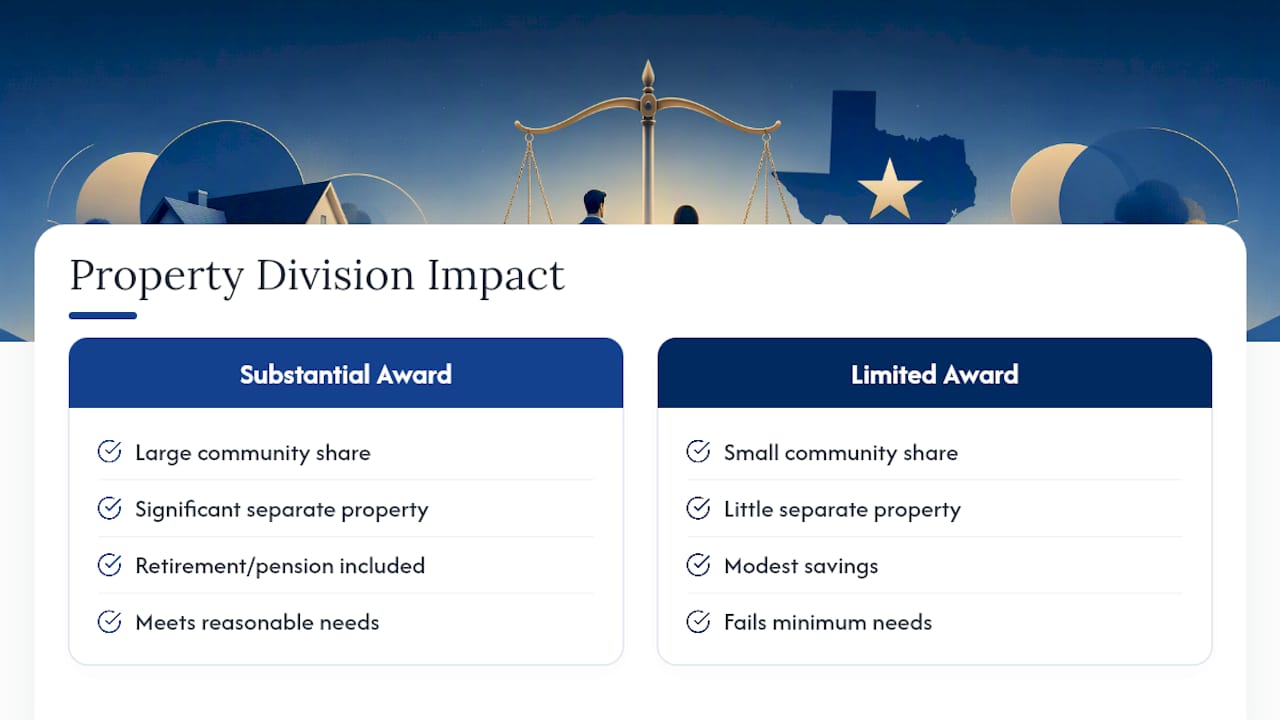
Property division happens first, and it directly shapes whether you’ll even qualify for maintenance. Remember the threshold test: you must lack sufficient property, including your share of the marital estate, to meet your minimum reasonable needs. A generous property settlement can disqualify you even if you’d otherwise fit one of the four eligibility routes.
Texas is a community property state, meaning most assets and income acquired during the marriage belong to both spouses and get divided in the divorce, typically close to equally, though not always exactly 50/50. Separate property, assets owned before the marriage, inheritances, or personal injury settlements, generally stays with the spouse who owns it and doesn’t count toward the community estate split.
Here’s where it gets practical. If you’re walking away with substantial separate property, savings, or a large share of community assets like a house, retirement accounts, or investments, a judge may conclude you have enough resources to meet your own needs without maintenance. Conversely, a spouse with little separate property and a small share of a modest community estate has a much stronger argument that maintenance is necessary.
This is why the property division phase of your divorce and the maintenance request aren’t separate conversations. They’re intertwined. An attorney evaluating your maintenance claim needs a clear picture of what you’re likely to receive in the property settlement before advising you on the strength of your maintenance case. If retirement accounts or a pension are part of your marital estate, that division can significantly change the math on whether you’ll qualify at all.
Do You Pay Taxes on Spousal Maintenance in Texas?
The tax treatment changed significantly, and a lot of outdated advice still floats around because of it. For any spousal maintenance order entered after 2018, the paying spouse cannot deduct the payments on their federal tax return, and the receiving spouse does not report the payments as taxable income, according to IRS guidance on alimony and separation agreements.
That’s a reversal from the old rule, where paying spouses got a deduction and receiving spouses paid income tax on what they received. If your divorce was finalized before 2019 and your order hasn’t been substantially modified since, the old tax treatment may still apply, so check the effective date on your specific order rather than assuming the current rule covers you.
This shift changes the math on negotiations. Because the payer no longer gets a tax deduction, some paying spouses push harder to minimize the maintenance amount or favor a lump-sum property settlement instead. If you’re the receiving spouse, the fact that your maintenance is tax-free income is worth factoring into your overall settlement comparison. Either way, this is a conversation to have with a tax professional alongside your family law attorney, since your specific filing status, other income, and the exact order language can all affect the outcome.
How Do You Apply for Spousal Maintenance in Texas?
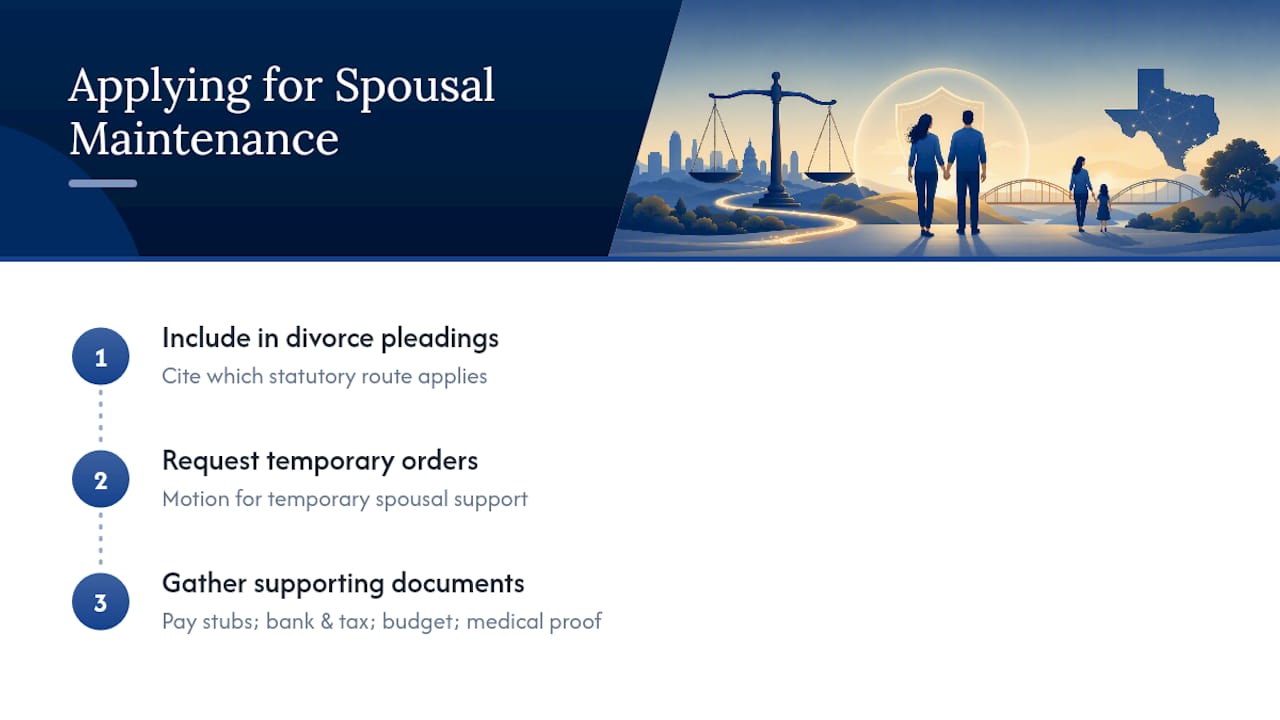
You don’t file a separate lawsuit for spousal maintenance. It’s requested as part of your existing divorce case, either in your original petition, your counterpetition, or a specific request for temporary spousal support while the case is pending.
Here’s the general sequence. First, your attorney includes a request for spousal maintenance in your divorce pleadings, citing which of the four statutory eligibility routes applies to your situation. Second, if you need support during the divorce itself, not just after, you can request temporary spousal support through a motion for temporary orders, which a judge can grant relatively quickly compared to the full divorce timeline. Third, you’ll need to gather documentation supporting both your eligibility and your minimum reasonable needs: recent pay stubs or proof of no income, bank statements, tax returns for the last few years, a monthly budget showing necessary expenses, and, where relevant, medical records or evidence of family violence.
The paperwork burden falls heavily on the requesting spouse. Judges want to see specifics, not general claims of financial hardship. A budget that lists an exact rent amount, utility costs, insurance premiums, and transportation expenses carries far more weight than a vague statement that you “can’t make ends meet.” If your case involves a disability claim, medical documentation from a treating physician strengthens your position considerably. If your case involves family violence, certified copies of the conviction or deferred adjudication record are essential.
Practitioner Perspective: Common Mistakes and When to Call an Attorney
The most costly mistake is accepting a verbal promise instead of a signed, enforceable order. The second is letting missed payments pile up for months before acting, since arrears become harder to prove and collect the longer they sit. Early legal involvement, drafting language that survives enforcement scrutiny, filing on time, and documenting everything changes outcomes for families facing exactly these situations.
— Giri
How Lawofficeofannadin Can Help With Your Maintenance Claim
Reading the statute is one thing. Building a case that survives a contested hearing, or getting a delinquent spouse to actually pay, is another. Legal professionals work with clients throughout The Woodlands, Houston, and surrounding communities on Chapter 8 disputes, from the initial eligibility review through drafting enforceable orders and pursuing enforcement when payments stop.

If you’re unsure whether your marriage length, financial situation, or family history qualifies you for maintenance, that’s not a question to answer alone from a statute printout. An attorney can review your income, property division outlook, and documentation, then provide guidance on your options, including whether an agreed order or a court-ordered award better protects your interests. If your former spouse has already stopped paying, we can move on income withholding, contempt, or interstate enforcement without the months of delay that let arrears pile up. Book a consultation through our divorce attorney practice page and get a clear read on your specific case before your next court date.
Key Statutes and Resources to Read Next
Review the primary law directly: Texas Family Code Chapter 8 and the TexasLawHelp overview.
This article is general information, not a substitute for advice from a qualified lawyer. Consult a qualified legal professional about your own circumstances before acting on anything here.
Sources
- Texas Family Code Section 8.051 – Eligibility for Maintenance
- Spousal Maintenance (Alimony) — TexasLawHelp
- IRS — Publication 504 (Alimony and Separation Agreements) overview
FAQ
How Much Alimony Does a Spouse Get in Texas?
Texas caps spousal maintenance at whichever is lower: $5,000 per month or 20% of the paying spouse’s gross monthly income; the actual amount within that cap depends on the receiving spouse’s documented minimum reasonable needs.
What Disqualifies You From Alimony in Texas?
Having enough property or income to meet your own minimum reasonable needs disqualifies you, as does failing to meet any of the four eligibility routes under §8.051: family violence, a 10+ year marriage with limited earning ability, disability, or caring for a disabled child.
Does a Husband Have to Support His Wife During Separation in Texas?
Texas doesn’t recognize legal separation, but a spouse can request temporary spousal support through a motion for temporary orders once a divorce case is filed, which a judge can grant while the case is pending.
Can You Modify a Spousal Maintenance Order After It’s Been Issued?
Yes. Either spouse can file a motion to modify based on a material and substantial change in circumstances, such as job loss, a new disability, or a significant income change, and the order automatically ends on remarriage, death, or the stated expiration date.
Recommended
Questions About Your Situation?
Every family is different. Schedule a confidential consultation with Anna Din to discuss your options.
Schedule a Consultation