Stay-at-Home Mom Divorce: 30-Day Playbook to Protect Retirement

If you are a stay-at-home mom facing divorce, you have the same legal standing as a working spouse. Courts in most states treat homemaking and child rearing as a real contribution to the marriage, not a favor you owe your spouse for financial support. Your priorities right now are to request temporary orders for support and custody, gather financial documents, and build a small team: an attorney, a financial adviser, and a therapist, before you make any big moves.
TL;DR:
- Homemaking and caregiving are recognized as contributions comparable to income in divorce proceedings, giving stay-at-home moms legal leverage.
- Gathering financial documents, creating private accounts, and consulting an attorney before discussing divorce are critical steps to protect assets and establish support.
- Retirement assets are often the most valuable marital property and require proper valuation and a Qualified Domestic Relations Order for fair division.
- Early request for temporary support, custody, and asset protection orders can help stabilize the situation during the divorce process.
- Building a support team of a lawyer, financial analyst, and therapist improves your ability to navigate custody, support, and financial negotiations effectively.
Table of Contents
- What Are Your Rights in a Stay-at-Home Mom Divorce?
- How Do Assets and Debts Divide When You Have No Income?
- What Temporary Orders Can Stabilize Your Situation Early?
- What Happens to Custody and Child Support?
- How Do You Rebuild Financially After Divorce?
- Who Should Be on Your Support Team?
- How Does an Attorney Actually Help With These Steps?
- Understanding Legal Rights Specific to Stay-at-Home Moms in Divorce
- How Do You Handle Childcare and Its Costs After Divorce?
- How Do You Negotiate a Fair Settlement as a Stay-at-Home Mom?
- What Does the Divorce Timeline Look Like?
- What Custody Considerations Apply to Very Young Children?
- What the Data Actually Tells Us About This Decision
- Get Help From the Law Office of Anna Din
- Sources
- FAQ
What Are Your Rights in a Stay-at-Home Mom Divorce?
Your years at home count as a financial contribution to the marriage, not an absence from it. Family law scholarship, including work from faculty at the University of Minnesota Law School, treats caregiving as a recognized input to marital property, on par with a paycheck. That principle shapes how courts divide assets and decide support, and it means you walk into this process with leverage, even if your name is not on the paycheck.
Here is a discrete, prioritized way to start protecting yourself before or right after separation:
- Copy your financial records first. Pull the last three years of tax returns, bank and credit card statements, retirement and investment account statements, mortgage and title documents, insurance policies, and recent pay stubs. Store digital copies somewhere your spouse cannot access, a cloud folder tied to a new email, or a drive at a trusted relative’s house.
- Set up private digital accounts. Create an email address your spouse has never seen, and change passwords on any account not shared with him. Back up photos, calendars, and documents outside your home network.
- Talk to an attorney before you talk to your spouse. Practitioner guides consistently recommend that the first real conversation about divorce happen with a qualified family law attorney, not your spouse, so you understand timing and leverage before anything is said out loud.
- Think carefully before leaving the house. Moving out without a court order can complicate custody and property claims later, since some courts read it as abandoning the marital home. Ask an attorney whether staying put or requesting exclusive use through a temporary order fits your situation better.
- Document your caregiving role. Save school records, medical appointment logs, shared calendars, and transportation schedules. These become evidence of who has handled day-to-day parenting.
Pro Tip: Keep a simple daily log for two to four weeks, drop off times, pickups, appointments, meals prepared. Judges respond to specifics far more than general claims about who “did everything.”
How Do Assets and Debts Divide When You Have No Income?
Not having a paycheck does not mean you leave with nothing. States follow one of two frameworks: community property states split most marital assets and debts 50/50, while equitable distribution states divide property based on fairness, weighing factors like length of marriage, each spouse’s earning capacity, and contributions to the household. Either way, homemaking counts as a contribution the court factors into the split.
Retirement accounts are often the single biggest asset in a stay-at-home mom’s divorce, and they are also the easiest to undervalue. A Certified Divorce Financial Analyst (CDFA) can show you what a 401(k), pension, or IRA accumulated during the marriage is actually worth over the long term, not just its current balance. Dividing a retirement account correctly usually requires a Qualified Domestic Relations Order (QDRO), a separate court order that instructs the plan administrator to pay your share directly, without triggering early withdrawal penalties.
Before any settlement talk, build a conservative financial inventory:
- List every joint bank account, credit card, and loan, including balances as of today.
- Flag any account or asset you have never seen a full statement for, that is where hidden assets tend to hide.
- Note recurring expenses (mortgage, childcare, insurance) so you know your real monthly baseline.
- Open a private checking account in your own name, even with a small deposit.
Retirement accounts accumulated during marriage are frequently a couple’s most valuable marital asset, according to CDFA guidance from SmartAsset, which is exactly why a rushed settlement that skips a proper valuation tends to shortchange the spouse who was not managing the finances. A detailed look at pension division walks through how these valuations typically work.
Health coverage needs attention immediately too. Losing coverage under your spouse’s plan usually triggers a COBRA election window or a Marketplace special enrollment period, both time-limited, so this is not a step to postpone until after the divorce is final.
What Temporary Orders Can Stabilize Your Situation Early?
Temporary orders exist precisely for the gap between filing and final judgment, and they are one of the most underused tools available to a stay-at-home spouse. Courts can issue temporary orders covering support, custody schedules, and asset protection while the case works through the system, and those orders can also freeze joint accounts or require one spouse to pay the other’s legal fees.
Ask your attorney to request:
- Temporary spousal support, calculated from current household expenses, not a future settlement figure.
- A temporary custody and visitation schedule, so caregiving continues without ambiguity.
- Exclusive use of the family home, if staying there is safer or more stable for the children.
- An asset freeze, preventing your spouse from draining joint accounts or selling shared property mid-case.
- An order requiring your spouse to pay reasonable attorney fees, which judges grant more often than most people expect when there is a clear income gap between spouses.
Courts weigh several factors when setting spousal support, both temporary and final: length of the marriage, each spouse’s standard of living, your realistic employability given time out of the workforce, and the value of your homemaking contributions. None of these factors penalize you for having stayed home. They are built to account for exactly that situation.
Pro Tip: Request temporary orders early rather than waiting for the full financial picture to emerge. Stabilizing support and custody first gives you room to negotiate the rest without financial panic driving your decisions.
If mediation or a lower-conflict path appeals to you, understanding how alternative dispute resolution works can help you decide whether it fits your case before you commit to full litigation.
What Happens to Custody and Child Support?
Courts decide custody using the best-interests-of-the-child standard, and continuity of caregiving carries real weight under that standard. If you have been the consistent presence at school drop off, doctor visits, and bedtime, that pattern typically supports maintaining a similar arrangement post-divorce, though it is never an automatic guarantee.
Child support in most states follows an income-shares model, which factors in both parents’ incomes, the amount of parenting time each parent has, and, in some cases, imputed income if a parent is considered capable of earning more than they currently do. Because you have been out of paid work, courts generally will not impute a full-time salary to you immediately, but expect that question to come up if the case drags on.
Start collecting now:
- School records and report cards showing your involvement in academic decisions.
- A running log of medical appointments and who scheduled or attended them.
- Text or email threads discussing parenting logistics with your spouse.
- Shared calendars showing routine drop offs, pickups, and activities.
For cases involving contested schedules or high conflict, a parenting coordinator or child specialist can help translate a caregiving history into a workable custody plan, especially useful when joint custody and sole custody arrangements are both on the table and neither parent agrees on which fits.
How Do You Rebuild Financially After Divorce?
Getting back to paid work, or back to full-time work, is usually the biggest financial lever a stay-at-home mom has post-divorce, and it works best when you start planning before the ink dries on the settlement.
- Map your transferable skills first. Budgeting a household, coordinating schedules, managing a family’s logistics, these translate into project management, administrative, and operations roles more directly than most people realize. Update your resume around outcomes, not just job titles.
- Look into short certification programs. Community colleges and workforce boards often run subsidized courses in bookkeeping, medical billing, real estate, or administrative software, many completed in under six months.
- Get real market pay data before settlement talks end. Knowing what a role in your field actually pays locally strengthens your position when negotiating spousal support duration and amount. Debt.org’s guidance on preparing for divorce financially recommends this kind of grounded budget work as an early, not late, step.
- Decide on the house before deciding on anything else big. A house buyout can make sense if you can qualify for the mortgage solo, but downsizing is often the financially sounder move, especially once you factor in property taxes, upkeep, and lost equity from refinancing costs.
Pro Tip: Get a written pay range for your target role before final settlement talks, not after. Vague income assumptions almost always favor the spouse with more current financial information, which is rarely you at this stage.
Who Should Be on Your Support Team?
Divorce decisions made in isolation, especially financial ones, tend to be the ones people regret most. Build a small, deliberate team instead of leaning on any one person for everything.
- A family law attorney handles filings, temporary orders, and negotiation strategy, and is the one person whose advice carries legal weight in your case.
- A Certified Divorce Financial Analyst (CDFA) models what different settlement offers actually mean over 10, 20, or 30 years, particularly for retirement assets.
- A therapist helps you separate emotional decisions from strategic ones, which matters most in the weeks right after filing.
- A divorce coach, if you want structured help managing logistics and communication, without legal advice mixed in.
If cost is a concern, legal aid organizations, limited-scope representation (where an attorney handles only specific parts of your case), sliding-scale therapists, and pro bono legal clinics all exist for exactly this situation. None of these options require you to handle everything alone or pay full-service rates for every task.
Pro Tip: Set a rule for yourself: no major financial decision gets made the same day it is discussed. A 24-hour pause protects you from decisions driven by exhaustion rather than judgment.
How Does an Attorney Actually Help With These Steps?
A first consultation typically starts with a full financial inventory, income, debts, retirement accounts, and property, followed by a decision on whether to request temporary orders right away. From there, the attorney coordinates any retirement valuation or QDRO work with a financial analyst, and builds the custody and support strategy around documented caregiving history.
Anna Din’s practice has worked through this exact sequence with stay-at-home parents, including cases where early temporary orders prevented a spouse from draining joint accounts before the case was resolved. Readers weighing a house buyout or wondering what happens to a pension in divorce can find deeper breakdowns of both scenarios in the firm’s guides. This article draws on Giri’s background in family law reporting and editorial analysis of divorce procedure, applied specifically to the financial and custody questions stay-at-home mothers face most often.
Understanding Legal Rights Specific to Stay-at-Home Moms in Divorce
The legal system does not have a separate rulebook for stay-at-home moms, but the factors courts apply land differently when one spouse has no independent income. Judges weigh your non-financial contributions, cooking, cleaning, childcare, household management, as equivalent to a working spouse’s paycheck when dividing property and setting support. This is written into equitable distribution statutes in most states, not left to a judge’s personal sympathy.
You also have the right to request that your spouse cover reasonable attorney fees if there is a clear income disparity, and the right to seek temporary support the moment a case is filed, not after months of negotiation. Neither of these rights requires you to prove hardship beyond your actual financial situation.
One right people frequently miss: you can request financial discovery, formal access to your spouse’s pay stubs, tax returns, business records, and account statements, even if he has always managed the finances. This levels the information gap that many stay-at-home spouses face going into settlement talks, and it is one of the clearest legal rights for homemakers built directly into the divorce process.
How Do You Handle Childcare and Its Costs After Divorce?
Childcare costs typically shift the moment a custody schedule replaces a two-parent household, and this catches many stay-at-home moms off guard. If you are returning to work, factor full-time daycare, after-school care, or a nanny into your budget before you finalize a support agreement, not after.
Child support calculations in most states account for reasonable childcare costs tied to employment or job training, meaning these expenses can be built into the support order itself rather than absorbed entirely out of pocket. Ask your attorney whether your state’s guidelines treat childcare as an add-on to base support or as a factored-in expense, since the answer changes your monthly math significantly.
Subsidized childcare programs, employer-sponsored dependent care accounts, and sliding-scale daycare centers are worth researching early, particularly if your return to work is still months away. Coordinating a custody schedule that aligns with realistic childcare hours, rather than an idealized 50/50 split that no daycare center’s hours actually support, saves considerable stress later.
How Do You Negotiate a Fair Settlement as a Stay-at-Home Mom?
Negotiating from a position with no independent income feels intimidating, but the leverage points available to you are more concrete than they seem. Come to the table with your financial inventory complete, a realistic support figure backed by actual expenses, and a retirement valuation from a CDFA rather than a guess at account balances.
Never negotiate against a number you have not verified yourself. If your spouse’s attorney proposes a settlement, request the underlying financial disclosures before responding, not after signing anything. Settlements finalized quickly tend to favor whichever spouse controlled the financial information going in, and that is rarely the stay-at-home parent.
Prioritize retirement assets and the QDRO process over cash in hand when the two are in tension, since a lump sum today rarely matches the long-term value of a properly divided 401(k) or pension. If custody and support are both still open, settle the schedule that reflects your actual caregiving history first, then build the financial terms around that stable foundation rather than the reverse.
What Does the Divorce Timeline Look Like?
Most divorces move through recognizable stages, though the pace varies significantly by state and by whether the case is contested. Filing starts the clock, followed by temporary orders within the first few weeks if requested. Financial disclosure, both sides exchanging full records, typically follows over the next one to three months.
Uncontested cases with full agreement on custody, support, and property can resolve in a matter of months. Contested cases, particularly ones involving retirement valuation, business assets, or custody disputes, commonly run six months to over a year. Mediation sessions, if used, usually happen after disclosure but before trial dates are set, and many cases settle at this stage without ever reaching a courtroom.
For a stay-at-home mom, the early weeks matter most, since temporary orders set the financial and custody baseline that shapes everything that follows. A step-by-step filing guide can help you understand what to expect week by week if you want a fuller picture before filing.
What Custody Considerations Apply to Very Young Children?
Custody arrangements for infants and toddlers raise questions that do not come up with older kids. Overnight schedules, for instance, are often handled differently for children under three, since some courts favor shorter, more frequent transitions over long stretches away from either parent at this age.
Breastfeeding, if still ongoing, can factor into a temporary schedule, and courts generally accommodate it without treating the request as favoring one parent unfairly. As children age out of infancy, schedules typically evolve toward longer blocks and more overnight time with both parents, so an initial custody order for a very young child is rarely meant to be permanent as written.
Continuity of routine matters enormously at this age. Judges weigh who has handled naps, feeding, and daily structure, which is exactly the kind of documentation worth collecting now if you have been the primary caregiver. What Texas courts weigh in these decisions is detailed further in a breakdown of custody factors, useful reading if your children are still in the early years.
What the Data Actually Tells Us About This Decision
The conventional advice in most divorce guides treats emotional readiness and financial preparation as parallel tracks, work on your feelings, then handle the paperwork. That framing gets it backwards for stay-at-home moms. Financial advocates consistently point to the technical financial inventory as the piece people delay longest, and it is the piece with the shortest windows, insurance enrollment, temporary order requests, evidence preservation, all move faster than emotional readiness ever will.
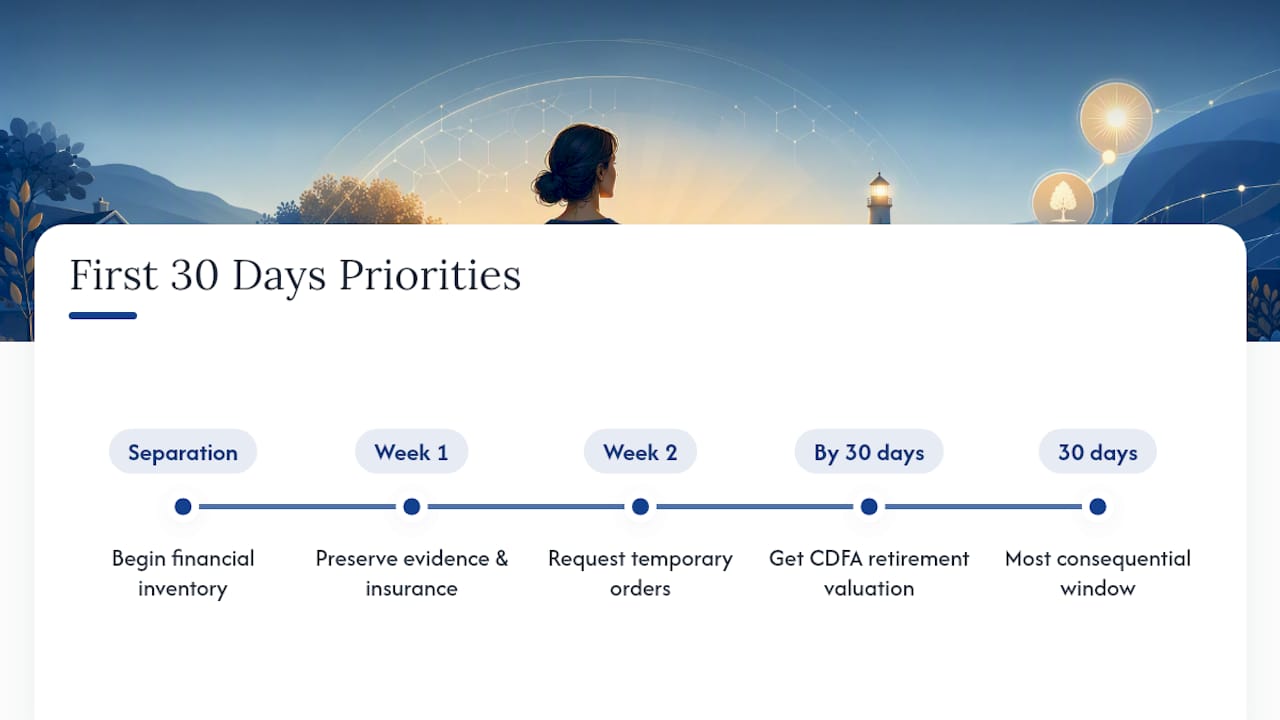
The retirement account is where most of the real money sits, and it is also where a rushed settlement does the most damage, since a 401(k) balance today and its value at retirement are two very different numbers. Prioritizing a CDFA-backed valuation before signing anything protects you far more than a slightly faster settlement timeline.
Temporary orders deserve more attention than they get. Too many stay-at-home moms wait for the full case to resolve before requesting support or custody stability, when that request could have been filed in week two. If there is one thing worth doing differently from what most advice suggests, it is this: treat the first thirty days after separation as the most consequential window of the entire process, not the calm before the real fight starts.
— Giri
Get Help From the Law Office of Anna Din
The Law Office of Anna Din works specifically with parents in situations like this, where one spouse managed the household and the other managed the paycheck, and the settlement has to account for both fairly. Unlike generic legal templates or DIY filing services, Anna Din builds each case around a full financial and custody picture from the first consultation, drawing on local experience in The Woodlands and Houston to anticipate how these cases actually play out in Texas courts.

Bring what you can to your first consultation: financial documents you have already gathered, a rough household budget, and a clear sense of your custody priorities. Limited-scope representation may be available for those who need help with a specific piece of the case, like temporary orders.
The firm handles divorce and marital law, child custody and support, and protective orders for situations that require emergency action. If you need a schedule adjustment down the road, modifications and enforcement fall under the same practice area. Request a consultation through the divorce attorney page to start the financial and custody conversation before your next major decision, not after.
Sources
- Stay-at-Home Mom Divorce Rights — LegalClarity
- Debt
- Stay-at-home moms and dads account for about one-in-five U.S. parents — Pew Research Center
State laws vary, so confirm specific thresholds and procedures with a licensed attorney in your state before acting on any of this.
This article is general information, not a substitute for advice from a qualified lawyer. Consult a qualified legal professional about your own circumstances before acting on anything here.
FAQ
What Happens if You Get Divorced as a Stay-at-Home Mom?
You retain full legal rights to marital property, spousal support consideration, and custody based on your caregiving history, regardless of having no independent income. Courts can issue temporary orders early in the case to stabilize support and custody while the full case proceeds.
What Does a Stay-at-Home Wife Get in Divorce?
She typically receives a share of marital assets, including a portion of retirement accounts through a QDRO, potential spousal support based on marriage length and standard of living, and consideration for her homemaking contributions. Courts do not treat lack of income as a reason to reduce her share of the marital estate.
How Do You Divorce Your Husband When You Are a Stay-at-Home Mom?
Start by consulting a family law attorney before discussing divorce with your spouse, then gather financial documents and request temporary orders for support and custody. This sequence protects your access to information and stabilizes your finances before negotiations begin.
How Often Do Stay-at-Home Moms Get Divorced?
Stay-at-home parents make up about one-in-five U.S. parents, a large enough share that divorce among this group is common rather than rare. No single figure captures a stay-at-home mom’s individual divorce risk, since it depends on marriage length, location, and personal circumstances.
Does a Stay-at-Home Mom Need Her Own Attorney?
Yes. A stay-at-home mom typically has less visibility into household finances than her spouse, which makes independent legal representation essential for requesting fair discovery, temporary support, and an accurate valuation of retirement assets.
Recommended
Questions About Your Situation?
Every family is different. Schedule a confidential consultation with Anna Din to discuss your options.
Schedule a Consultation