House Buyout in Divorce: How to Keep the Home
September 9, 2026 · Law Office of Anna Din PLLC

Yes, you can buy out your spouse’s share of the marital home in most U.S. divorces. The most common route is a cash-out refinance or a divorce/equity buyout refinance tied to a signed settlement agreement or divorce decree. Before you agree to any terms, three things need to happen first: get a professional appraisal to establish fair market value, calculate your net equity (home value minus the mortgage payoff and any liens), and contact a lender to find out whether you can qualify for a new mortgage on your own.
- Get a certified appraisal. A licensed appraiser’s report is the foundation of every buyout negotiation. Broker price opinions and online estimates are not substitutes courts or lenders will accept.
- Run the equity math. Subtract the outstanding mortgage balance and any liens from the appraised value. Divide the result by two (or by whichever share your state’s property rules assign) to get the buyout amount.
- Test your solo qualification. Call a lender before you sign anything. Your debt-to-income ratio and credit score on a single income may look very different from your joint profile.
Contact a family-law attorney and a lender at the same time. Setting enforceable payment deadlines in the decree before you finalize terms is the single most protective step you can take.
Pro Tip: Ask your attorney to include a fallback sale provision in the decree. If refinancing falls through within the agreed deadline, the home goes to market automatically. Without that clause, you may need to return to court to force a sale.
Key Takeaways
A divorce house buyout is achievable for most homeowners, but it requires a certified appraisal, confirmed solo mortgage qualification, and enforceable decree language before you agree to any terms.
| Point | Details |
|---|---|
| Get a certified appraisal first | A licensed appraiser’s written report is the only valuation courts and lenders will accept as the basis for a buyout. |
| Run the equity math before negotiating | Subtract the mortgage payoff and liens from appraised value; each spouse’s share flows from that net equity figure. |
| Test solo qualification early | Contact a lender before signing the decree; debt-to-income and credit on a single income often differ significantly from the joint profile. |
| Include a refinance deadline and fallback sale | The decree must set a specific deadline (60–90 days is standard) and an automatic sale trigger if refinancing fails. |
| Lawofficeofannadin drafts enforceable buyout terms | The Law Office of Anna Din aligns decree language with lender requirements and records owelty liens for Texas clients. |
Table of Contents
- How does a house buyout in divorce work, step by step?
- What financing options can you use to buy out a spouse?
- How do you remove a spouse from the mortgage and the title?
- What are the federal tax rules for a divorce house buyout?
- How do you set the buyout price and protect yourself in the settlement?
- What is the realistic timeline and cost of a divorce house buyout?
- When is selling the home a better option than a buyout?
- How a family law attorney supports a house buyout
- What practitioners see go wrong in divorce buyouts
- Law Office of Anna Din can guide you through a divorce house buyout
- Sources
- FAQ
How does a house buyout in divorce work, step by step?
The process follows a clear sequence. Skipping or reordering steps is where most buyouts stall or collapse.
- Agree on fair market value. Both spouses commission or accept a certified appraisal from a licensed appraiser. If the appraisals differ, you can split the cost of a third appraiser, average the two figures, or ask the court to appoint one.
- Calculate the buyout amount. Subtract the mortgage payoff balance and any liens from the agreed value to get net equity. Each spouse’s share flows from that number.
- Choose your financing method. Cash, cash-out refinance, divorce/equity buyout refinance, HELOC, mortgage assumption, or an asset offset. Details are in the next section.
- Secure the funds. Get a loan commitment letter or confirm liquid cash before signing the settlement.
- Sign the settlement instrument. The divorce decree or separation agreement must spell out the buyout amount, payment source, payment deadline, and what happens if the deadline is missed.
- Refinance or pay off the joint mortgage. The staying spouse takes out a new loan in their name alone, paying off the old joint mortgage and wiring the buyout amount to the departing spouse at closing.
- Record the deed transfer. A quitclaim or warranty deed, signed by the departing spouse, is recorded with the county clerk. In Texas, an owelty lien is often recorded in the decree itself to secure the payment and allow refinancing up to approximately 95% LTV.
Sample equity calculation:
The staying spouse needs a new loan large enough to pay off the $250,000 balance plus the $75,000 buyout, totaling $325,000 in this example.

Pro Tip: Use an escrow account to hold the buyout funds at closing. The title company releases the payment to the departing spouse only after the deed is signed and the new mortgage funds. This protects both parties and eliminates the risk of a payment dispute after the fact.
What financing options can you use to buy out a spouse?
Choosing the right financing method depends on your credit profile, available equity, and how quickly the divorce needs to close. Each option carries different eligibility requirements and costs.
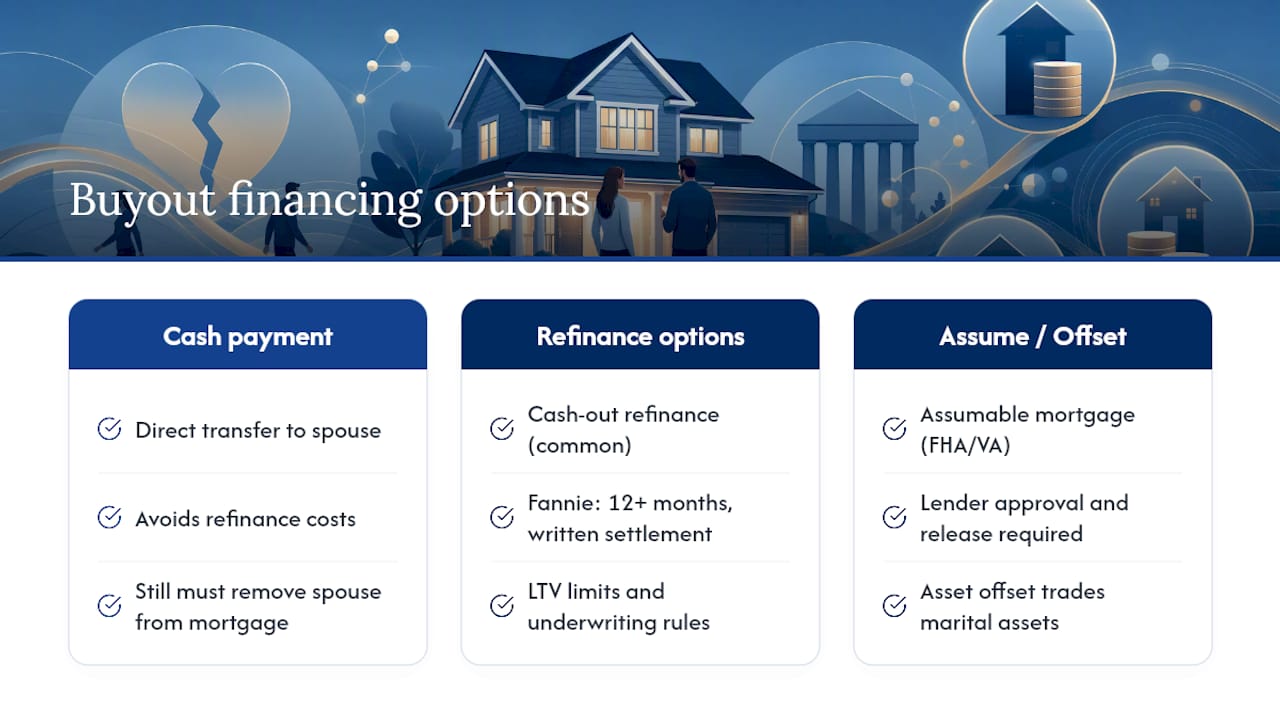
Cash payment
If you have liquid assets, paying the buyout in cash avoids refinancing costs entirely. You still need to refinance or assume the mortgage to remove your spouse’s name from the loan, but the buyout itself is a direct transfer. This works best when equity is modest and you have savings or a retirement account to draw from. Review how a retirement account offset might substitute for a cash payment before liquidating anything.
Cash-out refinance
The most common path. You replace the joint mortgage with a new, larger loan in your name alone, using the extra proceeds to pay your spouse. Divorce buyout refinances are a common way the staying spouse accesses equity, but program rules, LTV limits, and underwriting requirements are critical constraints you need to verify with your lender before assuming you qualify.
Divorce/equity buyout refinance (Fannie Mae-style)
Some lenders offer a divorce buyout refinance treated as a limited cash-out rather than a full cash-out, which can mean a higher LTV and a lower rate. Fannie Mae-style eligibility exceptions generally require both spouses to have owned the property jointly for at least 12 months and a written settlement agreement specifying the amount paid to the departing spouse. When those conditions are met, the transaction may qualify under rate-and-term rules rather than full cash-out rules. Ask your lender specifically whether they offer this program.
HELOC or home equity loan
A home equity line of credit or a second mortgage can fund the buyout without replacing the first mortgage. This makes sense if your first mortgage carries a low rate you want to keep. The catch: both loans remain on the property, and the departing spouse is still on the original mortgage until you refinance or pay it off separately.
Mortgage assumption
If your loan is assumable (common with FHA and VA loans), you can apply to take over the existing mortgage in your name alone. The lender must approve the assumption and formally release your spouse. Approval is not automatic, and you still need to fund the equity buyout separately.
Asset offset
Instead of cash, you trade other marital property. You keep the house; your spouse keeps the retirement account, investment portfolio, or other assets of equivalent value. This avoids refinancing entirely if you can assume or keep the existing mortgage, but it requires careful valuation of both assets. Consider how pension and retirement offsets are structured before agreeing to this approach.
Solo qualification: the real hurdle
Qualifying on a single income is where many buyouts fail. Lenders will evaluate your credit score, debt-to-income ratio, employment history, and income documentation independently. Alimony and child support you receive can count as income if the payments are documented and expected to continue for at least three years. The CFPB’s guidance on special loan programs is a useful starting point for understanding your options and consumer protections when refinancing.

How do you remove a spouse from the mortgage and the title?
Title and mortgage are two separate legal instruments, and confusing them is one of the most expensive mistakes in a divorce property settlement.
- Title is ownership. It is recorded in the county deed records and determines who legally owns the property.
- Mortgage is a loan obligation. It is a contract between you, your spouse, and the lender. A divorce decree does not change that contract.
A quitclaim deed transfers your spouse’s ownership interest to you. It does nothing to remove their name from the mortgage. If the joint mortgage stays in place after the divorce, your ex-spouse’s credit is still tied to every payment you make or miss. A divorce decree does not release a borrower from the original mortgage contract; only a refinance, a paid-off loan, or a lender-approved assumption can accomplish that.
Options to remove mortgage liability:
- Refinance in one name. The cleanest solution. The old joint loan is paid off and replaced with a new loan solely in the staying spouse’s name. The departing spouse is released from all mortgage liability at closing.
- Lender-approved assumption with release. The staying spouse formally assumes the loan and the lender issues a written release of the departing spouse. Not all conventional loans allow this; FHA and VA loans are more commonly assumable.
- Payoff or sale. Paying off the mortgage in full, whether through a buyout refinance or a sale, eliminates the joint obligation entirely.
Deed transfer options:
A quitclaim deed is the most common instrument used in divorce. It transfers whatever interest the departing spouse holds, with no warranties about title defects. A warranty deed offers stronger title guarantees but is less common in divorce contexts.
Pro Tip: Never rely on a quitclaim deed alone to protect the departing spouse’s credit. The decree should include a recorded refinance deadline and a lien-release mechanism. In Texas, an owelty lien recorded in the decree gives the departing spouse a secured interest in the property until the refinance closes and the buyout is paid.
What are the federal tax rules for a divorce house buyout?
Most property transfers between spouses incident to divorce do not trigger an immediate tax bill, but the long-term tax consequences depend on how the transfer is structured and documented.
IRC §1041: the nonrecognition rule
Under Internal Revenue Code §1041, no gain or loss is recognized on transfers of property between spouses or incident to divorce. The transferee (the spouse receiving the property) takes the transferor’s adjusted basis. This means the departing spouse generally owes no capital gains tax at the time of transfer, but the staying spouse inherits the original cost basis, which matters when they eventually sell.
Basis carryover and future capital gains
If you bought the home for $200,000 and it is now worth $400,000, the staying spouse carries over the $200,000 basis. When they later sell, the $200,000 gain is measured against that original basis, not the buyout price. The primary-residence exclusion under IRC §121 can shelter up to $250,000 of gain for a single filer (or $500,000 for a married couple), but after a buyout you are a single filer. Timing the sale matters.
Under IRC §1041, transfers incident to divorce are treated as gifts for tax purposes, meaning the transferee steps into the transferor’s shoes on basis. The practical consequence: a low-basis home transferred in a divorce can generate a significant taxable gain years later when the staying spouse sells. Document the original purchase price, capital improvements, and the divorce instrument carefully. IRS Publication 504 walks through exactly what records to keep and how these transfers are reported.
Gift tax considerations
Property transfers that qualify under §1041 are generally also exempt from gift tax under IRC §2516 if they are made pursuant to a written agreement and within the applicable time period. An IRS private letter ruling (PLR-112463-18) confirmed that certain buyout payments can meet both §1041 and §2516 requirements, but the transfer must be documented as incident to the divorce, not as a separate gift.
Post-transfer tax checklist:
- Save the divorce decree or separation agreement in your permanent tax files.
- Document the original purchase price and all capital improvements to establish adjusted basis.
- Consult IRS Publication 504 for filing-status changes and withholding updates.
- Confirm with a tax advisor whether the §121 exclusion applies to your planned sale timeline.
- Note that the IRS considers you married for tax purposes until a final decree of divorce or separate maintenance is entered.
Pro Tip: Label all transfer documents explicitly as “incident to divorce” and reference the decree by date and case number. This documentation is your defense if the IRS later questions whether §1041 applies.
How do you set the buyout price and protect yourself in the settlement?
The buyout price is not always a straight 50/50 split of net equity. Several legitimate approaches exist, and the one you choose should be reflected precisely in the settlement language.
Valuation and split approaches:
- Equal split of net equity. The default in most community-property and equitable-distribution states. Both spouses receive half of the appraised value minus the mortgage payoff and liens.
- Asset offset. One spouse keeps the house; the other receives retirement accounts, investment accounts, or other marital assets of equivalent value. This avoids a cash transfer but requires accurate valuation of both sides.
- Present-value installment buyout. The staying spouse pays the buyout in installments over time, often with interest. The decree must specify the payment schedule, interest rate, security instrument, and default remedy.
- Deferred buyout. Common when children are in school. The home is not sold or bought out immediately; both spouses retain an interest until a trigger event (youngest child graduates, a set date, or a market condition). The decree must define the trigger and the split at that future point.
Settlement language checklist:
- State the agreed appraised value and the date of the appraisal.
- Specify the exact buyout dollar amount and the payment source (refinance proceeds, cash, asset transfer).
- Set a refinance deadline (typically 60–120 days from the decree date).
- Include a deed-recording instruction: the departing spouse signs a quitclaim deed held in escrow, released to the county clerk upon confirmation of payoff.
- Define the enforcement remedy: if the deadline passes without refinancing, the home is listed for sale within 30 days at a mutually agreed list price, or a court-appointed receiver lists it.
- For installment buyouts, attach an amortization schedule and specify the lien instrument securing the payments.
A postnuptial or settlement agreement that omits any of these elements creates enforcement gaps that can require additional litigation to resolve.
What is the realistic timeline and cost of a divorce house buyout?
Budget both time and money before committing to a buyout. Underestimating either is a common reason buyouts fall apart after the decree is signed.
Timeline phases:
- Appraisal: 3–7 business days to schedule and receive a written report from a licensed appraiser.
- Lender prequalification: 1–2 weeks to receive a preliminary qualification decision based on your solo income, credit, and debt profile.
- Loan underwriting: 4–6 weeks from application to clear-to-close, assuming no documentation delays. Complex income situations (self-employment, variable commissions, recent job changes) can add 2–4 weeks.
- Closing: 1–2 weeks once the lender issues a clear-to-close. The title company schedules closing, the deed is signed, and funds are disbursed.
- Deed recording: 1–5 business days after closing, depending on the county recorder’s office.
Total elapsed time from appraisal order to recorded deed: typically 8–14 weeks under normal conditions.
Typical costs:
- Appraisal: $400–$700 for a standard single-family home, more for larger or complex properties.
- Title search and title insurance: varies by state and property value; often included in closing costs.
- Closing costs: generally 2%–4% of the new loan amount, covering lender origination fees, title insurance, escrow fees, and prepaid items.
- Recording fees: $25–$150 depending on the county.
- Attorney fees: varies by complexity; drafting a buyout clause and owelty lien in Texas typically adds to the overall legal cost of the divorce.
The CFPB recommends that borrowers document all refinance uses and account for closing-cost drag on net proceeds, which is especially relevant when refinance proceeds are used entirely to pay a departing spouse rather than for personal cash-out.
Pro Tip: Order the appraisal and lender precheck simultaneously, not sequentially. Running them in parallel can cut 2–3 weeks off your timeline. Include a specific refinance deadline in the decree (60–90 days is standard) and a fallback sale trigger if that deadline passes.
When is selling the home a better option than a buyout?
A buyout is not always the right financial decision. Three situations consistently point toward an alternative.
Sell and split the proceeds:
- Solo qualification fails after a good-faith effort with multiple lenders.
- Net equity is low relative to closing costs and moving expenses, making the buyout economically marginal.
- Both spouses want a clean financial break with no ongoing shared obligations.
Selling is often the cleanest outcome. Both parties receive cash, the mortgage is retired, and neither carries ongoing credit exposure to the other.
Offset with other marital assets:
- Liquid retirement accounts or investment portfolios exist that can be divided in lieu of a cash buyout.
- Both spouses prefer to avoid refinancing costs and a higher interest rate on a new loan.
- The staying spouse can assume or keep the existing mortgage without triggering a due-on-sale clause.
This approach works when asset values are well-documented and both parties agree on the valuation methodology.
Temporary co-ownership or deferred sale:
- Minor children are in school and stability is the priority.
- The housing market is depressed and selling now would crystallize a loss.
- Both spouses can cooperate on maintenance, insurance, and mortgage payments during the interim period.
Co-ownership after divorce requires a detailed written agreement covering payment responsibilities, maintenance decisions, and the trigger event for the eventual sale or buyout.
Pro Tip: If children’s school stability is the reason for a deferred sale, tie the trigger date to the school calendar rather than a fixed date. A provision that says “the home will be listed within 60 days after the youngest child completes the current school year” is far more enforceable than a vague “when the time is right.”
How a family law attorney supports a house buyout
An attorney’s role in a house buyout goes well beyond reviewing paperwork. The legal and financial risks in a poorly drafted buyout clause can follow both spouses for years.
What an attorney does during a buyout:
- Drafts the buyout clause in the divorce decree, specifying the amount, payment source, deadline, and enforcement remedy.
- Drafts owelty lien language (in Texas) to secure the departing spouse’s interest and allow the staying spouse to refinance up to approximately 95% LTV, as recognized in Texas divorce mortgage practice.
- Coordinates with the lender to confirm that the decree language meets underwriting requirements before the decree is finalized.
- Reviews the deed transfer and confirms it is recorded correctly after closing.
- Advises on tax consequences and coordinates with the client’s CPA or tax advisor on basis documentation.
- Builds in a fallback sale deadline so the departing spouse has an enforceable remedy if refinancing fails.
A practical example of how this works:
The lender was brought into the process before the decree was signed, confirming the loan structure in advance. The departing spouse signed a quitclaim deed held in escrow, released automatically at refinance closing. The entire process closed within 90 days of the decree.
The single most common reason a buyout fails after the decree is signed is that the decree language does not match what the lender requires. Getting the lender’s underwriting team to review the proposed decree language before you sign it is not optional — it is the step that determines whether the buyout actually closes.
What to bring to your first attorney meeting:
- The property deed and most recent mortgage statement.
- Any appraisal or market analysis you have already obtained.
- Drafts of any separation agreement or decree language already exchanged.
- Three months of pay stubs or income documentation.
- A list of all marital assets and liabilities you are aware of.
Review the pre-filing checklist before your first meeting to make sure you arrive prepared.
What practitioners see go wrong in divorce buyouts
The financial pressure of divorce creates conditions where people make decisions they would never make in a calmer moment. These are the mistakes that show up most often in practice.
- Assuming the decree removes mortgage liability. It does not. Only a refinance, assumption with lender release, or payoff removes a name from the mortgage. Spouses who sign a decree and walk away without refinancing often discover years later that a missed payment by their ex has damaged their credit.
- Failing to test solo qualification before signing. Agreeing to a buyout in the decree without confirming you can actually get the loan is a serious risk. If refinancing fails after the deadline, you may be forced into a sale you did not want, on a timeline you did not control.
- Skipping the appraisal. Accepting a Zillow estimate or a real estate agent’s informal opinion as the basis for a buyout is not defensible in court and often leads to disputes after the fact. A licensed appraiser’s written report is the standard.
- Missing the refinance deadline. Decrees with no deadline or an unenforceable deadline leave the departing spouse with no remedy if the staying spouse delays indefinitely.
The emotional weight of divorce is real, and it can push people toward quick agreements that feel like relief in the moment but create legal and financial problems later. Taking the time to get the numbers right, test the financing, and draft enforceable language is not overcaution. It is the difference between a buyout that closes and one that ends up back in court.
Law Office of Anna Din can guide you through a divorce house buyout
Navigating a house buyout while managing the rest of a divorce is genuinely difficult. The Law Office of Anna Din handles exactly this kind of work for clients in The Woodlands, Houston, and surrounding Texas communities.

Anna Din’s firm drafts buyout clauses and owelty lien language that lenders will actually accept, coordinates directly with your lender to align decree language with underwriting requirements, and builds in the enforcement provisions that protect you if the other side delays. The firm also advises on deed transfer mechanics, fallback sale deadlines, and the tax documentation steps that protect your basis for years after the divorce closes.
To schedule a consultation with a Texas divorce attorney who handles property division and buyout agreements, contact the Law Office of Anna Din. Bring your mortgage statement, any appraisal you have, and your current draft of the settlement agreement. The earlier you involve counsel, the more options you have.
This article provides general legal information, not legal advice. Consult a qualified family law attorney for guidance specific to your situation and jurisdiction.
Sources
- U.S.C. Title 26 – INTERNAL REVENUE CODE 26 U.S.C. United States Code, 2024 Edition Title 2
- Publication 504 (2025), Divorced or Separated Individuals | Internal Revenue Service
- Refi
- Lower
This article is general information, not a substitute for advice from a qualified lawyer. Consult a qualified legal professional about your own circumstances before acting on anything here.
FAQ
How does a buyout work during a divorce?
One spouse pays the other for their share of the home’s net equity, typically through a cash-out refinance that pays off the joint mortgage and wires the buyout amount to the departing spouse at closing. The terms are formalized in the divorce decree or separation agreement, and a deed transfer records the ownership change with the county.
Can you remove an ex-spouse from a mortgage without refinancing?
In most cases, no. A lender-approved assumption with a formal release is the only alternative, and it is available primarily on FHA and VA loans. A quitclaim deed transfers ownership but does not remove the departing spouse’s mortgage liability; only a refinance, assumption with release, or full payoff accomplishes that.
Is it better to buy out a spouse or sell the house in a divorce?
A buyout makes sense when the staying spouse can qualify for a solo mortgage and the equity is sufficient to make the transaction worthwhile. Selling is often cleaner when solo qualification fails, equity is low, or both parties want a complete financial separation with no ongoing shared obligations.
Do you pay taxes on a divorce house buyout?
Under IRC §1041, transfers incident to divorce generally do not trigger immediate capital gains tax for either spouse. The staying spouse inherits the departing spouse’s adjusted basis, which affects capital gains calculations when the home is eventually sold; consult IRS Publication 504 and a tax advisor for your specific situation.
Recommended
Questions About Your Situation?
Every family is different. Schedule a confidential consultation with Anna Din to discuss your options.
Schedule a Consultation