Turn §153 Into Enforceable Supervised Visitation Orders in Texas
Supervised visitation in Texas is a court-ordered arrangement that lets a parent see their child only while a third party or approved center supervises the visit, and Texas courts authorize it under the Texas Family Code when safety concerns exist. The order controls until a judge changes it. If you believe supervision is needed, or you are the parent required to comply, get a copy of the current order, write down your specific concerns with dates, and call Texas Access or an attorney before your next scheduled visit.
TL;DR:
- Supervised visitation orders in Texas are based on safety concerns and require a court order; they never change automatically without a motion and hearing.
- The supervision level can range from continuous supervision with immediate intervention to more relaxed access, depending on safety assessments and specific order language.
- Supervision is typically paid for by the visiting parent, with fees varying by provider, and records of payments are essential if disputes arise.
- To modify or enforce visitation orders, parents must file court motions supported by evidence, not rely on hotlines or agencies alone.
- Clear, specific language in the order about supervision details, payment responsibilities, and exchange procedures reduces future conflicts and legal complications.
Table of Contents
- What Texas Law Says About Supervised Visitation
- How Much Supervision Does Your Order Actually Require?
- Where Supervised Visits Happen in Texas
- Who Pays for Supervised Visitation in Texas?
- Requesting, Modifying, or Enforcing a Supervised Visitation Order
- Your Visitation-Day Checklist
- What Makes a Supervised Visitation Order Actually Work
- Where Conventional Advice on Supervised Visitation Falls Short
- How Anna Din Helps You Get Enforceable Visitation Orders
- Sources
- FAQ
What Texas Law Says About Supervised Visitation
Texas Family Code Section 153 gives judges authority to order supervised visitation, protective exchanges, and other safeguards whenever credible evidence shows a history or pattern of family violence or child abuse. The statute creates a rebuttable presumption against unsupervised visitation in those cases, meaning the parent seeking normal access has to overcome that presumption with evidence.
Courts drawing on Texas Family Code Section 153 can order several layers of protection depending on the risk:
- Continuous supervision by a court-selected person or agency for the entire visit
- Protective exchanges, where the parents never come into direct contact
- Substance-abstinence conditions, often requiring no alcohol or drugs within 12 hours of the visit
- Completion of a battering intervention and prevention program, commonly called a BAT program
None of this happens automatically. A judge has to sign the order, and that order governs both parents until someone files a motion and a different judge changes it.
How Much Supervision Does Your Order Actually Require?
Not every supervised visitation order means the same thing, and the difference between “high” and “low” supervision changes what a monitor is legally required to do. The Texas Department of Family and Protective Services (DFPS) best-practice guidance describes three general tiers:
- High supervision: the monitor stays within sight and hearing range for the entire visit and can intervene immediately.
- Medium supervision: the monitor checks in periodically and stays nearby, but isn’t glued to every interaction.
- Low supervision: the monitor is present in the building or general area but allows more independent parent-child time.
DFPS recommends tying the supervision level to an actual safety assessment rather than a generic label. Your order should also specify whether supervision must be continuous throughout the visit, or whether it only applies to the handoff, known as exchange-only supervision. A monitor can be a court-selected agency, a private supervision service, or a family member or friend the court approves, and judges weigh that person’s neutrality, availability, and any relationship to either parent before naming them.
Where Supervised Visits Happen in Texas
Texas families generally choose between county-run visitation centers and private supervision providers, and the two operate differently. County centers usually require a referral tied to an existing court order and operate on fixed schedules with limited capacity. Private agencies offer more flexible hours but vary widely in fees, documentation requirements, and willingness to testify if a dispute lands back in court.
Before naming a provider in your order, check:
- Whether the center or agency serves your county and accepts the specific language in your order
- Intake documentation requirements and whether they differ from what your decree already states
- Fee structure and whether any sessions are grant-funded
- Whether staff will document incidents and testify if needed
Harris County’s Domestic Relations Office operates The Visitation Center, which requires a court order specifically directing supervised visitation before it will schedule sessions. The center runs supervised group visitation on set days, so confirm current calendars directly rather than assuming availability, since scheduling and capacity shift.
Who Pays for Supervised Visitation in Texas?
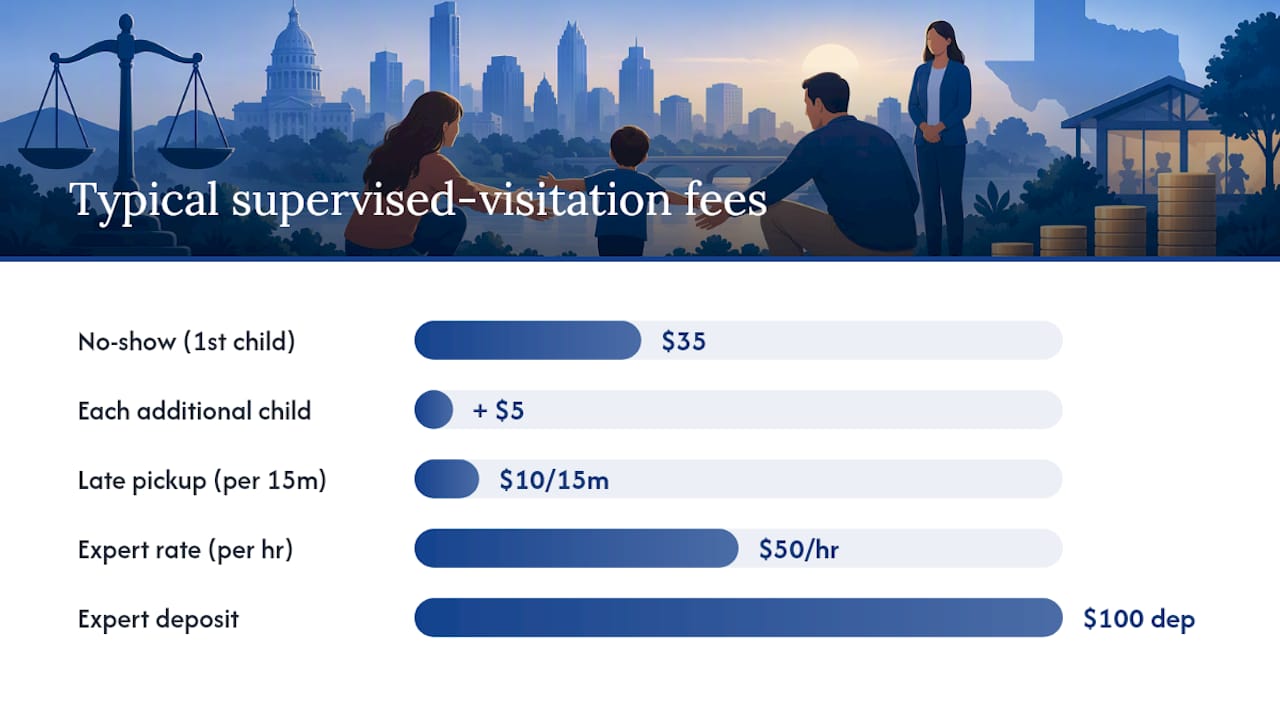
Payment responsibility usually falls on the visiting parent, though your order may split intake and session fees between both parents, or a program’s grant funding may cover part of the cost. Harris County’s published fee schedule offers a useful example of what real charges look like: a $35 no-show fee for the first child plus $5 for each additional child, a $10 charge per 15 minutes of late pickup, and expert-testimony rates around $50 an hour with a $100 deposit. Some supervised group-visitation sessions are grant-funded and don’t carry a per-visit charge at all.
Check your specific order for payment allocation language, since it controls even when a center’s general policy says otherwise. Keep every receipt and record of payment. If the other parent disputes who owes what, those records become the evidence your attorney uses in court.
Requesting, Modifying, or Enforcing a Supervised Visitation Order
Getting supervision added, changed, or enforced runs through the same court that issued your original order, not through any hotline or agency.
- File a motion to modify possession or access. Attach evidence supporting the change, whether that’s new safety concerns or proof the original concerns have resolved.
- Consider a protective order or DFPS involvement if the safety issue is active or ongoing, rather than historical.
- Pursue enforcement through contempt or modification in the district or county court that has jurisdiction over your case.
The Office of the Attorney General’s Access and Visitation program cannot enforce visitation orders directly. Its Texas Access Hotline (1-866-292-4636) provides information and referrals to local providers, but enforcement authority sits with the court. Gather incident logs, witness statements, existing protective orders, CPS reports, and correspondence with the other parent or the visitation provider before you file. That documentation is often what separates a strong enforcement motion from one a judge dismisses for lack of proof.
Your Visitation-Day Checklist
Show up prepared, because most centers won’t make exceptions for a missing document.
- Photo ID for the supervised parent
- A copy of the current court order
- A recent photo of the child, if the center requires one
- Copies of any protective or restraining orders on file
- Relevant case numbers for quick reference at intake
Follow the center’s arrival and departure windows, notification deadlines, and no-alcohol or no-drug policies. Staff have authority to end a visit early if rules are broken.
Pro Tip: Keep a simple visit log with the date, arrival and departure time, staff member’s name, and any incident notes. Six months of consistent documentation is worth more in court than one dramatic complaint.
What Makes a Supervised Visitation Order Actually Work
Vague orders create fights. A workable order names the supervisor or agency directly rather than saying “an appropriate third party.” It states plainly whether supervision must be continuous for the whole visit or applies only to exchanges. It sets the exact exchange location and method, a notification deadline for confirming visits, and who pays which fees.
The TexasLawHelp supervised possession order template shows how courts typically structure this language, tying safety findings to specific safeguards with measurable terms. If your case involves family violence, build in a review date so the court can lift restrictions once conditions are met. Bring your existing order, any incident documentation, and a clear list of what you want changed to your first consult.
Where Conventional Advice on Supervised Visitation Falls Short
Most guidance on supervised visitation treats it as a temporary inconvenience that ends once emotions cool down. That is not how Texas courts actually operate, and treating it that way costs parents time and credibility. The rebuttable presumption in Section 153 means the parent seeking to loosen supervision carries the burden of proof, not the other way around. Waiting passively for the arrangement to expire on its own rarely works, because most orders don’t expire. Someone has to file a motion.
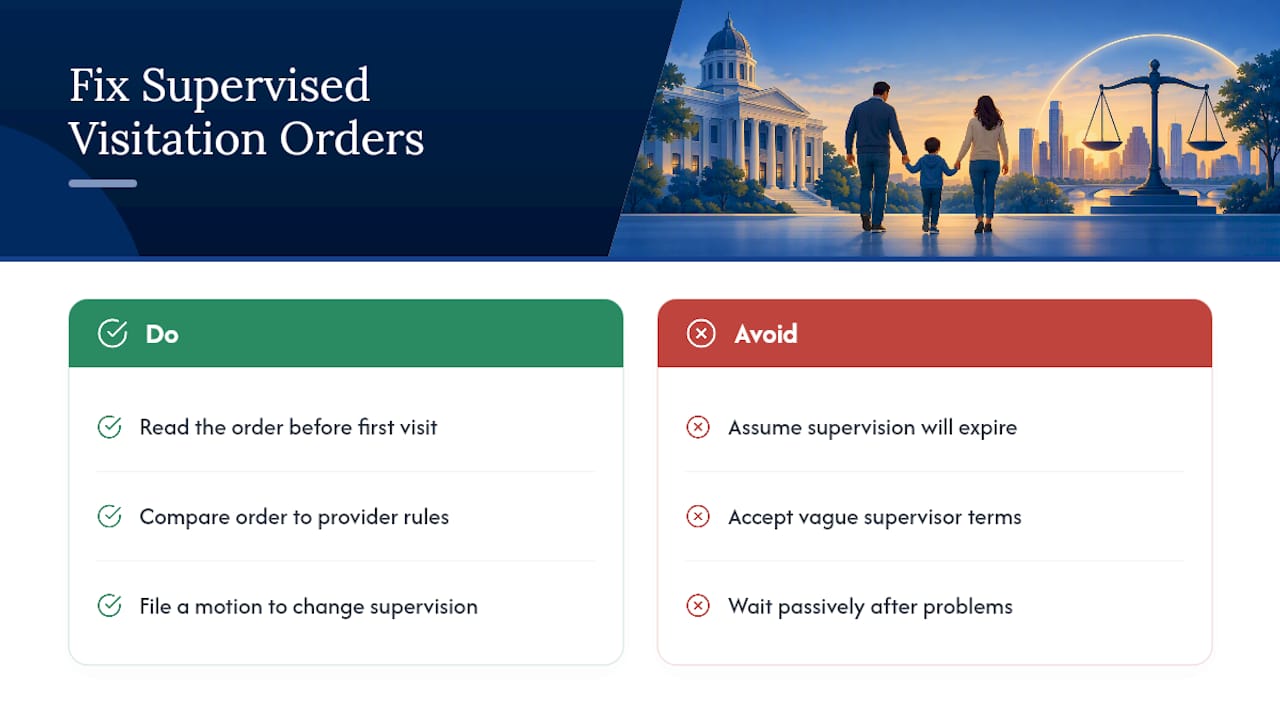
The gap I see most often is specificity. Parents accept order language like “supervised visitation at an approved facility” without pinning down who supervises, what counts as continuous supervision, or who pays the no-show fee. That vagueness is exactly what turns into a contested hearing eighteen months later. DFPS’s own framework ties supervision level to a documented safety assessment for a reason: it gives both sides a measurable standard to argue from, instead of a subjective one.
If you take one thing from this guide, take this: read your actual order language before your first visit, not after a dispute. Compare it against what your local center or provider actually requires. If the two don’t match, that mismatch is your first legal problem, and it’s cheaper to fix before a missed visit than after one.
— Giri
How Anna Din Helps You Get Enforceable Visitation Orders
Vague visitation language is what turns one missed exchange into a courtroom battle, and some family law attorneys draft orders built to survive that fight. Based in The Woodlands and serving families across the Houston area, the firm handles child custody and support matters, including custody modifications and enforcement actions, with the same attention to specific, workable language discussed above.

That means naming the actual supervising agency in your motion, defining continuous supervision in writing, and building in payment terms before a dispute forces the issue. Experienced family law attorneys can assemble evidence, draft filings, and provide representation at hearings, whether requesting supervision for safety reasons or seeking to modify restrictions once conditions improve. If family violence is part of your case, the firm also handles protective orders alongside custody matters, so your safety filings and your visitation order work together instead of conflicting. Contact the firm to schedule a consultation and bring your current order so Anna Din can review the exact language you’re working with.
This article is general information, not a substitute for advice from a qualified lawyer. Consult a qualified legal professional about your own circumstances before acting on anything here.
Sources
- Texas Family Code — Sec. 153 (Family violence and supervised visitation provisions)
- DFPS visitation best-practice guide (Sept 2025)
- Harris County Domestic Relations Office — The Visitation Center
- Texas Access — Access and Visitation program and hotline
FAQ
What Are the Rules for Supervised Visitation in Texas?
Texas courts order supervised visitation under Family Code Section 153 when credible evidence shows a history of family violence or abuse, and the order can require continuous supervision, protective exchanges, or substance restrictions. The specific rules always come from your individual court order, so review it alongside any visitation center’s intake policy before your first visit.
Who Pays for Supervised Visitation in Texas?
The visiting parent typically pays intake and session fees, though your order may split costs or a program’s grant funding may cover part of it. Harris County, for example, charges a $35 no-show fee for the first child and $10 per 15 minutes for late pickup, but your specific order controls how those costs are allocated.
What Is the Current Law on Child Visitation in Texas?
Texas Family Code Section 153 remains the controlling law, giving judges authority to order supervised visitation when family violence or abuse is credibly shown, and creating a presumption against unsupervised access in those cases. Any order issued under this statute stays in effect until a judge modifies it, regardless of how circumstances change afterward.
Which Parent Pays for Supervised Visitation?
In most cases, the parent whose visitation is being supervised covers the fees, since supervision is typically ordered in response to that parent’s conduct or a documented safety concern. Your written order is the final word on payment allocation, and courts can adjust that responsibility if either parent files a motion showing changed circumstances.
How Do I Get Help Modifying a Restrictive Visitation Order?
You file a motion to modify possession or access with the court that issued your original order, supported by evidence that the underlying safety concerns have resolved or changed. An attorney experienced in custody modifications can help gather that evidence and present it effectively at your hearing.
Recommended
Questions About Your Situation?
Every family is different. Schedule a confidential consultation with Anna Din to discuss your options.
Schedule a Consultation