Act Before the 6 Month Deadline: Court Ready Texas Custody Enforcement

If a Texas court order is being ignored, your legal path is straightforward: document every denial with exact dates and times, then file a motion for enforcement under Family Code chapter 157. Use the Texas Access & Visitation hotline or your county’s Domestic Relations Office for support, and if safety is at risk, skip the paperwork and call 911 or seek an emergency protective order instead.
TL;DR:
- Enforced violations require precise, unambiguous order language; vague terms like “by agreement” often cannot be enforced without first seeking a court modification.
- Building a court-ready case involves detailed documentation, including exhibits with specific dates, original communications, and witness affidavits, to prove violations beyond subjective feelings.
- Filing a motion for enforcement must follow strict procedures: identify the exact violated provisions, serve the other parent properly, and prepare to address potential defaults if they ignore the process.
- Courts can order contempt fines, make-up time, attorney’s fees, security bonds, or warrants, but cannot alter underlying order terms without a formal modification case.
- Immediate safety threats warrant calling 911 or seeking emergency protective orders; routine enforcement procedures are not suitable for urgent danger situations.
Table of Contents
- Is Your Custody Order Enforceable, or Do You Need a Modification First?
- Building a Court-Ready Evidence File
- When Mediation or Administrative Help Beats an Immediate Court Filing
- How to File a Motion for Enforcement Step by Step
- What Remedies Can a Texas Court Actually Order?
- When Safety Concerns Should Override the Standard Process
- Texas Contacts and Forms You Can Use Right Now
- What a Strong Enforcement Case Looks Like Before It Ever Reaches a Judge
- How Law Office of Anna Din Handles Custody Enforcement Cases
- Primary Sources for Texas Custody Enforcement
- Sources
- FAQ
Is Your Custody Order Enforceable, or Do You Need a Modification First?
Not every violated order can be enforced the way you think. Texas courts will only hold someone in contempt for violating language that is specific, clear, and unambiguous. If your order says exchanges happen “by agreement” or “as the parties decide,” a judge generally cannot enforce that because there’s nothing concrete to violate. You may need a modification of your child custody order before you can enforce anything at all.
Enforcement and modification solve two different problems, and mixing them up costs parents time they don’t have.
- Enforcement compels compliance with terms that already exist in your order.
- Modification asks the court to change those terms going forward, for example, adjusting exchange times or geographic restrictions.
A Standard Possession Order typically includes exact pickup times, drop-off locations, and holiday schedules, which makes it far easier to enforce than a loosely worded custom arrangement.
Timing matters just as much as wording. Texas law gives you a firm window to act:
- a limited window from the date the child turns 18, or from when the possession/access right otherwise ends, to file a contempt action for denied visitation.
- a limited window from when the child support obligation ends to file contempt for unpaid support.
Miss these statutory deadlines, and the court loses jurisdiction to hold the other parent in contempt, even if the violations were obvious and repeated.
Building a Court-Ready Evidence File
Judges don’t rule on feelings. They rule on what you can prove happened on specific dates, at specific times, at a specific location described in your order. Before you file anything, pull your original file-stamped order and highlight the exact paragraphs that were violated. Vague complaints like “he’s always late” carry no weight in a contempt hearing.
Build your case in this order:
- Create an exhibit table. List each date, the order paragraph violated, what actually happened, any witnesses present, and which exhibit backs it up.
- Preserve original communications. Export text threads with their metadata intact rather than screenshotting them, since edited or cropped screenshots invite challenges to authenticity.
- Keep a contemporaneous journal. Write entries the same day something happens, not weeks later from memory.
- Photograph the exchange location. A time-stamped photo showing you present, and the other parent absent, is hard to argue against.
- Collect witness affidavits early. Memories fade, and witnesses move, so get statements in writing while details are fresh.
TexasLawHelp’s guidance is blunt on one point: you generally have to show you actually showed up at the correct exchange location and time to prove the other parent denied access. Showing up and being turned away is a very different case than simply not showing up at all.
Pro Tip: Label every exhibit with the corresponding date and order paragraph number before your hearing. Judges and clerks move faster through organized binders, and a clean exhibit index can shorten your hearing time considerably. If your evidence involves digital communications, a guide to legally collecting digital evidence can help you avoid mistakes that get exhibits thrown out.
When Mediation or Administrative Help Beats an Immediate Court Filing
Filing a motion isn’t always the fastest fix. For a first-time or minor violation, less adversarial options often resolve things quicker and cheaper.
- Call the Texas Access & Visitation hotline at 1-866-292-4636, Monday through Friday, 1:00 to 5:00 p.m. Central, for help locating Access and Visitation programs in your area. The Texas OAG runs these programs but does not itself enforce visitation orders; that’s the court’s job.
- Contact your county’s Domestic Relations Office for orientation sessions, parenting conferences, or supervised visitation, which frequently resolve disputes without a judge ever getting involved.
- Send a written demand letter referencing the specific order language before assuming litigation is your only option, unless safety concerns make delay unwise.
One catch: county DROs generally cannot take your case once conservatorship or possession litigation is already pending in court. At that point, private counsel becomes the practical path forward.
How to File a Motion for Enforcement Step by Step
Once you’ve decided enforcement is the right route and your evidence is organized, the filing process follows a defined sequence under Texas law.
- Draft the motion to meet statutory requirements. Under Family Code section 157.002, your motion must identify the specific order provision violated, state exactly how the other parent failed to comply, and request the relief you want. For possession or access violations, you must list the date, place, and time of each alleged failure.
- File in the right court. This is the court of continuing, exclusive jurisdiction, usually the district or county court that issued your original order, filed through that court’s clerk.
- Request a hearing and an Order to Appear. The clerk’s office or the judge’s coordinator will set a hearing date and issue an order compelling the other parent’s appearance.
- Arrange proper service. The respondent must be formally served with the motion and the order to appear, following the timelines your local court sets.
- Prepare for what happens if they don’t show. A respondent who ignores service and skips the hearing risks a default judgment against them, and in some cases a capias, essentially a warrant for arrest, may issue.
- Present your case at the hearing. Bring your exhibit binder, be ready to testify under oath about each incident, and have witnesses available to corroborate your timeline.
- Ask for specific remedies. Vague requests get vague rulings. Name exactly what you want: make-up time, attorney’s fees, a finding of contempt.
Local rules vary by court, so calling the clerk’s office or the judge’s coordinator ahead of filing saves you from an avoidable procedural delay.
What Remedies Can a Texas Court Actually Order?
A successful motion for enforcement can produce real consequences for the violating parent, but courts also have limits worth understanding before you walk in.
- Contempt findings can carry fines, and in serious or repeated cases, jail confinement or probation.
- Make-up parenting time is close to automatic. Under Family Code section 157.168, a court shall order additional periods of possession or access to compensate for time you were denied, unless the other parent shows good cause why it shouldn’t.
- Attorney’s fees and court costs can be shifted onto the violating parent.
- Bonds or security may be ordered to guarantee future compliance.
- Capias can issue against a parent who fails to appear once properly served.
What a court will not do on an enforcement motion is rewrite your order’s underlying terms. If the schedule itself isn’t working, that’s a modification case, not an enforcement case, and filing the wrong one wastes a hearing date you can’t get back easily.
When Safety Concerns Should Override the Standard Process
If you believe your child is in immediate danger, the enforcement process outlined above is not your first move. Call 911. Then pursue an emergency, ex parte protective order rather than a standard motion for enforcement, since routine enforcement timelines aren’t built for urgent safety threats.
- Use a supervised visitation center when exchanges have become hostile, since these settings are domestic-violence-informed and designed to prevent confrontation.
- Never use a scheduled exchange as an opportunity to force a confrontation. That escalates risk and can backfire on your own case.
- If you’re facing a credible abduction threat or an existing pattern of violence, retain family law counsel quickly. An attorney can coordinate directly with law enforcement and move the court for emergency relief faster than you can alone.
Pro Tip: Keep your protective order paperwork and your custody order in the same folder, physical or digital. Officers responding to a safety call need to see both quickly, and confusion at the door costs precious minutes.
Texas Contacts and Forms You Can Use Right Now
You don’t need to start from scratch. Several official resources exist specifically to help Texas parents move quickly.
- Texas Access & Visitation hotline: 1-866-292-4636, Monday through Friday, 1:00 to 5:00 p.m. Central. More detail is available at txaccess.org.
- TexasLawHelp’s Visitation Enforcement Kit includes guided forms for a Motion to Enforce and for Contempt, a proposed order, a demand-letter template, and a printable visitation journal.
- Harris County Domestic Relations Office offers parenting-time conferences and supervised visitation services; check hours and intake procedures directly with your own county, since DRO structure and availability vary across Texas.
Verify your specific county’s filing rules with the district clerk before you submit anything. Procedures shift enough county to county that assuming your neighbor’s process matches yours is a common, avoidable mistake.
What a Strong Enforcement Case Looks Like Before It Ever Reaches a Judge
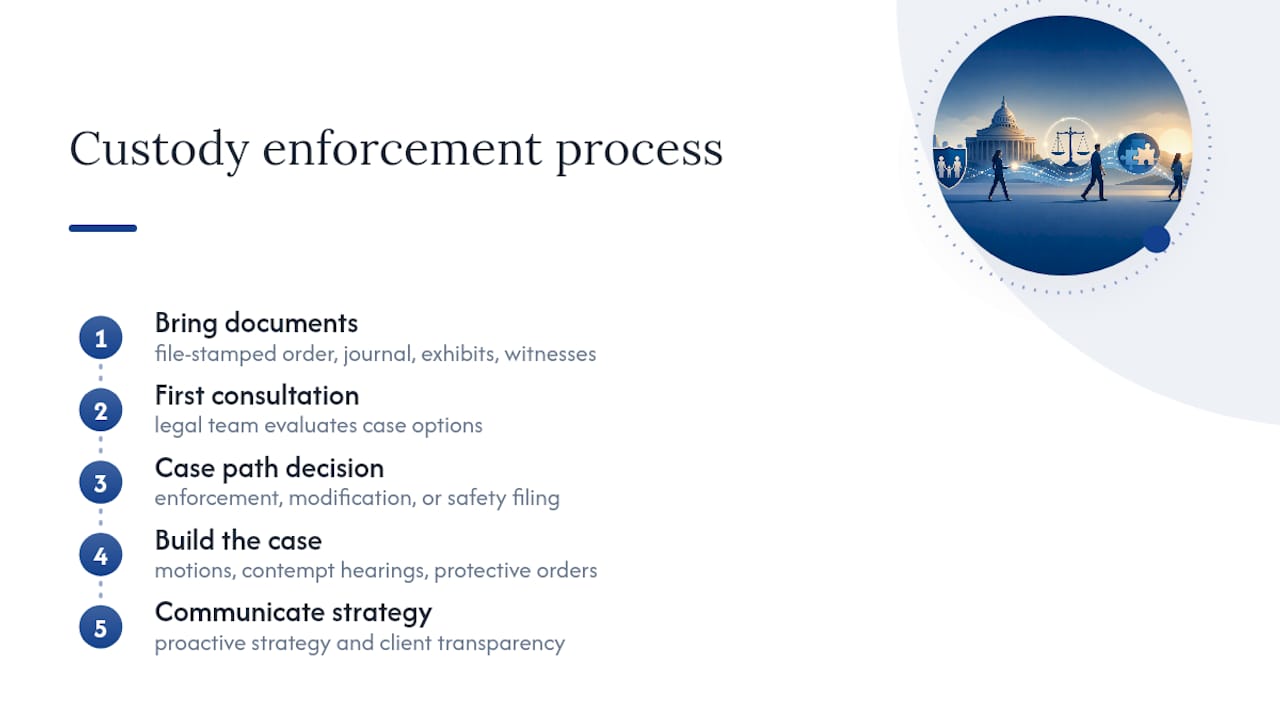
The parents who win enforcement motions almost always show up to their first consultation with the same three things: the file-stamped order, an exhibit table matching each violation to a specific paragraph, and a witness list. That preparation lets an attorney assess the real gaps immediately, whether documentation is thin, whether jurisdiction is even correct, or whether the case actually calls for a modification rather than enforcement.

From there, retained counsel typically drafts and files the motion, arranges service on the other parent, and represents the filing parent at the hearing itself. Safety planning gets folded in at this stage too, since an attorney can flag when a case needs an emergency filing instead of the standard enforcement timeline.
How Law Office of Anna Din Handles Custody Enforcement Cases
Enforcement cases move faster and land stronger when someone who’s built exhibit binders for a courtroom is guiding the process. Consider seeking legal assistance when documentation alone hasn’t prompted a violating co-parent to comply, and personalized attention and clear communication are needed in escalating cases.

The firm handles enforcement motions, contempt hearings, and, when a case involves danger rather than just noncompliance, protective orders and emergency filings too. Bring your file-stamped order, your visitation journal, key messages or exhibits, and a list of witnesses to your first consultation. From there, A legal team evaluates whether enforcement, modification, or a safety-focused filing fits the situation, then builds the case accordingly with proactive strategy and transparency to keep clients informed throughout.
If a Texas court order has stopped working for your family, visit the child custody and support practice page or reach out through the contact form to schedule a consultation.
Primary Sources for Texas Custody Enforcement
For direct statutory language and official forms, consult Family Code Chapter 157 for enforcement procedures, TexasLawHelp’s enforcement kit for guided forms, the Texas OAG Access & Visitation program for hotline support, and your county DRO for local parenting-time services. Keep certified copies of anything you file, and confirm county-specific rules with your district clerk before submitting.
This article is general information, not a substitute for advice from a qualified lawyer. Consult a qualified legal professional about your own circumstances before acting on anything here.
Sources
- Texas Statutes, Family Code Chapter 157 (Enforcement)
- How to Enforce a Visitation Order | TexasLawHelp
- Access and Visitation | Office of the Attorney General
- Parenting-Time Services | Harris County Domestic Relations Office
FAQ
Can police enforce a custody order in Texas?
Police generally do not enforce custody orders directly; that authority belongs to the courts through a motion for enforcement. Officers may get involved in cases involving an active danger or a clear criminal violation, but routine denied visitation is a matter for the court, not a 911 call.
What is the new child custody law in Texas?
Texas custody law is governed primarily by Family Code chapter 157, and specific provisions get amended periodically rather than replaced wholesale. Rather than one sweeping “new law,” parents should check current statutory text directly through the Texas Statutes site or confirm recent changes with an attorney before relying on outdated information.
What can cause a mother to lose custody of her child in Texas?
Texas courts don’t favor either parent by gender; custody decisions turn on the child’s best interest, evaluated through factors like safety, stability, and each parent’s willingness to support the other parent’s relationship with the child. A documented pattern of denying court-ordered visitation, family violence, or substance abuse can all weigh against any parent, mother or father, in a modification or enforcement proceeding.
Is Texas a 50/50 state for child custody?
Texas is not a strict equal-split state; courts default to a Standard Possession Order, which typically gives one parent primary residence with the other receiving structured visitation. What matters legally is the specific language in your order, since that’s what determines whether a violation is enforceable under Family Code chapter 157.
How long do I have to file for enforcement in Texas?
You generally have six months from when the child turns 18 or the possession/access right ends to file contempt for denied visitation, and two years after a child support obligation ends to file contempt for unpaid support. Missing these statutory deadlines can bar the court from holding the other parent in contempt entirely.
Recommended
Questions About Your Situation?
Every family is different. Schedule a confidential consultation with Anna Din to discuss your options.
Schedule a Consultation