Recording Your Spouse in Texas: What the Law Allows
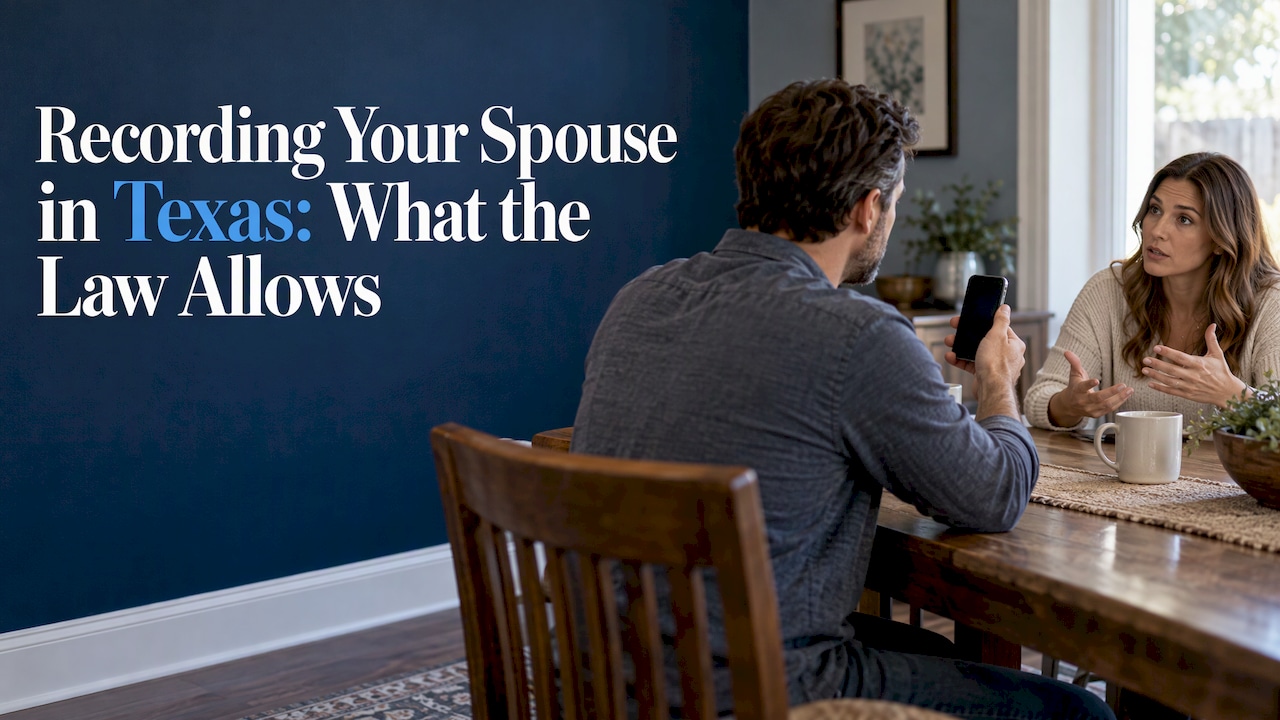
You can legally record a conversation in Texas when you are part of it, because Texas follows a one-party-consent rule. You cannot legally record conversations between your spouse and someone else, and you cannot use hidden cameras or recorders in private spaces. Even a lawful recording can hurt you in a divorce or custody case if it is used the wrong way. Before you press record, talk through the situation with a family law attorney, because the details of who is speaking, where, and why decide the outcome.
TL;DR
- Texas and federal law allow you to record a phone call or in-person conversation if you are a participant, or if one participant has consented, as long as it is not for a criminal or harmful purpose.
- Recording a conversation you are not part of is a crime. Under the Texas Penal Code, illegal interception is graded as a second-degree felony.
- Hidden video in a bedroom, bathroom or similar private place can be a state jail felony, and a 2025 law widened the places it covers.
- A court may admit a recording, but it can also exclude it, and a recording can reveal as much about you as about your spouse.
- Before you record anything, have an attorney review your goals and your case.
Table of Contents
- What Texas law says about recording a conversation
- Recording that is usually lawful, and recording that is not
- Video, hidden cameras and the 2025 change
- Phones, texts and cross-state calls
- Recording your child’s conversations with the other parent
- Will a recording be admitted in your divorce or custody case?
- The practical costs of playing detective
- What to do instead: a step-by-step routine
- Why it helps to have a family law attorney before you record
- How we can help
- FAQ
- Sources
What Texas law says about recording a conversation
The Texas State Law Library explains that Texas and federal wiretapping laws make it a crime to record a conversation unless at least one party to it consents, when the speakers have a reasonable expectation of privacy. That is why Texas is called a one-party-consent state.
In plain terms:
- If you are in the conversation, you are a party, and your own consent counts.
- If you are not in the conversation and nobody in it knows about the recording, you are intercepting it, and that is what the law prohibits.
The statute itself is Texas Penal Code § 16.02. Subsection (b) prohibits intentionally intercepting a wire, oral or electronic communication. Subsection ©(4) gives an affirmative defense when the person recording is a party to the communication or one party gave prior consent, unless the interception is made to commit an unlawful act. Subsection (f) grades the offense as a second-degree felony in most cases. An affirmative defense means you may have to raise and prove it, so you do not want to rely on it as a safety net.
Federal law works the same way. The federal Wiretap Act, 18 U.S.C. § 2511(2)(d), allows interception by a party or with one party’s prior consent, but it bars even a participant from recording to commit a criminal or tortious act, as an American Academy of Matrimonial Lawyers journal article explains.
Recording that is usually lawful, and recording that is not
The line is easier to see side by side.
| Situation | Generally lawful? | Why |
|---|---|---|
| You record your own phone call with your spouse | Generally yes | You are a party to the conversation |
| You record your own face-to-face conversation with your spouse | Generally yes | You are a party, and you consent |
| You leave a recorder running to capture your spouse talking to a friend or relative | No | You are not a party and no one in the conversation consented |
| You secretly record a call between your spouse and a third person that you are not on | No | This is interception under § 16.02 |
| You record to blackmail, harass or commit another crime or wrong | No | Party consent does not protect a recording made for an unlawful purpose |
| You record in a bedroom or bathroom with a hidden camera | Likely not | Texas Penal Code § 21.15 can apply |
This table is general information, not advice on your facts. Whether a person had a reasonable expectation of privacy, or whether your purpose was unlawful, can turn on details that only a lawyer reviewing your situation can assess.
Video, hidden cameras and the 2025 change
Audio and video are treated differently. The same AAML article notes that the federal Wiretap Act does not prohibit silent video recording without audio. That does not make hidden video safe in Texas, for two reasons.
First, if the camera also captures sound from a conversation you are not part of, the audio can trigger the interception rules above.
Second, Texas Penal Code § 21.15 makes it a state jail felony to photograph or record, without consent and with intent to invade privacy, an intimate area, or a person in a place where they reasonably expect privacy. A posted recording sign is not enough consent under § 21.15(e).
The law also changed recently. H.B. 1465, effective September 1, 2025, widened § 21.15(b)(2) from a “bathroom or changing room” to any place where a reasonable person would believe they could disrobe in privacy, which includes a bedroom. It also added § 21.15 convictions to the offenses that trigger sex-offender registration for offenses committed on or after that date.
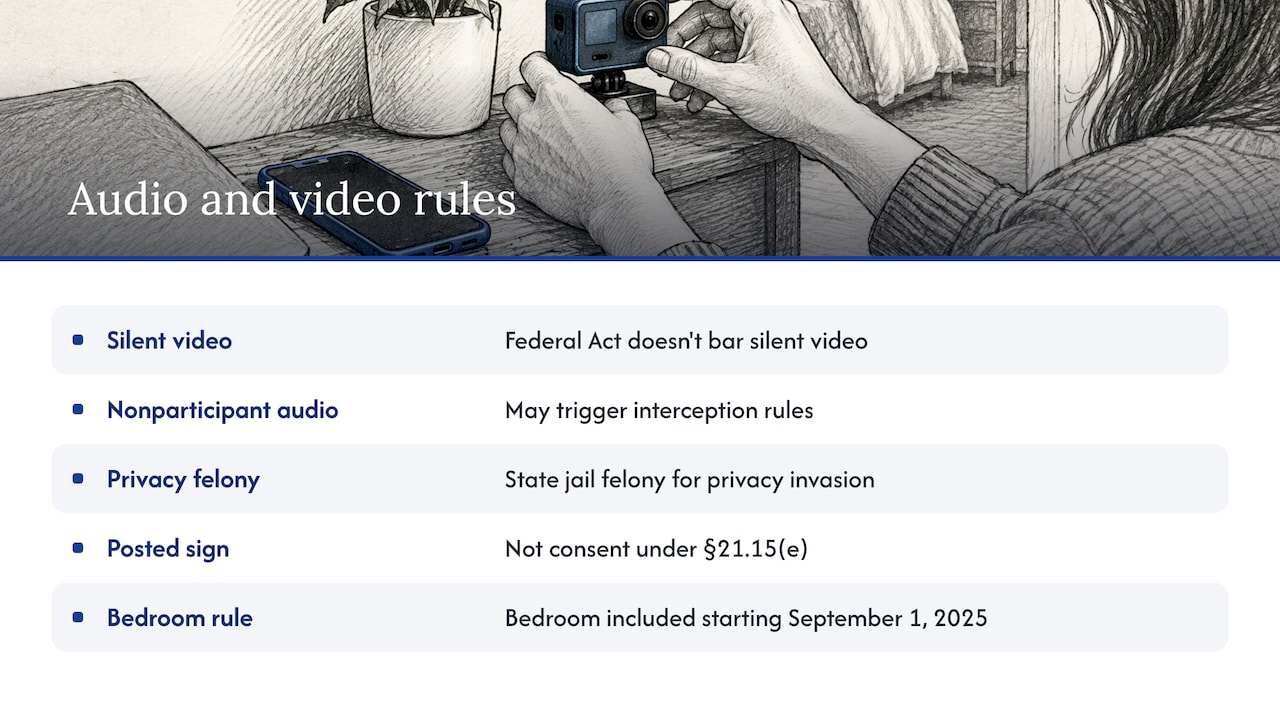
For a married couple sharing a home, this means a hidden camera in the bedroom or bathroom is not a harmless way to gather proof. Do not install one, even if you own the home.
Phones, texts and cross-state calls
Two other situations come up often.
Texts, emails and social media. Reading or copying messages is a different issue from recording a call, and the rules about how you got access matter. We cover how courts treat messages, screenshots and other digital proof in our guide to electronic evidence in a Texas divorce. If you are tempted to log into your spouse’s phone or accounts, speak with an attorney first.
Calls across state lines. If you are in Texas and your spouse is in another state, more than one state’s law may apply. Michaela Cronin, writing in the ABA Family Law Advocate, points out that the location of the recorder, the spouse and the device can each bring a different state’s rules into play. Some states require every party to consent. A recording that would be fine under Texas law could be a problem somewhere else. The same consent questions come up in other call settings, such as managing calls from jail, where who is on the line and who knows about a recording matters.
Recording your child’s conversations with the other parent
Parents ask this often in custody disputes. The general rule still applies: if you are not a party to the call and nobody in it consented, recording is risky.
There is a narrow exception some courts recognize. According to the AAML article, a guardian may consent on a child’s behalf only when the guardian has a good-faith, objectively reasonable belief that consent is necessary to protect the child, for example from verbal, emotional or sexual abuse by the other parent. Cronin notes that this vicarious consent is recognized only in some states.
That is not a license to monitor ordinary calls between your child and your ex. If you believe your child is being harmed, document what you see and hear, and bring the concern to an attorney quickly. Our article on custody evidence in Texas explains what to gather and how to present it, and our overview of what Texas courts consider in custody cases shows how judges weigh a child’s best interests.
Will a recording be admitted in your divorce or custody case?
There is no one answer, and that is the problem with treating a recording as a trump card.
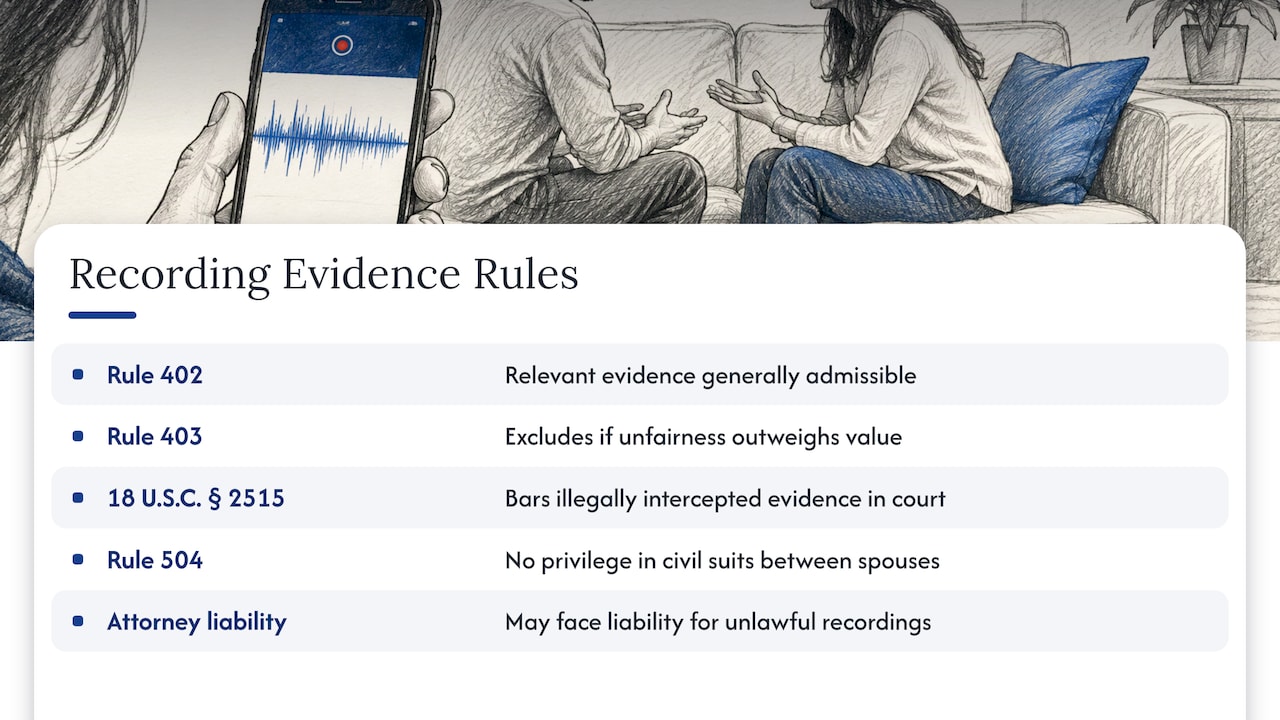
Relevance comes first. Under Texas Rule of Evidence 402, relevant evidence is generally admissible unless the Constitution, a statute or the rules say otherwise, and irrelevant evidence is not. Under Rule 403, a judge may exclude relevant evidence if its value is substantially outweighed by unfair prejudice, confusion of the issues or misleading the jury. A long, rambling recording of an argument can fall on the wrong side of that test.
Illegal recordings carry their own risk. Federal law, 18 U.S.C. § 2515, bars the use in federal or state court of illegally intercepted wire or oral communications and evidence derived from them. A Georgetown-hosted legal brief quotes that rule and notes it does not extend to electronic communications such as emails and texts. Nicholas Himonidis, in the ABA Family Law Advocate, reports that some custody courts have received relevant recordings anyway, because they must determine the child’s best interests. That discussion involves a Nevada case, so do not assume a Texas judge would rule the same way. A recording that might come in does not protect you from criminal exposure for making it.
The marital privilege will not shield your spouse. Under Rule 504, a person may generally refuse to disclose a confidential communication made to a spouse during the marriage, but the privilege does not apply in a civil proceeding brought by one spouse against the other. A divorce is such a proceeding.
Lawyers have to be careful too. The AAML article explains that attorneys can face liability for using or disclosing a recording they know, or have reason to know, was unlawfully intercepted. A responsible family law attorney will therefore ask how, when and why a recording was made before using it. If you bring a lawyer a recording, expect questions about who was on the call, where everyone was, and what you intended.
The practical costs of playing detective
Even a legal recording has costs.
- It can change the tone of your case. A judge may see a spouse who recorded everything as escalating the conflict, especially in a custody case where cooperation matters.
- It records you, too. Your own words, tone and reactions are on the file. If you lose your temper or say something you regret, your spouse’s attorney can use it.
- It can be incomplete. A clip without context can mislead, and a judge who suspects editing or selective recording may discount it.
- It may not prove what you hope. Judges decide on the full record. One conversation rarely settles property, custody or support.
- Delivery and storage matter. Keep original files unaltered and backed up, and do not share them online or with family members.
If you are worried about safety, recording is not a substitute for protection. A protective order in Texas is the legal tool built for that, and if an order is already in place, our page on protective order violations covers what to do after a breach. If you are in immediate danger, call 911.
What to do instead: a step-by-step routine
If you feel you need proof, a safer routine looks like this.
- Write down what happens as it happens. Dates, times, what was said, who was present. A consistent log made at the time carries weight.
- Keep what you already lawfully have. Messages sent to you, voicemails left for you, emails you received, bank statements and shared account records are things you can preserve without intercepting anything.
- Do not access private accounts or devices. Logging into your spouse’s email, phone or cloud account can create its own legal problems.
- Do not record anyone you are not talking with. That includes your spouse’s calls with friends, family or a new partner.
- Before recording your own conversation, ask why. If the answer is to protect yourself from a specific, real risk, say so to your attorney. If the answer is to catch your spouse saying something, there may be better ways.
- Bring everything to an attorney before you act. The right question is not only whether you can record but whether you should, and what else can show the same thing.
The information that wins a case is often the information organized well: finances, parenting routines, school and medical records, and a clear timeline. Formal discovery in a divorce lets your attorney request documents and information from the other side through the court, which is a safer route than self-help surveillance.
Why it helps to have a family law attorney before you record
Secret recording rules sit at the crossroads of criminal law, federal law, evidence rules and family law. A mistake can expose you to criminal liability and weaken a case you might otherwise have won. Having an attorney involved early lets you decide, with a clear view of the risks, whether any recording is worth making and how it would be used.
That applies whether you are a mom or a dad facing divorce, a parent trying to set up or change custody, or someone who needs protection from a spouse.
Our perspective
When a client in a divorce or custody dispute asks about recording a spouse, we treat the question as a strategy question as well as a legal one. Most clients ask because they feel unheard or unsafe, and we take that seriously.
Our approach is built on clear communication and careful preparation. We would rather walk you through what the law allows, what a judge is likely to care about and what is worth documenting, so you can make informed decisions without taking on avoidable risk. Your evidence should help your case, not become a problem in it.
We practice family law in The Woodlands, Houston and surrounding Texas communities, and we know that each family’s situation is different. Contested or uncontested divorce, custody, support, enforcement or protective orders: you should always know where your case stands and what to do next.
Giri
How we can help
The Law Office of Anna Din handles divorce, child custody and support, modifications and enforcement, and protective orders for individuals and families in The Woodlands, Houston and surrounding communities. If you are weighing whether to record your spouse, or you already have a recording and are not sure what to do with it, we can review your situation and explain your options. You can start with our divorce practice area page, or see how we handle child custody and support.

If safety is your concern, our protective order services include family violence protective orders and emergency (ex parte) orders.
FAQ
Is it illegal to record my spouse in Texas?
Not if you are part of the conversation. Texas is a one-party-consent state, so you can generally record a call or talk you are in. Recording a conversation between your spouse and someone else, or recording for an unlawful purpose, can be a crime.
Is it illegal to look through my spouse’s phone in Texas?
It depends on how you get in and what you take. Using a password you were never given or logging into private accounts can create legal trouble separate from the recording laws. Speak with an attorney before you look, and see our guide to electronic evidence in a Texas divorce for more.
Can I put a hidden camera in my house to catch my spouse?
It is risky. Texas Penal Code § 21.15 covers recording people in places where they reasonably expect privacy, and since September 1, 2025 that includes places such as bedrooms. If the camera picks up audio of conversations you are not part of, interception rules can apply too.
Can a recording be used in my Texas divorce or custody case?
Possibly. Relevant evidence is generally admissible, but a judge can exclude it under Rule 403, and an unlawfully made recording can create separate legal problems for you. Your attorney can tell you how a particular recording is likely to be treated.
Sources
- Texas State Law Library: Audio Recording laws guide
- Texas Penal Code § 16.02
- Texas Penal Code § 21.15
- H.B. 1465, 89th Legislature, enrolled text
- Hidden Landmines for the Family Law Practitioner, AAML
- ABA Family Law Advocate: The Price You’ll Pay to Press Play
- ABA Family Law Advocate: The Admissibility of Illegally Obtained Evidence in Family Law Cases
- Texas Rules of Evidence, effective July 2, 2026
- Texas Rules of Evidence, effective September 1, 2025
- Georgetown law brief quoting 18 U.S.C. § 2515
Recommended
Questions About Your Situation?
Every family is different. Schedule a confidential consultation with Anna Din to discuss your options.
Schedule a Consultation