What Community Property Means for Texas Couples
Texas is a community property state, which means the law presumes that everything you or your spouse acquire during marriage belongs equally to both of you, regardless of whose name is on the title. That presumption governs divorce and estate planning alike, and it holds unless you prove otherwise. Separate property, such as what you owned before marriage, gifts, inheritances, and certain injury recoveries, is the exception, not the rule. Under Tex. Fam. Code §§ 3.002 to 3.003, you must rebut the community presumption with “clear and convincing evidence,” which is a higher bar than the standard used in most civil disputes.
Pro Tip: If you think an asset is separate property, start gathering documentation now. Waiting until a divorce or probate filing forces the issue often means records have already disappeared.
Key Takeaways
Texas presumes property acquired during marriage is community property, and only clear and convincing evidence can establish that an asset is separate.
| Point | Details |
|---|---|
| Community is the default | Property acquired during marriage is presumed community unless proven separate. |
| Separate property needs proof | Pre-marriage assets, gifts, and inheritances require clear and convincing evidence to stay separate. |
| Division follows fairness, not 50/50 | Courts apply a “just and right” standard weighing earning capacity, health, and child care roles. |
| Commingling is the biggest risk | Mixing separate funds into joint accounts can convert them to community property. |
| Planning ahead prevents disputes | Lawofficeofannadin helps clients document assets and structure agreements before conflicts arise. |
This article is general information, not a substitute for advice from a qualified lawyer. Consult a qualified legal professional about your own circumstances before acting on anything here.
Table of Contents
- What Is Community Property in Texas Under State Law?
- Separate Property: What Stays Yours and How to Prove It
- How Texas Courts Divide Property in a Divorce
- Tracing, Commingling, and Reimbursement Claims Explained
- What Happens to Community Property When a Spouse Dies
- Protecting Your Assets: Prenups, Postnups, and Documentation
- Remarriage and Property From a Prior Marriage
- Tax Considerations Tied to Community Property
- Community Property Rules for Same-Sex Couples in Texas
- Sources
- FAQ
What Is Community Property in Texas Under State Law?
Community property in Texas covers nearly everything you or your spouse earn, buy, or build while married. Tex. Fam. Code § 3.002 defines it as all property acquired during the marriage other than separate property, and the presumption runs in favor of community classification for anything either spouse possesses once the marriage begins.
You will recognize community property in situations like these:
- Wages and bonuses either spouse earns during the marriage, no matter who deposits the check.
- A home purchased during marriage, even if only one spouse’s name appears on the deed.
- Retirement contributions and growth that accrue while you are married, including 401(k) balances and pensions earned during that period.
- Income, dividends, and rental proceeds generated by separate property once the marriage begins.
Here is where people get tripped up: title on paperwork does not decide who owns what. A car titled solely in one spouse’s name, a bank account opened before the wedding but funded with marital income, a house deed with only one signature. None of that overrides the source-of-funds analysis courts actually use. What matters is when the asset was acquired and where the money came from, not whose signature sits on the form.
Separate Property: What Stays Yours and How to Prove It
Separate property falls into a few well-defined categories, but proving it in court is where cases get complicated. Texas law recognizes three main types of separate property:
- Property owned before marriage. Anything you brought into the marriage, whether it’s a car, a savings account, or a house you already owned, stays yours as long as you can show when you acquired it.
- Gifts and inheritances. A gift given to you individually, or property you inherit, remains separate even if it arrives during the marriage. A wedding gift addressed to both spouses, however, is typically treated as community property.
- Certain personal injury recoveries. Compensation for your own pain and suffering is separate property, though damages for lost wages during the marriage are usually treated as community property.
The confusion usually starts when separate property gets mixed into shared life. A house inherited from a parent that later becomes the family home, with mortgage payments made from joint income, raises real classification questions. So does an inheritance deposited into a joint checking account and used to pay household bills for years. Courts require clear and convincing evidence to preserve separate character, which typically means deeds, account statements, gift letters, and a paper trail connecting the original asset to whatever it became.
How Texas Courts Divide Property in a Divorce
Texas courts do not split marital estates 50/50 as a rule. The governing standard is “just and right” division, a phrase that shows up throughout Texas divorce law and gives judges real discretion to weigh fairness over strict math. A 50/50 split is a common misconception, not a legal mandate, and outcomes shift based on the specifics of each marriage.
Judges typically weigh several factors before finalizing a division:
- Each spouse’s earning capacity and employability going forward.
- Health conditions that limit one spouse’s ability to work or maintain a household.
- Who will have primary responsibility for children after the divorce.
- The size of each spouse’s separate estate, and whether one spouse benefits from significant separate assets.
- Contributions to the marriage, including one spouse staying home to raise children while the other built a career.
Debt gets divided using the same “just and right” framework, but there’s a catch many people miss: a divorce decree only binds the two spouses, not third-party creditors. If a credit card is jointly held, the lender can still pursue either spouse for the full balance no matter what the decree says about who is “responsible” for it.
Pro Tip: A negotiated settlement almost always gives you more control over outcomes than litigation. Judges have to apply general fairness principles to facts they’re seeing for the first time; you and your spouse understand your finances and needs far better than a courtroom does.
Tracing, Commingling, and Reimbursement Claims Explained
Separate property does not stay separate automatically, it stays separate only if you can prove it stayed separate. This is where tracing comes in, and it’s one of the most technically demanding areas of Texas family law.
Courts may treat commingled funds as fully community property once separate funds can no longer be distinguished from marital funds. The tracing doctrine requires a party asserting separate ownership to trace the funds back to their separate source with specificity, not just claim they exist.
Picture an inheritance deposited into a joint checking account also used for the mortgage, groceries, and everyday spending. Within a year or two, untangling which dollars were the inheritance and which were paychecks becomes nearly impossible, and the whole account risks community characterization.
Reimbursement claims add another layer. If community time, effort, or funds enhanced the value of a spouse’s separate business, Texas law increasingly recognizes claims for the community’s contribution, sometimes called “time, toil, and talent” reimbursement. This matters enormously for business owners: a company you started before marriage can still generate a reimbursement obligation to the community estate if your spouse’s unpaid labor, or your own uncompensated effort, helped it grow. Anyone running a separate business through a marriage should track this carefully.

Pro Tip: Keep separate funds in a segregated account, save gift letters and inheritance documentation, and never deposit inherited money into a shared account you use for daily expenses.
What Happens to Community Property When a Spouse Dies
Dying without a will in Texas doesn’t leave your community property in limbo, but the outcome may not match what you’d have chosen yourself. Tex. Est. Code § 201.003 sets specific rules for intestate succession:
- If all of the decedent’s surviving children are also children of the surviving spouse, the surviving spouse inherits the entire community estate.
- If the decedent has children from a prior relationship, the decedent’s half of the community estate passes to those children instead of the surviving spouse.
Separate property follows different intestacy rules and can be split between a surviving spouse and children even in a first marriage, depending on whether the property is real estate or personal property.
The fix here is simpler than people expect. A basic will, a transfer-on-death deed for real property, and a prenuptial or postnuptial agreement coordinated with your broader estate plan can prevent your assets from being distributed according to a statutory formula that may not reflect your actual wishes, especially in blended families.
Protecting Your Assets: Prenups, Postnups, and Documentation
You don’t need to wait for a wedding invitation to think about asset protection, and you don’t need to be planning a divorce either. Prenuptial and postnuptial agreements let couples define what stays separate before disputes ever arise, and Texas courts generally enforce them when both parties had independent legal advice and full financial disclosure.
Take these steps to protect what’s yours:
- Sign a prenup or postnup that lists separate assets explicitly and states how future appreciation, income, or business growth will be classified.
- Keep a documentation file with deeds, account statements, gift letters, and inheritance records that establish the date and source of every separate asset.
- Coordinate with an estate planner to align your will, trusts, and transfer-on-death deeds with whatever your marital agreement already establishes.
Getting ahead of this instead of scrambling during a divorce or after a death saves both money and heartache. The table below summarizes the essentials.
| Point | Details |
|---|---|
| Presumption favors community | Property acquired during marriage is presumed community unless proven otherwise. |
| Evidence standard is high | Separate property claims require clear and convincing evidence, not just a preponderance. |
| Division is “just and right” | Courts weigh fairness factors, not an automatic 50/50 split. |
| Documentation prevents disputes | Gift letters, segregated accounts, and deeds preserve separate property claims. |
| Legal guidance matters early | Lawofficeofannadin helps clients document and protect property before disputes arise. |
Remarriage and Property From a Prior Marriage
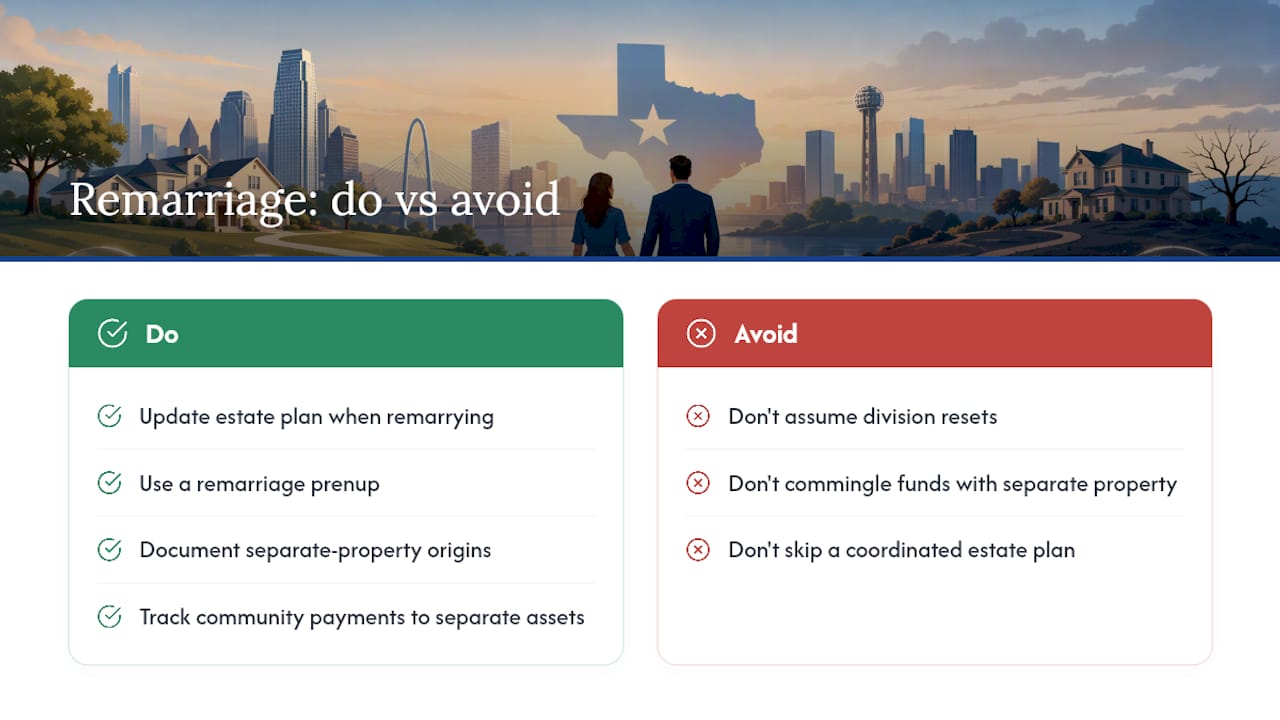
Second and third marriages introduce a wrinkle that first-time spouses rarely face: property division doesn’t reset with each new marriage, it stacks. Assets you owned before a second marriage, including anything you received as separate property in a divorce settlement from your first marriage, remain your separate property going into the new one. But once you remarry, any income or appreciation on that separate property that flows into joint use starts building fresh community property questions all over again.
This is especially relevant for retirement accounts and real estate carried from marriage to marriage. A house you kept as separate property after divorce number one, then used as the family residence during marriage number two, can trigger the same commingling risks discussed earlier. Community funds used for mortgage payments, renovations, or property taxes during the second marriage can create a reimbursement claim owed to the community estate, even though the house itself stays separate.
Blended families face additional complexity around inheritance. Without a will or a coordinated estate plan, Tex. Est. Code § 201.003 can direct your share of community property to your current spouse rather than children from a prior marriage, an outcome many people don’t intend but discover too late. A second marriage prenup addresses exactly this scenario, spelling out how property from a first marriage stays protected and how children from that marriage are provided for regardless of what happens in the new one.
Anyone remarrying in Texas benefits from revisiting their estate plan and property documentation at the same time they update their marital status, not years later when a dispute forces the issue.
Tax Considerations Tied to Community Property
Community property status affects more than divorce court, it shapes how the IRS treats your income and assets while you’re married and after a spouse dies. Married couples in Texas typically file federal returns as “married filing jointly” or “married filing separately,” and because community income belongs equally to both spouses, filing separately in a community property state means each spouse generally must report half of the combined community income, not just what they personally earned. This surprises a lot of people who assume separate filing keeps their earnings walled off from a spouse’s tax return.
The bigger financial advantage shows up after death. Community property offers a meaningful estate planning benefit: when one spouse dies, both halves of the community estate, not just the deceased spouse’s half, typically receive a step-up in basis to fair market value as of the date of death. In common law states, only the deceased spouse’s separate share gets that adjustment. For couples holding appreciated real estate, stock, or a family business, this full step-up can substantially reduce the capital gains tax due if the surviving spouse later sells the asset.
None of this is a substitute for advice from a tax professional, since individual circumstances vary and federal tax rules change. But it’s worth understanding as part of why classification questions, community versus separate, aren’t just about who gets what in a divorce. They follow you through tax season and estate settlement too, which is one more reason accurate documentation matters from the start of a marriage, not just at the end of one.
Community Property Rules for Same-Sex Couples in Texas
Since the Supreme Court’s Obergefell v. Hodges decision legalized same-sex marriage nationwide, Texas community property law applies to same-sex married couples exactly the same way it applies to opposite-sex couples. There is no separate statute or carve-out; Tex. Fam. Code §§ 3.002 to 3.003 governs every legally married couple in the state without regard to gender.
Where things get complicated is for couples who were in committed relationships before same-sex marriage became legal in Texas. Some couples cohabited for years, or held a commitment ceremony, before they were able to legally marry. Property acquired during that pre-marriage period is generally treated as separate property for community property purposes, because the community estate legally begins at the date of marriage, not the date a relationship started. This can create real disputes when a couple has been together for a decade but legally married for only a few years, since assets built together during the unmarried years don’t automatically get community treatment.
Texas does not recognize registered domestic partnerships as a status distinct from marriage, so couples who want relationship recognition and community property protections need an actual marriage license. Couples navigating this gap, particularly those with long pre-marriage histories together, benefit from a tailored legal strategy that accounts for both the community estate and any separate property claims tied to the years before the wedding.
A practitioner’s view on what actually protects clients
Most people treat community property as a divorce-only problem, and that’s the biggest blind spot I see in how families plan. The clients who come out ahead, whether in a divorce or after a spouse’s death, are the ones who documented their separate property years before any dispute existed. Lawofficeofannadin’s family law work regularly involves tracing inherited funds, drafting prenuptial and postnuptial agreements for business owners, and coordinating estate plans so a will and a marital agreement actually say the same thing instead of contradicting each other. The reimbursement rules around “time, toil, and talent” are also more commonly misunderstood than almost any other part of this area of law, particularly among entrepreneurs who assume a pre-marriage business stays entirely untouchable no matter how much unpaid spousal labor went into growing it. If you’re unsure where you stand, a consultation early is worth far more than a scramble later.
— Giri
How Lawofficeofannadin Helps You Protect What’s Yours
Property classification disputes rarely resolve themselves, and guessing wrong about what counts as separate property can cost you real money in a divorce or leave your estate distributed in ways you never intended. Lawofficeofannadin gives Texas families a direct path to answers instead of months of uncertainty, handling contested and uncontested divorce representation, prenuptial and postnuptial agreements, and estate coordination that keeps your will and marital agreements aligned.

The firm’s approach centers on personalized attention rather than a one-size-fits-all playbook, which matters most when your case involves tracing separate funds, a family business, or a blended family with children from a prior relationship. Clients throughout The Woodlands, Houston, and the surrounding Texas communities work directly with attorneys who explain each step clearly and build a documentation strategy suited to their specific assets. If you’re facing divorce, planning a prenup, or want to make sure your estate plan reflects how Texas actually classifies your property, schedule a consultation with a Texas divorce attorney to get clear answers before decisions get made for you.
Sources
- Texas Family Code — Chapter 3
- Community Property — TexasLawHelp
- Tracing and Commingling (St. Mary’s Law Journal article)
FAQ
Is Texas a 50/50 Divorce State?
No.
What Assets Cannot Be Touched in Divorce?
Separate property, including assets owned before marriage, gifts, inheritances, and compensation for personal injury pain and suffering, generally cannot be divided in divorce as long as you can prove it with clear and convincing evidence.
Is My Wife Entitled to Half My House if It’s in My Name in Texas?
Possibly. If the house was purchased during the marriage, it’s presumed community property regardless of whose name is on the deed, unless you can prove it was bought with separate funds or received as a gift or inheritance.
Does a Spouse Automatically Inherit Everything in Texas?
Not always. Under Tex. Est. Code § 201.003, a surviving spouse inherits the full community estate only if all the decedent’s children are also the surviving spouse’s children; otherwise, the decedent’s half passes to their children.
Recommended
Questions About Your Situation?
Every family is different. Schedule a confidential consultation with Anna Din to discuss your options.
Schedule a Consultation