Fund Your Trust First: How Texans Avoid Probate and Guardianship
A will is usually enough if you’re single or married to a simple estate, minor debts, and no property outside of Texas. A trust becomes the stronger choice when you own real estate in more than one county or state, have a blended family, or want a plan for incapacity—not just death. Many Texas families ultimately use both: a revocable living trust paired with a pour-over will. The real dividing line is how each document handles probate and incapacity.
TL;DR:
- A trust avoids probate only for assets that are properly retitled; failure to fund the trust leaves property in probate court.
- Funding a trust involves retitling real estate deeds, bank, and brokerage accounts, and reviewing beneficiary designations, which can significantly increase initial costs.
- A will can name guardians for minor children, but does not provide incapacity protection, unlike a funded trust with a successor trustee ready to act.
- Probate costs for wills can add up to several thousand dollars, while trust administration after death is typically faster and less expensive.
- Families with real estate in multiple states or blended households benefit most from a funded trust paired with a pour-over will to prevent out-of-state probate and ensure privacy.
Table of Contents
- Will vs. Trust in Texas: A Side-by-Side Comparison
- How a Will Works in Texas: Probate, Independent Administration, and Guardianship
- How a Trust Works in Texas: Funding, Successor Trustees, and Real Limits
- What Do Wills and Trusts Actually Cost in Texas?
- How Do You Choose Between a Will and a Trust in Texas?
- Checklist: How to Fund a Trust and Back It Up With a Pour-Over Will
- Our Take: Why Incapacity Planning Deserves More Attention Than It Gets
- How Lawofficeofannadin Helps You Build a Plan That Actually Works
- Sources
- FAQ
Will vs. Trust in Texas: A Side-by-Side Comparison
The clearest way to see the difference is to line up what each document actually does, and when.
- Timing: A will takes effect only after you die. A trust takes effect the moment you sign it and fund it, and it keeps working if you become incapacitated.
- Probate: A will generally must be admitted to probate before your executor can act on it. A properly funded trust avoids probate entirely for the assets titled in its name.
- Incapacity: A will does nothing while you’re alive. A trust lets your named successor trustee step in and manage assets without a court-appointed guardian.
- Privacy: A probated will becomes part of the public court record. Trust terms generally stay private because they never pass through the courthouse.
- Upfront cost: A basic will typically costs less to draft than a trust, since a trust also requires retitling assets.
- Downstream cost and timeline: Probate can add months of attorney fees, court costs, and executor compensation. Trust administration after death is usually faster and cheaper.
Here’s the catch that trips up a lot of Texas families: a trust only skips probate for what’s actually inside it. Sign a trust document and never retitle your house, and that house still lands in probate court, funding requirement and all. A single homeowner with a modest 401(k) and no property elsewhere often does fine with a will alone. A remarried parent with a rental property in another state usually needs the trust.
How a Will Works in Texas: Probate, Independent Administration, and Guardianship
A will is a set of instructions, not a transfer document. Under the Texas Estates Code, a will generally has no legal effect over probate assets until a court admits it to probate. That single fact drives almost everything else about how a will functions in practice.
- Probate application. Your executor files an application with the county probate or county court, and Texas law sets a deadline: applications generally must be filed within four years of the date of death, or the estate risks losing certain probate options.
- Independent vs. dependent administration. Most Texas wills name an independent executor, which lets the estate settle debts and distribute property with minimal court check-ins. Dependent administration requires court approval for nearly every step, including selling property, and it drags out the timeline considerably.
- Muniment of title. When an estate has no unpaid debts (other than a mortgage) and no need for a full administration, Texas allows a streamlined process called muniment of title, which uses the will itself as proof of ownership transfer.
- Guardian designation. Only a will can name a guardian for minor children. A trust cannot do this job, no matter how well it’s drafted.
- Timeline and cost drivers. Expect the process to stretch from a few months to well over a year depending on estate complexity, creditor claims, and whether any heir contests the will. Executor duties also carry real deadlines, including filing an inventory of estate assets, and missing those deadlines creates added liability for the executor.
How a Trust Works in Texas: Funding, Successor Trustees, and Real Limits
A revocable living trust is a legal entity you create and control while you’re alive. It becomes effective as soon as you sign it, but it only controls property you actually move into it, a step lawyers call funding.
Funding means retitling ownership so the trust, not you personally, holds the asset:
- Real estate deeds get re-recorded in the trust’s name at the county clerk’s office.
- Bank accounts get re-registered or converted to trust accounts.
- Brokerage accounts get retitled, and beneficiary designations on retirement accounts and life insurance get reviewed for alignment.
- Newly purchased property has to be added to the trust going forward, not just what you owned when you signed it.
Pro Tip: Set a calendar reminder every time you buy a car, open a new account, or purchase property to confirm it’s titled correctly. An unfunded trust is the single most common reason a “trust plan” still ends up in probate.
Once the trust is funded, your named successor trustee can step in immediately if you become incapacitated, no guardianship proceeding required. After death, that same trustee distributes assets according to your instructions, without a courthouse filing. Property held outside Texas also skips ancillary probate in that other state, which can otherwise mean two separate probate cases for one family.
Trusts have real limits, though. A trust cannot name a guardian for your minor children. And a revocable trust, by itself, does nothing to reduce federal estate tax exposure, since you retain control of the assets during your lifetime.
What Do Wills and Trusts Actually Cost in Texas?
A simple Texas will typically costs less to draft than a revocable living trust, mainly because a trust requires the added legal work of retitling deeds, accounts, and beneficiary forms. That funding step is where most of the price difference lives, not the trust document itself.
Probate costs tend to run in the other direction. Attorney fees, court costs, required publication notices, and executor compensation can add up to several thousand dollars for a straightforward estate, and considerably more for a contested one. Trust administration after death generally avoids most of those costs entirely.
That’s the breakeven logic estate attorneys point to: a trust’s higher upfront price often pays for itself the moment it saves an estate from a drawn-out probate. A will-only plan can genuinely be cheaper today and more expensive for your family later.
How Do You Choose Between a Will and a Trust in Texas?
Start with your assets and your family structure, not with a generic rule of thumb.
- Single homeowner, one property, simple accounts. A will with an independent executor clause is often sufficient.
- Real estate in multiple counties or states. A funded trust avoids the ancillary probate problem that a will can’t solve.
- Blended family or estranged relatives. A trust’s privacy and controlled distribution terms reduce the odds of a contested probate fight.
- Minor children in the household. You need a will regardless, since only a will names a guardian; a trust can still manage their inheritance until they’re older.
- Special needs beneficiary. A properly structured trust protects eligibility for government benefits in ways a direct inheritance under a will cannot.
- Business owner. A trust can keep succession and management decisions out of probate court entirely.
Ask a prospective attorney these questions directly: How will my trust be funded, and who confirms it happened? What happens to property I acquire after signing? Is a pour-over will included as backup? Watch for red flags in any existing plan: an unfunded trust, no pour-over will, no named guardian, or beneficiary forms that contradict what the will or trust says. When in doubt, a coordinated plan combining a trust, a pour-over will, and durable powers of attorney is the standard recommendation for most Texas families with meaningful assets.
Checklist: How to Fund a Trust and Back It Up With a Pour-Over Will
Signing the trust document is the easy part. Funding it is the part that actually protects your family.
- Retitle real estate deeds into the trust’s name at the county clerk’s office.
- Move or re-register bank accounts so the trust is the account holder.
- Retitle brokerage accounts and confirm beneficiary designations on retirement and life insurance match your overall plan.
- Sign a pour-over will so anything left outside the trust still routes into it after probate.
- Execute durable powers of attorney to cover any asset the trust doesn’t hold.
- Keep copies of new deeds and bank confirmation letters, and give your successor trustee a way to find them.
The most common mistake isn’t skipping funding altogether. It’s partial funding: the house gets retitled, but the new savings account opened two years later never does.
Our Take: Why Incapacity Planning Deserves More Attention Than It Gets
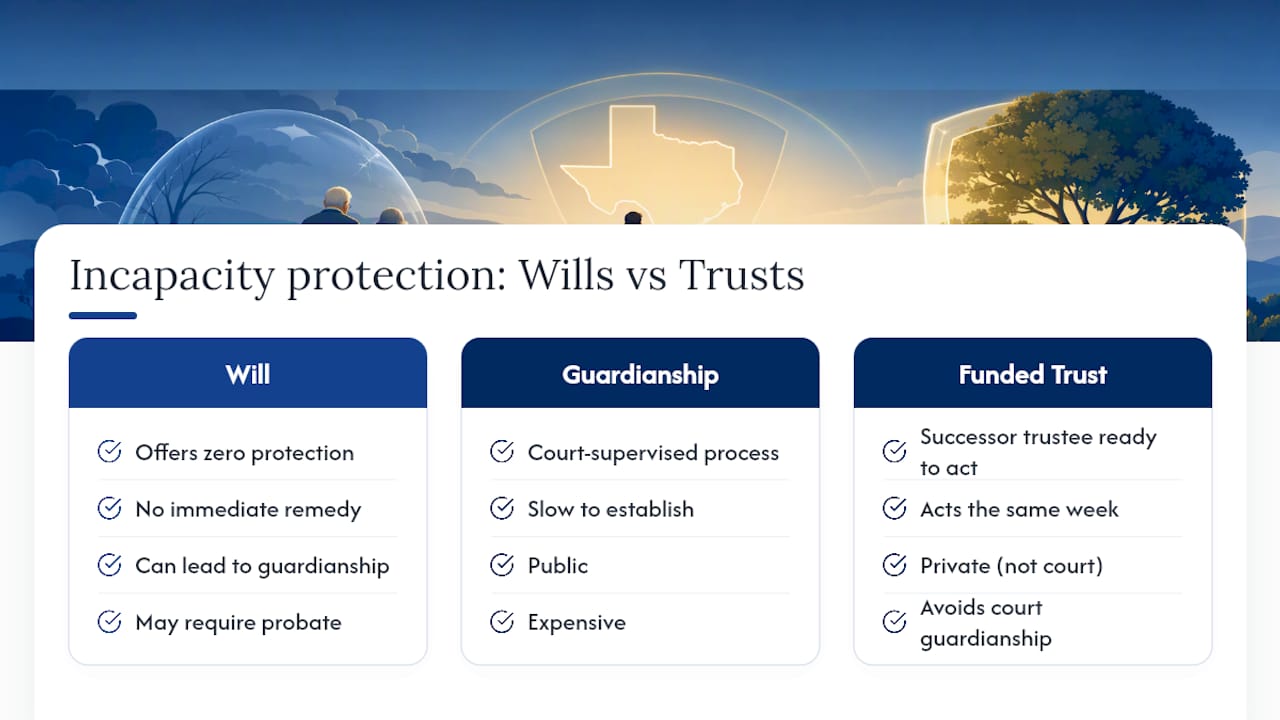
Most conversations about wills versus trusts in Texas fixate on probate avoidance, and that’s fair, since probate costs money and time. But the more overlooked issue is incapacity. A will offers zero protection if you have a stroke or an accident and can’t manage your own finances for six months. Your family’s only options at that point are a court-supervised guardianship, which is slow, public, and expensive, or a properly funded trust with a successor trustee ready to act the same week.
At the Law Office of Anna Din, we see this gap most often in families who built a will years ago and assumed they were covered. They weren’t wrong to start with a will. They were wrong to stop there. For Texas families with property in more than one place, a blended household, or a member who might need Medicaid planning down the road, a will alone leaves real exposure sitting on the table.
— Giri
How Lawofficeofannadin Helps You Build a Plan That Actually Works
Some law offices in Texas offer coordinated wills-and-trusts plans built around how specific assets and family circumstances actually work, rather than generic templates.

A typical consultation usually begins with a review of assets and locations, followed by recommendations on whether a will alone is sufficient or whether a funded trust and pour-over will are advisable. Afterward, clients may receive guidance on retitling deeds, accounts, and beneficiary forms to ensure the plan works as intended. If minor children, blended family dynamics, or out-of-state property are part of your picture, this is worth getting right the first time. Visit the wills and family planning practice page to schedule a consultation and get a plan built around your actual assets.
Sources
For the statutory language on probate applications and filing deadlines, see the Texas Estates Code. The Texas State Law Library’s probate guide walks through muniment of title and filing steps. For funding mechanics and cost framing, see McCulloch & Miller and the Mike Massey Law roadmap. Families with art or collectibles in their estate should also review special-asset estate planning guidance for how those items fit into a trust.
This article is general information, not a substitute for advice from a qualified lawyer. Consult a qualified legal professional about your own circumstances before acting on anything here.
- Texas Estates Code — probate application and related provisions
- Probating a will — Texas State Law Library guide
- Revocable living trust vs will in Texas — McCulloch & Miller blog
- The complete roadmap to Texas wills and revocable trusts — Mike Massey Law
FAQ
How much can you inherit from a trust without paying taxes in Texas?
Texas has no state inheritance or estate tax, so beneficiaries generally owe nothing to the state on trust or will inheritances regardless of amount; federal estate tax only applies to estates above the federal exemption threshold, which affects very few Texas families.
What assets should not be placed in a trust in Texas?
Retirement accounts and life insurance generally stay outside a trust and instead use direct beneficiary designations, and certain vehicles or accounts with existing payable-on-death features often don’t need retitling either.
How much does a will and trust cost in Texas?
A basic will typically costs less than a revocable living trust, since a trust also requires the added work of retitling deeds and accounts; probate after a will-only plan can later cost several thousand dollars in fees, which is the tradeoff families weigh against the trust’s higher upfront price.
What are the negatives of a trust versus a will?
A trust costs more to set up and only protects assets that are actually funded into it, meaning an unfunded or partially funded trust can still leave property stuck in probate; a trust also cannot name a guardian for minor children, so a will is still required for that purpose.
Recommended
Questions About Your Situation?
Every family is different. Schedule a confidential consultation with Anna Din to discuss your options.
Schedule a Consultation