Harris County Family Court Procedures: A Step-by-Step Guide
Family cases in Harris County follow a set path: you file in a family district court at the Civil Courthouse in downtown Houston, the other side is served, temporary orders may be set, and the case ends in an agreement or a trial. The path is predictable. The mistakes happen in the details: the wrong county, a missing form, a missed hearing setting. At the Law Office of Anna Din, we handle divorce, custody, support and protective order cases for families in Houston, The Woodlands and the surrounding area, and this guide walks you through each stage so you know what comes next.
TL;DR
- Harris County’s family courts hear divorce, custody, child support, visitation and protective order cases, and they sit in the Civil Courthouse at 201 Caroline St., Houston.
- To file for divorce, one spouse must have lived in Texas for 6 months and in Harris County for 90 days.
- You can file by e-filing, mail or the clerk’s 24-hour drop box. E-filing is the quickest.
- Custody is called conservatorship in Texas, and parents can raise it inside a divorce or in a separate suit.
- Protective orders follow their own track, with standardized state forms and a separate court location.
Table of Contents
- Where family cases are heard in Harris County
- Step 1: Confirm you can file in Harris County
- Step 2: File the petition
- Step 3: Service of the other spouse
- Step 4: The 60-day waiting period and temporary orders
- Step 5: Custody, possession and child support
- Step 6: Settlement, mediation or trial
- Protective orders: a separate track
- Marital agreements in a Texas family case
- Our perspective
- How we can help
- FAQ
- Sources
Where family cases are heard in Harris County
Harris County’s family courts handle divorce, child custody, child support, visitation, protective orders and emancipation of minors. They are located in the Civil Courthouse at 201 Caroline St., Houston, TX 77002. When you file, the case is assigned to one of the family district courts, and that judge usually stays with your case until it ends.
Two locations are worth knowing separately:
- Protective orders: the 280th Protective Order Court is at 1200 Congress, 1st floor. The Family Violence Unit of the District Attorney’s Office is listed temporarily at 1310 Prairie, 5th Floor, Suite 500, phone (713) 274-0212.
- Filing and records: the Harris County District Clerk’s office handles filings, and each court’s own coordinator handles hearing settings.
If you live in The Woodlands, you are still in Harris County or Montgomery County depending on which side of the county line you live. Residency decides where you file, so confirm your county before anything else.
Step 1: Confirm you can file in Harris County
Texas has residency rules that decide whether the court can hear your divorce. Under Texas Family Code §6.301, a divorce can be filed in the county where either spouse has lived for the last 90 days, as long as that spouse has lived in Texas for at least the last 6 months. Section 6.302 lets a nonresident spouse file in Texas when the other spouse has lived in the state for 6 months. Both rules are summarized in the Texas State Law Library’s filing for divorce guide.
In practice:
- Count back 6 months for Texas and 90 days for Harris County from the day you plan to file.
- Keep proof of address, such as a lease, utility bill or driver’s license.
- If you recently moved between counties, wait until the 90 days are met rather than filing early and risking a dismissal.
Custody cases between unmarried parents work differently, because the child’s residence and the parents’ circumstances drive where the suit belongs. Our team can sort that out in a consultation before you file.
Step 2: File the petition
A divorce begins with an Original Petition for Divorce. A custody case between unmarried parents begins with a Suit Affecting the Parent-Child Relationship, usually shortened to SAPCR. A SAPCR is simply the lawsuit that asks a court to decide custody, visitation and child support.
The Harris County District Clerk accepts three filing methods:
| Method | What to know |
|---|---|
| E-filing through TexFile | The quickest option |
| Allow 2 to 3 weeks for confirmation | |
| Drop box | On the north side of 201 Caroline, available 24 hours a day, 365 days a year |
The filing fee is set by the clerk’s schedule. The District Clerk’s fee schedule effective January 1, 2026 lists $350.00 for civil and family cases of the declaratory judgment type. Fees change, so check the current schedule before you file. For the full picture of court costs plus legal fees, see our guide to divorce cost in Houston.
Step 3: Service of the other spouse
After filing, the other party must be formally notified. That happens in one of two ways: a process server or constable delivers the papers, or your spouse signs a waiver of service. A signed waiver is common in uncontested cases and saves time.
Service is where cases stall. A wrong address, a spouse who avoids the papers, or a defective return can hold things up for weeks. If your spouse never responds, the court can eventually proceed without them. We explain that route in our article on getting a default divorce in Texas.
Step 4: The 60-day waiting period and temporary orders
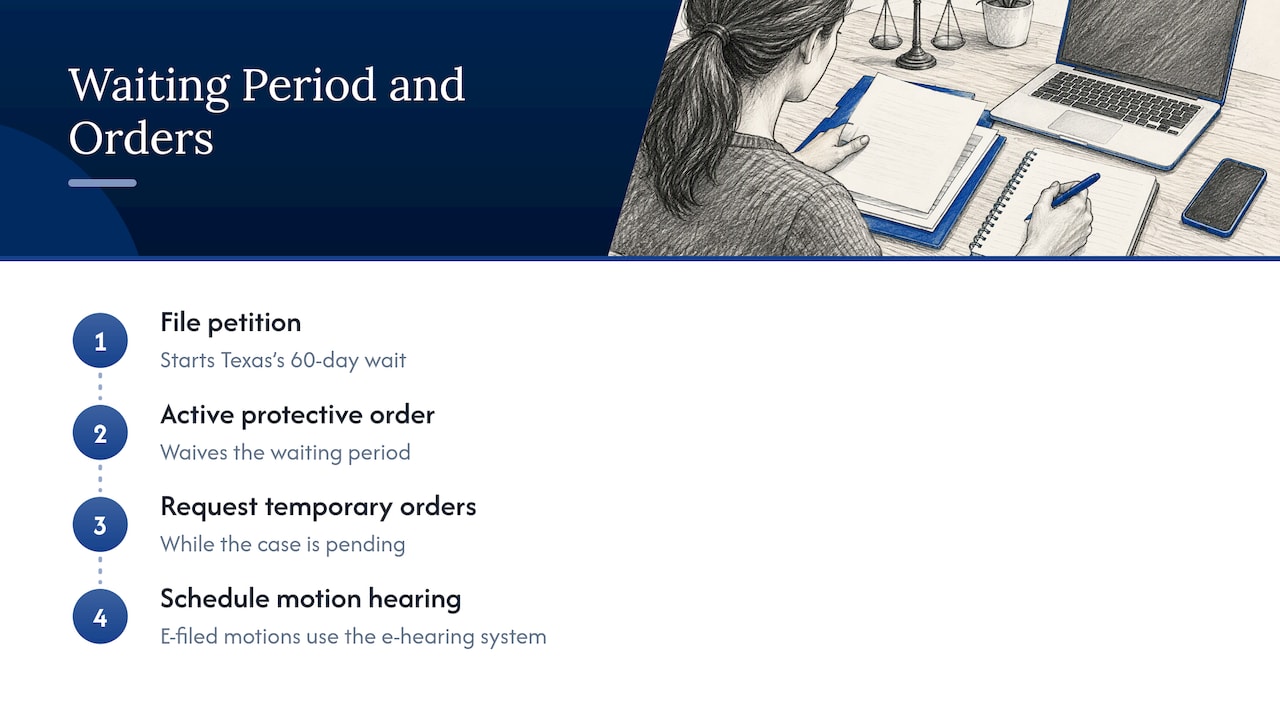
Texas requires a 60-day wait after the petition is filed before a divorce can be granted. The wait is waived if the petitioner has an active protective order, as the Texas State Law Library’s protective order guide explains.
While the case is pending, either parent can ask for temporary orders. These cover who lives in the home, who has the children and when, temporary child support, and who pays which bills. Temporary orders often set the tone for the whole case, so prepare for that hearing as seriously as for trial.
Harris County also has local scheduling rules. Joint policies of the 246th, 247th, 308th, 310th, 312th and 507th District Courts effective January 1, 2025 require e-filed motion hearings to be scheduled through the e-hearing system on the District Clerk’s website. A motion filed correctly but never set on the system can sit untouched.
Many readers also ask about standing orders, which are court-wide rules that can restrict conduct while a case is pending. Our page on Harris County standing orders in divorce and custody cases covers what they mean for your case.
Step 5: Custody, possession and child support
Texas does not use the word custody in its statutes. Under Chapter 153 of the Family Code, the terms are conservatorship (decision-making rights and duties) and possession and access (the schedule). The Texas Advocacy Project’s family law guide lists three types:
- Joint Managing Conservators: the parents share decision-making, and this is presumed to be in the child’s best interest.
- Sole Managing Conservator: one parent holds the main decision-making rights.
- Possessory Conservator: a parent has scheduled time with the child but limited decision-making.
Married parents raise these issues inside the divorce. Unmarried parents file a SAPCR, and paternity cases are part of that process. If the parents agree on child support, they can prepare the paperwork themselves, while parents who disagree can contact the Child Support Division of the Texas Attorney General’s office at (800) 255-8014, according to the same guide.
History of violence matters. The court considers any history of family violence or sexual abuse when deciding conservatorship, and a protective order issued two or fewer years before the suit may be considered as evidence.
For what judges weigh, read what Texas courts actually consider when deciding child custody. If daycare is part of your budget, see childcare and child support in Texas. Once an order exists and life changes, our guide to Harris County custody modification explains how to ask the court to change it.
Step 6: Settlement, mediation or trial
Most family cases settle. Parents and spouses negotiate, often with a mediator, and the agreement becomes a decree or order the judge signs. If you cannot agree, the court sets the case for trial and the judge decides.
Prepare the same way for both outcomes:
- List your assets, debts and income, with statements to back each one.
- Write down the children’s school, medical and activity schedules.
- Collect messages, records and witnesses that support your position.
- Decide in advance what you can accept and what you cannot.
Uncontested cases move fastest when everything is agreed and documented. Our uncontested divorce checklist shows what the court expects to see.
Protective orders: a separate track
Protective orders do not wait for a divorce. A person can apply for themselves or a child when a spouse, dating partner or household member has threatened or hurt them, or when they were a victim of family or dating violence, sexual offense, stalking, trafficking or burglary. The application can be filed in the applicant’s county, the respondent’s county, or any county where the offense occurred, per the Texas State Law Library.
What has changed recently:
- The Texas Office of Court Administration posts mandatory standardized protective order forms in English and Spanish, for use beginning September 1, 2025.
- Effective September 1, 2025, Family Code §82.004 requires the state form and disclosure of Title IV-D child support case status, and §82.011 lets courts shield an applicant’s mailing address and county of residence from public records, according to a 2025 legislative update by Judge Janice L. Berg.
- Under §85.025, an order generally lasts up to two years, and when a divorce, SAPCR or family-violence criminal case is involved it can run until the second anniversary of that case’s final order, with extensions when the respondent is incarcerated.
A protective order can collide with other orders and with a pending criminal case. Families dealing with that overlap can read about no-contact orders and bail. For the process itself, see our six steps to a Houston protective order and how to prepare for the protective order hearing, where testimony time is short. If an order has been filed against you, or one was violated, read about protective order violations in Texas. If you are in danger now, call 911.
Marital agreements in a Texas family case
Couples sometimes want to settle property questions before or during marriage. A premarital agreement becomes effective on marriage and can be amended or revoked only by a written agreement signed by both parties (Tex. Fam. Code §4.005). Agreements between spouses about property must be in writing and signed by both (§4.104). Either kind can be challenged if signed involuntarily, or if unconscionable when signed without fair disclosure, as the Texas Bar’s Bar Books explain. The same source notes courts look more closely at agreements made during marriage because spouses owe each other special duties.
That is why careful drafting and full disclosure matter. See prenup vs postnup and postnuptial agreements in Texas.
Our perspective
Most people come to us after they have already lost time. A petition filed in the wrong county, a hearing never set on the e-hearing system, a protective order application on an outdated form: none of these is a legal question, yet each can cost weeks.
We believe the best preparation is clear communication. Our approach is personalized: you should know where your case stands, what the next filing is and why. We prepare each case meticulously and plan strategy ahead of the hearing, so you walk into the Civil Courthouse informed rather than surprised.
Because we are rooted in The Woodlands and practice in Houston and nearby communities, we know the local courthouse routines that shape a case from the first filing.
Giri
How we can help
Whether you are starting a divorce, arranging custody or responding to an order, we guide you through each filing and hearing. Our divorce practice covers contested and uncontested cases, our child custody and support practice covers modifications, enforcement and paternity, and our protective order practice covers emergency orders and responding to an order.

To talk through your situation, contact the Law Office of Anna Din through our website.
FAQ
What is the first step in getting a divorce in Harris County?
Confirm residency: one spouse must have lived in Texas for 6 months and in Harris County for 90 days. Then file an Original Petition for Divorce with the Harris County District Clerk, by e-filing, mail or the drop box at 201 Caroline.
How long does a Harris County divorce take?
Texas has a 60-day waiting period after filing, waived when the petitioner has an active protective order. Beyond that, timing depends on service, whether you agree on children and property, and the court’s calendar.
Where do I file for custody if I am not married?
You file a SAPCR in a Harris County family district court when the child’s circumstances connect the case to the county. A consultation can confirm the right court before you file.
Can I file a protective order if I do not want a divorce?
Yes. A protective order is a separate case, and you can apply without filing for divorce. Use the state’s standardized forms, and in an emergency call 911.
Sources
- Harris County District Clerk: Family Courts
- Harris County District Clerk: Filing Methods
- Harris County District Clerk: Fee Schedule, Civil and Family
- Texas State Law Library: Filing for Divorce
- Texas State Law Library: Getting a Protective Order
- Texas Advocacy Project: Family Law Guide
- Texas Judicial Branch: Standardized Protective Order Forms
- Judge Janice L. Berg: 2025 Legislative Update
- Texas Bar Books Online: Property Agreements
Recommended
Questions About Your Situation?
Every family is different. Schedule a confidential consultation with Anna Din to discuss your options.
Schedule a Consultation