Temporary Spousal Support in Texas: Who Qualifies

If you’re facing a divorce and can’t cover your bills while the case moves through court, Texas law allows a judge to order your spouse to pay you temporary support. This is separate from post-divorce spousal maintenance, and it’s often easier to get.
- Who qualifies: the spouse with less income or fewer liquid assets, who can show a documented monthly shortfall and the other spouse’s ability to pay
- Typical duration: the entire time your divorce is pending, starting after Texas’s mandatory waiting period until the final decree
- Immediate next step: file a Motion for Temporary Orders and request a hearing under Tex. Fam. Code §6.502
Federal tax rules under IRS Publication 504 also affect how this support gets treated on your return, which we’ll cover further down.
Key Takeaways
Temporary spousal support in Texas depends on demonstrated need and the other spouse’s ability to pay, not a fixed formula, and it lasts only while the divorce case remains open.
| Point | Details |
|---|---|
| No fixed formula exists | Texas has no statutory 1/3 rule; judges compare documented need against ability to pay. |
| Temporary support ends at final decree | Orders run from the temporary hearing through the minimum 60-day waiting period until finalization. |
| Documentation drives outcomes | Sworn financial statements, pay stubs, and bank records matter more than verbal claims of hardship. |
| Federal tax rules apply post-2018 | Support isn’t deductible by the payor or taxable to the recipient for divorces finalized after January 1, 2019. |
| Lawofficeofannadin builds the case file | The firm prepares itemized motions and exhibit packets for temporary-orders hearings across the Houston area. |
Where to Read the Statutes Yourself
Review Tex. Fam. Code §6.502 for temporary orders and Chapter 8 for final maintenance rules. Check your county clerk’s site for current filing fees and hearing schedules before you file.
This article is general information, not a substitute for advice from a qualified lawyer. Consult a qualified legal professional about your own circumstances before acting on anything here.
Table of Contents
- What Is Temporary Spousal Support Under Texas Law?
- Who Qualifies for Temporary Spousal Support?
- How Do Texas Judges Calculate the Amount?
- How Long Does Temporary Support Last in Texas?
- How Do You Request Temporary Spousal Support?
- What Disqualifies a Temporary Support Request?
- What Are the Tax Consequences of Temporary Support?
- What Does an Attorney Prepare for a Temporary Support Hearing?
- How Lawofficeofannadin Helps You Get Temporary Support in Place Fast
- Sources
- FAQ
What Is Temporary Spousal Support Under Texas Law?
Temporary spousal support is court-ordered financial help paid by one spouse to the other while a divorce case is still open. Courts sometimes call this “pendente lite” support, a Latin term meaning “while the suit is pending.” It exists to keep both households functioning until the judge signs a final decree.
The authority for this comes straight from Tex. Fam. Code §6.502, which lets a court issue temporary orders, including payments for the support of either spouse, while a suit for dissolution is pending. Final spousal maintenance is a different animal entirely, governed by Chapter 8 of the Texas Family Code, which imposes strict eligibility rules and dollar caps that don’t apply here.
Temporary support asks one question: does this spouse need help right now, and can the other spouse afford to provide it? Final maintenance asks a much harder question about long-term inability to earn a living.
- Temporary support: need-based, no 10-year marriage requirement, no statutory dollar cap
- Final maintenance: requires meeting Chapter 8’s eligibility tests, subject to statutory caps and duration limits
Who Qualifies for Temporary Spousal Support?
You don’t need to satisfy Chapter 8’s stricter maintenance tests to receive temporary support. Courts instead look at demonstrated present need against the other spouse’s demonstrated ability to pay, a much lower bar than the long-term self-sufficiency standard used for final maintenance.
Judges weigh several practical factors at the temporary-orders hearing:
- Income disparity between spouses, especially when one has stopped working or earns significantly less
- A documented monthly shortfall between reasonable living expenses and available income
- Housing, utility, and insurance costs that one spouse can no longer cover alone
- Custody or caregiving responsibilities that limit a spouse’s ability to work full time
- Any history of family violence that affects a spouse’s access to shared finances
Before your hearing, gather the paperwork that proves your case:
- A sworn Financial Information Statement listing income, expenses, and debts
- Recent pay stubs and two to three months of bank statements
- Copies of recurring bills (rent, mortgage, utilities, insurance)
- Proof of employment history or reasons for unemployment
- Documentation of child-care or medical expenses tied to the children
TexasLawHelp notes that this stage focuses on immediate need rather than the long-term eligibility tests final maintenance requires. That distinction is why many spouses who wouldn’t qualify for maintenance after divorce still receive help during it.
How Do Texas Judges Calculate the Amount?
Texas courts use a two-part comparison: your reasonable monthly needs against your spouse’s ability to pay. There’s no worksheet, no online calculator, and no statutory formula written into the Family Code for temporary support amounts.

Myth to bust right away: Texas has no mandatory “1/3 rule” for temporary spousal support. Some attorneys use a rough guideline in negotiations, but no statute requires a judge to award one-third of an obligor’s income, and judges routinely order amounts above or below that figure based on the facts.
Bring an itemized budget to your hearing rather than a vague dollar request. Include:
- Housing costs (rent, mortgage, HOA fees)
- Utilities and insurance premiums
- Transportation expenses, including car payments and fuel
- Child-care costs tied to your work schedule
- Out-of-pocket medical and dental expenses
A judge comparing a $4,500 monthly shortfall against a spouse’s $7,000 monthly income will land on a different number than one comparing a $1,200 shortfall against the same income. Specific, itemized numbers move judges far more than general statements about being “financially strained.”
How Long Does Temporary Support Last in Texas?
Temporary support runs for the life of the divorce case. It starts once a judge signs the temporary order and ends automatically when the final decree is entered, at which point Chapter 8 maintenance rules take over if the recipient qualifies for continued support.
Texas requires a minimum 60-day waiting period between filing and finalization, so temporary support never lasts less than two months. In practice, contested divorces often run six to twelve months or longer, and the temporary order stays in effect the entire time unless a judge modifies it.
- Uncontested cases: often close near the 60-day minimum
- Contested cases: commonly six to twelve months, sometimes longer with custody disputes or asset battles
- Modification: either spouse can request a change if income, expenses, or living situations shift materially while the case is open
How Do You Request Temporary Spousal Support?
Getting a temporary order in front of a judge follows a fairly predictable sequence, though local practice varies by county.
- File your Original Petition for Divorce, along with a Motion for Temporary Orders (or attach the request to your petition)
- Serve the opposing party according to Texas civil procedure rules
- Wait for the court to issue notice of a hearing date
- Prepare your sworn financial statement and supporting exhibits
- Attend the hearing, where the judge hears both sides and rules on temporary support, temporary custody, and any restraining orders
Most counties schedule temporary-orders hearings within a few weeks of filing, though busy dockets can push that timeline out. Hearings are typically short, often under an hour, and judges focus heavily on the numbers in your financial statement rather than emotional arguments.
- Courts can also issue a temporary injunction alongside support orders to freeze shared assets
- In rare cases involving disputed property, the court may appoint a receiver, which triggers additional filing deadlines under §6.502
- Many courts refer contested temporary-orders disputes to mediation before a contested hearing, and reaching an agreed temporary order there can save months
If you’re still working through the initial filing steps, our guide on filing for divorce in The Woodlands walks through residency requirements and paperwork before you even reach the temporary-orders stage.
What Disqualifies a Temporary Support Request?
Temporary orders carry real teeth. If a spouse ignores one, the court can hold them in contempt, order wage withholding, or in rare cases appoint a receiver to manage shared assets until compliance improves.
Certain patterns commonly sink a temporary support request before it starts:
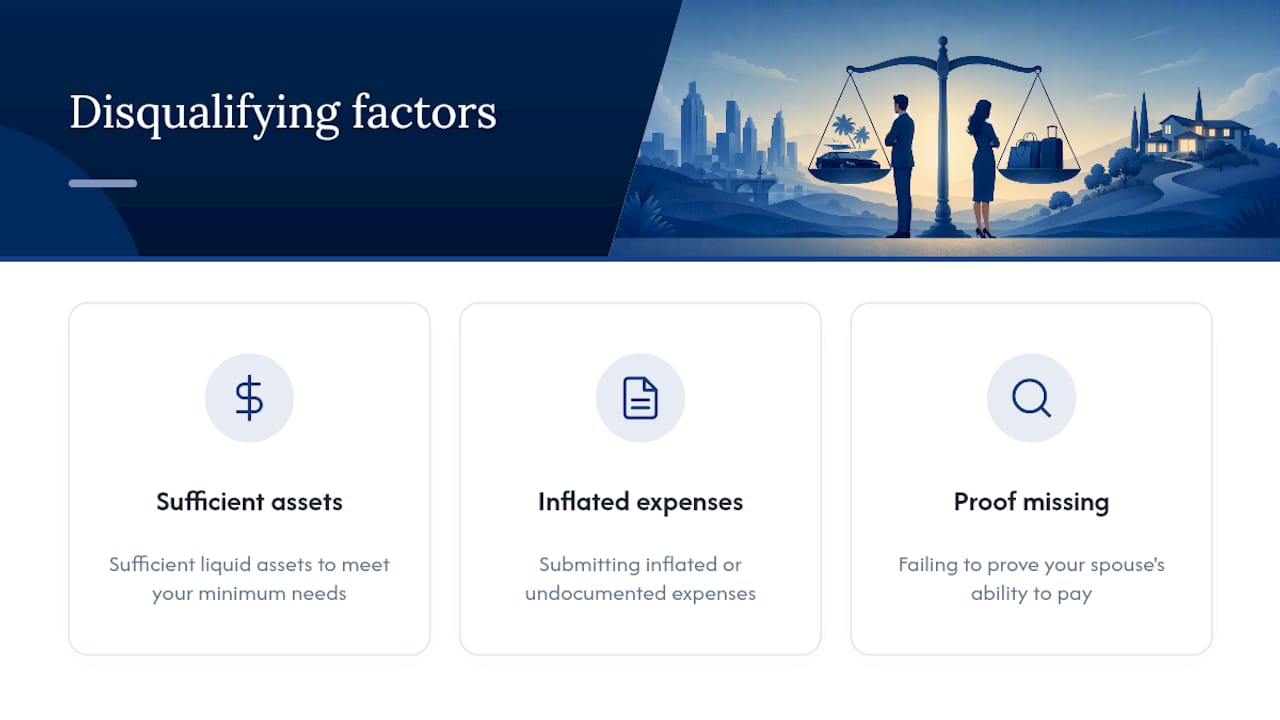
- The requesting spouse already has liquid assets sufficient to cover minimum reasonable needs
- The expense list looks inflated or doesn’t match bank records
- Paperwork wasn’t properly served on the other spouse
- The petitioner can’t show the other spouse actually has the ability to pay
Pro Tip: Never rely on a spouse’s verbal promise to “just send money” instead of getting a signed temporary order. Informal arrangements aren’t enforceable, and judges have little patience for petitioners who waited months to formalize support they could have requested immediately.
Document every expense with a receipt or statement, disclose your finances accurately, and file promptly.
What Are the Tax Consequences of Temporary Support?
For divorces finalized after January 1, 2019, alimony is not deductible by the paying spouse and not counted as income for the recipient under federal rules, per IRS Publication 504. That change from the Tax Cuts and Jobs Act applies to temporary support payments too.
- Keep copies of every signed order, payment record, and bank transfer confirmation
- Texas has no state income tax, but federal treatment still matters for your overall budget
- Complex situations, like support combined with property division, warrant a conversation with a tax advisor
What Does an Attorney Prepare for a Temporary Support Hearing?
An experienced family lawyer builds a case file well before your hearing date, not the week of it.
- Draft the Motion for Temporary Orders with specific, itemized dollar requests rather than vague language
- Assemble and index exhibits: pay stubs, bank statements, mortgage or rent statements, and childcare or medical cost documentation
- Prepare you and any witnesses for likely questions about expenses and employment history
- Propose an agreed temporary order when both sides are close, which avoids a contested hearing entirely
- Follow up after the hearing to confirm compliance and address any missed payments
Pro Tip: Two strategic requests come up often at this stage: exclusive occupancy of the marital home when safety or stability is a concern, and interim attorney’s fees when one spouse controls most of the household income. Both require specific evidence, so raise them early with your attorney rather than as an afterthought.
How Experienced Texas Family Lawyers Approach These Requests
An attorney’s job here is protecting your immediate stability while positioning the case for a strong final outcome, not just winning the hearing in isolation. That balance, informed by years of local courtroom practice in The Woodlands and Houston, shapes every document filed. If you’re weighing your options, a consultation can clarify what’s realistic for your situation.
How Lawofficeofannadin Helps You Get Temporary Support in Place Fast
Lawofficeofannadin gives Texas spouses something a lot of people don’t expect going into a contested divorce: a clear, itemized path to a temporary support hearing instead of months of guesswork about what to file and when.

Anna Din’s practice handles temporary-orders motions regularly for clients across The Woodlands, Houston, and Harris County, building the sworn financial statements and exhibit packets judges expect to see. Clients typically leave their first consultation with a document checklist and a realistic timeline estimate for their hearing, so they’re not walking into court unprepared. If you need support in place while your divorce is pending, schedule a consultation through the divorce attorney page to start building your temporary-orders request today.
Sources
FAQ
How long does temporary spousal support last in Texas?
It lasts for the duration of the divorce case, starting after the 60-day minimum waiting period and ending when the final decree is signed. Contested cases commonly keep it in place for several months, depending on case complexity.

What disqualifies you from spousal support in Texas?
Having sufficient liquid assets to meet your own minimum needs, submitting inflated or undocumented expenses, or failing to prove your spouse’s ability to pay can all sink a request.
How much is spousal support in Texas?
There’s no fixed dollar amount. Judges compare your documented monthly shortfall against your spouse’s income and ability to pay, using an itemized budget rather than a calculator.
What is the 1/3 rule for spousal maintenance?
It’s a common negotiation reference some attorneys use informally, but it’s not a Texas statute. Judges can and do order amounts above or below one-third of the obligor’s income based on the actual evidence presented.
How do I request temporary spousal support?
File a Motion for Temporary Orders with your divorce petition, serve the opposing party, and prepare a sworn financial statement for the hearing under Tex. Fam. Code §6.502. Lawofficeofannadin can help draft and file this motion for clients in the Houston area.
Recommended
Questions About Your Situation?
Every family is different. Schedule a confidential consultation with Anna Din to discuss your options.
Schedule a Consultation